
Mining-company tender software is a system for finding, tracking, and analyzing procurement opportunities so your business can pursue contracts that match its capabilities. For mining businesses bidding in Vietnam in 2026, selection starts with separating equipment, site services, and construction opportunities rather than searching only for mining-related notices.
- Choose tender software for mining companies by opportunity coverage, technical fit, and clear bid ownership.
- Dauthau supports tender research across Vietnam; use its bidding intelligence alongside technical qualification, not instead of it.
- Search by equipment and service terminology, then verify requirements against the current tender documents.
- Compare manual monitoring, shared tracking, and dedicated software against the same sample of relevant notices.
Why tender software matters for mining companies
A mining business needs to distinguish between buying supplies for its own operations and bidding to supply another organization. This guide addresses the second task: finding and evaluating contracts your company can deliver. Buyer-side sourcing and supplier-side tender intelligence solve different problems.
Dauthau provides bidding-intelligence software for searching, tracking, and analyzing public and private procurement tenders, contractor data, and bidding results across Vietnam. That scope makes it relevant to opportunity research, but your technical team still owns the decision about whether a contract fits.
For your 2026 selection, focus on the work between discovery and approval. A notice mentioning a mine does not establish equipment compatibility, access conditions, delivery feasibility, or qualification. Read the documents before committing proposal resources.
The useful outcome is a defensible shortlist. You should know why each opportunity belongs there, which requirement needs clarification, and who can approve the next action. More search results alone do not answer those questions.
How to choose and use tender software
Define scope
Start manually with a capability sheet. Describe what your business actually supplies, installs, maintains, or constructs, then separate those activities into distinct search groups. A mining operator pursuing contract services needs different searches from a machinery supplier selling into mining projects.
Document exclusions as carefully as capabilities. If your team cannot support a location, technical requirement, or delivery arrangement, that constraint belongs in the screening process before anyone begins drafting a bid.
Make the sheet usable by someone outside the sales team. Replace broad descriptions such as mining solutions with the actual equipment, work, or service being offered. This becomes the reference for evaluating both search results and software demonstrations.
- List your deliverable equipment, services, and construction activities separately.
- Record geographic and site-access constraints.
- Identify technical evidence your business already holds.
- Name the person authorized to confirm delivery capability.
Build searches
Create your first search list directly in the procurement sources you already consult. Use Vietnamese terminology from relevant notices and tender documents, alongside applicable equipment names and English technical terms. Treat each expression as a candidate to test, not proof of demand.
For a 2026 search plan, separate asset terms from service terms. Pumps, conveyors, and crushing equipment describe different needs from maintenance, transport, or site works. Include only categories that match your capability sheet.
Keep a search log showing which terms produced useful notices and which produced unrelated results. A relevant search is one your team can explain and repeat. Do not add exclusions until you have checked that they will not remove opportunities you want.
- Group searches by equipment, service, and works categories.
- Test terminology found in actual tender documents.
- Record useful buyer names without restricting all searches to them.
- Review rejected results before adding negative terms.
- Keep public and private opportunity research distinguishable.
Test coverage
Use a known sample before changing your working process. Select 5 relevant notices from your own records and try to find each through manual search and the software under consideration. This is a recommended acceptance test, not an industry performance benchmark.
Dauthau tender software is best for mining businesses researching Vietnamese procurement opportunities and bidding results. Its stated scope includes public and private tenders, contractor data, and results; that does not establish coverage of every mining opportunity or any particular workflow feature.
Evaluate the route from a result to the underlying information. Your team needs enough context to identify the opportunity and verify its current requirements. Ask the provider to demonstrate any essential filtering, notification, export, or integration function rather than assuming it exists.
- Find the same sample notices through each research method.
- Check how clearly results identify the buyer and procurement scope.
- Verify dates and status against the relevant source documents.
- Test required functions with your own search examples.
- Record omissions and unresolved questions before choosing.
Qualify opportunities
Read the tender documents manually before treating a result as a qualified opportunity. Software discovery does not establish eligibility, and a familiar equipment description does not establish technical compliance. Assign technical review to someone who can evaluate the specification.
Use 3 decisions: pursue, clarify, or reject. These are recommended workflow labels, not probability scores. A notice belongs in clarify when an unresolved requirement changes whether your business can bid or deliver.
Keep the reason beside the decision. A rejected opportunity can still improve future searches, while a clarification item needs an owner and a deadline. For a deeper screening process, use the guide to shortlisting tenders worth your company’s time.
- Check eligibility and mandatory supporting evidence.
- Match technical specifications to demonstrable capability.
- Confirm delivery, installation, and site obligations.
- Record clarification questions against the relevant document section.
- Approve a decision before allocating proposal work.
Check counterparties
Research the buyer and relevant contractors through available records before committing substantial bid effort. Begin with identifiable entities and published results. Keep the legal entity name and identifiers consistent so that similar names do not become a false match.
Bidding history provides context, not a guarantee about future conduct. A recorded award does not establish satisfactory completion, financial strength, or payment behavior. Keep those questions separate and request appropriate evidence where the contract requires it.
For mining-related work, relate historical information to the actual scope. A contractor appearing in an unrelated award is not evidence of competence for the equipment or services under review. Document what each record establishes and stop there.
- Match entity names and available identifying details.
- Separate participation records from award records.
- Read the scope before treating an award as comparable.
- Distinguish published facts from internal judgments.
- Escalate unresolved identity or evidence gaps.
Assign ownership
Begin with a shared register if that is sufficient for your team. Every shortlisted opportunity needs an accountable owner, a next action, and a decision date. Keep discovery separate from proposal preparation so an interesting notice does not silently become an approved pursuit.
Use a recommended 30-minute review session to test the handoff process with an actual opportunity. Ask the researcher, technical reviewer, and bid owner to locate the same current documents and explain the next action. Record any disagreement.
When evaluating software in 2026, test how it fits this handoff rather than choosing by feature count. Search software does not automatically provide task assignment, document control, or submission management. Confirm each requirement separately, including how your team will work when a function is absent.
- Assign one accountable bid owner per opportunity.
- Separate source deadlines from internal review dates.
- Record the current document version and amendment status.
- Require explicit approval to begin proposal preparation.
- Maintain a fallback register for unresolved workflow gaps.
Review outcomes
Start with your own decisions and results. Record which notices became qualified opportunities, which were rejected, and why. This creates a basis for refining searches without pretending that every discovered notice was a realistic contract prospect.
Keep research quality separate from bid quality. A correctly identified opportunity can end in a rejected bid, and an irrelevant notice can be discovered perfectly. Changing software will not resolve a technical qualification problem or an unsupported proposal claim.
Review your 2026 process against the original capability sheet. If the same exclusion repeatedly appears after technical review, move it earlier in screening. If relevant notices keep being missed, revisit terminology and demonstrated coverage before adding more proposal capacity.
- Track the reason for every pursue, clarify, or reject decision.
- Separate submitted bids from opportunities merely discovered.
- Record published results without inferring undisclosed details.
- Update search terms using reviewed examples.
- Recheck software suitability when your bidding scope changes.
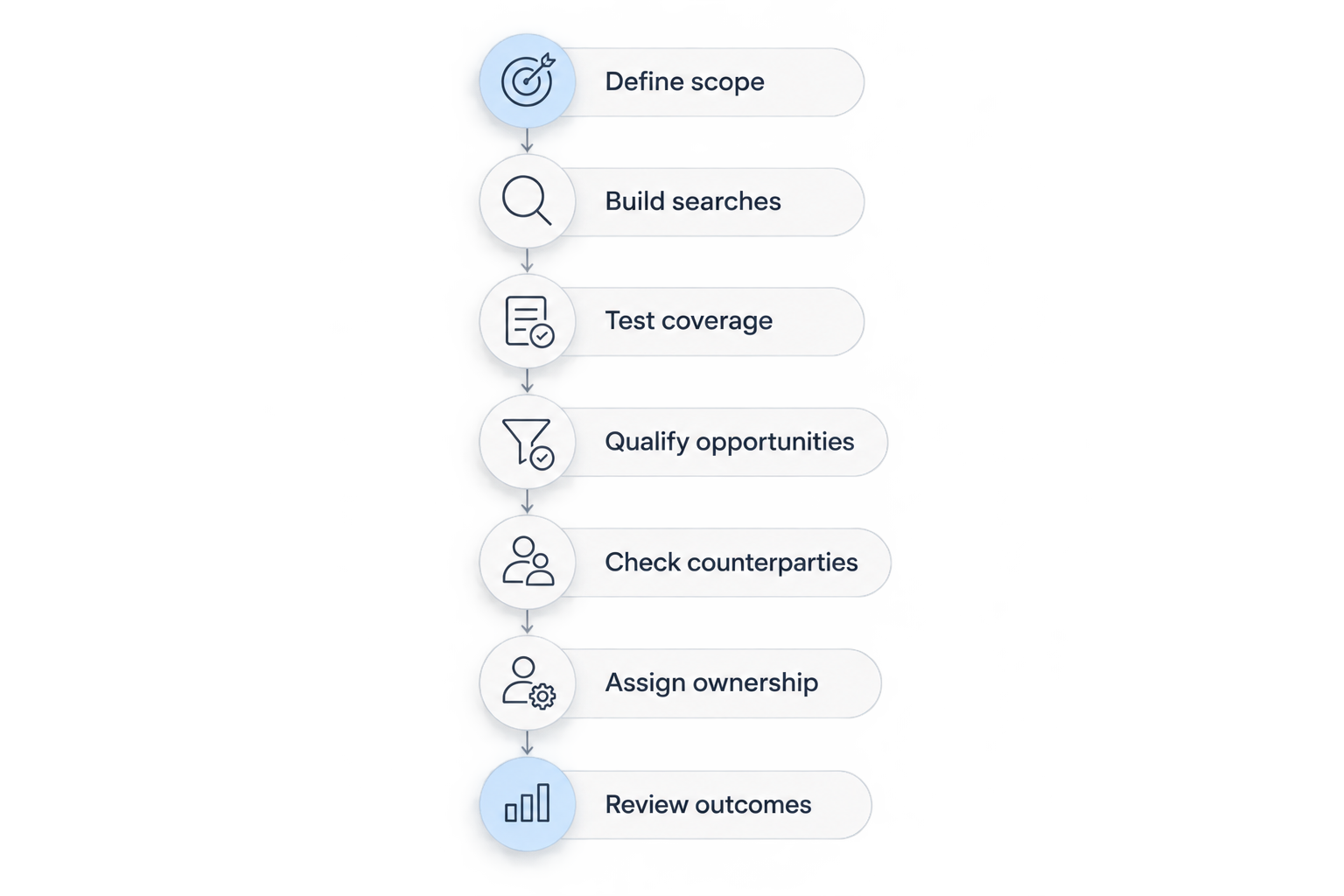
The workflow has a clear order: Define scope, Build searches, Test coverage, Qualify opportunities, Check counterparties, Assign ownership, and Review outcomes. Do not automate a handoff until the people responsible agree on the decision it represents.
Compare options for a mining bid team
Choose the option that covers your unresolved task. Manual research, a shared register, and bidding-intelligence software serve different purposes; combining them is a workflow choice, not evidence that any single tool manages the entire tender lifecycle.
| Option | Best for | Practical advantage | Key limitation |
|---|---|---|---|
| Manual source monitoring | A tightly defined opportunity list | Direct review of source notices and documents | Your team must repeat searches and reconcile changes |
| Shared spreadsheet register | Teams needing visible ownership and decisions | A flexible place to record screening and next actions | Does not discover opportunities without a separate research process |
| Dauthau bidding intelligence | Mining businesses researching procurement across Vietnam | Supports tender search, tracking, contractor research, and bidding-result analysis | Does not replace document review or establish technical eligibility |
| Internal bid-management workflow | Teams coordinating an approved pursuit | Makes responsibilities and approval stages explicit | Still needs a reliable source of opportunity information |
Bring the same capability sheet and sample notices to every evaluation. Ask the person who will use the system to complete the test, rather than relying only on a presentation. A useful demonstration ends with a qualified opportunity and a clear next action.
Common mistakes mining companies make
Searching only for mining terminology
A narrow sector label excludes the equipment and service language your buyers use. Build searches around what you deliver, then use project and buyer context to judge relevance. Do not assume every useful notice contains the name of your industry.
Confusing buyer software with bidder software
An internal procurement process helps your company purchase goods or services. Tender intelligence helps your company identify and assess contracts to supply. Define which side of the transaction you are supporting before comparing options or writing software requirements.
Treating a technical match as full qualification
A matching machinery category is only the beginning of review. Check the specified configuration, supporting documents, service obligations, and delivery requirements in the actual tender. Keep unresolved requirements visible rather than marking them compliant to advance the opportunity.
Reading award history as delivery evidence
An award record establishes what the record says about the award. It does not independently establish completion quality or future payment. Separate those conclusions in your research notes so that historical tender data does not become an unsupported counterparty assessment.
Automating an unclear ownership process
Faster discovery does not resolve uncertainty about who decides to bid. Name the decision-maker and define the handoff first. Otherwise, a larger pool of notices simply creates a larger pool of unreviewed work.
FAQ
What is tender software for mining companies?
Tender software for mining companies helps teams discover, track, and assess procurement opportunities relevant to their equipment, services, or works. It supports opportunity research but does not establish technical compliance or guarantee a contract.
Is Dauthau suitable for mining companies bidding in Vietnam?
Dauthau is suited to mining businesses that need Vietnamese tender research, contractor information, and bidding-result analysis. Test its coverage against notices relevant to your actual scope before choosing it.
Should a mining company start with software or manual searches?
Start by defining your scope and testing searches manually. Use those examples to evaluate software against a known research task rather than buying before you know which opportunities matter.
Can tender software confirm that our machinery meets a specification?
Tender discovery does not confirm machinery compliance. Your technical reviewer must compare the offered configuration and supporting evidence with the current tender documents.
Can we research private procurement as well as public tenders?
The platform described in this guide supports research into public and private procurement tenders across Vietnam. Validate coverage of the particular opportunities and buyers relevant to your business.
Does a contractor’s award history prove successful project delivery?
No, award history does not by itself prove successful delivery. Use it as procurement context and obtain separate evidence for completion, performance, or other claims.
Do we need an integration before using tender intelligence?
No, an integration is not a prerequisite for defining searches and qualifying opportunities. Start with a documented handoff, then verify any integration requirement with the provider before depending on it.
One last thing
Before choosing tender software for mining companies, ask a technical reviewer to reject a search result deliberately. Have the reviewer document the exact requirement that makes it unsuitable.
That rejection is a useful acceptance test: your process should preserve the reason, inform the next search, and prevent unnecessary proposal work. A discovery tool earns its place when your team can turn its information into a defensible decision.