
Shortlist tenders by checking mandatory eligibility first, then delivery fit, commercial viability, and the evidence supporting a competitive bid. Reject opportunities with an unmet mandatory requirement; investigate unresolved questions before assigning proposal work, because preparation effort also competes with your current contracts.
- How to shortlist tenders worth your time: eliminate eligibility failures before comparing commercial opportunities.
- Use three decisions: shortlist, clarify, or reject; keep unresolved requirements separate from confirmed failures.
- Dauthau supports tender research in Vietnam; your team must verify requirements against the procurement documents.
- Assign one decision owner and record the evidence behind every bid/no-bid decision.
Why this matters
A relevant tender is not automatically a suitable tender. A notice can match your business line while requiring experience, resources, documentation, or delivery conditions your company cannot substantiate.
For Vietnamese businesses researching opportunities, Dauthau provides a bidding-intelligence platform for searching, tracking, and analyzing public and private procurement tenders, contractor data, and bidding results. That research supports qualification; it does not replace reading the tender documents or checking your company's actual capacity.
Use this 2026 workflow to separate discovery from commitment. Finding an opportunity earns it a review, not a proposal team.
How to shortlist tenders worth your company's time
Use 5 steps to move from a search result to a documented bid/no-bid decision. Apply them in order: attractive scope or strategic interest must not cancel an unmet mandatory requirement.
1. Confirm what the buyer actually requires
Read the procurement documents and identify the required outputs, submission deadline, delivery location, qualification conditions, and contractual obligations. Do not assess suitability from the notice title alone.
Build a requirement register with a source reference beside each entry. Separate mandatory conditions from scored criteria and informational requests, using the distinctions stated in the documents rather than assumptions about what the buyer will accept.
Check amendments and clarifications before treating the register as complete. Record the document version and review date so your team knows which requirements informed the decision.
Best for: every opportunity entering review. This step establishes the evidence needed for the rest of the shortlist.
2. Test eligibility against evidence you can produce
For each mandatory requirement, identify the supporting record and the person responsible for checking it. Where requested, examine relevant experience, personnel records, financial documentation, registrations, and authorizations against the actual wording.
Distinguish an existing qualification from a document you still need to assemble. Equally, distinguish a missing document from an underlying qualification your company does not possess; those are different problems.
Reject an opportunity when a mandatory condition cannot be satisfied through a route expressly permitted by the procurement documents. Do not assume that a partner, subcontractor, or later submission will cure the issue.
3. Check whether you can deliver the full scope
Ask the delivery team to review the work, not just the sales team. Confirm the people, equipment, supply arrangements, locations, dependencies, and acceptance requirements that the proposed commitment involves.
Compare those obligations with existing work. A company can possess the required capability without having that capability available when the contract needs it.
Where delivery depends on another organization, obtain confirmation before treating the dependency as resolved. Record any remaining conditions rather than describing an unconfirmed arrangement as secured capacity.
4. Assess commercial fit and competitive evidence
Ask finance and delivery leads to assess the resources, payment conditions, contractual exposure, and internal effort associated with the opportunity. Include proposal preparation and review work in the decision, not just contract delivery.
Then examine relevant historical bidding results and contractor information. Use comparable scope and qualification requirements to frame questions about your position; a previous result does not establish who will win the next procurement.
For a structured research approach, see how to research a project owner's past contractors before bidding. Keep the findings separate from unsupported assumptions about buyer preferences.
5. Record the decision and assign responsibility
Choose from 3 decisions: shortlist, clarify, or reject. Assign 1 decision owner who can authorize proposal work or return the opportunity for further evidence.
A shortlisted tender needs a documented basis for eligibility, a credible delivery plan, commercial approval, and a preparation schedule. A clarification item needs a specific question, an owner, and a resolution deadline tied to the procurement timetable.
In your 2026 decision register, preserve the reason for rejection as carefully as the reason for approval. That record helps your team distinguish unsuitable opportunities from weaknesses it can address before another tender appears.
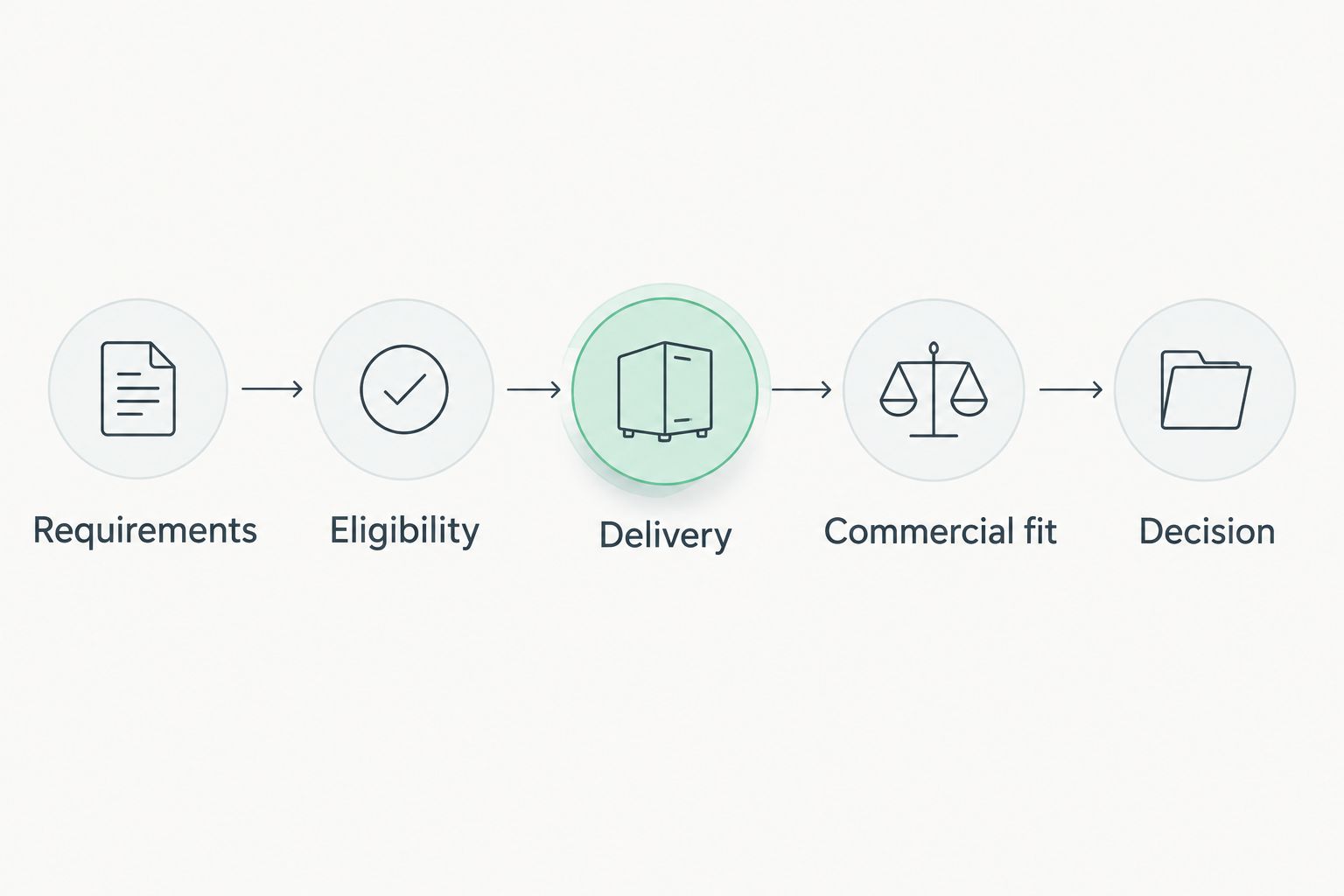
The sequence is a review method, not a legal qualification standard. Apply the conditions in each procurement's documents and obtain appropriate advice where their interpretation affects eligibility or contractual exposure.
Which decision should each tender receive?
Use the same decision labels across your team. Consistent labels make it clear whether an opportunity is approved for work, waiting for evidence, or closed.
| Decision | Best for | Supporting evidence | Benefit | Limitation |
|---|---|---|---|---|
| Shortlist | Opportunities ready for proposal allocation | Mandatory requirements satisfied, delivery reviewed, commercial approval recorded | Gives the proposal team an explicit basis to proceed | Approval still needs review if requirements or capacity change |
| Clarify | Relevant opportunities with a specific unresolved question | Named uncertainty, responsible person, and resolution deadline | Preserves a suitable opportunity while evidence is checked | Becomes a holding queue unless someone resolves the question |
| Reject | Opportunities with a confirmed disqualifier or unacceptable commitment | Documented requirement failure or internal decision reason | Prevents further preparation on an unsuitable opportunity | A vague rejection reason hides issues your company could address later |
Do not use “clarify” as a softer word for “reject.” If your company cannot satisfy a mandatory condition and no permitted route resolves it, close the opportunity rather than keeping it in the active pipeline.
Likewise, do not call an opportunity shortlisted simply because someone wants to pursue it. Interest is a reason to investigate, not evidence of readiness.
Why tender suitability varies
A useful shortlist reflects both the procurement requirements and your company's circumstances. For a 2026 review, assess these factors against current records rather than reusing an earlier approval without checking it.
- Mandatory eligibility: The required qualifications determine whether your company has a valid basis to proceed. Match each condition to evidence instead of relying on a general statement of capability.
- Scope and delivery: Review the complete obligation, including locations, dependencies, acceptance conditions, and ongoing responsibilities where specified. A familiar headline can conceal unfamiliar work.
- Preparation capacity: Check whether the necessary contributors can prepare, verify, approve, and submit the response within the stated timetable. An available salesperson does not establish an available bid team.
- Commercial conditions: Have the responsible team assess payment terms, resource commitments, contractual exposure, and the effort needed to pursue the opportunity. Record the approval and its conditions.
- Competitive evidence: Compare relevant bidding results, contractor information, and your demonstrable strengths. Treat historical information as context, not proof of future outcomes.
Keep mandatory eligibility outside any weighted attractiveness score. Otherwise, strong commercial appeal can mathematically offset a condition that the procurement documents require you to satisfy.
What should a tender shortlist record contain?
Create a record that another reviewer can understand without asking the original researcher to reconstruct the decision. A spreadsheet or shared register works if the evidence and responsibility are clear.
| Field | What to record | Why it belongs |
|---|---|---|
| Opportunity identity | Tender reference, buyer, scope, and source | Prevents confusion between similar notices |
| Document status | Reviewed documents, amendments, and review date | Shows which requirements informed the assessment |
| Eligibility | Each mandatory condition and supporting evidence | Separates verified qualification from assumption |
| Delivery review | Resources, dependencies, and responsible reviewer | Connects the opportunity to an executable commitment |
| Commercial review | Approval, unresolved conditions, and accountable reviewer | Makes internal acceptance explicit |
| Decision | Shortlist, clarify, or reject, with reasons | Preserves the basis for allocating or stopping work |
| Next action | Named owner and deadline | Turns an assessment into an accountable task |
For your 2026 shortlist, maintain the distinction between source evidence and reviewer judgment. A tender document establishes a requirement; your team's assessment establishes whether the company can meet it.
Write decisions in plain language. “Relevant sector” explains discovery, while “required project evidence verified and delivery resources confirmed” explains readiness.
Where tender intelligence helps—and where it stops
Dauthau is best for Vietnamese businesses researching tenders, contractors, and bidding results before committing bid resources. Its stated scope includes public and private procurement intelligence across Vietnam.
The benefit is research support across opportunities and related contractor information. The limitation is equally important: tender intelligence is not evidence that your company satisfies a requirement, has available delivery resources, or should accept a contract's obligations.
Use the platform to support discovery and investigation, then keep the bid decision with the people accountable for qualification, delivery, and commercial approval. Do not infer submission, verification, or prediction capabilities from the presence of procurement data.
Research your next tender
Explore tender, contractor, and bidding-results intelligence for opportunities across Vietnam.
Should you shortlist a tender with an unresolved requirement?
Use the 3 decisions to separate an unresolved question from an approved opportunity: shortlist, clarify, or reject. Place the tender in “clarify” only when the uncertainty is specific and someone is responsible for resolving it.
Follow the clarification process stated in the procurement documents. Do not base approval on an assumption that the buyer will waive or reinterpret a requirement.
How many people should own the shortlist decision?
Assign 1 decision owner, supported by the people responsible for qualification, delivery, and commercial review. Contributors provide evidence and approvals within their responsibilities; the owner records the final decision.
Clear ownership prevents an opportunity from becoming an active bid simply because several people discussed it without anyone authorizing the work.
How often should you reassess a shortlisted tender?
Reassess a shortlisted tender when its requirements, your delivery capacity, or the evidence behind approval changes. Tie the review to those changes and the procurement timetable rather than treating initial approval as permanent.
For opportunities pursued in 2026, check the current documents before submission. An earlier decision remains useful only while its supporting assumptions remain valid.
FAQ
What's the best way to shortlist tenders worth your time?
Check mandatory eligibility before comparing delivery fit, commercial conditions, and competitive evidence. Record each opportunity as shortlist, clarify, or reject, with a named decision owner.
Should I reject a tender if my company cannot meet a mandatory requirement?
Reject the tender when your company cannot satisfy a mandatory requirement through a route expressly permitted by the procurement documents. Do not assume that a partnership or later submission resolves the failure.
Is a tender matching my business line enough to justify bidding?
No, a business-line match justifies review, not automatic approval. You still need to verify eligibility, delivery capacity, commercial acceptance, and preparation readiness.
Can historical bidding results tell me whether I will win?
Historical bidding results do not establish whether you will win a future tender. Use comparable results to investigate your competitive position while assessing the current procurement on its own requirements.
Can Dauthau help me build a tender shortlist in Vietnam?
Dauthau supports shortlist research through its platform for searching, tracking, and analyzing Vietnamese tenders, contractor data, and bidding results. Your team must still verify eligibility and approve the delivery and commercial commitments.
What should I do when a tender requirement is unclear?
Record the exact uncertainty and follow the clarification process stated in the procurement documents. Keep the opportunity in the clarify category until the answer supports a documented decision.
Should a high attractiveness score override an eligibility failure?
No, an attractiveness score should not override an unmet mandatory requirement. Assess eligibility separately before ranking opportunities that pass the required conditions.
One last thing
Keep a rejection-reason field, not just a rejected-tender folder. Separate missing evidence, insufficient capacity, unsuitable scope, and unacceptable obligations so the record explains what stopped the bid.
That distinction gives your next review a practical starting point. Some rejected opportunities reveal a capability gap to address; others confirm a boundary your company should keep.