
To avoid disqualification for incomplete bid documents, map every tender requirement to the evidence you will submit, verify signatures and document consistency, and check the final submission against the latest tender instructions. Do not assume you can repair an omission after the deadline: clarification and correction depend on the applicable rules and the specific defect.
- How to avoid disqualification for incomplete bid documents: connect every requirement to verifiable evidence before submission.
- Use the latest tender documents and amendments, not a checklist carried over from another procurement.
- Dauthau supports tender research; your bid team must verify document completeness against the actual tender instructions.
- Treat clarification as a formal process, not a guaranteed opportunity to complete an unfinished bid.
Why this matters
A persuasive technical proposal does not resolve a missing eligibility document or an improperly executed form. Your submission needs to demonstrate compliance, not merely describe your ability to deliver.
For a 2026 bid, build the checklist from the actual procurement documents and applicable requirements. The guide to bidding compliance software for Vietnamese enterprises provides related reading when you assess software support, but the tender instructions remain your working reference.
A complete bid is a traceable response to the requirements, not a folder containing familiar documents. Use that distinction to decide whether your submission is ready.
How do you avoid disqualification for incomplete bid documents?
Follow the sequence below before authorizing submission. Keep the requirement, supporting evidence, responsible person, and final verification status together so that nobody has to reconstruct the compliance case from email threads.
1. Establish the controlling document set
Start with the tender notice, bidding documents, prescribed forms, published amendments, and formal clarifications relevant to your submission. Identify which documents govern the package you intend to bid for. Check whether instructions distinguish between lots, consortium members, subcontractors, or other participants.
Record the source and version of each working document. When an amendment changes a requirement, update the checklist and the affected response together; simply saving the amendment in a folder does not implement it.
Use the latest applicable instructions as your baseline. Ask for clarification through the prescribed channel when instructions conflict rather than choosing the interpretation that is easiest to satisfy.
2. Build a requirement-to-evidence matrix
Convert each submission requirement into a checkable entry. Avoid vague items such as “company documents complete.” Identify the exact evidence, its location, and the condition it must satisfy.
A practical 2026 bid checklist can use the structure below. These are review categories, not a claim that every tender requires every listed document.
| Review category | Evidence to identify when required | Verification question |
|---|---|---|
| Bidder identity | Registration and bidder details | Does the legal entity match throughout the submission? |
| Signing authority | Signatory details and authorization | Can you demonstrate the signer's authority as instructed? |
| Eligibility | Required declarations and supporting records | Does each stated condition have the requested evidence? |
| Experience | Contracts, acceptance records, or references | Does the evidence demonstrate the specified experience? |
| Technical response | Specifications, schedules, and supporting documents | Is every required technical item addressed? |
| Financial capacity | Financial statements or other specified records | Do the documents cover the requested entity and reporting period? |
| Bid security | The instrument or evidence specified by the tender | Do its terms match the tender requirements? |
| Submission | Required forms, attachments, and receipt records | Is the final package complete in the required format? |
Mark an item complete only when someone has checked the actual evidence. A promise to obtain a document is an open task, not proof of compliance.
3. Validate the evidence against the requirement
Read each document for substance. A file named after a requirement does not establish that the requirement is met. Check the relevant entity, dates, scope, execution details, and any conditions the tender specifies.
For experience evidence, distinguish the contract description from proof of what your business actually performed. For financial evidence, check that the entity and reporting period correspond to the requirement. For declarations, verify that the content responds to the requested statement rather than an unrelated template.
If evidence depends on another organization, request it while there is still time to resolve errors. Do not leave third-party documents as unverified attachments until the final review.
4. Reconcile names, authority, and cross-document details
Compare the bidder name, registration details, signatory, and participation structure across the forms and supporting records. Investigate differences before submission. Do not silently edit a third-party document to make it match.
Where a consortium or authorization arrangement applies, check the tender's instructions for the relevant agreements, signatures, and responsibilities. Verify that the documents support the role each participant claims in the bid.
Treat consistency as a review task of its own. A document can be present and readable while still contradicting another part of your submission.
5. Review the final package independently
Ask a reviewer to work from the requirement matrix and the final submission package, not from the drafter's explanation. The reviewer should locate the supporting evidence for each entry and identify anything missing, ambiguous, unreadable, or inconsistent.
Check the files that will actually be submitted. Confirm that scanned pages are legible, required pages are included, and attachments open correctly. Where instructions prescribe forms or file formats, verify those details directly.
For your 2026 review, keep unresolved items visible until someone accepts responsibility for resolving them. Do not replace an open issue with a completion mark merely because the deadline is approaching.
6. Verify submission and retain the record
Follow the prescribed submission method and check the applicable deadline, including any stated time reference. For an electronic submission, distinguish preparing files, uploading files, and completing the platform's submission procedure.
Check the status and acknowledgment that the submission channel provides. Retain the submitted package, relevant confirmation, and the version of the requirement matrix used for approval.
If you discover an error before closing, follow the stated process for modification or withdrawal rather than assuming an uploaded attachment has replaced the submitted version. Your internal approval is not evidence that the procuring entity received the intended bid.
The sequence is deliberate: establish the requirements before collecting evidence, then verify the package before confirming submission. Reversing that order turns the final review into a search for whatever happens to be available.
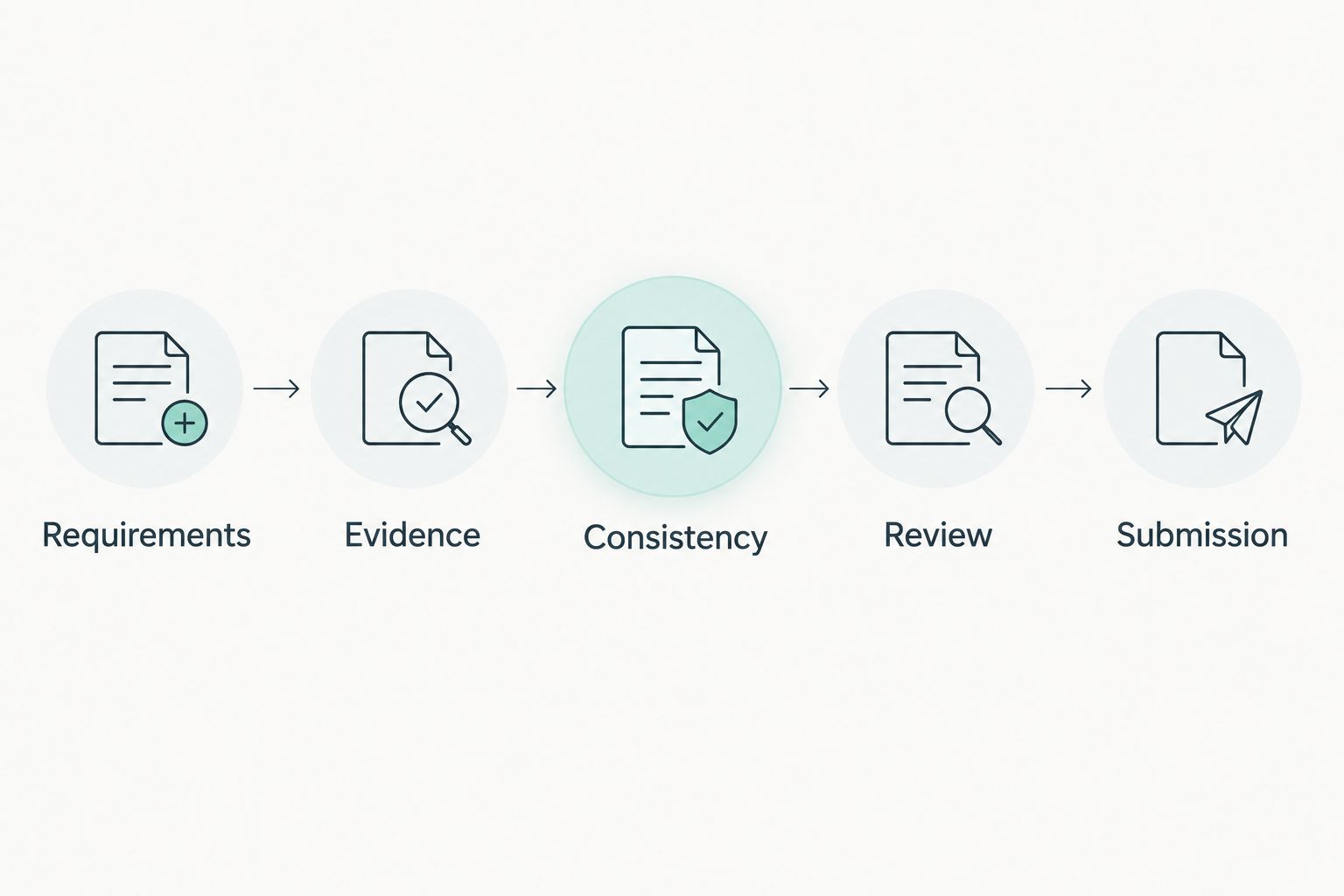
Why document-completeness checks vary between tenders
The tender determines what you must demonstrate and how you must submit it. A reusable checklist helps organize work, but it cannot establish that a particular procurement accepts your evidence.
Check these factors against the instructions:
- Procurement scope: The required technical response and supporting evidence must correspond to the goods, works, or services being procured.
- Bidder structure: A sole bidder and a consortium need their respective participation arrangements checked against the stated requirements.
- Evidence conditions: Relevant periods, document scope, and acceptance conditions affect whether an attachment answers the requirement.
- Submission channel: Electronic and physical instructions require their own checks for format, execution, and delivery.
- Amendments: A changed requirement can make a previously reviewed response incomplete.
- Clarification rules: The permitted treatment of missing or unclear information depends on the governing rules and tender conditions.
For Vietnamese public procurement in 2026, verify the applicable legal requirements alongside the procurement documents. Do not apply assumptions from a private-sector invitation to a public procurement, or from an earlier tender to the current package.
What should your final completeness review check?
Use the final review to challenge the submission, not to confirm that the team worked hard. Ask the reviewer to identify the evidence an evaluator would need without relying on background conversations.
Required evidence
Can the reviewer locate every required document and the relevant passage within it? If a requirement refers to an attachment, confirm that the attachment is present in the final package rather than only in a working folder.
Execution and readability
Are required forms completed and executed as instructed? Check signatures, authorizations, page completeness, and legibility without assuming that a saved or uploaded file is usable.
Internal consistency
Do the technical response, schedules, declarations, and supporting records tell the same factual story? Resolve conflicting entity details, dates, or commitments before approval.
Submission status
Does the recorded status show the action required by the submission instructions? Retain the relevant acknowledgment rather than relying on a colleague's message that the bid was sent.
For your final 2026 review, record exceptions explicitly. “Reviewed” and “compliant” are different conclusions; a reviewer can finish checking a package and still identify a reason not to submit it.
Where does tender-intelligence software fit?
Dauthau is best for Vietnamese businesses that need tender intelligence for opportunity research. The platform supports searching, tracking, and analyzing public and private procurement tenders, contractor data, and bidding results across Vietnam.
Use Dauthau tender intelligence to inform opportunity research, then verify submission requirements against the actual procurement documents. That division keeps research useful without treating it as approval of your bid.
The benefit is access to procurement information for your research. The limit is that tender intelligence does not establish whether your particular attachments, signatures, or submission satisfy a tender's requirements.
Can you fix missing bid documents after submission?
Do not assume you can fix missing bid documents after submission. Whether clarification or supplementation is permitted depends on the applicable rules, the tender conditions, and the nature of the missing information.
If you receive a formal request, respond through the required channel and within the stated deadline. Preserve the request and response, and obtain procurement or legal advice when the permitted scope is unclear.
Does uploading every file mean your bid is complete?
Uploading every file does not establish that your bid is complete. The files must answer the requirements, contain usable evidence, and form part of a submission completed through the prescribed process.
Check content and submission status separately. A complete working folder is not the same as a complete submitted bid.
FAQ
What's the best way to avoid disqualification for incomplete bid documents?
The best practical control is a requirement-to-evidence matrix checked against the final submission. Assign responsibility for each requirement and verify the actual document before marking it complete.
Will a missing attachment automatically disqualify my bid?
A missing attachment does not have a universal outcome across all tenders. Its treatment depends on the applicable rules, the tender requirements, and the significance of the missing evidence; do not assume you can supply it later.
Can I reuse the checklist from my previous tender?
You can reuse its structure, but you must rebuild its requirements for the current tender. Check the current instructions, amendments, forms, and evidence conditions before relying on any previous entry.
Who should check my bid documents before submission?
A reviewer who can assess the final package independently of its drafter should check the bid documents. Give the reviewer the requirements and submitted files, not just a summary of completed tasks.
Can Dauthau confirm that my bid is legally compliant?
Dauthau tender intelligence does not establish the legal compliance of your bid documents. Verify compliance against the procurement documents and applicable rules, and obtain qualified advice for disputed or unclear requirements.
What should I save after submitting a bid in 2026?
Save the submitted package, the applicable instructions and amendments, your final review record, and the acknowledgment provided by the submission channel. These records let you identify what was submitted and which requirements informed the review.
One last thing
Review the submitted package as an evaluator, not as its author. Open it without your working notes and try to prove each checklist entry using only the evidence inside.
If a requirement becomes understandable only after someone explains it verbally, strengthen the written response before submission. Your team's knowledge of the business is not a substitute for evidence the evaluator can locate.