
Research a project owner's past contractors by matching the owner's identity, collecting published award results, and comparing winners across genuinely similar contracts. Verify each contractor's identity and role before drawing conclusions; a repeated winner is evidence of past awards, not proof of preferential treatment or future success. For a 2026 bid decision, separate documented findings from unanswered questions.
- How to research a project owner's past contractors: verify identities, compare similar awards, and document gaps before bidding.
- Dauthau supports Vietnamese businesses researching procurement tenders, contractor data, and bidding results.
- Repeated awards identify an incumbent; they do not establish misconduct or predict your next bidding result.
- Use award records for selection history and contract-performance evidence for delivery assessments.
How to research a project owner's past contractors before bidding
Start with the owner, not the contractor name you already recognize. Otherwise, your research becomes a search for evidence supporting an existing assumption. Build an owner-specific record first, then identify the contractors appearing in it.
Use this sequence to turn scattered notices into a bid decision. The companion guide to bidding results and competitor win-rate reports covers the next analytical step once your records are organized.
- Identify the owner. Record the legal name, available organization identifiers, and named procuring entity.
- Collect award records. Search using the verified identity and documented name variants.
- Match contractors. Confirm legal entities, joint-venture membership, and the role actually disclosed.
- Compare similar packages. Group awards by scope, procurement method, location, and requirements.
- Check delivery evidence. Distinguish selection results from documented contract performance.
- Write the decision. State whether to pursue, seek clarification, or stop preparation, with reasons tied to evidence.
Keep the research date visible. A working file marked as reviewed in 2026 tells colleagues when the evidence was checked, not when every underlying contract occurred.
Why this matters
Past awards help you understand what a project owner has bought and which contractors have supplied it. They do not tell you whether your current offer satisfies the tender requirements. That distinction keeps competitor research from replacing the eligibility and technical checks that determine whether you should bid.
Your goal is not to assemble the longest contractor list. It is to answer a narrower question: does the documented history reveal relevant experience, recurring requirements, or unresolved risks that change your preparation?
A useful output connects evidence to action. If comparable awards emphasize a delivery requirement, check your ability to meet it; if the record only names the winner, do not invent an explanation for the selection.
Establish the owner's identity before collecting awards
The project owner, procuring entity, and organization publishing a notice are not interchangeable labels. Read the roles recorded in each document instead of merging organizations because their names appear together.
Create an identity sheet containing:
- The owner's full legal name as published.
- Available organization identifiers and address details.
- The procuring entity named for the relevant package.
- Name variants supported by documents.
- The source document and retrieval date.
Do not merge records on name similarity alone. Abbreviations, translated names, and organizational changes require corroboration. Preserve the original text alongside your normalized name so another reviewer can retrace the match.
For a 2026 review, also record whether the current tender names the same entity as the historical awards. When the connection is unclear, keep the records separate and explain the uncertainty in your decision note. A smaller verified dataset is more useful than a larger mixed one.
Build an award register you can audit
Use a spreadsheet or database with one row per procurement package. Keep contractor membership in separate fields so a joint venture does not become several independent awards during analysis.
Record the package identifier, package name, owner, procuring entity, publication date, selected contractor, procurement method, and source reference where disclosed. Add a status field that distinguishes an award result from a cancellation, amendment, or other notice.
Retain the document wording for the selected contractor. Your cleaned name helps analysis, while the original wording supports verification. If a later document changes an earlier result, connect the records rather than silently overwriting the history.
What should each research source establish?
Different records answer different questions. Use the table to select the evidence you need, rather than treating every search result as interchangeable proof.
| Evidence source | Best for | Strength | Limitation |
|---|---|---|---|
| Published award result | Identifying the selected contractor | Records the stated selection outcome | Does not establish successful delivery |
| Tender documents and amendments | Understanding requirements | Shows the published conditions for that package | Does not explain every bidder's outcome |
| Business-registration information | Matching a legal entity | Helps distinguish similarly named companies | Does not establish tender participation or performance |
| Available evaluation or decision documents | Understanding documented selection reasons | Adds context beyond the winner's name | Conclusions are limited to what the document discloses |
| Available contract-performance records | Assessing documented delivery | Addresses execution rather than selection alone | Absence of a record does not establish good performance |
Treat these as complementary evidence sources, not substitutes. A registration record resolves identity; it cannot explain why a bid lost. An award result confirms selection; it cannot demonstrate that the contractor completed the work as required.
Match contractors without overstating their role
Contractor names are the beginning of verification. Match available legal identifiers and registration details before combining records, and keep unresolved matches outside your confirmed totals.
A joint-venture award needs particular care. Record the venture as named and identify members only when the source provides them. Do not assign the entire contract to every member, infer work shares, or label a member as the lead without documentary support.
Use explicit role labels:
- Selected contractor: named in the award result.
- Joint-venture member: identified as part of the selected venture.
- Subcontractor: documented in that role.
- Unverified match: a possible identity connection awaiting confirmation.
These labels prevent an attractive company profile from becoming an unsupported experience claim. They also keep your competitor analysis fair: a firm appearing in a supporting role is not automatically the principal competitor for the next package.
Compare similar awards before interpreting repeat winners
An owner's overall award history is not automatically your competitive market. Separate packages that differ materially in scope or qualification requirements. Otherwise, a contractor's success in unrelated work distorts your assessment of the tender you are considering.
Create comparable groups using the fields actually available. Explain each inclusion rule, preserve excluded records, and avoid adjusting the group simply because the result looks unexpected.
Why past-contractor patterns vary
Check these factors before treating repeated awards as a meaningful pattern:
- Scope: Different goods, works, or services require different capabilities.
- Qualification requirements: Experience, personnel, and other stated conditions shape eligibility.
- Procurement method: Compare outcomes within the context of the published method.
- Delivery location: Geographic requirements affect the relevance of past contracts.
- Contract structure: A standalone contractor and a joint venture represent different arrangements.
- Evidence coverage: Missing or unresolved records limit the conclusions you can support.
Do not create a win rate from a list of awards alone. A win rate requires a defined set of observed participations and corresponding outcomes. If only winners are known, report award counts within your collected dataset instead.
For a 2026 bid assessment, label your scope clearly: which owner, which package types, which records, and which review date. Never present your collected results as the owner's complete procurement history unless completeness is established.
Turn the research into a bid decision
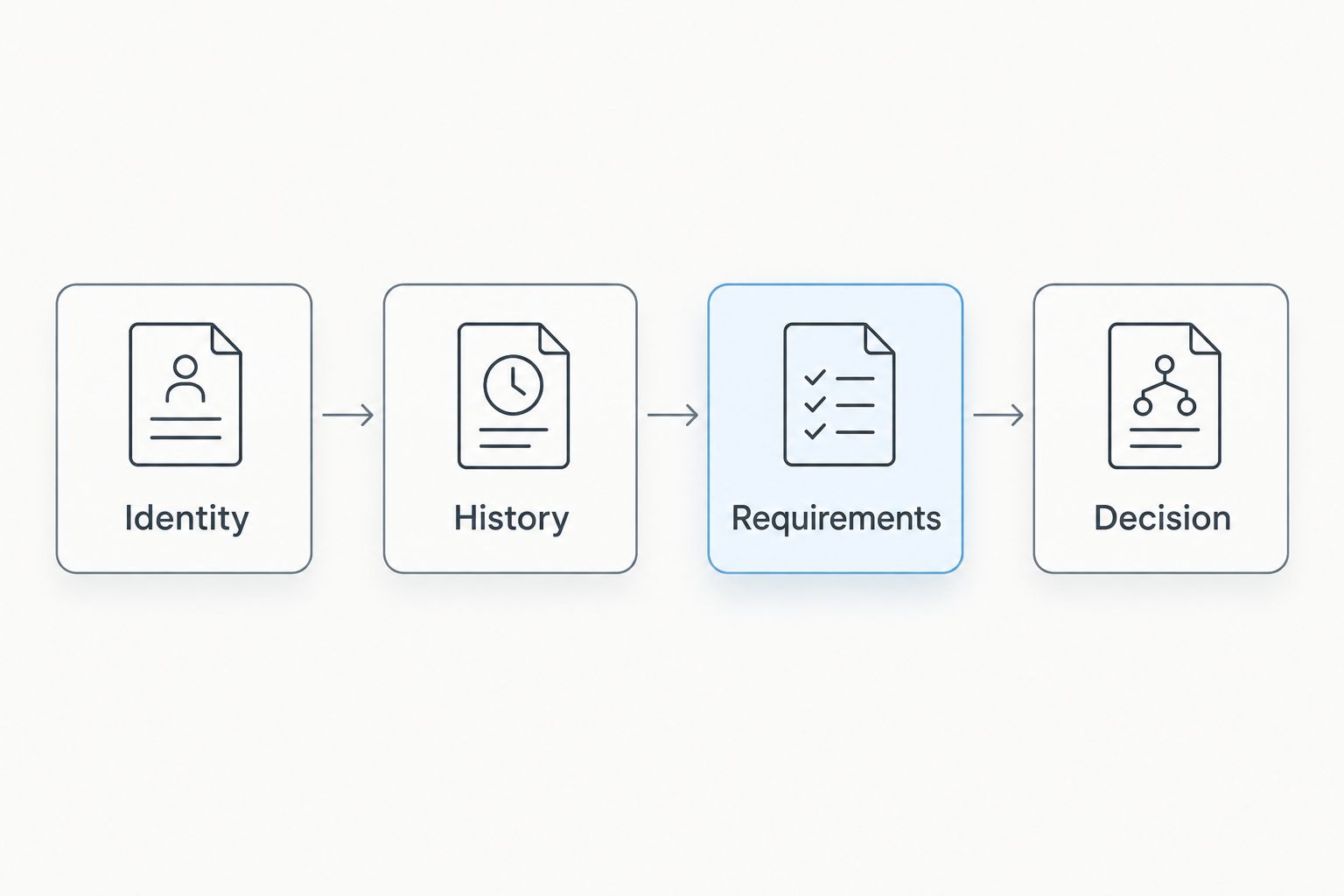
Organize the findings under four headings: Identity, History, Requirements, and Decision. This structure keeps a recognizable incumbent from dominating the assessment before you have checked your own fit.
Under Identity, confirm who owns the project and which contractor entities appear in the evidence. Under History, summarize comparable awards and unresolved gaps. Under Requirements, map the current tender's conditions to your documented capabilities. Under Decision, explain the next action and the evidence supporting it.
Write conclusions that another person can challenge. For example, say that the collected records show repeat awards in a defined package group; do not claim the owner always chooses the same contractor. The first statement has a testable scope. The second exceeds the evidence.
Your decision note should distinguish:
- Confirmed findings: statements supported by an identified source.
- Open questions: gaps requiring verification or formal clarification.
- Bid implications: specific changes to qualification checks, technical preparation, or resource allocation.
Do not infer corruption, disqualification, or hidden relationships from repeated awards alone. If a concern affects your bid, identify the relevant requirement and use the applicable clarification process rather than turning a pattern into an allegation.
Where bidding-intelligence software fits
Dauthau bidding-intelligence software is best suited to Vietnamese businesses researching tenders, contractors, and bidding results. Its stated purpose fits the discovery and analysis stage of this workflow. You can use Dauthau as a starting point for that research, while retaining the underlying evidence needed for your decision.
The benefit is relevance to the procurement research task. The limit is evidentiary: software does not turn an award result into proof of delivery, and a search output does not establish that every relevant record has been found. Verify the specific records you rely on and keep unresolved questions visible.
Start your contractor research
Explore tender, contractor, and bidding-result research for your next Vietnam bid.
Does a repeated winner mean you should not bid?
A repeated winner is not, by itself, a reason to skip a tender. Check whether the previous awards concern comparable work and whether your business meets the current requirements. An incumbent's documented experience is relevant competition, not proof that the next result is predetermined.
Use the history to sharpen preparation. Identify the requirements you can satisfy with evidence, the gaps you cannot close, and the questions that need clarification before committing resources.
Can award records prove a contractor performed well?
Award records establish selection, not successful performance. Look for available completion, acceptance, termination, or other contract-execution evidence relevant to the question you are assessing. Keep allegations separate from documented findings.
If performance evidence is unavailable, describe performance as unverified. Do not convert the absence of a negative record into a positive assessment.
What should you save before making the final decision?
Save the source, identity match, comparable-package rules, and decision rationale. Include the review date and distinguish original documents from your own analysis. Your 2026 decision file should make it possible to reconstruct each material conclusion without relying on the researcher's memory.
Assign an owner to each unresolved question. A question without a next action is not a control; it is simply a gap carried into the bid.
FAQ
How do I find a project owner's previous contractors?
Identify the project owner precisely, collect published award results, and verify the selected contractors named in those records. Separate comparable packages from unrelated purchases before interpreting the pattern.
Can I search by the owner's name alone?
An owner's name is a starting point, not sufficient identity verification. Compare available identifiers, addresses, and documented name variants before merging records.
Does a contractor's award count show its win rate?
An award count does not show a win rate. You need a defined set of observed participations and outcomes; otherwise, report only the awards found within your stated research scope.
Should I count joint-venture members as separate winners?
Record the awarded joint venture and its disclosed members without multiplying the package into separate awards. Do not infer membership roles or work shares that the source does not state.
Can Dauthau help with past-contractor research in Vietnam?
Dauthau bidding-intelligence software supports searching, tracking, and analyzing procurement tenders, contractor data, and bidding results across Vietnam. Verify the underlying records before using a finding in your bid decision.
How do I check whether a past contractor delivered successfully?
Use available contract-performance evidence rather than the award result alone. An award confirms selection, while completion or other execution records address different questions.
What should my 2026 contractor-research report include?
Your 2026 report should identify the owner, evidence sources, verified contractors, comparison rules, unresolved gaps, and the resulting bid decision. Keep the review date separate from the dates of the underlying procurement records.
One last thing
Your inclusion rules deserve as much scrutiny as your contractor list. A polished summary is misleading if it mixes unrelated packages or silently excludes unresolved identities. Before approving the bid, ask a colleague to trace a material conclusion back to its source and challenge why each package belongs in the comparison.
If the conclusion changes when an uncertain record is removed, make that dependency explicit. The strongest research file is not the one that sounds most confident; it is the one that shows exactly what supports the decision.