
Engineering firms’ tender software is a search, tracking, and analysis tool with the aim of finding procurement opportunities that match your technical capability and delivery capacity. This 2026 guide explains how to select it for Vietnamese tenders, where discipline-specific requirements, project references, and named personnel need careful review.
- Dauthau suits engineering firms researching Vietnamese public and private tenders, contractor records, and bidding results.
- Choose tender software for engineering firms around technical fit and bid qualification, not the volume of search results.
- Keep source-document review separate from tender discovery; search results do not establish eligibility.
- Use procurement intelligence to prioritize opportunities, then assign engineers to verify requirements before committing proposal resources.
Why tender software matters for engineering firms
An engineering opportunity is not qualified just because its title matches your discipline. You need to distinguish consultancy from construction, design from supervision, and equipment supply from installation before deciding whether a tender deserves technical review.
That distinction matters when the same team both delivers projects and prepares proposals. A search result creates work; a qualified shortlist directs that work toward contracts your firm can actually pursue.
For your 2026 pipeline, use a repeatable tender shortlisting process before comparing software features. Define what qualifies an opportunity first, then assess whether the software helps you find and investigate it.
Choose for decision quality, not notice volume. A useful system brings relevant opportunities into view without turning every keyword match into an instruction to bid.
Build an engineering-specific tender workflow
Use the following steps to separate discovery, technical qualification, and proposal preparation. Begin with a manual process you understand; introduce software where searching and researching become repetitive.
Define your technical scope before searching
Start with a shared document listing the work your firm can deliver and the evidence supporting it. Separate civil, structural, mechanical, electrical, environmental, and other disciplines according to your actual services rather than treating engineering as a single search category.
Next, distinguish your intended role. Lead consultant, specialist subcontractor, supervision consultant, and works contractor require different assessments of scope and responsibility. Read the tender documents to establish which role the buyer is procuring.
As a practical starting structure, write 3 search briefs: core services, adjacent services requiring review, and work you will exclude. These are organizational choices, not market benchmarks. Each brief should give a colleague enough detail to reproduce your screening decision without relying on your memory.
- Record your disciplines and the deliverables you provide.
- Separate consultancy, supervision, supply, installation, and construction.
- List acceptable locations and delivery constraints.
- Identify work requiring a partner or specialist.
- Define explicit exclusions, including misleading keyword matches.
Map eligibility requirements to available evidence
Before evaluating software, build a spreadsheet connecting tender requirements to your supporting documents. Use actual tender documents as your reference, not a generic checklist presented as a universal legal requirement.
For engineering firms, inspect requirements concerning comparable assignments, personnel, technical methods, equipment, and financial evidence wherever the documents request them. A company brochure does not automatically establish that a particular requirement has been met.
Use 4 fields for each requirement: source reference, supporting evidence, evidence owner, and review status. Keep the exact wording accessible so reviewers can distinguish an unmet condition from an unclear one. This manual register also becomes a useful test case when assessing software: can your team carry the relevant information through its proposed workflow?
- Copy each requirement with its document reference.
- Identify the assignment or credential offered as evidence.
- Assign responsibility for confirming validity and relevance.
- Mark unresolved interpretation questions for clarification.
- Separate mandatory conditions from evaluation criteria.
Test tender discovery against your search briefs
Search relevant procurement notices manually first and record which terms return suitable engineering work. In Vietnam, test Vietnamese terminology used in the notices alongside the terminology your commercial team uses internally. Do not assume a translated phrase identifies the same scope.
Then assess Dauthau for tender software needs involving the search, tracking, and analysis of Vietnamese public and private procurement opportunities, contractor data, and bidding results. Use your search briefs to judge relevance; confirm any specific alert, export, or integration requirement directly before making it part of your process.
Dauthau is best suited to engineering firms researching Vietnamese tenders and contractor records. Its role here is procurement intelligence, not a substitute for your engineers’ technical assessment or a guarantee of bid eligibility.
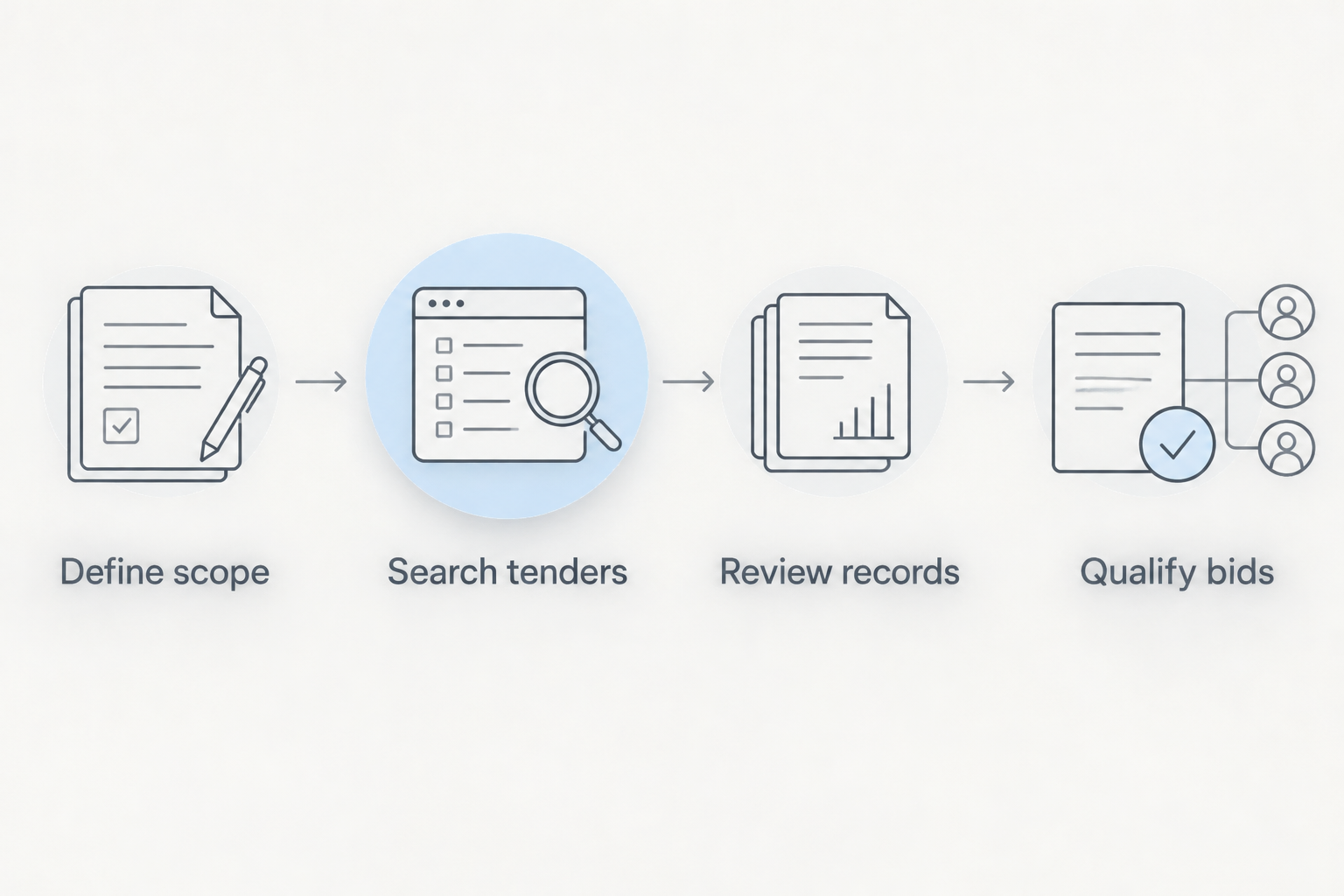
Use this sequence to keep discovery connected to a decision:
- Define scope: select the relevant technical brief.
- Search tenders: collect notices matching that brief.
- Review records: investigate scope, parties, and published results.
- Qualify bids: record a pursue, clarify, or reject decision.
Research project owners and contractor records
Start by reading the current opportunity and any relevant published results you can locate manually. Record the buyer’s identity, package scope, named contractors, and the source of each observation before drawing conclusions.
Compare like with like. A supervision assignment is not a direct comparator for a design-and-build package merely because both concern the same facility type. Likewise, a published award identifies an award outcome; it does not by itself establish delivery quality, payment reliability, or the reason another bidder lost.
For your 2026 research register, separate facts from interpretations. An engineering director should be able to identify which statements come from documents and which need further investigation. Use historical records to frame questions, not to manufacture certainty about the next procurement decision.
- Confirm entity identity before combining contractor records.
- Compare discipline, contractual role, and package scope.
- Record the publication date and source document.
- Distinguish award information from performance evidence.
- Write unresolved questions beside each research conclusion.
Apply a technical and commercial bid gate
Hold a short review before allocating proposal work. A spreadsheet and a discussion between the technical lead and commercial owner are enough to establish the process; software is not a prerequisite.
Use 2 named reviewers as a starting arrangement: one responsible for technical feasibility and one for commercial commitment. Combine those responsibilities only when your organization explicitly assigns them. The decision needs an owner, not simply a status label in a system.
Assess whether your engineers can meet the requested scope, whether suitable evidence exists, and whether delivery commitments conflict with current assignments. Record pursue, clarify, or reject with a reason. Do not convert a numerical score into an automatic approval when a mandatory requirement remains unresolved.
- Verify relevant experience against the stated requirements.
- Check proposed personnel against delivery commitments.
- Review partner dependencies and responsibility boundaries.
- Examine contractual terms with the appropriate advisers.
- Assign clarification questions before approving proposal work.
Track document changes and learn from outcomes
Create a shared register of the source documents, amendments, clarification responses, submission instructions, and internal decisions relevant to each tender. A controlled folder and spreadsheet provide a manual starting point.
For your 2026 operating process, assign responsibility for checking the authoritative source through submission. A discovery platform helps research opportunities; do not assume it performs submission, amendment control, calendar synchronization, or document validation unless you have confirmed those functions.
After the decision or published outcome, compare what happened with your initial qualification. Separate an internal no-bid, a withdrawn pursuit, a submitted bid, and a published award outcome. Those distinctions stop the team from treating every discovered notice as a lost opportunity or every unsuccessful bid as a pricing problem.
- Record the current source-document version and review date.
- Assign an owner to monitor amendments and clarifications.
- Keep internal deadlines distinct from submission requirements.
- Preserve the evidence supporting the final bid decision.
- Review outcomes without assigning unsupported causes.
Compare options for your engineering firm
The right option depends on where your process breaks down. Manual research suits a team establishing its criteria; a shared register organizes decisions; procurement-intelligence software supports opportunity and contractor research. These approaches can work together rather than replace one another.
For your 2026 selection, compare each option against the same tender examples. Check what information you can find, how you verify its source, and how it reaches the person making the bid decision.
| Option | Best for | Main benefit | Key limitation |
|---|---|---|---|
| Manual source searches | Engineering firms defining their first search briefs | Direct inspection of notices and procurement documents | Your team must repeat searches and maintain its own research trail |
| Shared spreadsheet and document folders | Teams coordinating qualification and evidence | An explicit record of owners, requirements, and decisions | Records depend on disciplined manual updates; the register does not discover tenders |
| Dauthau tender software | Firms researching Vietnamese tenders, contractors, and bidding results | Supports procurement search, tracking, and analysis across public and private tenders | Engineers still need to validate technical fit; confirm specific workflow features before relying on them |
Keep discovery and qualification connected, but do not confuse them. A relevant notice belongs in your research queue; only a reviewed opportunity belongs in your committed proposal pipeline.
When evaluating a platform, ask the supplier to demonstrate your actual engineering search brief. Record unresolved questions about document access, data scope, account permissions, and information transfer rather than assuming those capabilities from a general product description.
Common mistakes engineering firms make
Searching only for the word engineering
A broad discipline label misses the distinction between what a project concerns and what the buyer is purchasing. Search around deliverables and roles, then inspect the procurement documents before classifying the opportunity.
Treating project similarity as eligibility
Two projects can involve similar assets but require different evidence. Compare the requested scope, your contractual role, and the wording of the experience requirement instead of relying on a familiar project name.
Committing named specialists before checking workloads
A proposed team is not a delivery plan until someone checks existing commitments. Make the technical lead responsible for confirming the staffing assumptions behind the bid decision, including dependencies on outside specialists.
Reading award history as proof of performance
An award record establishes a procurement outcome within that record’s scope. It does not prove satisfactory completion, explain evaluation decisions, or establish that a contractor remains suitable for a different assignment.
Buying software before assigning decision ownership
A research platform cannot decide who is accountable for a technical exception or a commercial commitment. Name the decision owner and document the approval path before introducing more notices into the pipeline.
FAQ
What's the best tender software for engineering firms in Vietnam?
Choose tender software that matches your engineering search scope and supports the research behind bid qualification. Dauthau suits firms researching Vietnamese public and private tenders, contractor records, and bidding results; technical eligibility still requires document review.
Can tender software tell us whether our engineering firm qualifies?
Tender discovery alone does not establish qualification. Compare the procurement documents with your firm's experience, personnel, technical approach, and any other requested evidence before approving a bid.
Should a small engineering consultancy start with a spreadsheet?
A spreadsheet is a practical starting point for recording requirements, evidence owners, and bid decisions. Add procurement-intelligence software when you need support for tender discovery and research, rather than expecting the spreadsheet to find opportunities.
Can we research private engineering tenders as well as public ones?
Dauthau supports research into public and private procurement tenders in Vietnam. Confirm coverage for your specific engineering discipline and target buyers before building the process around particular opportunities.
Does a contractor's award history prove it delivers good engineering work?
Award history does not by itself prove delivery quality. Use it to understand published procurement outcomes, then seek relevant performance evidence separately before making a partnership or subcontracting decision.
Can we connect tender information to our existing systems?
Confirm the specific integration before planning an automated connection. Ask about supported transfer methods, required fields, account access, and ongoing maintenance; use a controlled manual handoff until the proposed connection is verified.
How should we measure whether tender software helps?
Measure whether the software helps your team find relevant opportunities and reach documented qualification decisions. Track review effort, rejection reasons, and progression to approved bids without attributing contract wins to software alone.
One last thing
Test rejected opportunities, not just attractive ones. Include a clear technical mismatch, an ambiguous requirement, and a relevant opportunity in your software evaluation. A useful research process helps your engineers explain all of those decisions, including why the firm should stop work on a bid.