
Build a bidding strategy from win-rate data by calculating wins against decided bids, comparing genuinely similar opportunities, and turning the findings into explicit bid/no-bid rules. Use historical results to guide selection—not as a guaranteed probability of winning—and keep eligibility, delivery capacity, and commercial judgment as separate decision gates.
- Learn how to build a bidding strategy from win rate data using decided bids, comparable segments, and documented selection rules.
- Dauthau supports Vietnamese tender research; your internal records must supply bid effort, delivery constraints, and commercial outcomes.
- Separate pending, cancelled, and withdrawn opportunities from decided bids before calculating an award win rate.
- Choose opportunities using evidence and eligibility together; a strong historical win rate cannot cure a compliance failure.
How do you build a bidding strategy from win rate data?
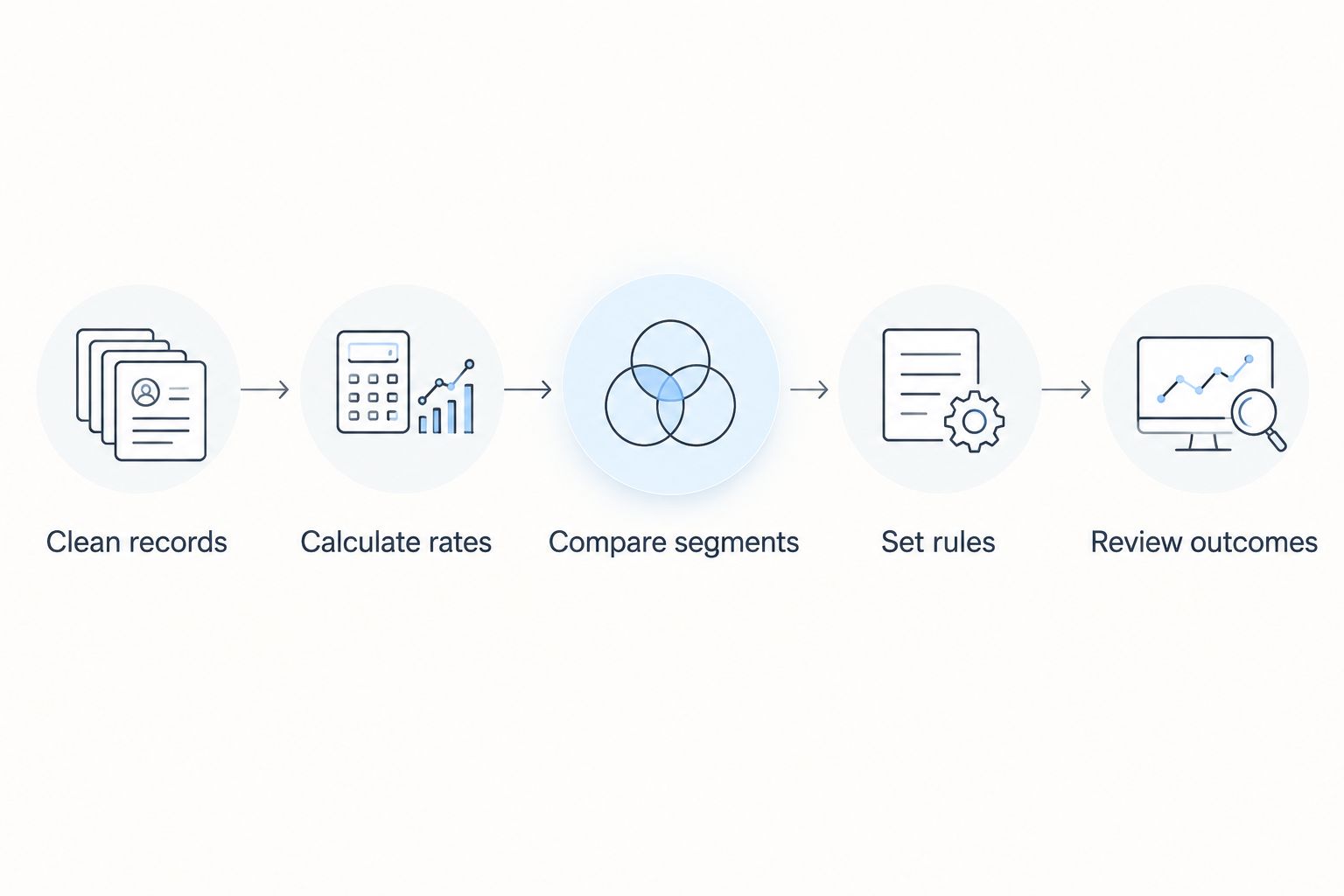
Follow this sequence: clean the records, calculate comparable rates, identify useful segments, set selection rules, and review subsequent outcomes. For the research side, the bidding-results-to-competitor-win-rate workflow addresses the connection between award records and competitor analysis.
- Clean records: establish what counts as a bid and a final outcome.
- Calculate rates: divide awards won by eligible, decided bids.
- Compare segments: examine comparable buyers, categories, and requirements.
- Set rules: translate evidence into pursue, investigate, or decline decisions.
- Review outcomes: compare later results with the original decision rationale.
Why this matters
Your overall win rate answers a narrow question: how frequently did the bids in that dataset win? It does not identify which new opportunity deserves your team's attention.
A useful 2026 bidding strategy connects that historical measure to a decision you can make before submission. The objective is not simply to increase the percentage; it is to select work your business can qualify for, deliver, and justify commercially.
Clean records before calculating anything
Choose the unit of analysis first. A tender and an individual lot are not interchangeable when a procurement contains separately awarded lots, so keep the selected unit consistent across wins and losses.
Build a working register with the fields needed to reconstruct each decision:
- Tender or lot identifier and procurement category.
- Buyer identity and relevant delivery location.
- Submission date, decision date, and final status.
- Your bidding role, including consortium participation where relevant.
- Outcome source and the date you checked it.
- Recorded reasons for rejection or loss, where available.
- Internal preparation effort and delivery constraints.
Keep pending, cancelled, withdrawn, and unresolved records separately identifiable. A pending submission is not a loss, and a withdrawn opportunity needs its own explanation rather than an assumed award outcome.
For a 2026 planning review, state the observation cutoff explicitly. Compare submissions that have reached a decision by that cutoff; otherwise, recent submissions still awaiting results distort the denominator.
Also distinguish a recorded award from a commercially successful contract. An award record establishes an outcome, not the quality of subsequent delivery or the return your business earned.
Calculate rates with an explicit denominator
Award win rate = bids won ÷ decided bids × 100%.
For this measure, decided bids are your submitted bids with a confirmed win or loss under the stated classification rules. Record those rules beside the calculation so another team member can reproduce the result.
The mathematical boundaries are straightforward: 0 wins among decided bids produces a 0% win rate; winning every decided bid produces a 100% win rate. Neither boundary establishes what your next bid will do.
Always show wins and decided bids beside the percentage. A percentage without its denominator hides how much evidence supports it, while a single additional outcome changes a small dataset more sharply than a large one.
A rise of 1 percentage point means an increase of one point on the percentage scale, not a 1% relative increase. Label changes correctly when you compare reporting periods.
Which measurement should you use?
Different measures answer different questions. Choose the measure that matches the decision rather than treating every percentage as the same result.
| Measure | Best for | Strength | Limitation |
|---|---|---|---|
| Tender-count win rate | Reviewing tender-level selection | Gives each decided tender equal weight | Conceals separately awarded lot outcomes |
| Lot-count win rate | Reviewing separately awarded lots | Matches the unit actually awarded | Requires reliable lot-level records |
| Value-weighted award share | Assessing the scale of awarded work | Distinguishes awards by recorded value | Large opportunities dominate; it is not profitability |
For value-weighted analysis, define the submitted scope consistently and avoid counting the full tender value against a bid covering only part of it. Keep this measure separate from the count-based win rate.
Compare segments without mistaking patterns for causes
Start with distinctions that matter before submission: procurement category, buyer, delivery geography, eligibility requirements, and your relevant experience. Use only attributes that are recorded consistently enough to compare.
A segment becomes useful when it changes your decision. If dividing records by buyer reveals no actionable distinction, retain the broader grouping rather than producing a more elaborate dashboard.
Avoid slicing until every group contains only isolated outcomes. Small groups describe individual experiences; they do not establish a stable pattern.
Also check whether the groups overlap in important ways. A stronger result for one buyer might reflect a different category of work or a change in your delivery capability, rather than an advantage associated with that buyer alone.
For a 2026 shortlist, compare current requirements with the historical segment directly. An old win against materially different eligibility or delivery conditions is not equivalent evidence.
How should you use competitor results?
Keep competitor award records separate from confirmed participation records. An award list alone cannot establish a competitor's win rate because it does not identify all the bids that competitor lost.
If participation evidence is incomplete, describe the observed awards instead of calculating an unsupported percentage. Record whether each finding comes from an award notice, a participation record, or your own bid file.
Dauthau's procurement-intelligence platform supports research into Vietnamese tenders, contractors, and bidding results. Combine that external research with internal submission records rather than assuming public results contain your preparation effort or reasons for bidding.
Set bid/no-bid rules that a team can apply
Turn the analysis into a short decision record for each opportunity. Separate mandatory gates from preferences so a historical win-rate advantage cannot override a requirement you do not meet.
Eligibility
Confirm the actual qualification requirements against evidence your business can provide. Where a requirement is unclear, record the question for clarification instead of converting uncertainty into a passing score.
Decline opportunities you cannot qualify for. A favorable historical segment is not a substitute for meeting the current tender's requirements.
Delivery fit
Check whether you can perform the required scope under the stated conditions. Assign responsibility for assessing staffing, equipment, supply dependencies, and competing delivery commitments where those factors apply.
Keep delivery fit distinct from bid-writing capacity. Being able to prepare a submission does not establish that your business can perform the contract.
Evidence fit
Compare the opportunity with decided bids sharing relevant characteristics. Record both the supporting history and any material differences, including changed specifications, buyer requirements, or your business's capabilities.
Use “investigate” when the evidence is incomplete. That decision should produce a named question and an owner, not an indefinite place on the shortlist.
Commercial fit
Review the commercial case using your own delivery assumptions and approval process. Do not infer profitability from an award result or treat a high segment win rate as permission to accept unsuitable terms.
Historical success helps prioritize attention; it does not replace contract review. Pursue only when eligibility, delivery, evidence, and commercial assessment support the decision together.
The resulting workflow is sequential: establish trustworthy history, calculate the measure, compare relevant groups, set selection rules, and examine what happens next.
Why does your bidding win rate vary?
A changing percentage can reflect a different opportunity mix, a different denominator, or a change in execution. Check the underlying records before attributing the movement to strategy.
- Opportunity mix: different categories or buyers change what the aggregate rate represents.
- Decision timing: unresolved submissions distort comparisons when treated as losses or mixed with final outcomes.
- Counting rules: switching between tenders and lots changes the unit being measured.
- Qualification outcomes: noncompliant submissions need a different response from compliant bids that lost on evaluation.
- Delivery and experience fit: historical results must be read against the capabilities available for each submission.
- Incomplete evidence: missing participation or outcome records limit the conclusions the calculation supports.
Keep these explanations separate in your review. A recording error calls for data correction; repeated qualification failures call for changes to opportunity screening or submission controls.
Review outcomes against the original decision
Freeze the selection rationale when you approve a bid. Record the evidence available then, the unresolved questions, and the reason for proceeding before the final result is known.
After the decision, add the outcome without rewriting that original rationale. This separates a sound decision that lost from a weak decision that happened to win.
For your 2026 review, compare both outcomes and process. Ask whether the selection rule was followed, whether assumptions were supported, and whether the eventual result exposes a correctable mistake.
Track declined opportunities separately where later outcomes are observable. Your submitted-bid win rate describes the opportunities you selected; it does not measure all the work your business might have won.
What is a good bidding win rate?
A good bidding win rate cannot be reduced to a universal percentage. Judge it against a consistent internal baseline alongside qualification outcomes, preparation effort, delivery capacity, and commercial results.
A higher rate is not automatically better if it comes from avoiding suitable opportunities or accepting work on unsuitable terms. Define success before changing the selection rules.
Can historical win-rate data predict the next tender winner?
Historical win-rate data does not establish the winner of the next tender. It describes recorded outcomes under past conditions, while the next result depends on the current requirements, evaluation, and competing submissions.
Use the history to explain a selection decision, not to promise an award. Keep any probability estimate distinct from the observed historical percentage.
Where procurement research fits into the strategy
Dauthau is best suited to Vietnamese businesses researching tenders, contractors, and award results. Its stated role is procurement intelligence covering public and private opportunities, rather than an outsourced bid/no-bid decision.
Use Dauthau for the external research side of your bidding strategy. The platform's relevant strength is access to tender, contractor, and results research; the boundary is that your internal effort, delivery constraints, and commercial judgments must come from your business.
For a 2026 operating process, assign ownership of those internal records before expanding the analysis. More external records do not repair an undefined denominator or an undocumented selection decision.
FAQ
How do I calculate my company's bidding win rate?
Divide confirmed bids won by confirmed decided bids, then multiply by 100%. Use the same counting unit throughout and keep pending, withdrawn, and cancelled records separately classified.
Should pending tenders count as lost bids?
No, pending tenders should not count as lost bids in a decided-bid win rate. Keep them outside that denominator until a confirmed outcome is available.
Should I calculate win rate by tender or by lot?
Use tender-level records for tender-level decisions and lot-level records when separately awarded lots are the relevant unit. Do not mix the units within the same percentage.
How much historical data do I need before changing my bidding strategy?
There is no universal minimum that makes a bidding strategy reliable. Show wins and decided bids together, check comparability, and avoid treating isolated outcomes as a stable pattern.
Can I calculate a competitor's win rate from award notices alone?
No, award notices alone do not establish a competitor's win rate. You also need reliable evidence of that competitor's decided participation, including unsuccessful bids.
Can Dauthau replace our internal bidding records?
No, Dauthau's procurement-intelligence role does not replace your internal bidding records. Combine tender, contractor, and award research with your own submission decisions, effort records, and delivery assessments.
One last thing
Write down why you declined an opportunity, not just why you submitted a bid. Win-rate analysis otherwise preserves the outcomes of your selection process without preserving the choices that created it.
A short decline reason gives later reviewers something concrete to examine. It also prevents an improved win rate from being mistaken for a better strategy when the business has simply stopped considering harder opportunities.