
To find tenders that match your business lines, translate what you sell into buyer-facing search terms, search related terms separately, and screen each result against the actual tender requirements. Use business-line labels to organize your search, not as proof that you qualify. This 2026 guide gives you a repeatable process for separating relevant opportunities from tenders your business cannot deliver.
- Dauthau suits Vietnamese businesses seeking tender search and procurement intelligence; document review remains essential.
- Learning how to find tenders that match your business lines starts with buyer terminology, not company-registration wording.
- Separate tender discovery from eligibility checks: a matching keyword does not establish qualification.
- Build separate searches for each business line, then record why each opportunity qualifies or fails.
Why this matters
A relevant search result is a lead, not a bid decision. A package title can describe something you supply while the detailed scope requires installation, maintenance, or other work outside your capacity. Read beyond the title before assigning proposal work.
Dauthau provides tender search and procurement intelligence for Vietnamese businesses, including public and private tenders, contractor data, and bidding results. Use that intelligence to identify opportunities; use the applicable tender documents to decide whether your business meets the requirements.
For your 2026 search process, keep discovery and qualification separate. Discovery asks whether the work fits your offering. Qualification asks whether your business can satisfy the stated conditions and submit a complete response.
How to find tenders that match your business lines
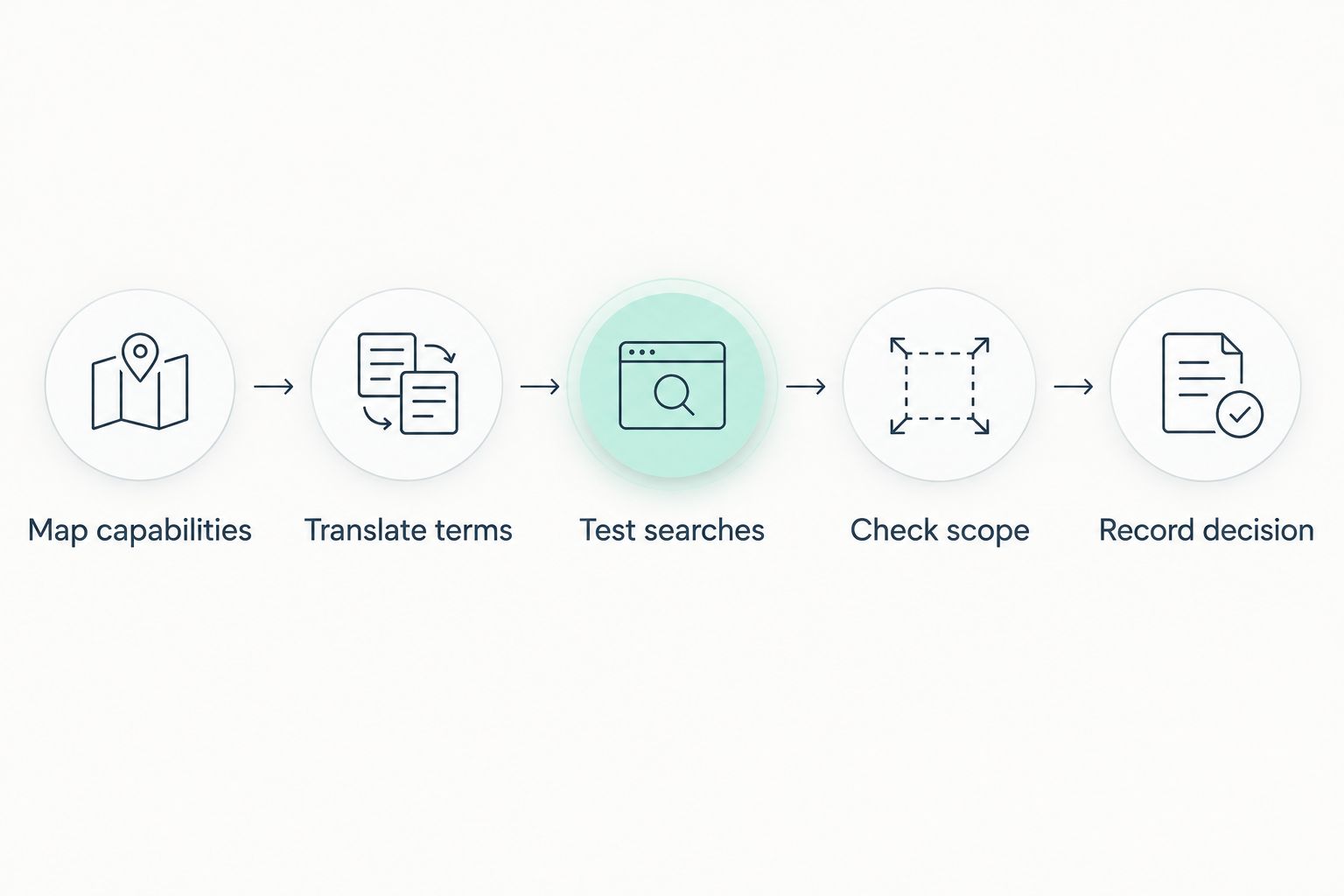
Use these 5 steps to build a search process you can repeat. Start with your actual delivery capabilities, then move toward the buyer's wording and the package-specific requirements.
1. Map your capabilities
Create a working list of the products, services, and works your business can deliver. Describe the deliverable, not just the broad industry: equipment supply, equipment maintenance, software implementation, or another specific activity that reflects your offering.
For each business line, record:
- Deliverables: What you supply or complete.
- Boundaries: What you do not provide.
- Coverage: Where you can perform the work.
- Evidence: Which existing records support your capability.
Keep aspirational services off this list. If a tender requires a capability you have not established, flag it for review rather than quietly treating it as a match.
2. Translate buyer terms
Turn each deliverable into a group of search phrases. Include the specific item, its broader category, and the activity involved, such as supply, installation, maintenance, or consulting where relevant to your business.
For searches in Vietnam, include Vietnamese terminology used in procurement documents. For example, an equipment supplier can investigate wording such as cung cấp thiết bị, then narrow the search using the actual equipment category. This is a search example, not a statement about qualification.
Build 2 search lists: core terms for direct matches and adjacent terms for related scopes. Keep them separate so a broader exploratory search does not obscure the work you already know you can deliver.
3. Test separate searches
Search each business line separately before combining results. A single broad query makes it harder to see which term produced irrelevant notices and which term identified a useful opportunity.
Use the comparison below to choose your starting approach. These are search methods, not claims about any platform's supported filters or query syntax.
| Search approach | Best for | Advantage | Limitation |
|---|---|---|---|
| Broad category search | Exploring unfamiliar buyer wording | Exposes related descriptions and scopes | Requires more manual screening |
| Specific deliverable search | Finding direct capability matches | Keeps attention on work you actually supply | Misses notices using different terminology |
| Buyer or project search | Investigating a known procurement need | Adds context to a specific opportunity | Does not replace searching across buyers |
Start with specific deliverables, then expand deliberately. Keep broad searches as a separate discovery exercise rather than using them as your entire opportunity list.
4. Check the scope
Open the notice and the available tender documents. Read what must be delivered, where the work takes place, the submission deadline, and any stated eligibility or qualification requirements.
Check the whole package. Supplying equipment is not the same task as supplying, installing, integrating, and maintaining equipment. A familiar item inside a wider package does not make the entire contract suitable for your business.
Record the requirement beside the evidence you would use to satisfy it. If the wording is unclear, follow the clarification procedure stated in the tender documents instead of assuming an interpretation that favors your bid.
5. Record the decision
Give each reviewed opportunity a clear status: pursue, clarify, or reject. Add the reason and assign responsibility for the next action.
Use 3 decision statuses, not an undifferentiated list of interesting notices. Pursue means the opportunity warrants further bid preparation; clarify means a specific question blocks the decision; reject means a known mismatch makes further work inappropriate.
The process below keeps discovery separate from commitment. An opportunity should move into bid preparation only after the scope and requirements have been checked.
Why tender relevance varies
A tender can match your business line and still fail your practical screening. Use these factors to explain the decision rather than relying on a vague relevance score.
- Buyer terminology: Different wording can describe a similar deliverable. Add a term only after checking what it means in the document.
- Package boundaries: A supply requirement can sit inside a wider implementation or works package. Assess the complete obligation.
- Delivery location: Check the stated site and your ability to perform there, including any on-site responsibilities.
- Qualification requirements: Compare each stated condition with evidence your business can actually provide.
- Preparation time: Read the submission deadline and work backward through document review, clarification, approval, and submission.
- Delivery capacity: Confirm that the people, equipment, and other resources needed for the scope are available within your own operating plan.
In your 2026 review log, distinguish a poor search match from a genuine capability gap. The first calls for a better query; the second calls for a business decision. Treating both as keyword problems hides the reason opportunities fail screening.
How do I turn business lines into useful keywords?
Start with the deliverable a buyer requests, then add alternative wording. Your registered business-line description is a starting reference, not a complete search vocabulary.
Create a small keyword worksheet with the following fields:
| Field | What to enter | What to avoid |
|---|---|---|
| Core deliverable | The item or service you actually provide | A broad industry name without a deliverable |
| Activity | Supply, installation, maintenance, or another relevant task | Activities outside your capability |
| Alternative wording | Equivalent terms found in relevant documents | Related words with a different technical meaning |
| Buyer context | The use or project context described in the notice | Assumptions based only on the buyer's name |
| Rejection reason | The specific mismatch found during review | An unexplained label such as “not suitable” |
For a hypothetical business that maintains equipment but does not supply new equipment, separate maintenance searches from supply searches. Review combined packages carefully rather than excluding every notice that contains the word supply.
Keep a record of where each useful term came from. During 2026 reviews, retain terms that identify relevant scopes and revise terms that repeatedly describe work outside your offering. Do not delete a term merely because an individual tender has unsuitable qualification requirements.
Should I search by business line or by buyer?
Use business-line searches for coverage and buyer searches for context. They answer different questions: what work exists, and what a particular buyer is procuring.
A business-line search helps you examine opportunities across buyers. Its limitation is wording: a buyer can describe the deliverable differently from your internal service catalog. A buyer-focused search helps investigate a known organization or project, but it leaves other buyers outside that search.
Start with your capability map, then investigate buyers associated with relevant work. Historical results can support that investigation, but a past award does not establish the requirements of a current tender. The guide to bidding results and competitor win-rate reports covers that separate research workflow.
How do I decide whether a matching tender is worth pursuing?
Use the 3 decision statuses: pursue, clarify, or reject. Base the status on written requirements and your evidence, not on how attractive the package title sounds.
For each opportunity, answer these questions in order:
- Can you deliver the full required scope?
- Can you substantiate the stated qualification requirements?
- Can you prepare and approve the required submission before the deadline?
- Is there an unresolved point that requires formal clarification?
A clear failure on a mandatory requirement belongs in the rejection record unless an authorized clarification changes the understanding. An uncertain scope belongs in clarify, with the exact question written down. Neither belongs in an active bid workload without an explicit decision.
Keep a document reference beside every material finding. “Installation required in the technical scope” is a useful explanation; “wrong tender” is not. This makes the screening decision understandable to someone who did not perform the search.
How should I maintain the search process?
Review search quality separately from bid outcomes. A tender can be accurately matched to your business and still be unsuitable after qualification review, or unsuccessful after submission.
For each 2026 opportunity, preserve the search term, scope finding, decision status, and reason. Use those records to identify whether the next improvement belongs in search vocabulary, document screening, or bid preparation.
When your offering changes, update the capability map before expanding your searches. When buyer wording changes, update the keyword worksheet. When a qualification requirement blocks a tender, record the requirement rather than distorting the search to hide similar opportunities.
Assign ownership of the worksheet and the review log. Without an owner, rejected notices and useful alternative terms remain in individual inboxes instead of improving the next search.
FAQ
What's the best way to find tenders that match my business lines?
Start with specific deliverables, build related search terms, and check each result against the full tender scope. Keep discovery separate from eligibility and qualification review.
Can I use my registered business lines as tender keywords?
Use registered business lines as starting terms, not as your entire keyword list. Add the buyer-facing descriptions of the products, services, or works you actually deliver.
Does a matching business line mean my company qualifies to bid?
No. A matching business line does not establish that your company satisfies the tender's stated requirements; check the documents and the evidence required for your response.
Should I exclude tenders outside my province?
Exclude a location only when your business cannot meet the delivery or performance requirements there. Check the actual work location and on-site obligations before rejecting the opportunity.
Can Dauthau help with tender searches in Vietnam?
Dauthau provides tender search and procurement intelligence for Vietnamese businesses, covering public and private tenders, contractor data, and bidding results. You still need to review the applicable documents before deciding to bid.
How many search lists should I start with?
Start with 2 search lists: core terms for direct matches and adjacent terms for related scopes. This is a practical starting structure, not a limit on how many searches your business needs.
What should I do when a tender looks relevant but the requirements are unclear?
Mark the opportunity for clarification and write down the exact unresolved requirement. Follow the clarification procedure stated in the tender documents rather than assuming that the requirement does not apply.
One last thing
Your rejection log is also a search-improvement tool. Separate rejected tenders into wording mismatches, scope mismatches, and qualification gaps so the next action addresses the actual problem.
Dauthau suits Vietnamese businesses seeking tender search and procurement intelligence. Pair discovery with a documented screening decision: a longer opportunity list is not the same thing as a better bid pipeline.