
Yes—tender software is worth it for small businesses in 2026 when finding and assessing procurement opportunities repeatedly takes time away from preparing qualified bids. The subscription is only part of the commitment: you still need someone to check requirements, decide which tenders fit, and prepare compliant submissions.
- Is tender software worth it for small businesses? Yes, when recurring research creates a measurable bidding bottleneck.
- Dauthau supports tender, contractor, and bidding-results research for businesses pursuing procurement opportunities in Vietnam.
- Keep manual research when opportunities are infrequent and your existing process remains manageable.
- Judge software by qualified opportunities and research time, not the volume of results it displays.
Why this matters
A small business needs enough information to make a sound bid decision without turning procurement research into a separate job. Finding a notice is useful; understanding whether you can deliver the contract is what makes it actionable.
For Vietnamese businesses, Dauthau provides software for searching, tracking, and analyzing public and private procurement tenders, contractor data, and bidding results. Those capabilities address research tasks, not the entire process of winning and delivering a contract.
Buy research support for a defined bottleneck, not as a substitute for bid judgment. Your 2026 decision should start with the work your team struggles to complete, rather than a list of features you might eventually use.
Is tender software worth it for small businesses in 2026?
Tender software is worth it when the information it helps you find changes a recurring business decision: whether to investigate an opportunity, commit bid-writing time, or decline unsuitable work. It is not automatically worthwhile because your business wants more contracts.
The practical comparison is between your current research process and a software-supported process. Neither removes the need to read the underlying tender documents.
| Approach | Best for | Main advantage | Main limitation |
|---|---|---|---|
| Manual tender research | Businesses checking an occasional, narrowly defined opportunity | Keeps research focused on a small set of known sources | You must repeat searches and maintain your own research record |
| Tender-intelligence software | Businesses repeatedly researching tenders, contractors, and bidding results | Provides a dedicated way to search, track, and analyze procurement information | Someone must still assess relevance and verify requirements |
Choose manual research when the task is genuinely small. Choose software when recurring searching and cross-checking have become a barrier to timely bid decisions.
A useful purchase decision needs evidence from your own workflow. Record what you search for, how long the work takes, which opportunities survive screening, and why you reject the rest. Software earns its place when it improves that process enough to justify the commitment.
When manual research is the better choice
Manual research is best for a small business with occasional procurement interest and a manageable set of sources. If you already know the relevant buyer and have a clear route to the tender documents, another research system needs a specific reason to exist.
The advantage is focus. You can investigate a defined opportunity without introducing another process for your team to maintain.
The limitation is repetition. When your search expands across buyers, tender categories, contractors, and historical results, you must organize those findings yourself.
Stay with manual research when:
- You can describe exactly where relevant opportunities appear.
- Your existing checks fit within the time you have allocated.
- You keep a clear record of deadlines and qualification decisions.
- Additional contractor or bidding-results research would not change your decision.
Do not replace a working process merely to collect more information. First identify the task that your current approach cannot handle reliably.
When tender-intelligence software is the better choice
Tender-intelligence software is best for recurring procurement research that needs a repeatable screening process. The strongest reason to adopt it is a specific information need: finding relevant opportunities, investigating contractors, or reviewing bidding results before committing resources.
Dauthau is best for Vietnamese businesses that need to research tenders, contractors, and bidding results in one procurement-intelligence platform. Its stated scope includes public and private procurement across Vietnam.
The useful distinction is between research and execution. Dauthau supports searching, tracking, and analysis; you should not treat those stated capabilities as proof of bid-writing, submission, or internal approval functionality.
That boundary matters for a small team. If your actual problem is assembling certificates, assigning document owners, or obtaining sign-off, evaluate that workflow separately rather than assuming a research platform resolves it.
Before choosing software, bring examples of the opportunities and companies you need to investigate. Assess whether the information helps you answer real bid questions, not whether the search results look extensive.
Why the value of tender software varies
The value of tender software depends on how your business uses procurement information. For a 2026 evaluation, assess these factors before comparing feature lists:
- Research frequency. Repeated searching creates a different workload from checking an isolated opportunity. Record the actual pattern in your business.
- Research scope. Searching public and private tenders, contractor records, and bidding results involves different questions. Identify which information you genuinely need.
- Screening discipline. More information helps only when you have a clear way to separate relevant opportunities from unsuitable work.
- Internal ownership. Assign someone to review findings and record decisions. Unreviewed search results do not become a bid pipeline.
- Bid readiness. Research cannot supply missing delivery capacity, qualifications, or tender-specific evidence. Check those constraints before preparing a submission.
- Use of historical results. Past awards can inform your research, but they do not establish who will win a future tender.
These factors explain why the same category of software can be useful to one small business and unnecessary to another. Business size alone is not the deciding variable; the recurring research task is.
How do you test whether tender software is worth keeping?
Use a 30-day evaluation window as a practical starting point, not an industry benchmark. If relevant opportunities appear less frequently, extend the review until it includes work representative of your business.
The test should compare equivalent tasks. Searching a narrow category manually and then running an unrestricted software search tells you little about relative usefulness.
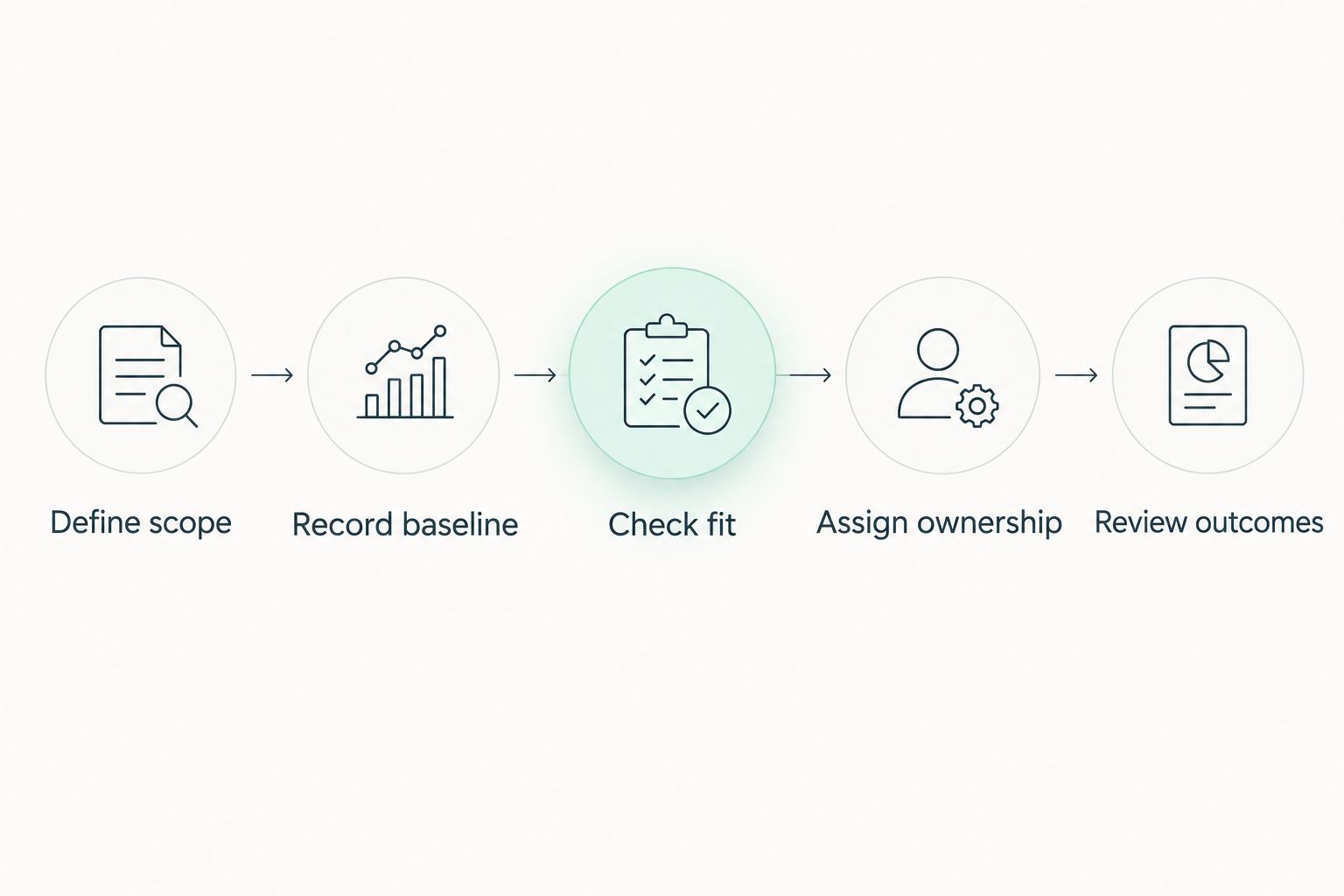
1. Define scope
Write down the goods or services you supply, the locations you serve, and the requirements that would immediately rule out a bid. Use those criteria throughout the evaluation.
Keep the scope specific enough that another employee could repeat your screening decision. A description such as suitable contracts leaves too much room for interpretation.
2. Record baseline
Record the time your current process takes, including searching, opening documents, checking companies, and organizing findings. Measure research separately from writing the bid.
Use 1-hour blocks if that makes recording easier. This is a suggested logging unit, not a claim about how long tender research should take.
3. Check fit
Repeat the same research task with software and examine the resulting shortlist. Check whether each opportunity matches your scope and whether the supporting information helps you make a decision.
Record irrelevant results too. A longer list is not an improvement if it simply shifts work from searching to rejecting unsuitable notices.
4. Assign ownership
Appoint 1 named owner for the evaluation and the research log. Other employees can contribute, but someone must ensure each shortlisted opportunity receives a recorded decision.
Separate the decision to investigate from the decision to bid. Finding a plausible opportunity is an intermediate result, not authorization to spend the team's preparation time.
5. Review outcomes
Compare research time, shortlisted opportunities, reasons for rejection, and unresolved information needs. Check whether the process is easier to repeat without depending on someone's memory.
Keep the software only if the evidence supports the task you bought it to perform. Do not require a contract win during the evaluation to prove research usefulness, and do not count an unqualified opportunity as a success.
What should you measure besides time saved?
Time is useful, but it is not the whole decision. A faster search that misses a disqualifying requirement does not improve your bidding process.
Use a simple research log with these fields:
- Opportunity reference: enough information to find the original notice again.
- Fit decision: investigate, reject, or prepare for a bid decision.
- Decision reason: the specific requirement or business constraint behind the choice.
- Research time: searching and checking, separate from document preparation.
- Outstanding question: the information you still need before committing resources.
Review the log for decision quality rather than activity alone. An early, well-supported rejection can be a useful outcome because it stops unsuitable work from entering bid preparation.
For historical analysis, the bidding-results-to-competitor-win-rate workflow provides a related research path. Keep the comparison scope consistent: results from unrelated categories or materially different contracts do not answer the same business question.
Does tender software increase your chance of winning?
Tender software supports research; it does not guarantee a contract award. Your bid still has to meet the tender's requirements, and your business must be able to deliver what it offers.
For your 2026 assessment, distinguish research outcomes from award outcomes. Finding a suitable opportunity and making a documented bid decision are research outcomes; winning depends on the submitted bid and the applicable evaluation process.
Treat any promise of automatic wins as a reason to ask for evidence. More notices, more searches, and more submitted bids are not interchangeable measures of success.
Can a spreadsheet replace tender software?
A spreadsheet can record opportunities, owners, deadlines, and decisions. It does not independently perform the tender, contractor, and bidding-results research that supplies those records.
Keep a spreadsheet when your main need is organizing information you already find efficiently. Consider dedicated research software when finding and assessing that information is the actual bottleneck.
The tools are not necessarily substitutes. A research platform can support discovery while your existing record remains the place where your team documents bid decisions, provided you verify how information will move between them.
What should a small business verify before committing?
Ask the provider to demonstrate your actual research task. A general demonstration cannot establish whether the platform answers the questions your business needs answered.
Check the scope of tender information, the contractor data you need, and the bidding-result details relevant to your analysis. Ask how to check the underlying source and confirm which functions are included in the arrangement you are considering.
Also verify how your team will retain its decisions and supporting references. Do not assume integrations, exports, automated notifications, or document-management functions exist unless the provider confirms them.
Finish your 2026 evaluation with a written keep-or-stop decision. State the task the software supports, the employee responsible, and the evidence that makes continued use worthwhile.
FAQ
Is tender software worth it for a very small business?
Tender software is worth it when recurring procurement research creates a real workload and the software improves that task. A very small business with occasional opportunities and a manageable manual process does not need software simply because it plans to bid.
What's the best way to evaluate tender software before committing?
Use a 30-day evaluation window to compare the same research tasks with your existing process. Extend the review if that period does not include representative opportunities, and record research time separately from bid preparation.
Does Dauthau help small businesses research tenders in Vietnam?
Dauthau provides software for searching, tracking, and analyzing public and private procurement tenders, contractor data, and bidding results across Vietnam. Assess those research capabilities against the information your business needs before deciding to bid.
Will tender software write and submit my bids?
Do not assume tender software writes or submits bids. Verify those functions separately, because searching and analyzing procurement information does not establish document-preparation or submission capabilities.
Is manual tender research better than software?
Manual tender research is better when your search scope is narrow, opportunities are occasional, and the workload remains manageable. Software becomes relevant when recurring discovery and checking create a specific bottleneck.
Can tender software guarantee that I win contracts?
Tender software cannot guarantee that you win contracts. It supports research, while your submission still needs to satisfy the tender requirements and evaluation process.
What should I measure if I haven't won a tender yet?
Measure research time, qualified opportunities, rejection reasons, and unresolved information needs. Those records show whether your research process improves without treating an unqualified lead as a successful outcome.
One last thing
The most useful result of better tender research can be a clear decision not to bid. Finding a disqualifying requirement before your team starts preparing documents is more actionable than adding another unsuitable opportunity to a tracker.
Before adopting software in 2026, write your rejection criteria alongside your search criteria. You need a repeatable way to say no, not just another way to find notices.