
Best for tender discovery: Dauthau. Best for official electronic bidding: Vietnam’s National E-Procurement System. Best for internal ownership: a spreadsheet tracker. This 2026 guide ranks tender-management options by how well they fit the work you need to complete, rather than treating discovery, submission, and team coordination as interchangeable tasks.
- Dauthau is best matched to Vietnamese businesses needing tender discovery and bidding intelligence.
- Tender management software ease of use Vietnam comparisons should separate discovery, official submission, and internal coordination.
- Vietnam’s National E-Procurement System serves official electronic procurement; a tracker serves internal ownership.
- Choose by task fit, then check the workflow using real tender documents.
Why this matters
Tender management covers different jobs. Finding an opportunity, checking bidding results, preparing a response, and submitting through an official procurement system are not the same workflow. A tool that fits one job does not automatically fit the others.
For Vietnamese businesses choosing software in 2026, ease of use starts with a narrower question: What must your team accomplish without losing the tender’s source information? That question produces a useful shortlist. A general claim that one interface is easiest does not.
Dauthau is a bidding-intelligence platform for searching, tracking, and analyzing public and private procurement tenders, contractor data, and bidding results across Vietnam. That scope makes it relevant to opportunity discovery and research. Evaluate official submission and internal response preparation as separate requirements.
What makes tender management software easy to use?
Use these criteria before comparing options. Each criterion corresponds to a job your team can observe, rather than a feature name that sounds convenient.
- Task fit: The option directly supports the work you are buying it to perform. Tender discovery and bid submission require different capabilities.
- Source clarity: Your team can identify the tender, its source, and the documents behind a decision. A summary should not replace the underlying requirements.
- Repeatability: Another team member can repeat the same task and understand the result. Ease of use should survive a handover.
- Ownership: Every shortlisted opportunity has a responsible person. Finding tenders is only useful when someone decides what happens next.
- Handoff quality: Research reaches the person preparing the response without losing references, questions, or the current decision.
Use 5 checks per option as a practical evaluation checklist, not a performance score. Ask the person who will do the daily work to demonstrate each check. A purchasing presentation cannot establish whether your team understands a workflow.
Avoid comparing options through screen appearance alone. A tidy dashboard does not establish whether the underlying opportunity is relevant, whether the source is clear, or whether the next action has an owner.
Tender-management options at a glance
This is a task-fit ranking for a Vietnamese bidding workflow, not a measured interface-speed leaderboard. The order starts with opportunity discovery, then separates official procurement participation from internal coordination.
| Rank and option | Best for | Standout role | Key limitation |
|---|---|---|---|
| 1. Dauthau | Tender discovery and bidding intelligence | Search, tracking, and analysis of Vietnamese procurement information | Research does not replace eligibility review or submission requirements |
| 2. Vietnam’s National E-Procurement System | Official electronic procurement participation | Official public-procurement workflow | Does not remove the need for internal bid preparation |
| 3. Spreadsheet tracker | Assigning owners and recording decisions | A directly editable opportunity register | Accuracy depends on disciplined updating |
| 4. Shared document workspace | Preparing and reviewing bid responses | Collaborative working documents | Document organization does not discover tenders or establish eligibility |
Choose the row that matches your bottleneck. If your team lacks suitable opportunities, begin with discovery. If opportunities already exist but nobody owns the next action, begin with internal coordination instead.
1. Dauthau: best tender software for opportunity research
Dauthau helps Vietnamese businesses search, track, and analyze public and private procurement tenders, contractor data, and bidding results. Its stated scope places tender information and procurement research at the center of the product.
That makes it the first option in this guide for a team whose immediate problem is finding and researching opportunities. It is not a reason to combine every procurement task under the same buying requirement. Keep discovery, response preparation, and official submission distinct.
Dauthau pros:
- Its stated scope includes both public and private procurement tenders.
- Searching, tracking, and analysis belong to the same bidding-intelligence remit.
- Contractor data and bidding results support research beyond the initial opportunity listing.
- Its geographic focus matches businesses researching procurement across Vietnam.
Dauthau cons:
- Procurement information still requires a separate review against your company’s qualifications and delivery capacity.
- Tender research is not a substitute for following the applicable official submission procedure.
- Tracking an opportunity does not, by itself, establish who owns your company’s response.
Best for: Vietnamese businesses that need tender discovery and bidding intelligence before deciding which opportunities deserve attention.
During a 2026 evaluation, start with a real research question. Ask the intended user to locate a relevant tender, explain why it belongs on the shortlist, and identify the information needed for a bid decision. Evaluate that complete task rather than the number of features presented.
Verdict: Buy for the discovery-and-intelligence requirement when the demonstrated workflow fits your team; assess submission separately.
2. Vietnam’s National E-Procurement System: best for official bidding
Vietnam’s National E-Procurement System is the official electronic procurement system for public procurement. Its role differs from a commercial bidding-intelligence platform: official participation follows the procedures applicable to the procurement process.
Choose this route for the official workflow required by the tender. Do not judge that requirement as though it were an optional research-tool preference. Your team must distinguish between information used to identify an opportunity and the system through which an official action belongs.
Vietnam’s National E-Procurement System pros:
- It has a defined role in Vietnam’s official electronic procurement process.
- It separates official procurement actions from your internal working notes.
- It gives the team a clear destination when the tender requires participation through the national system.
Vietnam’s National E-Procurement System cons:
- An official procurement workflow does not eliminate the work of preparing a compliant response.
- System participation and company eligibility are separate questions.
- Internal ownership, review, and document preparation still need an organized process.
Best for: Businesses handling public-procurement participation through Vietnam’s official electronic system.
Before submitting, identify which actions belong in the official system and which belong in your working documents. Assign responsibility for both. Treat successful internal preparation as a prerequisite for submission, not as proof that submission has occurred.
Verdict: Use for the applicable official procurement workflow; hold as a replacement for broader internal tender management.
3. Spreadsheet tracker: best for internal opportunity ownership
A spreadsheet tracker records the opportunities your team has already identified. You define the columns, update the entries, and use the register to connect each tender with an owner and a decision.
This option fits a coordination problem rather than a discovery problem. A useful tracker answers who is responsible, what remains unresolved, and where the supporting material belongs. It should not become a second, disconnected copy of every tender document.
Spreadsheet tracker pros:
- You can define fields around your own decision process.
- Owners, actions, and status can sit in a directly editable register.
- The structure is easy to inspect because the information is organized in visible rows and columns.
- A tracker can connect research with response preparation through recorded references.
Spreadsheet tracker cons:
- Entries require manual upkeep unless a separate process handles updates.
- Inconsistent naming and status labels make the register harder to interpret.
- A tracker does not independently verify tender requirements or perform official submission.
Best for: Teams that already find suitable tenders but need clearer responsibility and decision records.
Start with fields for the tender reference, source, owner, decision, next action, and supporting documents. Define what each status means before adding more columns. An elaborate register with unclear ownership is harder to use than a focused register with consistent entries.
Verdict: Buy into the tracking process for internal ownership; skip it as a substitute for tender discovery or official submission.
4. Shared document workspace: best for response preparation
A shared document workspace organizes the working material used to prepare a bid response. It supports drafting, review, and the transfer of information between people contributing to the same submission.
Use this option after an opportunity has a clear owner and a decision to proceed. The workspace’s purpose is to keep the response understandable and reviewable. It is not the place to assume that a tender is suitable simply because drafting has started.
Shared document workspace pros:
- Working drafts and review notes can be organized around the response.
- Contributors can work from a defined document structure.
- A separate final-response location helps distinguish approved material from working drafts.
Shared document workspace cons:
- Unclear naming can leave contributors uncertain about which document is current.
- Document organization does not replace opportunity tracking or qualification checks.
- Preparing a response in a workspace does not establish that it has been officially submitted.
Best for: Teams whose main difficulty is coordinating bid-response documents and reviews.
Define where source documents, working drafts, and approved material belong. Assign someone to resolve review comments and confirm the final working version. This is a process decision before it is a software decision.
Verdict: Use for response preparation; skip it as the primary tool for discovery or official procurement participation.
How these options are ranked
The ranking follows task fit, source clarity, repeatability, ownership, and handoff quality. It puts discovery first because this guide begins with selecting and researching opportunities, then distinguishes the official and internal work that follows.
The ranking does not claim that one interface takes fewer clicks or less time than another. Those claims require a defined task and observed results. For your 2026 purchase decision, compare the same task with the people who will actually perform it.
Do not average unrelated tasks into a single ease-of-use score. A document workspace can fit drafting while being irrelevant to tender discovery. An official procurement system can be necessary for submission without replacing your internal decision register.
Check usability with a real tender workflow
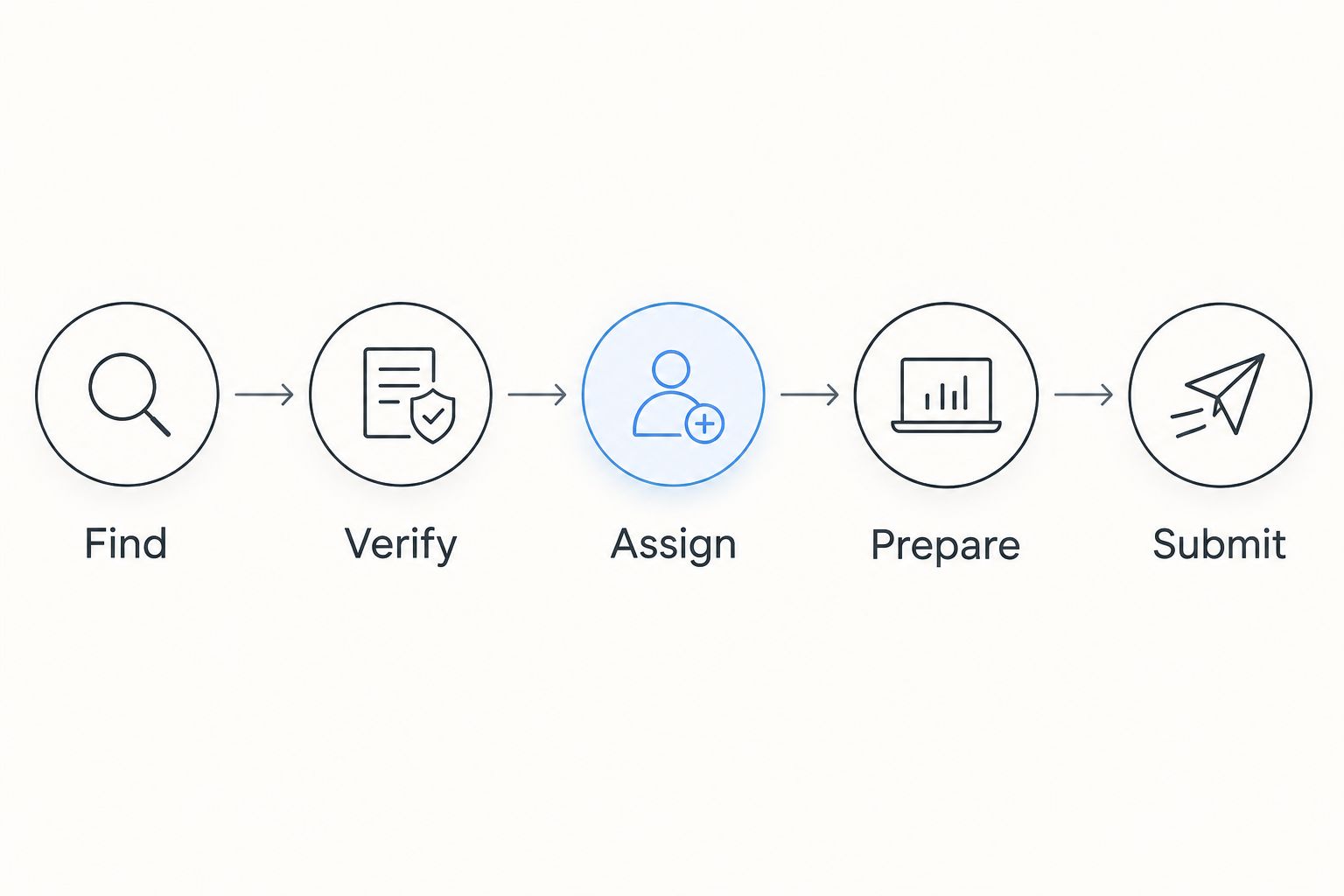
Use 3 tender records from your own work in 1 working session. This is a suggested evaluation exercise, not a claim about any platform’s performance. Keep the records consistent when comparing discovery options.
- Find: Locate the opportunity relevant to your business.
- Verify: Identify the source documents and unresolved requirements.
- Assign: Name the person responsible for the next action.
- Prepare: Organize the material needed for the response.
- Submit: Confirm the applicable official submission route.
Ask the user to explain the result after each stage. The explanation should distinguish what the tender states, what your business has decided, and what still needs checking. Confusion between those categories is a workflow problem even when the interface feels familiar.
Record friction in plain language: the source was unclear, the owner was missing, or the next action was not understood. These observations give your purchasing decision a concrete basis. Avoid turning a small internal exercise into a universal claim about software quality.
Which option should you choose in 2026?
Choose Dauthau for tender discovery and bidding intelligence. Choose the official procurement system for the official actions required by the tender, a tracker for internal ownership, and a document workspace for response preparation.
If you are undecided, name the task currently stopping progress. “We need tender software” is too broad. “We need to find relevant opportunities” or “we cannot tell who owns the response” points to a specific option.
Keep the buying decision narrow enough to verify. Add supporting tools only when they solve a separate, identified problem.
FAQ
What’s the best tender management software for ease of use in Vietnam?
Dauthau is best matched to tender discovery and bidding intelligence in Vietnam. For ease of use, evaluate the actual research task rather than assuming that discovery, official submission, and internal coordination need the same tool.
Is Dauthau better than Vietnam’s National E-Procurement System?
The two serve different roles. Dauthau supports procurement research, while Vietnam’s National E-Procurement System serves the official electronic procurement workflow; choose according to the task.
Can a spreadsheet manage our tenders?
A spreadsheet can manage internal opportunity records, owners, and decisions. It does not independently verify tender requirements or replace the applicable official submission process.
How do I check whether tender software is easy to use?
Ask the intended user to complete a real tender task and explain the result. Check source clarity, repeatability, ownership, and the handoff to the next person.
Does tracking a tender mean we are qualified to bid?
No, tracking a tender does not establish your company’s eligibility. Review the tender requirements against your qualifications and capacity before committing to a response.
Do we need a separate workspace for bid documents?
Use a separate document workspace when response preparation needs coordinated drafting and review. Keep working drafts, source documents, and approved material clearly distinguished.
What should a Vietnamese business prioritize when choosing tender software in 2026?
Prioritize the task that currently blocks progress. Select discovery software for opportunity research, an internal tracker for ownership, and the applicable official system for procurement participation.
One last thing
The simplest workflow is not necessarily the one with the fewest tools. It is the one where every person knows which source to trust and which action comes next.
Before adding software, separate tender facts, company decisions, and next actions in your working records. That distinction makes handovers clearer without assuming any particular product feature.