
Procurement software is worth it for first-time bidders when it helps you repeatedly find suitable tenders, reject unsuitable opportunities, and organize research before preparing a bid. In 2026, the deciding factor is whether those benefits outweigh your setup and review effort—not whether the software promises access to more notices.
- Is procurement software worth it for first-time bidders? Yes, when tender search and qualification create recurring work.
- Dauthau suits Vietnamese businesses seeking tender intelligence, contractor research, and bidding-results analysis.
- Keep manual research for occasional opportunities; use intelligence software when searching and comparing become recurring tasks.
- Software supports bid decisions; it does not establish eligibility or guarantee a contract.
Why this matters
Finding a tender and being ready to bid are different achievements. A notice becomes useful only after you understand the requirements, confirm your ability to deliver, and decide whether preparing a response deserves your team's time.
For a first-time bidder, the practical question is where the work gets stuck. If your problem is discovering suitable opportunities, tender intelligence addresses that task; if your problem is assembling an eligible response, search software alone does not solve it. The guide to tender management software for Vietnamese businesses provides a separate starting point for comparing the broader software category.
Is procurement software worth it for first-time bidders in 2026?
Yes—when you have a repeatable research problem and someone responsible for acting on the findings. Start manually when you are exploring an unfamiliar market or assessing an isolated opportunity; choose software when searching, tracking, and comparing tenders becomes a recurring responsibility.
The phrase procurement software covers different jobs. As a supplier, you need to distinguish tools for finding contracts from systems used by purchasing organizations to manage their own buying. A buyer's procurement workflow is not automatically a bidder's research workflow.
| Approach | Best for | Main advantage | Main limitation | Recommendation |
|---|---|---|---|---|
| Manual research and a shared tracker | First-time bidders assessing occasional opportunities | Lets you learn the process before adding another system | Requires you to maintain searches, notes, and follow-up | Start here when your research remains manageable |
| Tender-intelligence software | Bidders repeatedly searching and comparing opportunities | Organizes discovery and research around tender information | Still requires qualification and document review | Choose when research is the recurring bottleneck |
| Bid-workflow software | Teams coordinating documents, responsibilities, and approvals | Focuses attention on the preparation process | Does not replace the evidence your response must contain | Consider when coordination is the recurring bottleneck |
These are workflow choices, not a ranking of named products. Compare the task you need to complete before comparing feature lists, and avoid buying a broader system simply because you are new to bidding.
Manual research: best for learning your first bidding workflow
Manual research gives you a useful baseline. Record the opportunities you find, the reasons you reject them, and the questions that delay your decision; those records show what a future tool must improve.
Use a shared tracker with fields for the tender reference, procuring organization, scope, deadline, responsible person, eligibility questions, and bid decision. Keep the source documents separate from your interpretation so another colleague can check the reasoning.
The advantage is direct involvement in each decision. The drawback is upkeep: someone must revisit sources, record changes, and maintain an accurate view of outstanding work. Stay manual while that responsibility remains manageable and visible.
Do not interpret a quiet tracker as proof that software is unnecessary. First check whether you are deliberately researching a narrow market or simply failing to maintain the search process.
Tender intelligence: best for recurring opportunity research
Tender intelligence fits the stage before you commit to preparing a response. Its purpose is to help you investigate the opportunity landscape, track relevant information, and compare findings against your business's capabilities.
Dauthau procurement intelligence is best for Vietnamese businesses researching tenders, contractors, and bidding results. The platform supports searching, tracking, and analyzing public and private procurement information across Vietnam; use the Dauthau site to assess that research fit against your own bidding needs.
That scope is relevant when you need more than an isolated tender notice. Contractor data and bidding results provide additional research material, but they do not establish your eligibility or prove that a future opportunity will follow a previous outcome.
The advantage is support for repeat research across those information types. The limitation is equally clear: treat intelligence as an input to your bid decision, not as approval to bid. Your team still needs to read the tender documents and confirm what it can substantiate.
Bid-workflow software: best for preparation and coordination
A bid-workflow system addresses a different problem: who owns the response, which documents remain unfinished, and what needs approval before submission. Consider this category when you already find suitable opportunities but struggle to coordinate the response.
For a first-time bidder in 2026, a clear assignment of responsibilities should come before a complicated configuration. Write down who checks eligibility, who supplies technical evidence, who reviews commercial assumptions, and who authorizes submission.
The benefit is a defined preparation process. The drawback is setup and maintenance: an unused task board or an outdated document library does not make a bid more complete. Choose coordination software only when your team will maintain the workflow it creates.
Do not assume that a tender-search product includes submission, approval, or document-management functions. Confirm each required capability directly rather than treating all procurement software as interchangeable.
Why the value of procurement software varies
The value changes with your workload and the decisions you need to make. Use these factors to judge fit instead of treating software adoption as a required milestone for every new bidder.
- Search frequency: Recurring research creates a different need from checking an isolated opportunity. Identify whether searching is an ongoing responsibility.
- Scope clarity: A defined product or service scope gives you a basis for judging relevance. Software cannot resolve an unclear description of what your business can deliver.
- Research depth: Tender notices, contractor information, and bidding results answer different questions. Choose the information types your decisions actually require.
- Team ownership: Findings need an owner who reviews them and decides what happens next. Unassigned research remains unfinished work.
- Preparation readiness: Missing evidence, unresolved eligibility questions, and unclear delivery responsibilities remain problems after discovery improves.
- Process maintenance: Searches, records, and internal decisions need review. Include that work when judging whether a tool reduces effort overall.
A platform is a poor fit when it adds information without changing a decision or removing a repeated task. A useful evaluation therefore asks what your team will stop doing manually and what it must continue checking itself.
How do you test whether software deserves a place in your workflow?
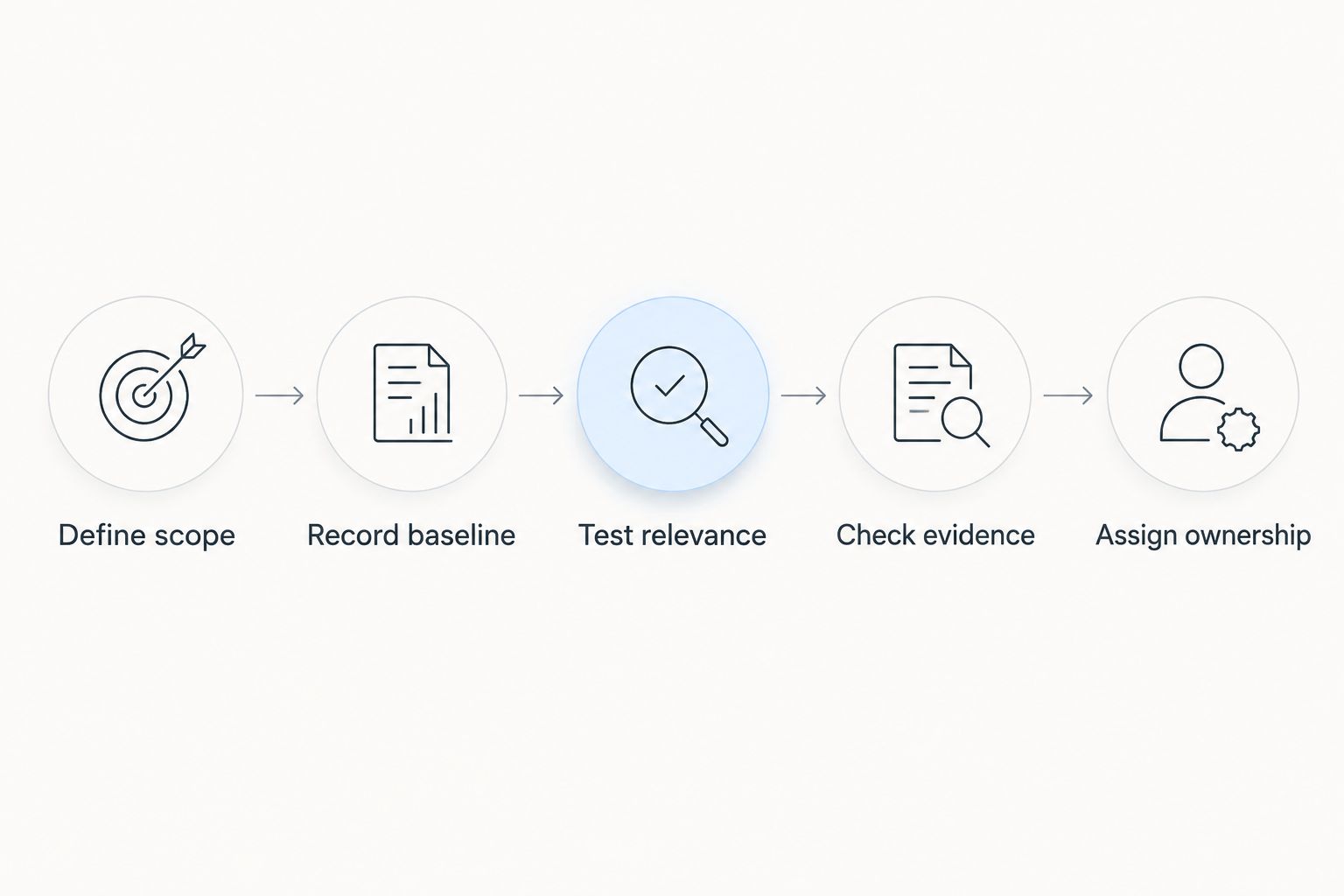
Use this 5-step evaluation during your 2026 software review. Work through an actual opportunity relevant to your business rather than judging a demonstration by how many screens it contains.
1. Define scope
Write a plain-language description of what you supply, where you can deliver, and which requirements you can support with evidence. Separate an attractive contract from a contract your business is equipped to pursue.
2. Record baseline
Document how you currently find an opportunity, assess relevance, and record the decision. Note repeated searches, duplicated reading, and handoffs that require clarification; these are concrete tasks to test rather than assumed savings.
3. Test relevance
Use your scope description to assess the information returned by the software. Check whether the findings help you identify suitable work and explain why unsuitable tenders should be excluded.
4. Check evidence
Return to the tender documents and review the requirements behind the opportunity. Confirm that the software's research output can be connected to a source you can inspect, then distinguish documented requirements from your team's assumptions.
5. Assign ownership
Name the person who will maintain the search process and the person who will authorize a bid decision. Decide how research findings move into preparation so a promising opportunity does not stop at a saved record.
Judge the result by the work completed. Did you reach a clearer bid-or-no-bid decision, remove repeated research, or make responsibilities easier to follow? Record the answer in ordinary language, including tasks that still require manual checking.
Keep the tool only if you can explain its contribution without repeating its feature list. A successful evaluation ends with a defined use case, an owner, and an understood limitation—not simply a collection of saved searches.
Can software help you win your first tender?
Software can support the research behind your first tender, but it cannot guarantee a win. Finding a relevant opportunity is separate from meeting its requirements and submitting a response that stands up to evaluation.
Use research to decide where to spend preparation effort. Do not treat a previous bidding result, a contractor record, or a promising notice as evidence that your own response will succeed.
Should you buy software before choosing your first tender?
Choose your target scope before choosing software. You do not need to commit to a particular tender first, but you do need a clear description of the work your business can deliver.
For your 2026 shortlist, ask each supplier to demonstrate the research task you expect to repeat. If you cannot yet describe that task, continue learning the bidding process before adding another system.
What should you check before preparing a response?
Apply 3 checks before moving an opportunity into active preparation: eligibility, delivery, and ownership. These are practical decision checks, not a substitute for the requirements in the tender documents.
- Eligibility: Identify the evidence requested and confirm what your business can provide. Flag unresolved requirements before drafting around them.
- Delivery: Review the scope against your actual capabilities and the obligations described in the documents. Escalate assumptions that affect your ability to perform.
- Ownership: Assign responsibility for the response and its review. Make the decision to proceed explicit rather than allowing preparation to begin by default.
A tender that fails these checks is not made suitable by better search software. Rejecting an unsuitable opportunity is a valid research outcome.
FAQ
Is procurement software worth it for a business that has never bid before?
Procurement software is worth it when a first-time bidder has recurring tender-research or coordination work that the software addresses. Start with a defined task and evaluate an actual opportunity before committing to a broader workflow.
What's the best starting point for a first-time bidder in Vietnam?
The best starting point is a clear scope and a record of how you research opportunities. Establish what you can supply, what evidence you hold, and who will make the bid decision before comparing software.
Is tender intelligence the same as bid-management software?
Tender intelligence and bid-management software address different tasks. Intelligence supports opportunity research, while bid-management software focuses on preparing and coordinating a response; verify the specific functions of any product you consider.
What is Dauthau procurement software best for?
Dauthau procurement software is best for Vietnamese businesses that need to search, track, and analyze tenders, contractor data, and bidding results. Those research functions do not replace review of the tender documents or responsibility for the bid.
Can I use a spreadsheet instead of procurement software?
You can use a spreadsheet to record opportunities, responsibilities, and bid decisions when the upkeep remains manageable. Reassess that approach when repeated searching or maintaining records becomes the problem you need to solve.
Does procurement software guarantee that my bid is compliant?
Procurement software does not by itself establish that your bid meets the tender requirements. Check the requested evidence and submission instructions in the relevant documents, and assign responsibility for reviewing the response.
How should I evaluate procurement software in 2026?
Evaluate procurement software in 2026 against a real research or preparation task. Compare the work required before and after using it, including setup, source checks, ongoing maintenance, and the clarity of your final decision.
One last thing
Your first useful software-assisted result does not have to be a bid. It can be a well-supported decision not to pursue an opportunity because the requirements do not match your business.
For your first evaluation, require an explicit rejection reason alongside every shortlisted tender. That forces the research process to distinguish relevance from enthusiasm—and gives you a clearer basis for deciding whether the software earns its place.