
Building an in-house team to track tenders in 2026 is worth it when your workload requires dedicated qualification, research, and coordination—not just repeated searches for new notices. Keep bid decisions inside your business, but test whether tender-search software and a named internal owner can handle discovery before creating a separate department. Include management time, backup coverage, and document review in the decision; finding an opportunity is only the beginning.
- Is it worth building an in-house team to track tenders? Only when qualification and coordination justify dedicated staff.
- Dauthau supports Vietnamese tender search and analysis; internal staff still own bid decisions.
- Compare manual tracking, software-supported ownership, and a dedicated team against the same workload.
- Measure qualified opportunities and decision delays, not the number of notices collected.
Is it worth building an in-house team to track tenders in 2026?
Build a dedicated team when the work requires sustained human judgment and clear operational coverage. Do not build one merely to copy tender notices into a spreadsheet. Separate discovery from qualification before deciding what to hire for.
For Vietnamese businesses, Dauthau provides software for searching, tracking, and analyzing public and private procurement tenders, contractor data, and bidding results. Those functions support opportunity research; responsibility for eligibility checks, commercial decisions, and submissions remains with your business.
| Operating model | Best for | Main advantage | Main limitation |
|---|---|---|---|
| Manual tracking by an existing employee | A narrow, clearly defined search scope | Direct control over searches and source review | Searching competes with that employee’s other responsibilities |
| Software-supported internal owner | A business that needs organized discovery and accountable screening | Separates information gathering from bid decisions | Someone must still assess fit, check documents, and assign action |
| Dedicated in-house tender team | A business with sustained qualification, research, and coordination work | Makes tender operations an explicit responsibility | Requires management, backup coverage, and a clear handoff to delivery teams |
These are operating choices, not stages every business must pass through. Choose the smallest structure that performs the work reliably, then expand when recorded workload supports the change.
Why this matters
A tender-tracking function should produce decisions, not an expanding inbox. A notice has operational value when someone establishes whether your business can bid, wants to bid, and has enough preparation time.
For your 2026 staffing decision, distinguish information work from judgment work. Information work includes finding notices, organizing records, and retrieving results. Judgment work includes interpreting requirements, assessing delivery capacity, and deciding whether the opportunity deserves a proposal.
Hiring against an undivided task called tender monitoring leaves the role unclear. You need to know whether the bottleneck is finding opportunities, reviewing them, or getting an accountable decision from colleagues.
When manual tracking is the right starting point
Manual tracking is a reasonable starting point when you can define a narrow search scope and assign it without displacing essential work. Give the employee written inclusion criteria, a shared register, and a route for escalating relevant opportunities.
Best for: a business testing a focused tender market before committing dedicated staff. The benefit is direct visibility into how searches become decisions. The drawback is dependence on the employee’s availability and competing priorities.
Do not confuse a quiet register with complete market coverage. Review how the employee searched, which sources were checked, and why notices were excluded. A list of saved links does not demonstrate that the search matched your business requirements.
Keep the arrangement only while it remains accountable. If searches stop during leave, reviews repeatedly stall, or nobody can explain exclusions, fix the process before assigning more searches to the same person.
When software-supported ownership is the better fit
Software-supported ownership fits a business that needs help finding and researching opportunities while retaining a clear internal decision-maker. Assign the owner to turn search results into reviewed records with a next action, rather than asking the owner to reproduce everything a search platform displays.
Dauthau is best for Vietnamese businesses seeking tender search and analysis, not a substitute for internal bid decisions. Its stated scope includes tender information, contractor data, and bidding results. Your internal owner must connect that information to your capabilities and commercial priorities.
Best for: a business that needs structured opportunity research without a separate tender department. The advantage is a defined division between research support and business judgment. The limitation is equally clear: software does not take responsibility for your decision to bid.
Before choosing this model, write down who reviews technical requirements, who checks commercial conditions, and who approves proposal effort. An internal owner coordinates those decisions; the title alone does not give that person the expertise or authority to make all of them.
When a dedicated tender team earns its place
A dedicated team makes sense when tender work forms a sustained operating function rather than an occasional search task. Look for recurring qualification, contractor research, document coordination, and decision follow-up that require assigned capacity.
Best for: a business whose recorded tender workload needs dedicated ownership across several responsibilities. The benefit is explicit accountability. The drawback is the management needed to keep research, qualification, and bid preparation connected.
Define the team’s boundary before hiring. Decide whether it only discovers opportunities, also qualifies them, or continues into bid coordination. Otherwise, a new team can become responsible for everything associated with tenders without controlling the decisions that move work forward.
A dedicated team still needs input from technical, finance, legal, and delivery colleagues where those functions are relevant. Creating a department does not remove those dependencies. Make their responsibilities part of the operating plan, not an informal request made near submission.
Why the right staffing model varies
Your 2026 structure should reflect the work you actually undertake. Assess these factors together rather than treating tender volume as the deciding measure:
- Search scope: Define the business lines, locations, procurement types, and project owners you intend to monitor. Broader coverage creates more material to review, but not necessarily more suitable opportunities.
- Qualification depth: Distinguish a basic relevance check from detailed assessment of requirements, contractor history, and delivery fit. Record who supplies the judgment at each stage.
- Coordination needs: Identify which decisions require colleagues outside the tracking function. Repeated handoffs need ownership, whether you choose an employee or a department.
- Coverage requirements: Specify what happens during leave and overlapping bid activity. A named backup is an operating requirement, not evidence that you need an entire team.
- Decision authority: State who can reject an unsuitable opportunity and who can authorize preparation. Extra researchers will not resolve an approval bottleneck.
- Record quality: Require source references, review status, and reasons for decisions. Without those records, you cannot distinguish insufficient capacity from an unclear process.
How do you test whether hiring is justified?
Use a defined measurement period before approving permanent roles. Choose a period that includes your normal search and review work, and record unusual activity separately rather than treating it as the baseline.
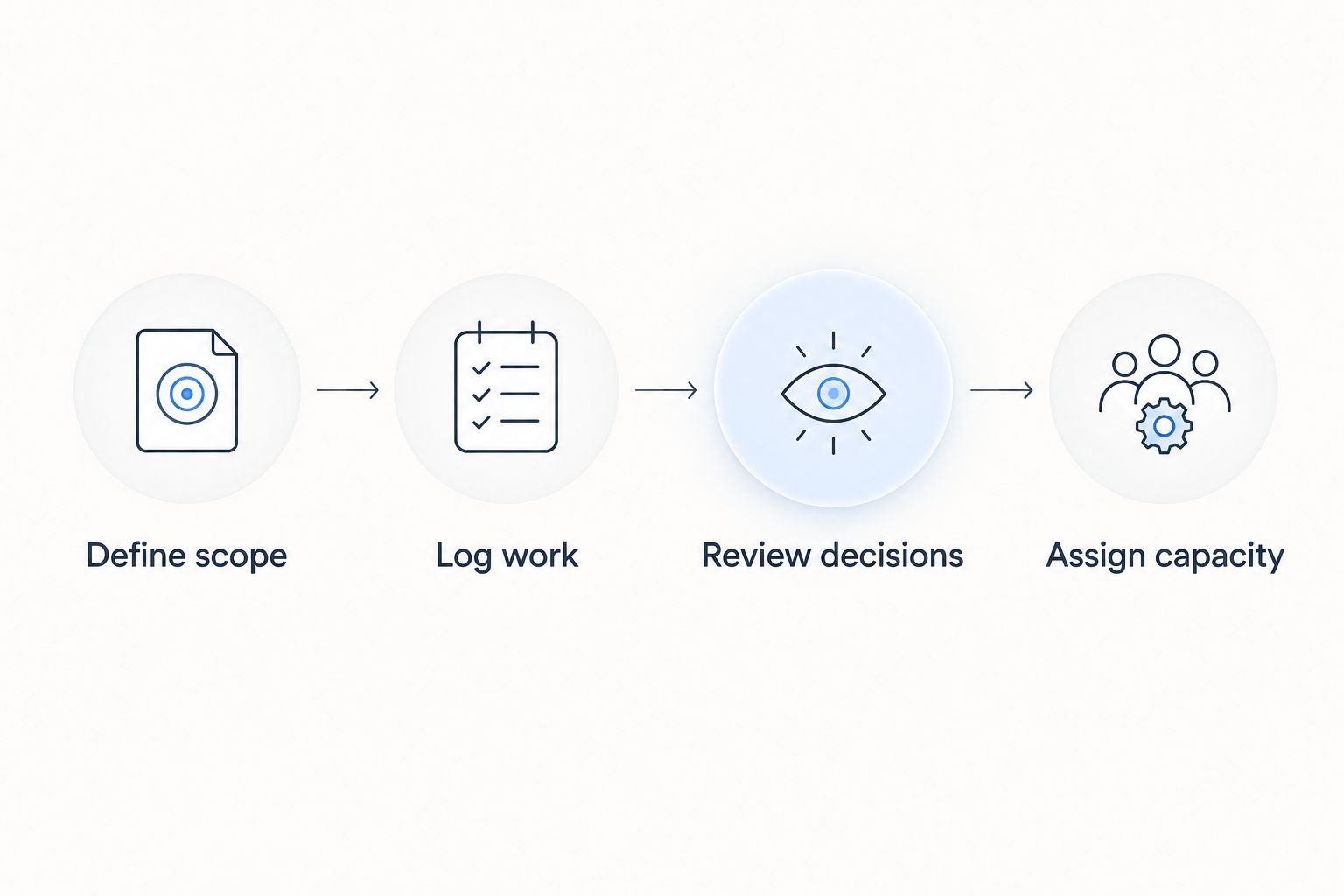
1. Define scope
Write the opportunity criteria before searching: relevant work, locations, procurement types, and requirements your business needs to assess. Include exclusion criteria so the person screening notices can explain a rejection.
Keep the criteria usable. The guide to shortlisting tenders worth your company’s time addresses the decision that should follow discovery: which opportunities deserve further attention.
2. Log work
Record time spent searching, screening, researching, coordinating, and preparing documents separately. Use hours per week as the workload unit, and distinguish active work from time spent waiting for another person’s decision.
Do not treat every tender-related hour as evidence for a tracking hire. If the time belongs to technical review or proposal writing, assign it to that function when planning capacity.
3. Review decisions
For each opportunity, record the source, review owner, decision, reason, and next action. Track the elapsed time between discovery and the bid-or-no-bid decision in working days.
Review rejected opportunities as well as pursued ones. A clear rejection can demonstrate useful qualification; a notice left untouched demonstrates neither relevance nor a considered decision.
4. Assign capacity
Use the record to identify the unresolved constraint. Expand discovery support when finding and organizing information consumes the work; add specialist input when qualification is blocked; change approval ownership when decisions are waiting.
Hire for the work that remains after the process is clear. Do not use headcount to cover an undefined handoff between discovery and bid preparation.
What should your workload record measure?
Your 2026 workload record should show both effort and outcomes. Pair hours per week with qualified opportunities per review period, and record decision time in working days. These are measurement units for your own operation, not staffing benchmarks.
Keep the definitions consistent. A qualified opportunity should meet your written screening criteria; it should not mean any notice containing a relevant keyword. A completed review should have a recorded decision or a clearly assigned request for further information.
Watch for misleading measures. Notices collected reward collection, while bids submitted reward activity without explaining whether the work suited your business. Neither measure alone establishes that a dedicated tracking team is justified.
Use the record to ask a sharper question: which necessary tasks remain undone, and why? If the answer is missing authority, unclear criteria, or delayed specialist input, address that constraint before expanding the tracking function.
Can software replace an in-house tender team?
Software can support tender discovery and research, but it does not replace accountability for bid decisions. Keep a named person responsible for checking the underlying documents, obtaining specialist input, and recording the next action.
Evaluate software against the tasks you intend to support. Search and analysis are different from document preparation, approval, and submission; do not assume a platform covers the entire process because it helps with an earlier stage.
Should a small business hire a tender analyst first?
A small business should define the tender analyst’s unresolved workload before opening the role. If an existing employee can own screening with appropriate research support, test that arrangement first; if essential analysis remains unassigned, define a dedicated role around it.
Avoid combining researcher, technical evaluator, proposal writer, and final approver into an unexplained job description. Specify what the analyst decides independently and what the analyst escalates.
FAQ
Is it worth building an in-house team to track tenders in 2026?
Build an in-house team when sustained qualification, research, and coordination require dedicated capacity. Do not create a department solely to repeat searches that a software-supported internal owner can manage.
What should a tender-tracking employee actually do?
A tender-tracking employee should find relevant opportunities, screen them against written criteria, maintain decision records, and assign next actions. Define separately whether the role includes proposal preparation or submission.
Is tender software better than hiring someone?
Tender software and an employee address different responsibilities. Software supports information work; an internal owner remains responsible for applying your criteria and obtaining bid decisions.
Can Dauthau help businesses research tenders in Vietnam?
Dauthau provides a bidding-intelligence platform for searching, tracking, and analyzing public and private tenders across Vietnam. Its stated scope also includes contractor data and bidding results.
How many employees do I need to monitor tenders?
Choose staffing from your recorded workload rather than a fixed headcount rule. Separate searching, qualification, coordination, and bid preparation before deciding which responsibilities need dedicated staff.
What should I measure before hiring a tender team?
Measure time by task, qualified opportunities, decision delays, and unassigned work. Use consistent screening criteria so your records distinguish relevant opportunities from search results.
Who should make the final bid-or-no-bid decision?
Assign the final bid-or-no-bid decision to someone with authority over the required business commitment. The tracking owner should assemble the evidence and obtain input, not become the default approver through an unclear process.
One last thing
The strongest reason to hire is unfinished, necessary work—not a busy tender inbox. Before approving a new role in 2026, ask for examples of qualified opportunities that stalled, identify the task that stalled, and name the authority needed to resolve it.
That review gives the hiring decision a purpose. You can then assign a researcher, an analyst, or a coordinator to a defined responsibility instead of building a team around an ambiguous promise to track everything.