
A paid tender alert subscription is worth it when it reduces manual searching and helps your team identify suitable tenders early enough to assess and prepare a bid. The subscription does not replace eligibility checks, document review, or proposal work; in 2026, judge its value by qualified opportunities and usable preparation time, not notification volume.
- Is a paid tender alert subscription worth it? Yes, when qualified opportunities and saved search time justify the commitment.
- Dauthau is best for Vietnamese businesses seeking tender intelligence across public and private procurement.
- Compare paid tender alerts with your current search routine before committing.
- Keep source-document checks and bid qualification separate from alert delivery.
Why this matters
Finding a tender and deciding to pursue it are different jobs. An alert brings a notice to your attention; your team still needs to establish whether the scope, eligibility requirements, and submission timetable fit the business.
For your 2026 subscription decision, separate discovery from qualification. If your main problem is preparing compliant submissions rather than finding opportunities, more alerts do not address that bottleneck. The same distinction applies when assessing whether tender software is worth it for small businesses.
Is a paid tender alert subscription worth it in 2026?
Pay for a better discovery process, not a larger inbox. A subscription earns its place when you can show which suitable opportunities it surfaced, what searching it replaced, and whether someone acted on the information.
Compare workflows rather than assuming that paid access is automatically better. Manual searching remains a valid baseline, especially when your target opportunities are narrow and someone already checks the relevant sources consistently.
| Approach | Best for | Main advantage | Main limitation |
|---|---|---|---|
| Manual tender searching | Businesses monitoring a narrow, familiar procurement scope | Direct control over what you review | Someone must repeat the searches and record findings |
| Paid tender alerts | Teams with recurring tender-discovery work | A defined route for receiving candidate opportunities | Irrelevant notices still require screening; capabilities need checking |
| Alerts with manual verification | Teams that need discovery and a documented bid decision | Separates finding notices from checking requirements | Requires an owner and a maintained review process |
The strongest evidence is a record of your own work. Before subscribing, write down what you currently search, who does it, and where the results go. Then assess the proposed service against those tasks rather than a feature list alone.
A notice that arrives but never reaches a decision-maker has no demonstrated operational value. A relevant notice that your team reviews and rejects for a clear reason still provides useful screening information, but it is not a qualified sales opportunity.
What would justify the subscription?
Look for a repeatable improvement: less duplicated searching, suitable tenders that your existing routine missed, or earlier awareness that leaves time for document review. Record the improvement against the same procurement scope so that the comparison stays meaningful.
Do not count every forwarded notification as a benefit. Count the work it replaces or the decision it supports, and retain the underlying notice so that someone else can check your assessment.
When manual searching is the better fit
Keep manual searching when you can cover your procurement scope reliably without a separate alert service. This is a workflow choice, not a claim that manual searching is universally cheaper or more accurate.
Manual review gives you direct control over the notices you inspect. Its limitation is the recurring attention it requires: someone must search, distinguish new information from previously reviewed material, and pass suitable opportunities to the right colleague.
Before adding a subscription, check whether your existing routine is actually failing. An undocumented process can look inefficient simply because nobody records completed searches. Conversely, a tidy spreadsheet does not prove that the search scope is sufficient.
The decision is straightforward: if your current routine consistently produces the information your team needs, require clear evidence of an additional benefit before changing it.
When paid alerts are the better fit
Consider paid alerts when tender discovery is recurring work with a defined owner and a clear qualification process. The benefit to test is whether receiving candidate notices improves that process, not whether the service sends more messages.
For your 2026 evaluation, ask the provider to demonstrate your actual procurement interests. Use representative tender descriptions and known notices rather than accepting an unrelated demonstration as evidence of fit.
Confirm the service's coverage, matching controls, delivery arrangements, and access to underlying information before relying on them. Treat each as a question to verify, not a capability that every subscription includes.
Paid alerts also create work. Someone must inspect matches, dismiss irrelevant notices, and decide what deserves further attention. If nobody owns that review, fix ownership before purchasing another information channel.
Why the value of tender alerts varies
The same subscription can support different tasks. Evaluate these factors against your business's procurement activity rather than treating them as universal performance benchmarks:
- Procurement scope: Establish whether you need public procurement, private procurement, or both. Assess coverage against that requirement.
- Search workload: Record the searching your team already performs. Without a baseline, you cannot identify which work the subscription replaces.
- Tender relevance: Distinguish a notice that mentions your field from an opportunity your business is eligible and equipped to pursue.
- Review ownership: Assign responsibility for checking notices and recording decisions. Delivery alone does not complete the workflow.
- Analysis needs: Decide whether tender discovery is enough or whether you also need contractor information and bidding results to support research.
- Preparation readiness: Check whether your team can review documents and assemble a submission after finding a suitable opportunity.
These factors explain why notification counts are a weak buying criterion. Your business needs useful information at a point when someone can act on it.
How should you test a tender alert subscription?
Use a 4-week evaluation window as a starting recommendation, not a promised period for finding a suitable tender. Keep the procurement scope consistent and continue recording your existing search routine so that you have a meaningful comparison.
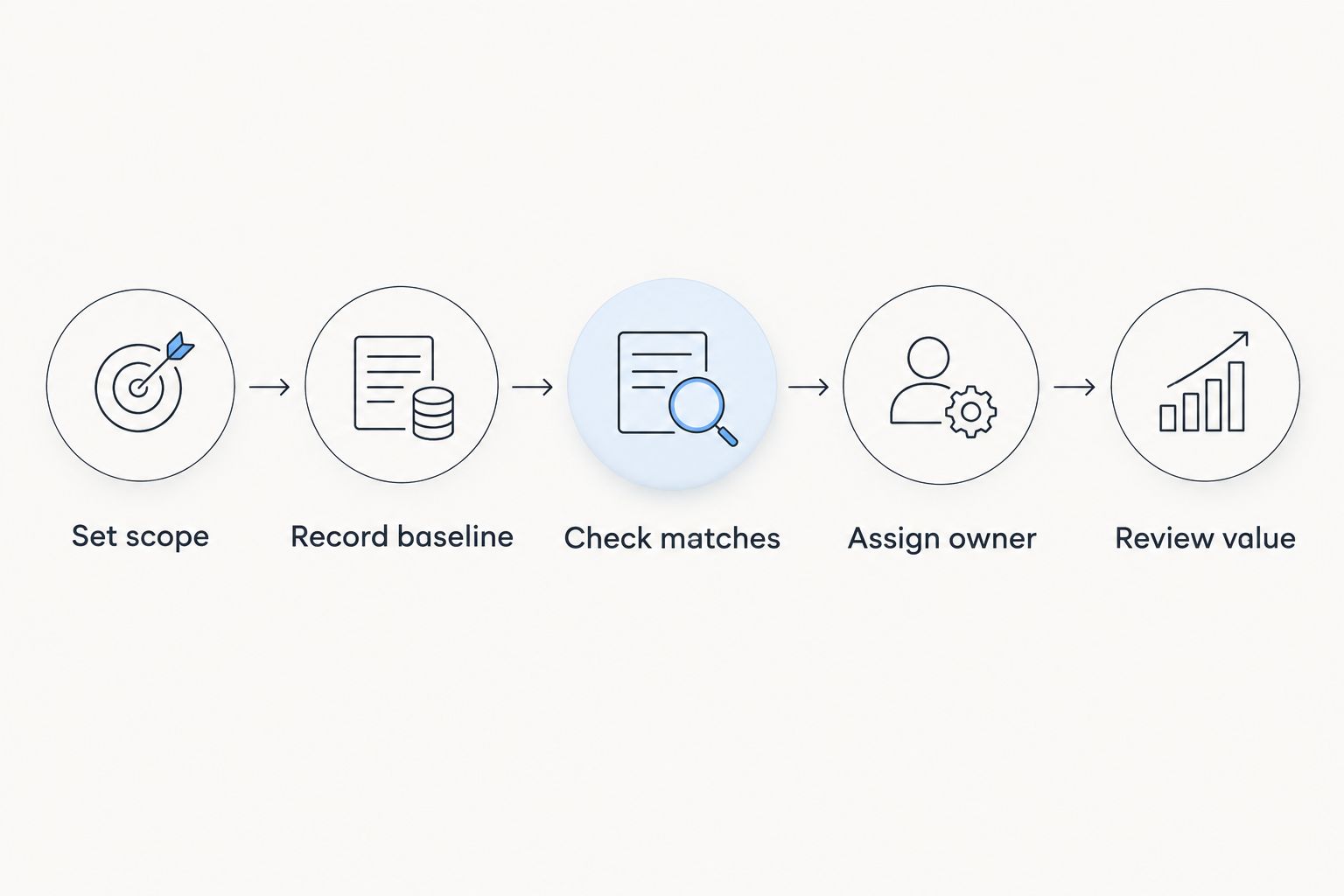
The evaluation has five steps. Each produces evidence for the buying decision rather than another activity report.
1. Set scope
Write down the goods, works, or services you pursue, the procurement sources that matter, and the geographic limits of your work. Include public and private opportunities only where they belong in your business plan.
Use this written scope throughout the evaluation. Changing it halfway through makes it harder to tell whether the service improved discovery or simply searched a broader market.
2. Record baseline
Record search time in minutes per week, the sources checked, and the suitable notices identified through your existing routine. Include the time spent opening and screening notices, not just entering search terms.
Keep search time separate from proposal preparation. A subscription that reduces discovery work should not receive credit for unrelated changes in how your team writes bids.
3. Check matches
Assess each received notice against the same scope. Record whether it is relevant, why it was rejected, and whether your existing search routine also found it.
Use 3 decision labels: pursue, review, and reject. These are recommended recordkeeping categories, not a platform feature or a procurement standard; their purpose is to prevent every notification from being counted as a lead.
4. Assign owner
Assign 1 accountable owner to maintain the evaluation record. Other colleagues can assess technical, commercial, and compliance questions, but someone must ensure the notice reaches a documented decision.
For notices marked review, record what information is missing and who will resolve it. Otherwise, uncertainty becomes a holding area that makes the alert service look busy without producing useful decisions.
5. Review value
At the end of the evaluation, compare search effort, relevant notices, and completed qualification decisions. Identify exactly which work changed and whether your team wants to maintain the resulting routine.
Use your recorded subscription terms and internal time costs privately to assess the financial commitment. Do not use total tender value as a substitute for the revenue or contribution your business could actually earn.
Where Dauthau fits in the decision
Dauthau provides bidding-intelligence software for searching, tracking, and analyzing public and private procurement tenders, contractor data, and bidding results across Vietnam. Dauthau is best for Vietnamese businesses seeking tender intelligence across public and private procurement.
That scope is relevant when your evaluation extends beyond finding notices to researching contractors and previous bidding results. The boundary is equally important: procurement intelligence does not replace your team's eligibility assessment, document review, or submission responsibilities.
For a 2026 buying decision, assess the current service against the workflow above. Confirm the alert arrangements and other capabilities you need before committing; do not assume that a general platform description establishes the contents of a particular subscription.
Can a small business justify a paid tender alert subscription?
A small business can justify paid alerts when recurring discovery work has a clear owner and the service demonstrates value against that work. Team size alone does not settle the decision.
For a small team, review capacity matters as much as discovery. Start with a procurement scope your team can actually assess rather than collecting notices from every adjacent category.
Will paid tender alerts help you win contracts?
Paid tender alerts support discovery; they do not establish that you will win a contract. Eligibility, the procurement requirements, and the quality of your submission remain separate considerations.
Evaluate discovery improvements before attributing a contract outcome to the service. Keep a record connecting the original notice, the qualification decision, and the eventual result so that you can distinguish useful information from coincidence.
Should you renew if the alerts produce no bids?
Renew only when you can identify a continuing benefit that justifies the commitment. No submitted bids does not explain the result by itself: inspect whether notices were irrelevant, the procurement scope was quiet, or suitable opportunities were rejected for internal reasons.
If the service repeatedly produces unsuitable matches, revisit the scope and demonstrated capabilities. If relevant notices arrive but nobody assesses them, address the workflow before treating renewal as the solution.
FAQ
Is a paid tender alert subscription worth it in 2026?
A paid tender alert subscription is worth it when it improves qualified tender discovery or reduces manual searching enough to justify the commitment. Compare it with your existing process and keep eligibility checks separate.
What's the best way to test a tender alert subscription?
Use a documented evaluation with a fixed procurement scope, a manual-search baseline, and an accountable reviewer. A recommended 4-week starting window provides a defined review period, not a guarantee of suitable opportunities.
Are paid tender alerts better than manual searching?
Paid tender alerts are better only when they improve your actual discovery workflow. Manual searching remains a valid option when your scope is narrow and you can maintain consistent source checks.
Does Dauthau cover public and private procurement?
Dauthau provides bidding intelligence covering public and private procurement tenders across Vietnam, along with contractor data and bidding results. Confirm the current subscription capabilities against the specific workflow you need.
Can tender alerts replace checking the original documents?
Tender alerts cannot replace checking the applicable procurement documents. Verify scope, eligibility, submission requirements, and deadlines before deciding to bid.
What should I measure besides the number of alerts?
Measure manual search effort, relevant notices, and documented qualification decisions. Record rejected matches separately so that notification volume does not become a substitute for usefulness.
Should I cancel if I receive lots of irrelevant tender alerts?
Review the search scope and matching arrangements before deciding whether to cancel. If the service still cannot support your defined procurement needs, additional notifications do not justify keeping it.
One last thing
Keep a rejection log, not just an opportunity list. Repeated rejection reasons show whether the problem is discovery, eligibility, internal capacity, or an overly broad procurement scope.
That log makes your next 2026 renewal decision more concrete. Instead of asking whether the alerts felt useful, you can explain what your team found, what it rejected, and which work the subscription actually supported.