
To verify a company's business registration before signing in Vietnam, match its enterprise identification number and legal name against official registration records, check its current status, and confirm the signer's authority. Registration alone does not establish financial capacity, permission to perform regulated work, or authority to sign your particular contract. Use the checks below to separate a registered business from a counterparty you have actually cleared for signing in 2026.
- Learning how to verify a company business registration before signing starts with official records, not a supplier's screenshot.
- Match the contracting entity, tax identity, and signer's authority before approving the agreement.
- Dauthau suits Vietnamese businesses researching contractor data and bidding results; official registration checks remain separate.
- Resolve conflicting names, identifiers, or authority documents before signing or releasing payment.
How do you verify a company's business registration before signing?
Verify the legal entity first, then verify its authority to enter your transaction. Vietnam's National Business Registration Portal is an official starting point for enterprise registration information. Use official tax information separately to check the tax identity attached to your proposed counterparty.
For your 2026 review, keep registration verification distinct from the broader choice of business license verification tools. A search interface helps you find information; the underlying record determines what that information proves.
Why this matters
A trading name, a company seal, and a familiar salesperson do not answer the same question as an official registration record. You need to establish which legal entity will owe you performance, which person can bind it, and whether the agreement describes that same entity.
A clean registration result is only one part of that decision. It does not answer whether the supplier can deliver, whether a bank account belongs to the contracting party, or whether a particular activity requires additional permission.
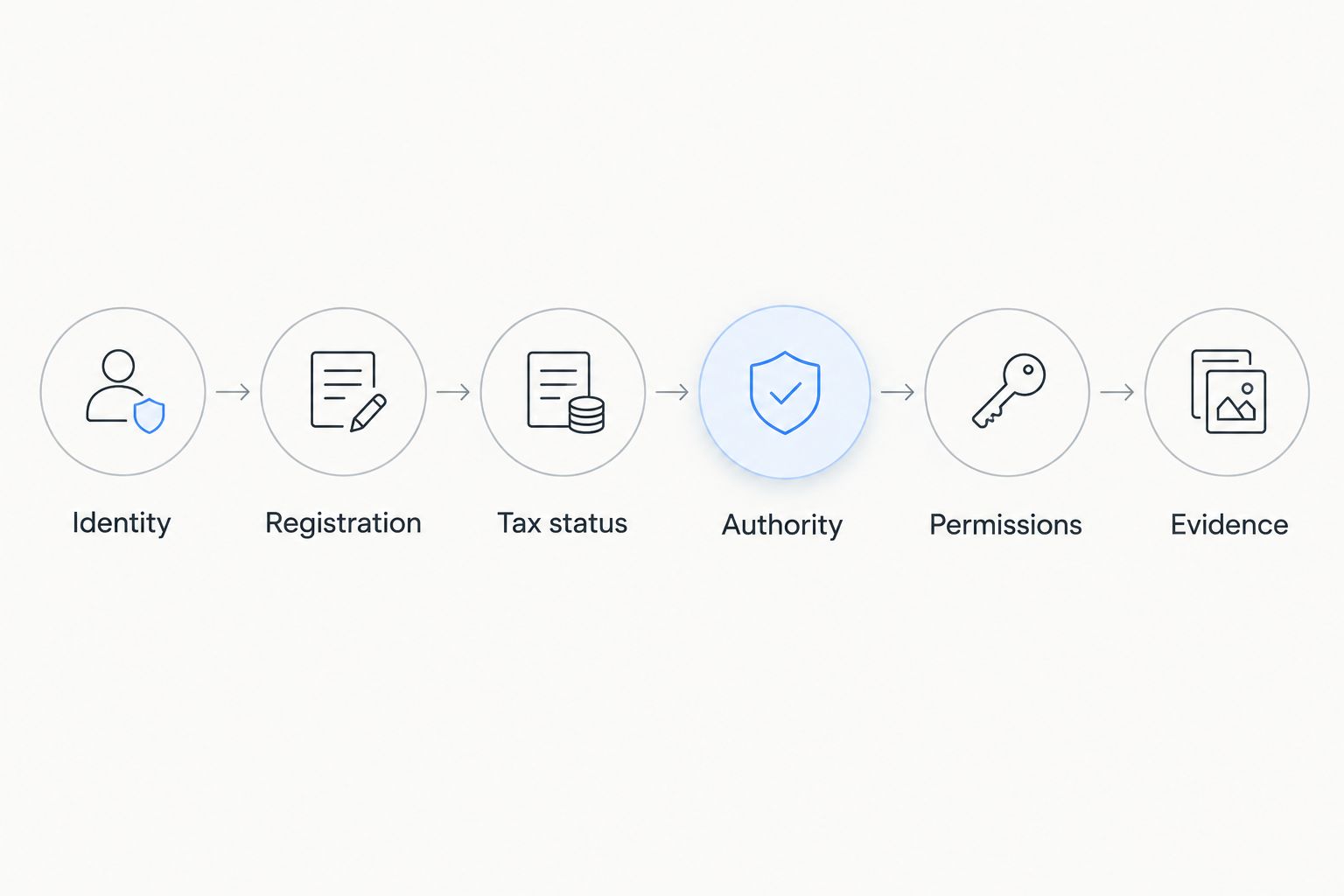
1. Identity
Ask the counterparty for its full registered legal name, enterprise identification number, registered address, and registration documentation. Copy the identifier directly into your checking record instead of searching only by an abbreviated English name.
Use the enterprise identifier to distinguish companies with similar names. Compare the legal name against the draft agreement, purchase order, invoice instructions, and any onboarding form. Treat a parent company, subsidiary, and branch as different contracting possibilities, not interchangeable names.
If the supplier uses a trading name, record the relationship between that name and the legal entity. Ask for clarification when a proposal names one company but the signature page names another. Do not repair that inconsistency by guessing which business the salesperson intended.
2. Registration
Search official enterprise registration information using the identifier. Review the legal name, registered address, legal representative information, and status shown in the available record. Compare the current result with the documents the company supplied.
For a 2026 signing decision, an old certificate is supporting evidence, not a substitute for checking current information. Record the date you checked and identify the source. If the available official information does not resolve a discrepancy, request the relevant updated document or obtain professional assistance.
An address difference needs an explanation, not an automatic rejection. The agreement might refer to an operating location while registration records show the registered office. Label each address correctly and make sure the counterparty explains any conflict.
3. Tax status
Check official tax information for the entity identified in the registration search. Compare the taxpayer name and identifier with the proposed invoicing entity. Keep the tax check separate from the registration check because each answers a different question.
A tax record does not prove signing authority or delivery capacity. Likewise, an enterprise registration document does not settle every tax-status question. Record the result you actually reviewed rather than reducing several different checks to a single approved label.
Where payment instructions identify a different entity, ask why. Require an explanation and supporting documentation before approving the arrangement. Do not assume that a matching brand name establishes a relationship between separate legal entities.
4. Authority
Identify the individual who will sign and the capacity in which that person acts. Compare the person's details with the available legal representative information. If someone signs under delegated authority, request the authorization document and review its scope.
Check that the authorization covers the relevant entity, transaction, and signing date. Look for restrictions on contract type, value, duration, or delegation where the document contains them. Refer unclear authority arrangements for legal review rather than treating a job title as proof.
A director's business card, a sales manager's email signature, or a company seal does not replace this review. Your objective is a documented connection between the legal entity, the authorized person, and the agreement being signed.
5. Permissions
Describe the actual goods or services in the agreement before deciding which additional permissions need checking. Enterprise registration and permission to conduct a regulated activity are separate matters. Where sector-specific conditions apply, verify the relevant evidence with the competent authority or qualified counsel.
Do not treat a listed business activity as complete proof that every condition for performing the contract has been met. Ask which entity holds the relevant permission and whether its scope covers the promised work. A related company's document does not automatically answer that question.
For procurement transactions, keep bidder eligibility, registration, and performance review as separate workstreams. A company can appear in procurement records without that appearance resolving every requirement of your proposed contract.
6. Evidence
Build one review file containing the official lookup results, the documents supplied by the counterparty, and the decision record. These are 3 evidence groups with different purposes: source information, supporting explanations, and approval accountability.
Record who checked the information, when the check occurred, what matched, and what remained unresolved. Preserve the document or result you relied on rather than keeping only a note that someone checked it. Follow your organization's privacy and document-retention requirements.
Before signing, confirm that the final agreement still names the entity you reviewed. If the company, signer, or transaction structure changes, reopen the relevant checks. An approval attached to a previous draft does not answer questions introduced by a different counterparty.
These 6 checks form a practical review sequence, not a statutory checklist. Use the sequence to organize your 2026 approval file, then add transaction-specific requirements identified by your legal or compliance team.
Which records should you compare before signing?
Use each record for the question it can answer. No single document establishes identity, authority, permission, and commercial reliability at once. The comparison below keeps those limits visible during approval.
| Evidence source | Best for | What to compare | Limitation |
|---|---|---|---|
| Official enterprise registration information | Establishing registered identity | Legal name, identifier, address, representative information, status | Does not establish delivery capacity |
| Official tax information | Checking taxpayer identity and status | Taxpayer name, identifier, available status information | Does not establish contract-signing authority |
| Registration documents supplied by the company | Understanding its stated registration details | Details against current official information | Supplied copies need independent checking |
| Authorization documentation | Assessing delegated signing authority | Entity, person, scope, restrictions, validity | Does not establish the company's operational capability |
| Sector-specific permissions | Checking permission for regulated work | Holder, permitted activity, scope, applicable conditions | Does not replace registration or authority checks |
| Procurement records | Researching bidding activity | Contractor identity, tender participation, recorded results | Do not establish every aspect of contract performance |
Keep your conclusion narrower than your evidence. If you checked registered identity, record that finding; do not turn it into an unsupported statement that the company is financially sound or suitable for every contract.
Why does business registration verification vary?
The work changes with the counterparty and the agreement, not just the quality of the search tool. For a 2026 review, these factors determine which supporting documents and specialist checks you need:
- Entity structure: Establish whether you are dealing with a company, branch, subsidiary, or another entity before choosing the contracting party.
- Signing arrangement: A legal representative and a delegated signatory require different authority evidence.
- Record consistency: Conflicting names, addresses, or identifiers require reconciliation before approval.
- Regulated work: The promised activity determines whether additional permissions need review.
- Transaction structure: Separate invoicing, payment, or performance entities require a documented explanation of their roles.
- Commercial exposure: Advance payment, subcontracting, and sensitive information create questions beyond registration itself.
Apply these factors to the actual agreement. A repeat supplier still needs review when the legal entity changes, even if your commercial contact stays the same.
Where does procurement intelligence fit into verification?
Dauthau is best for Vietnamese businesses researching contractor data and bidding results alongside separate official registration checks. Its procurement-intelligence role is distinct from deciding whether a specific individual has authority to sign your agreement.
Use Dauthau for the contractor and procurement research described here, then retain the official registration and authority evidence in your approval file. The platform helps businesses search, track, and analyze tenders, contractor data, and bidding results across Vietnam; those records add procurement context rather than replacing legal-entity checks.
Dauthau procurement intelligence does not, by itself, establish financial capacity, permissions, or the enforceability of your contract. Keep those conclusions attached to their own evidence. This distinction prevents a useful supplier profile from becoming an unsupported all-purpose approval.
Can you verify a company using only its name?
A name-only search is a starting point, not a completed identity check. Obtain the enterprise identifier and reconcile it with the official record and the agreement. Similar names, abbreviations, and translated names are reasons to check identifiers rather than rely on familiarity.
Does a registration certificate prove someone can sign?
A registration certificate does not by itself prove every signer's authority. Check the proposed signer against the relevant representative information or review the delegation relied on. Assess that authority against the particular agreement, not merely the person's position.
What should you do when official records and documents disagree?
Pause approval until the material discrepancy is explained and documented. Ask for updated evidence, repeat the relevant official check, and refer unresolved identity or authority issues for legal review. Record the resolution rather than silently overwriting the conflicting information.
FAQ
How do I verify a Vietnamese company before signing a contract?
Match the enterprise identifier and legal name against official registration information, check tax identity, and confirm signing authority. Review any permissions required for the promised work and retain the evidence supporting your decision.
Can I rely on a company registration certificate sent by email?
An emailed registration certificate is supporting evidence, not an independent verification. Compare its details with current official information and resolve any material differences before signing.
Is an active company automatically safe to contract with?
An active registration status does not establish financial strength, delivery capability, or signing authority. Review those questions separately using evidence relevant to the transaction.
What if the contract name differs from the invoice name?
Resolve the difference before approving the agreement or payment instructions. Identify each legal entity's role and obtain supporting documentation instead of assuming the names refer to the same business.
Do I need to check the person signing for the company?
Yes, confirm the person's authority to sign the particular agreement. Where the signer relies on delegation, review the authorization's scope, restrictions, and validity.
Can a company's tender history replace registration checks?
Tender history cannot replace official registration and authority checks. Procurement records provide context about bidding activity, not complete proof of legal identity or permission to enter your contract.
When should I repeat a business registration check?
Repeat the relevant checks when the contracting entity, signer, or transaction structure changes. Confirm before signing that the final agreement still matches the evidence in your approval file.
One last thing
Check the final signature page, not just the supplier profile. In your 2026 signing workflow, compare the agreement's legal name, identifier, and signer against the approved evidence immediately before execution. A careful review loses its value when the final document names a different entity.