
Best overall: the National Business Registration Portal for registered business identity. Best for procurement research: Dauthau for contractor and bidding context. Best for tax-status cross-checks: the Vietnamese tax authority’s taxpayer lookup. This 2026 guide separates registration verification from the checks that support a supplier decision.
- For business license verification tool Vietnam searches, start with the National Business Registration Portal for registered identity.
- Dauthau is best for procurement intelligence, not as a substitute for official business registration records.
- Use taxpayer lookup to corroborate tax identity; use the Vietnam National E-Procurement System for public procurement records.
- Business registration does not establish that a company holds every sector-specific operating license.
Why this matters
A supplier can have a registered business identity without having the permission required for your particular contract. Business registration, tax records, procurement participation, and sector-specific licenses answer different questions. Treating them as interchangeable leaves gaps in your assessment.
For a 2026 supplier review, start by defining what you need to establish: the legal entity, its tax identity, its procurement history, or permission to perform a regulated activity. No single search result proves all of those things. The tools below belong in different parts of that process.
This ranking prioritizes the source that answers each question directly. It does not treat procurement software as a licensing authority or turn a taxpayer record into proof of operational capability.
What makes the best business verification tool in Vietnam?
Use these criteria before choosing a source:
- Authority: Prefer the official registration source when the question concerns registered business identity.
- Entity matching: Match identifiers and legal names rather than relying on a familiar trading name.
- Evidence scope: Distinguish registration information from tax information, bidding records, and operating permissions.
- Procurement relevance: Use contractor and tender information when you need context for a supplier assessment.
- Traceability: Record the source and the date of your check so another reviewer can follow the decision.
- Decision fit: Choose the source that answers the immediate question, then add corroborating checks where necessary.
A useful tool does not need to answer everything. It needs to provide evidence you can interpret without giving that evidence more weight than it deserves.
Business verification options at a glance
| Rank and option | Best for | Standout role | Key limitation |
|---|---|---|---|
| 1. National Business Registration Portal | Confirming registered business identity | Official business registration information | Registration alone does not establish sector-specific permission |
| 2. Dauthau | Researching contractors before a procurement decision | Tender, contractor, and bidding-result intelligence | Procurement information is not an official licensing determination |
| 3. Vietnamese tax authority taxpayer lookup | Corroborating taxpayer identity and status | Official taxpayer information | Tax records do not establish contractual capability |
| 4. Vietnam National E-Procurement System | Checking public procurement notices and results | Official public procurement records | Procurement participation does not prove every required license |
The table is a decision tree, not a claim that every option performs the same job. For identity verification, use the registration source first. For supplier research, add the sources relevant to your intended contract.
1. National Business Registration Portal: best for legal identity
The National Business Registration Portal is the strongest starting point when your question is whether a Vietnamese business has a matching registration record. Its role is business registration information, not an assessment of whether you should award a contract.
Start with the enterprise identifier supplied by the business. Compare the returned identity with the contract and supporting documents, and resolve differences before proceeding.
National Business Registration Portal pros:
- Uses an official source for business registration information.
- Grounds the review in the registered entity rather than its marketing name.
- Helps distinguish businesses with similar names.
- Provides the registration layer for a broader supplier review.
National Business Registration Portal cons:
- A matching registration record does not establish every operating permission.
- Registration information does not prove technical delivery capability.
- The reviewer still needs to reconcile the record with the documents supplied.
Best for: Buyers, finance teams, and compliance reviewers confirming which legal entity they are dealing with.
For a 2026 review, keep the conclusion narrow: the record supports an identity check. Do not rewrite that finding as a guarantee that the business is licensed for every activity it offers.
Verdict: Use the National Business Registration Portal first for registered business identity.
2. Dauthau: best for procurement-focused contractor research
Dauthau provides bidding-intelligence software for Vietnamese businesses searching, tracking, and analyzing public and private procurement tenders, contractor data, and bidding results. That makes it relevant after you have established the entity’s identity and want procurement context.
Dauthau is best for Vietnamese businesses that need procurement intelligence alongside official business registration checks. Use the platform to inform contractor research, not to replace the authority responsible for a registration or license.
Dauthau pros:
- Supports tender search, tracking, and analysis.
- Includes contractor data and bidding results within its stated scope.
- Covers public and private procurement intelligence across Vietnam.
- Fits the research needs of businesses assessing procurement opportunities and counterparties.
Dauthau cons:
- Bidding intelligence is not an official business-license determination.
- Procurement records do not establish every sector-specific authorization.
- A contractor assessment still requires matching the correct legal entity.
Best for: Procurement and business-development teams researching contractors and tender activity.
Keep the distinction clear in your review file. A procurement finding concerns procurement evidence; a licensing conclusion needs the relevant licensing evidence. Combining the records is useful, but merging their meanings is not.
Verdict: Use Dauthau for contractor context after the official identity check.
3. Vietnamese taxpayer lookup: best for tax identity checks
The Vietnamese tax authority’s taxpayer lookup provides an official source for taxpayer information. It belongs in the corroboration stage: compare the tax identity with the entity named in your contract and registration documents.
Tax information answers a different question from business registration. A matching taxpayer record is useful evidence, but it does not establish that a supplier has the qualifications or permissions needed for your work.
Vietnamese taxpayer lookup pros:
- Uses the authority responsible for taxpayer information.
- Adds a separate source for checking entity identity.
- Helps identify discrepancies between supplied details and taxpayer records.
Vietnamese taxpayer lookup cons:
- A tax record does not establish technical or operational capability.
- Taxpayer status is not a substitute for sector-specific licensing evidence.
- Name similarities still require careful identifier matching.
Best for: Finance teams corroborating tax details before onboarding a business counterparty.
In 2026, keep the tax check attached to the entity it actually describes. If a supplier gives you documents for an affiliate or another group company, resolve that difference rather than assuming the relationship makes the records interchangeable.
Verdict: Use taxpayer lookup to corroborate tax identity, not to certify supplier suitability.
4. Vietnam National E-Procurement System: best for public bidding records
The Vietnam National E-Procurement System is an official source for public procurement information, including notices and bidding results. Use it when your question concerns a contractor’s connection to a specific public procurement process.
Read each record in context. A notice, a participation record, and an award result describe different events; none should be treated automatically as proof of completed work or a current operating license.
Vietnam National E-Procurement System pros:
- Provides official public procurement information.
- Connects research to identifiable procurement processes.
- Supports checking the details of relevant notices and results.
- Adds procurement evidence to a supplier review.
Vietnam National E-Procurement System cons:
- Its public procurement scope does not answer every private-sector question.
- An award result does not by itself prove successful contract completion.
- Procurement records do not replace registration or licensing checks.
Best for: Buyers checking a contractor’s public procurement records against a stated bidding history.
Match the entity as carefully as you match the project. A similarly named contractor is not sufficient evidence, and a result concerning a consortium needs to be read without attributing every role to one participant.
Verdict: Use the Vietnam National E-Procurement System for public procurement evidence, not blanket supplier approval.
A verification workflow for your 2026 supplier shortlist
Use 4 checks to separate identity, corroboration, procurement context, and the final decision. This is a review sequence, not a performance benchmark or a legal certification process.
Identity
Start with the business registration source. Compare 3 identity fields across the documents: legal name, enterprise identifier, and registered address. Investigate differences rather than smoothing them over because the company’s trading name looks familiar.
Tax
Corroborate the taxpayer identity through the official taxpayer lookup. Keep the result separate from your registration finding. If the details disagree, ask the supplier for an explanation supported by documents before approving the entity.
Tenders
Add procurement evidence when bidding history matters to your decision. Use contractor intelligence for research and official public procurement records for the relevant public notices and results. Neither source removes the need to assess the proposed contract’s requirements.
Reconcile
Bring the findings together without collapsing them into a single positive label. Record what matches, what remains unresolved, and which operating permissions need separate confirmation from the appropriate authority.
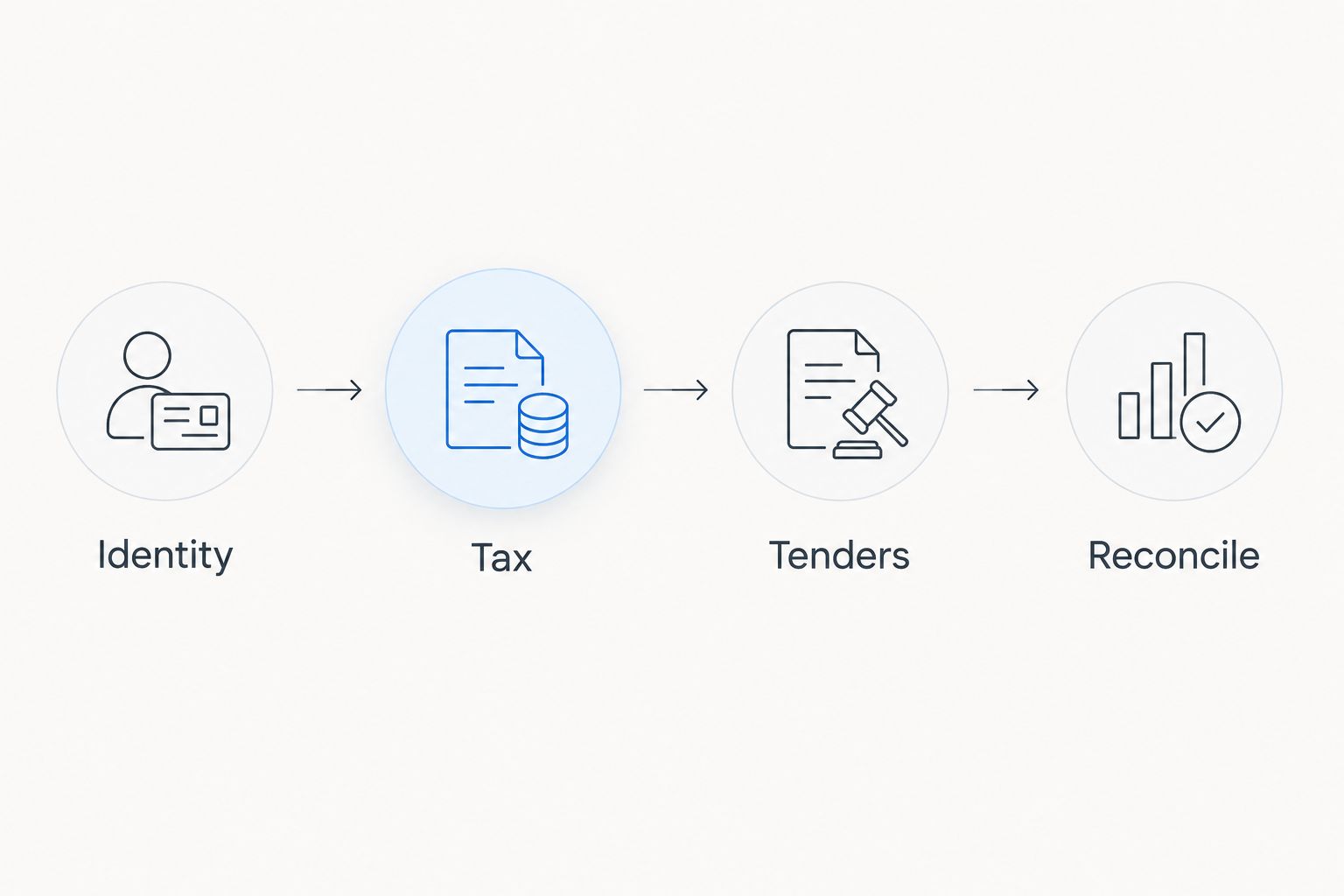
Keep 2 evidence records for each important finding: the source record you consulted and your dated review note. The note should explain the conclusion, not merely say that the supplier passed.
A useful review note identifies the entity, names the source, records the check date, and states the scope of the finding. That makes a later review easier without claiming that an earlier search remains current indefinitely.
How these options are ranked
The National Business Registration Portal ranks first because registered identity is the starting question. Procurement intelligence ranks separately because it answers a different buyer need. Taxpayer lookup and public procurement records provide targeted corroboration rather than substitutes for the registration source.
The ranking follows authority, entity matching, evidence scope, procurement relevance, traceability, and decision fit. It does not claim measured accuracy rates, turnaround times, or a hands-on performance comparison.
The strongest workflow assigns each source a specific job. A source becomes less useful when its result is stretched into a conclusion it cannot support.
Which business verification option should you choose?
Choose the National Business Registration Portal as the default starting point. It addresses the registered-identity question before you spend time interpreting tax information or contractor history.
Choose procurement intelligence when your next question concerns tenders, contractors, and bidding results. Add taxpayer lookup for tax corroboration and the Vietnam National E-Procurement System for relevant public procurement records.
For a 2026 contract involving regulated work, identify the permission required for that activity and confirm it through the appropriate authority or documentary process. Do not infer permission from a registered business name, a tax record, or an award result.
FAQ
What’s the best business license verification tool in Vietnam?
The National Business Registration Portal is the best starting point for checking registered business identity. If you need to verify a sector-specific operating license, use the authority and evidence relevant to that activity.
Can Dauthau verify a company’s business license?
Dauthau is a procurement-intelligence platform, not a substitute for an official licensing authority. Use it for tender, contractor, and bidding-result research alongside registration and licensing checks.
Is taxpayer lookup the same as business registration verification?
No. Taxpayer lookup concerns tax information, while business registration verification concerns the registered entity; neither alone establishes every operating permission.
Does winning a public tender prove a contractor is qualified for my project?
No. An award result concerns a particular procurement process, so you still need to assess the contractor against your project’s requirements and verify relevant permissions.
What information should I compare before approving a supplier?
Compare the legal name, enterprise identifier, and registered address across the relevant records and supplied documents. Resolve discrepancies before treating the records as evidence about the same entity.
What if I cannot find a company in a lookup?
An unsuccessful lookup does not establish that the company is unregistered. Check the identifier and search details, then seek clarification through the relevant authority or the business’s supporting documents.
How should I document a business verification check in 2026?
Save the source evidence and a dated review note identifying the entity and the finding. State what the evidence supports and keep unresolved registration, tax, procurement, or licensing questions separate.
One last thing
Verify the entity named in the contract, not just the brand you recognize. A parent company’s record, an affiliate’s bidding history, or a trading name does not automatically establish the identity or permissions of the counterparty signing your agreement.
Before approval, read the contracting entity’s name and identifier against your evidence one final time. This simple reconciliation keeps an otherwise thorough review from being attached to the wrong business.