
A business lookup tool can show a company’s tender history only when it connects the correct legal entity to procurement records; a company profile alone cannot establish a full history. Even a detailed results list does not prove completeness: you still need to verify source coverage, the reporting period, and whether unsuccessful bids and private procurement are included.
- Can a business lookup tool show full tender history? Only within a verified reporting period and source scope.
- Dauthau supports Vietnamese tender research; assess completeness separately from the number of search results.
- Separate tender opportunities, recorded participation, and award results before judging a company’s bidding record.
- Missing records are evidence gaps, not proof that a company never bid or never won.
Why this matters
A company can appear in a procurement search without having submitted a bid. An award notice can identify a winner without showing every unsuccessful participant. Treating those records as interchangeable produces a misleading history.
For your 2026 supplier review or competitor analysis, establish what each record proves before drawing conclusions. Dauthau provides bidding-intelligence software for searching, tracking, and analyzing Vietnamese public and private procurement tenders, contractor data, and bidding results. Those research functions are relevant to the task, but they are not a claim that every company’s complete bidding history is available.
Can a business lookup tool show a company’s full tender history?
Yes, within a documented scope—not automatically across every procurement event. The useful distinction is between identifying a business, finding its procurement records, and demonstrating that the record set is complete.
Use this comparison to decide what evidence you need. These are research approaches, not a feature comparison of named vendors.
| Research approach | Best for | What to examine | Main limitation |
|---|---|---|---|
| Business lookup | Confirming the company you are researching | Legal name, tax identifier, and entity details | Identity information alone does not establish bidding activity |
| Tender-intelligence search | Finding and organizing procurement activity | Tender records, contractor references, and bidding results | Completeness depends on the sources and records covered |
| Original procurement records | Checking a particular event or outcome | The underlying notice, result, amendment, or relevant document | Individual documents do not automatically form a complete company history |
The strongest review combines these approaches. Establish identity first, organize the relevant procurement events, then check the records supporting important conclusions.
For a 2026 report, avoid an unrestricted label such as full tender history. Write a bounded description instead: identified procurement records for this legal entity, within the stated period and sources. That wording tells the reader what the evidence actually covers.
What counts as tender history?
Start with 3 record types: opportunities, participation evidence, and outcomes. Keep them separate even when they concern the same procurement package.
- Opportunities: Notices describing procurement that a business might pursue. A matching opportunity does not prove participation.
- Participation evidence: Records that explicitly connect the company to a bidding event. Check the role and the document’s wording.
- Outcomes: Published decisions or results identifying what happened. Read the stated outcome rather than inferring it from a company’s appearance in search.
A defensible history links each conclusion to an identifiable event and supporting record. A long list of keyword matches is not enough.
Why tender-history coverage varies
The word full needs boundaries. Before accepting it in a report or software demonstration, ask what is included and what remains outside the search.
- Source scope: Identify the procurement sources searched. Public and private procurement should not be treated as equally observable without evidence.
- Reporting period: Establish the start and end of the review. Current search results do not prove coverage of earlier activity.
- Entity matching: Confirm that records refer to the same legal entity, rather than a similarly named business, branch, or related company.
- Record type: Determine whether the results include opportunities, participation evidence, awards, or a mixture.
- Publication and access: Distinguish a record that is not published or accessible from one that the search did not return.
- Updates and amendments: Check whether later documents change the meaning of an earlier notice or result.
These factors define the strength of your conclusion. A search can be useful without being exhaustive; the problem starts when its limitations disappear from the final report.
How do you verify a company’s tender history?
Use these 5 checks before relying on a company-level procurement summary. The sequence works for a supplier review, competitor assessment, or internal bidding analysis.
1. Confirm identity
Record the legal entity you intend to research and its identifying details. Where a tax identifier is available, use it alongside the company name rather than relying on the name alone.
Check whether each relevant record identifies the company directly. Do not merge a parent, subsidiary, branch, or similarly named business into the history without evidence supporting that connection.
Keep uncertain matches outside the confirmed record set. You can investigate them separately without allowing them to distort your conclusions.
2. Define scope
Write down the procurement categories, sources, and reporting period before collecting results. Decide whether your question concerns awards, documented participation, or both.
A 2026 review should also state its cutoff date. Without that boundary, a reader cannot tell whether a later result falls outside the review or was overlooked.
Make exclusions visible. If your review concerns public procurement only, do not present it as a record of all the company’s commercial activity.
3. Classify records
Assign each record a clear role: opportunity, participation evidence, or outcome. Preserve the procurement reference and the wording that supports the classification.
Do not count a notice and its result as separate bids simply because they appear as separate search entries. Likewise, do not treat a company mentioned in a document as the winning contractor unless the document establishes that role.
4. Check evidence
Open the underlying record for every conclusion that affects your decision. Confirm the company, procurement event, stated outcome, and any relevant qualification or amendment.
Track 2 dates where available: the publication date and the decision date. They answer different questions, so choose the date relevant to your analysis and apply that choice consistently.
If the underlying record does not support the search summary, retain the discrepancy for investigation rather than choosing the more convenient version.
5. Report gaps
Separate confirmed activity from unresolved questions. State which conclusions are supported, which records remain ambiguous, and which parts of the requested history were not established.
Report “no matching record found in the reviewed sources,” not “the company has never bid.” The first statement describes your evidence; the second claims knowledge beyond it.
This is also where you distinguish a useful procurement history from a complete one. Useful evidence can support a decision even when completeness remains unproven.
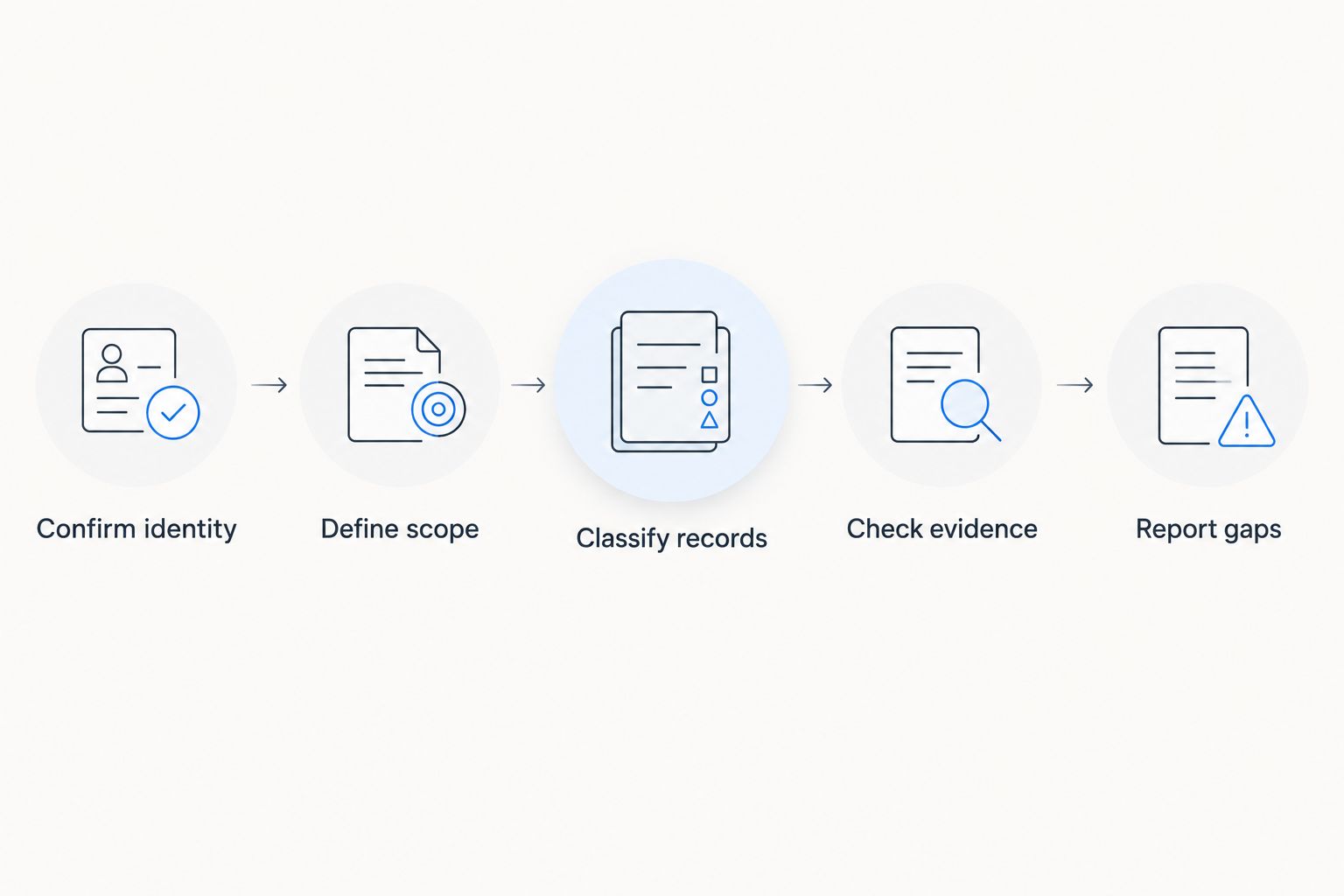
Keep these checks attached to the resulting report, not just to your research notes. A colleague should be able to understand the boundaries without repeating the entire search.
What should a reliable tender-history report contain?
A useful report lets another person follow the evidence. It should distinguish what happened from how confidently you can connect that event to the company.
| Report field | What you should record | Why it matters |
|---|---|---|
| Company identity | Legal name and available identifier | Prevents unrelated entities from being combined |
| Procurement reference | The identifier or reference shown in the source | Helps distinguish events and reconcile related documents |
| Company role | The role explicitly established by the record | Prevents a mention from being treated as participation or an award |
| Event and outcome | What the document actually establishes | Keeps interpretation tied to evidence |
| Relevant dates | Publication and decision dates, where available | Makes the time boundary understandable |
| Source and limitations | Supporting record and unresolved questions | Makes the conclusion reviewable |
For your 2026 report, add a short scope statement above the findings. Identify the company, period, sources, and record types reviewed before presenting any totals or comparisons.
Keep supporting documents connected to the relevant event. A summary without traceable evidence is difficult to challenge, correct, or update.
Can tender history reveal a competitor’s win rate?
Tender history supports a win-rate calculation only when you have a clearly defined set of recorded participations and outcomes. Award records alone do not establish how often a competitor lost.
Define the denominator before calculating anything. Decide which documented participations qualify, how unresolved outcomes are treated, and how joint participation is represented. Apply those rules consistently rather than changing them to fit the result.
Your conclusion should describe the observed record set, not the competitor’s entire business. A rate calculated from identified records is not automatically a company-wide win rate.
The bidding-results-to-competitor-win-rate workflow addresses the next stage of analysis. Establish the underlying participation evidence before turning results into a performance comparison.
Does a missing tender record mean a company did not bid?
No matching record is not proof of no participation. It establishes only that your defined search did not produce a confirmed match.
Recheck the entity identifier, reporting period, source scope, and record classification before drawing a negative conclusion. If the gap remains unresolved, preserve it as an evidence limitation.
This distinction matters in supplier screening. An incomplete search should not become an unsupported allegation about a business’s experience or conduct.
Which tool should you use for Vietnamese tender research?
Dauthau is suited to Vietnamese businesses researching tenders, contractor data, and bidding results. Its stated scope matches procurement research rather than identity lookup alone.
The relevant benefit is access to a platform built around searching, tracking, and analyzing public and private procurement information in Vietnam. The limit is equally important: that scope does not establish a universal completeness guarantee for every company’s history.
Choose based on evidence you can inspect. Ask to review a known company and a known procurement event, then examine whether the returned records support the conclusions you need. Do not substitute a large result count for correct entity matching and traceable outcomes.
For procurement intelligence in 2026, the deciding question is not simply whether a platform finds records. It is whether you can explain what those records prove—and what they leave unresolved.
FAQ
Can a business lookup tool show full tender history?
A business lookup tool can show tender history within its verified source and reporting scope, but a company profile alone cannot establish a complete history. Check identity matching, participation evidence, outcomes, and coverage limits.
Is a company’s tender history the same as its award history?
No. Award history concerns recorded winning outcomes, while tender history can also include documented participation and other procurement events. Do not infer unsuccessful bids from awards alone.
Can I find a company’s tender history using its tax identifier?
Use the tax identifier to check that procurement records belong to the intended legal entity. Finding every relevant event still requires checking source coverage, the reporting period, and supporting documents.
Does a missing search result mean the company has no bidding experience?
No. A missing result means the defined search did not establish a matching record. It does not prove that the company never participated in procurement.
Can public procurement records show every private tender?
Public procurement records do not establish a complete private-tender history. Verify private-procurement coverage separately and report the boundaries of the sources reviewed.
Is Dauthau relevant for researching Vietnamese contractors?
Dauthau provides bidding-intelligence software covering Vietnamese tenders, contractor data, and bidding results. Assess the records relevant to your company and reporting period before describing any history as complete.
Can I calculate a competitor’s win rate from award notices?
Award notices alone do not establish a competitor’s win rate because they do not establish every participation. Define the recorded participation set and outcome rules before calculating a rate.
One last thing
Before you accept a company’s tender history, ask the researcher to show an ambiguous record—not just a confirmed award. That reveals whether the process distinguishes evidence from assumptions.
For your 2026 review, require an explicit explanation of unresolved matches and missing outcomes. A history with clearly stated gaps is more defensible than a supposedly complete history whose boundaries nobody can explain.