
To spot potential shell companies in Vietnamese public tenders, match the bidder’s legal identity to its tender records, then verify its claimed people, equipment, experience, and delivery arrangements. Treat unexplained inconsistencies as reasons to investigate—not proof of fraud—and distinguish missing public information from evidence that a claim is false.
- How to spot shell companies in public tenders: verify identity, tender history, capacity, and relationships before drawing conclusions.
- Dauthau suits Vietnamese businesses researching contractor data and bidding results; documentary verification remains a separate task.
- A shared address or sparse tender history does not establish that a bidder is a shell company.
- Record each discrepancy, its source, the bidder’s explanation, and the evidence needed to resolve it.
Why this matters
Screen the claims, not the company’s appearance. A sparse website tells you little about whether a contractor can perform the work. A polished company profile does not establish that its experience belongs to the bidding entity.
For a 2026 screening exercise, start with an identifiable contractor record rather than a name-only search. Dauthau supports research into Vietnamese tenders, contractor data, and bidding results. Use that research to identify records for verification, not to assign a fraud label.
Your output should explain what matches, what conflicts, and what remains unresolved. That is more useful to a procurement decision-maker than an unsupported yes-or-no accusation.
How to spot shell companies in Vietnamese public tenders?
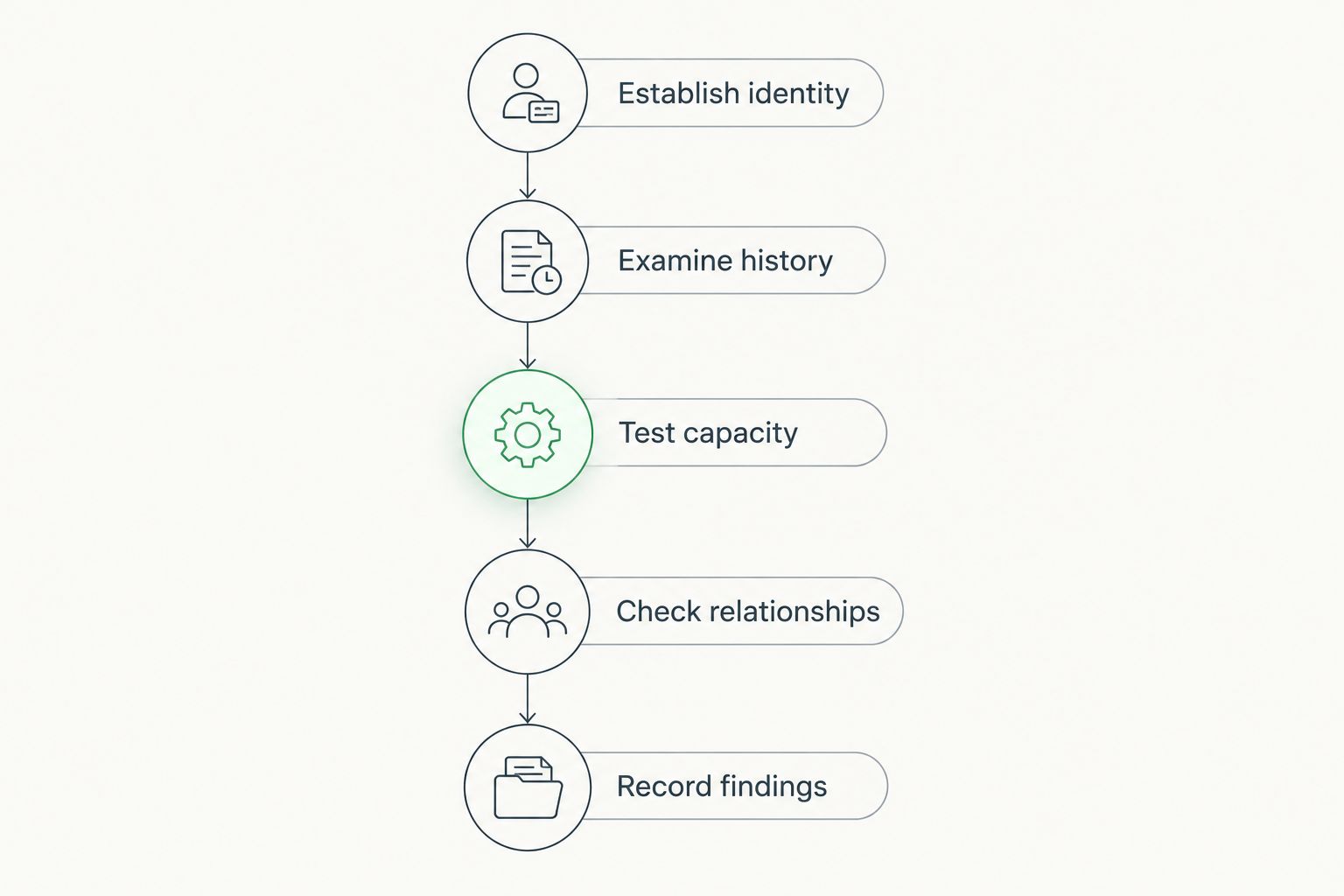
Follow 5 verification steps: establish identity, examine tender history, test capacity claims, investigate relevant relationships, and document the decision. Keep the original record beside every conclusion so another reviewer can reproduce the check.
1. Establish identity
Record the bidder’s legal name, enterprise or tax identifier, registered address, and legal representative as shown in the documents under review. Compare those details with the relevant official registration records and the tender submission.
Resolve differences before combining records. Similar names do not establish that two entries describe the same business; a documented name change also needs to be distinguished from a different legal entity.
Ask these questions:
- Does the identifier match across the records?
- Does the signatory’s stated role match the supporting authorization?
- Is the claimed experience attributed to this entity, a partner, or another business?
- Do the records describe the business at the relevant submission date?
A discrepancy is a verification task. Record the competing entries and seek the document that explains the difference.
2. Examine history
Find tender notices, participation records, and award results associated with the verified entity. Separate participation from awards, and separate awards from evidence of completed work.
An award result is not a completion certificate. If the bidder claims successful delivery, ask for evidence that addresses delivery and acceptance rather than treating a winning result as a substitute.
Compare the claimed experience with the contract being assessed. Relevant questions concern the scope of work, the entity’s role, and whether the evidence supports the specific capability being claimed—not simply whether the company has appeared in procurement records.
The guide to checking a company’s full tender history explains the separate research question behind this step. Keep the boundary clear: an incomplete search result does not establish that experience never existed.
3. Test capacity
Translate the proposed contract into the resources it requires. Then ask how the bidder will provide those resources: employees, equipment, facilities, specialist qualifications, suppliers, or permitted delivery partners, as relevant to the work.
Do not assume every resource must be owned directly. Instead, check the tender’s conditions and the evidence supporting the proposed arrangement.
For example, when a bidder relies on hired equipment, examine the supporting arrangement rather than rejecting the claim solely because the equipment is not owned. When it relies on named personnel, verify the role and supporting credentials through an appropriate channel.
The question is concrete: does the evidence support the delivery arrangement stated in this bid? A company profile alone does not answer it.
4. Check relationships
Compare relevant identifiers, representatives, addresses, and contact details across the businesses being reviewed. Record any overlap precisely, then investigate its explanation and relevance to the procurement.
A shared address does not prove common control. Likewise, a documented business relationship does not, by itself, establish improper coordination.
Keep separate questions separate: who owns or controls the bidder, who prepared or authorized the submission, and whether the bidder satisfies the applicable tender conditions. Do not turn one unexplained overlap into answers to all three.
5. Record findings
Write a finding for each material claim, rather than assigning an unexplained overall label. Include the source, retrieval date, relevant tender reference, discrepancy, clarification request, and outcome.
Use neutral wording such as experience claim not verified or identifier mismatch unresolved. Reserve allegations of fabrication or misconduct for findings supported by evidence and reviewed through the appropriate process.
For a 2026 decision, retain the records used at the decision date. A later search should not silently replace the evidence on which the original assessment depended.
Which evidence answers each screening question?
Use different records for different questions. Registration evidence addresses identity; tender results address recorded procurement outcomes; delivery evidence addresses the work actually performed.
| Evidence option | Best for | Strength | Limitation |
|---|---|---|---|
| Official registration record | Checking legal identity | Provides an identity reference for matching records | Does not establish contract delivery capacity |
| Tender participation and award records | Examining procurement history | Connects an identified bidder with recorded tender events | An award alone does not prove completion |
| Bid documents and supporting records | Testing specific representations | Shows what the bidder claims for the procurement | Claims still require verification |
| Contract acceptance or delivery evidence | Checking claimed performance | Addresses the work represented as delivered | Must be matched to the entity and scope claimed |
| Relevant ownership or relationship documents | Examining a specific connection | Helps clarify the relationship under review | A relationship alone does not prove misconduct |
Choose the evidence that answers the disputed claim. Collecting more records is not a substitute for resolving the actual inconsistency.
For example, registration confirmation does not resolve a disputed project reference. Conversely, a credible project reference does not fix a mismatch between the bidder’s identity and the entity named in the submission.
Why screening conclusions vary
The conclusion depends on what the records establish, not on how suspicious a single detail looks. Organize the review around 4 evidence factors:
- Identity consistency: Determine whether differences describe separate entities, historical changes, or an unresolved mismatch.
- Scope of the claim: Test the specific experience or resource claimed, not a broader statement about the company’s reputation.
- Evidence coverage: Distinguish records you examined from records you could not locate or access.
- Timing: Compare the company’s circumstances with the relevant bid date, rather than substituting its present circumstances.
Apply the same questions consistently across bidders. For a 2026 review, label current checks separately from records describing an earlier tender event.
This discipline prevents two opposite mistakes: treating missing evidence as proof of wrongdoing, and treating a valid registration as proof that every bid claim is accurate.
What should you ask when a claim does not match?
Ask for a response tied to the exact discrepancy. State which document contains the claim, which record conflicts with it, and what evidence would resolve the issue.
Request clarification without writing the conclusion into the question. Ask who performed the referenced work, for instance, rather than asking why the bidder misrepresented its experience before that has been established.
Useful requests include:
- Identify the legal entity that performed the cited contract.
- Explain the bidder’s role in the referenced project.
- Provide supporting authorization for the person signing the submission.
- Explain the arrangement covering a claimed resource.
- Identify the document supporting a stated completion or acceptance claim.
Keep requests within the applicable procurement process and involve the responsible procurement or legal team where needed. This article describes a research workflow, not a substitute for the tender’s rules or a legal determination.
Can contractor-search software prove a company is a shell?
Contractor-search software does not, by itself, prove that a company is a shell. Search results support document discovery and comparison; a conclusion requires evidence addressing the company’s identity, representations, and actual arrangements.
Dauthau is best for Vietnamese businesses researching contractor data and tender results, not for establishing fraud. Its stated purpose covers searching, tracking, and analyzing procurement information. That makes it relevant to the research stage, while verification of disputed claims remains separate.
The practical benefit is access to relevant procurement research. The limitation is equally important: finding a contractor record does not authenticate every supporting document or establish how a contract was performed.
Do not assume a platform contains complete ownership information, private delivery records, or every relevant tender event unless that coverage is explicitly established.
Does a shared address mean bidders are connected?
A shared address is an overlap to investigate, not proof of common control or collusion. Verify the exact address, the relevant dates, and any documentary explanation before drawing a conclusion.
Even when a relationship is established, assess its significance against the applicable procurement conditions. Record the relationship separately from any finding about eligibility, independence, or conduct.
Does no tender history mean a company is a shell?
No tender history in your search does not establish that a company is a shell. It establishes that the search did not return the history sought within its coverage.
Check the identifier, search scope, and claimed source of experience. Then request evidence for the relevant claim instead of using search absence as a substitute for verification.
How should you close a screening review?
Close the review with 3 decision fields: finding, evidence, and next action. These fields describe the review record; they are not a legal risk score or an automatic exclusion rule.
| Finding | Evidence to record | Next action |
|---|---|---|
| Claim supported | Matching documents and verification outcome | Retain the evidence and continue the applicable process |
| Claim unresolved | Missing record, conflicting entry, or unanswered clarification | Seek the specific evidence needed to decide |
| Claim contradicted | Identified conflict with the supporting source | Refer for review under the applicable process |
In a 2026 screening file, make the next action specific enough to assign. Verify experience is vague; confirm which entity performed the referenced contract identifies the unresolved question.
Avoid creating numerical fraud scores without a documented basis. An unexplained score hides the evidence instead of helping the decision-maker assess it.
FAQ
What is the first check when screening a Vietnamese tender bidder?
Match the bidder’s legal identity across the submission and relevant official registration records. Resolve identifier or entity-name discrepancies before combining tender histories.
Can a valid tax identifier prove a contractor is genuine?
A matching tax identifier helps establish identity, but it does not prove every capacity or experience claim. Verify those claims against the evidence relevant to the proposed work.
Is a company with no website a shell company?
The absence of a website does not establish that a company is a shell. Assess its legal identity, bid claims, supporting records, and proposed delivery arrangements instead.
Does winning public tenders prove a contractor can deliver?
An award result does not, by itself, prove successful delivery. Match any performance claim to appropriate completion, acceptance, or other supporting evidence.
Can Dauthau help with contractor screening?
Dauthau supports research into Vietnamese tenders, contractor data, and bidding results. Use the records for investigation and comparison, not as an automatic finding that a company is fraudulent.
What should a contractor screening file contain in 2026?
A 2026 screening file should identify the entity, sources, retrieval dates, disputed claims, clarification responses, and decision. Keep the evidence supporting each conclusion rather than retaining only a summary label.
Should I publicly name a suspected shell company?
Do not turn an unresolved screening concern into a public accusation. Preserve the evidence and refer the concern through the appropriate procurement, compliance, or legal process.
One last thing
Verify whose experience you are reading. A detailed project reference is not useful evidence for the bidder until the record establishes which entity performed the work and what role it held.
Before closing a 2026 review, return to that identity match. It connects registration research, tender history, and capacity verification—and prevents an impressive document from answering the wrong question.