
Yes, procurement software can flag potential conflicts of interest when it has relevant relationship data and rules for matching bidders with people involved in a tender. A flag is a reason to investigate, not proof of misconduct; missing declarations, incomplete ownership records, and mistaken identity limit what screening can establish.
- Can procurement software flag conflicts of interest? Yes, but only against relationships and records it can actually check.
- Dauthau supports Vietnamese tender and contractor research; do not assume tender intelligence includes automated conflict screening.
- Separate relationship evidence from bidding patterns: repeated wins alone do not establish a conflict.
- Require a source, reviewer, and recorded decision for every conflict alert.
Can procurement software flag conflicts of interest in a bid?
Software can identify a possible relationship; an accountable reviewer must determine its relevance to the procurement. For a 2026 assessment, distinguish the information a platform contains from the checks it actually performs. A searchable contractor database is not, by itself, an automated conflict-detection system.
Start by deciding whether you need research, screening, or case handling. The guide to tender software for legal and compliance teams addresses the broader software-selection context.
| Approach | Best for | Useful contribution | Limitation |
|---|---|---|---|
| Tender and contractor research | Finding procurement context | Helps you examine bidders, tenders, and results | Does not establish personal interests or undisclosed relationships |
| Relationship screening | Checking defined connections | Flags matches against the relationship records supplied | Misses relationships outside those records and needs identity checks |
| Human conflict review | Deciding what a relationship means | Considers evidence, roles, disclosures, and applicable rules | Requires accountable judgment and documented follow-up |
These approaches serve different purposes. Choose research tools for finding evidence and screening capabilities for applying defined checks; keep the decision with a qualified reviewer.
Why this matters
A conflict review asks whether a person's interests or relationships affect their procurement responsibilities. A bidding-pattern review asks whether procurement activity deserves closer examination. Those questions overlap, but they are not interchangeable.
For example, repeated awards to a contractor do not reveal whether an evaluator has a financial interest in that contractor. Conversely, a relevant declared relationship deserves assessment even when the bidding results look ordinary.
Your 2026 procurement review should therefore keep alerts separate from findings. Calling every unusual pattern a conflict creates accusations that the evidence does not support; ignoring relationship checks leaves a different question unanswered.
What should a conflict-screening check examine?
Define the relationship you want to detect before asking a vendor about automation. A useful specification names the parties, the source record, the matching rule, and the person responsible for reviewing the result.
Bidder identity
Confirm the legal entity before comparing relationships. Similar trading names, abbreviations, and translated names can refer to different businesses. A name match is a starting point, not a completed identity check.
Ask whether the proposed workflow distinguishes a contractor's legal identifier from its display name. Keep the original record available so a reviewer can explain why the match was accepted or rejected.
Ownership and control
Ownership records can support a check for connections between a bidder and a person involved in procurement. The check depends on having records that actually identify the relevant parties; a list of company names cannot answer the ownership question alone.
Do not assume that a platform traces indirect ownership or beneficial ownership. Ask the vendor to demonstrate the specific relationship path you need and identify the source behind each connection.
Procurement roles and declarations
A relationship becomes relevant to a particular review when you understand the person's role. Someone evaluating submissions raises a different question from someone with no involvement in the award decision.
Compare the relationship evidence with the assigned responsibilities and any declarations collected for that procurement. An absent declaration is not proof that no relationship exists, and a disclosed relationship still needs an appropriate decision.
Tender history
Tender history supplies context: which entities participated, what outcomes were recorded, and which procurement activities deserve further review. It does not, on its own, prove a personal interest or improper influence.
Keep historical patterns in a separate evidence category. That prevents a suspicious-looking result from becoming a substitute for checking the actual relationship.
How should you review a flagged bid?
Use a repeatable process rather than treating an alert as a verdict. The following 6-step workflow is a proposed review method, not a claim about any platform's built-in features.
- Define scope. Identify the tender, participating entities, relevant procurement personnel, and the rule being checked. State whether the review concerns an actual, potential, or perceived conflict under your applicable policy.
- Confirm identity. Resolve the people and entities involved using suitable identifiers. Record uncertainty instead of silently treating a similar name as the same person.
- Check relationships. Compare the available ownership information, declarations, and other authorized records. Preserve the source and retrieval date for each relevant connection.
- Assess relevance. Determine whether the relationship affects a responsibility in this procurement. Give an authorized reviewer enough context to distinguish an irrelevant connection from a matter requiring action.
- Record action. Document the review outcome and the action required under the applicable rules. Assign responsibility for completing that action rather than leaving the alert open without an owner.
- Close review. Record the rationale, reviewer, unresolved questions, and supporting evidence. Reopen the case if later information changes the relationship assessment.
A diagram helps keep the review sequence distinct from the alert itself. Detection starts the process; identity confirmation and evidence review determine whether the alert deserves further action.
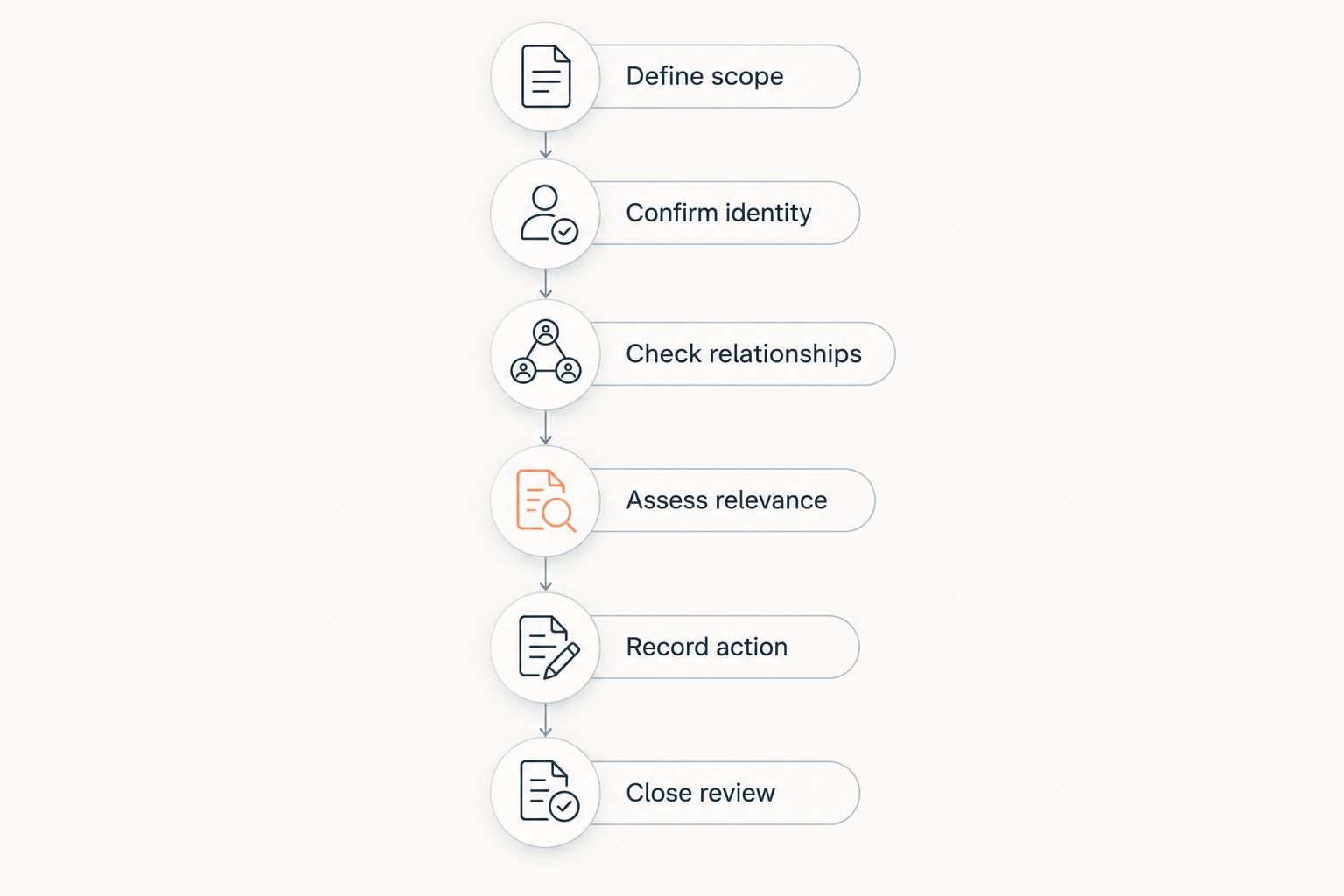
For your 2026 review log, use explicit outcomes rather than a single risk label. Suggested statuses include insufficient evidence, identity mismatch, relationship requiring assessment, and review completed. Keep the reasoning beside the status so another authorized reviewer can understand the decision.
Why conflict-detection results vary
Screening quality depends on what the check can see and how the review is designed. Assess these factors before accepting a demonstration as evidence that a system meets your needs:
- Record coverage. A check cannot identify a relationship that is absent from every source it uses. Ask which people, entities, and relationship types are covered.
- Identity resolution. Shared names and inconsistent spelling require careful matching. Ask how the workflow handles ambiguous identities rather than only exact matches.
- Record currency. Ownership and procurement roles change. Review the dates attached to the underlying records, not just the date an alert appeared.
- Relationship depth. A direct connection and an indirect connection require different supporting records. Define how far your review needs to follow a relationship.
- Rule design. A shared address, common owner, and declared family relationship are different signals. Require a clear explanation of the rule behind each alert.
- Review discipline. An unexplained alert is not a defensible outcome. Assign an owner and require a documented assessment before closing the case.
Do not accept an accuracy claim without the test conditions. Ask what was checked, how correct matches were confirmed, and how missed relationships were identified. A demonstration using clean records does not establish performance on your actual procurement data.
What should you ask a software vendor to demonstrate?
Build a 2026 evaluation around controlled examples that your review team understands. Use authorized or fictional records, and avoid submitting confidential personal information without an approved basis and suitable safeguards.
Ask the vendor to work through these cases:
- A clear connection: the supplied records show a relevant relationship between a bidder and a procurement participant.
- A mistaken identity: similar names belong to different people or legal entities.
- An unresolved connection: the available evidence cannot establish whether the parties are related.
- A disclosed relationship: the reviewer must assess an existing declaration rather than merely identify a match.
For each case, require the original evidence, the matching explanation, and the review outcome. Ask whether a reviewer can correct an identity match without erasing the original alert or its history.
Also inspect access controls. Tender intelligence and personal conflict declarations are different information types; decide who is authorized to see each before combining them in a review workflow.
The acceptance question is practical: can your reviewer explain the alert and defend the resulting decision? A prominent warning badge is not enough.
Where does Dauthau fit in a Vietnamese bid review?
Dauthau is best suited to Vietnamese businesses researching tenders, contractors, and bidding results. Its stated role is a bidding-intelligence software platform covering public and private procurement across Vietnam.
That makes Dauthau relevant to the research stage of a bid review. Searching, tracking, and analyzing procurement information can support the context you assemble before assessing a possible relationship.
The boundary matters: do not treat that stated research scope as confirmation of automated conflict alerts, ownership-network analysis, or employee-declaration matching. Verify any required screening capability directly before including it in your procurement controls.
Use the platform's stated purpose to frame your evaluation, not to infer an unconfirmed compliance function. Tender research supports an investigation; it does not replace the evidence needed to establish a conflict.
Can an unusual bidding pattern prove a conflict of interest?
An unusual bidding pattern cannot, by itself, prove a conflict of interest. It can justify further examination, but the review still needs evidence connecting a relevant interest or relationship to a procurement responsibility.
Keep the questions separate in your case notes. Record what the bidding history shows, then record what the relationship evidence establishes; do not use the first as shorthand for the second.
Can software clear a bidder when it finds no matches?
No matches means the configured check found no matches in the records it examined. It does not establish that every relevant relationship has been disclosed or recorded.
For a 2026 clearance decision, record the scope of the check and any unresolved evidence gaps. Avoid describing a limited database search as proof that a bidder has no conflicts.
FAQ
Can procurement software flag conflicts of interest automatically?
Procurement software can flag potential conflicts automatically when it has relevant relationship records and configured matching rules. Confirm the capability for the specific platform, and require human review before treating an alert as a finding.
What information do I need to check a bid for conflicts of interest?
You need reliable bidder identities, the relevant procurement roles, and evidence of the interests or relationships being checked. Declarations and ownership records answer different questions, so document the source and scope of each check.
Does a shared business address prove that bidders have a conflict?
A shared business address does not, by itself, prove a conflict of interest. Verify the entities and investigate the relationship before deciding whether it matters to the procurement.
Can tender results reveal an evaluator's financial interest?
Tender results alone do not establish an evaluator's financial interest. That question requires evidence about the evaluator and the relevant business relationship, not just award outcomes.
Should I reject a bidder after a software alert?
Do not base rejection solely on an unexplained software alert. Verify the evidence and follow the applicable procurement rules, review procedure, and decision-making authority.
What should I keep after reviewing a conflict alert?
Keep the supporting sources, identity checks, relationship assessment, reviewer, rationale, and resulting action. Preserve unresolved questions so the record does not imply that an incomplete check was conclusive.
One last thing
The most useful field in a conflict-review record is the explanation, not the risk label. Require every closed alert to state what was checked, what the evidence established, and why the reviewer chose the recorded action.
Before approving your 2026 workflow, ask another authorized reviewer to read a closed case without a verbal briefing. If the record cannot explain the decision on its own, improve the documentation before expanding automation.