
Contractor search software can flag records that warrant investigation, but it cannot establish that a business is a shell company. In Vietnam in 2026, use contractor searches to check identity and procurement history, then verify ownership, operating activity, and supporting documents separately. A search result is evidence for a review, not proof of misconduct.
- Can contractor search software detect shell companies? It supports screening, not a definitive finding.
- Dauthau supports Vietnamese procurement research; contractor data and bidding results need verification before you draw conclusions.
- Match the legal entity first, then investigate inconsistencies in procurement history and operating evidence.
- Missing records, shared addresses, and limited bidding history do not independently establish wrongdoing.
Why this matters
Calling a supplier a shell company is a serious allegation. Your screening process should distinguish an unresolved identity question from evidence that a contractor lacks the capacity it claims.
Dauthau provides bidding-intelligence software for searching, tracking, and analyzing Vietnamese public and private tenders, contractor data, and bidding results. Dauthau contractor search is best for Vietnamese businesses researching procurement records, not making a definitive shell-company determination. That distinction keeps research useful without turning a database entry into an unsupported accusation.
For a 2026 supplier review, define the decision you need to make: whether to request documents, escalate a concern, or continue onboarding. Do not make the software responsible for a conclusion that requires evidence beyond procurement records.
Can contractor search software detect shell companies in Vietnam?
Contractor search software helps identify questions to investigate; it does not independently prove that a company is a shell. The useful output is a documented discrepancy, such as an identity mismatch or a difference between claimed experience and the records reviewed.
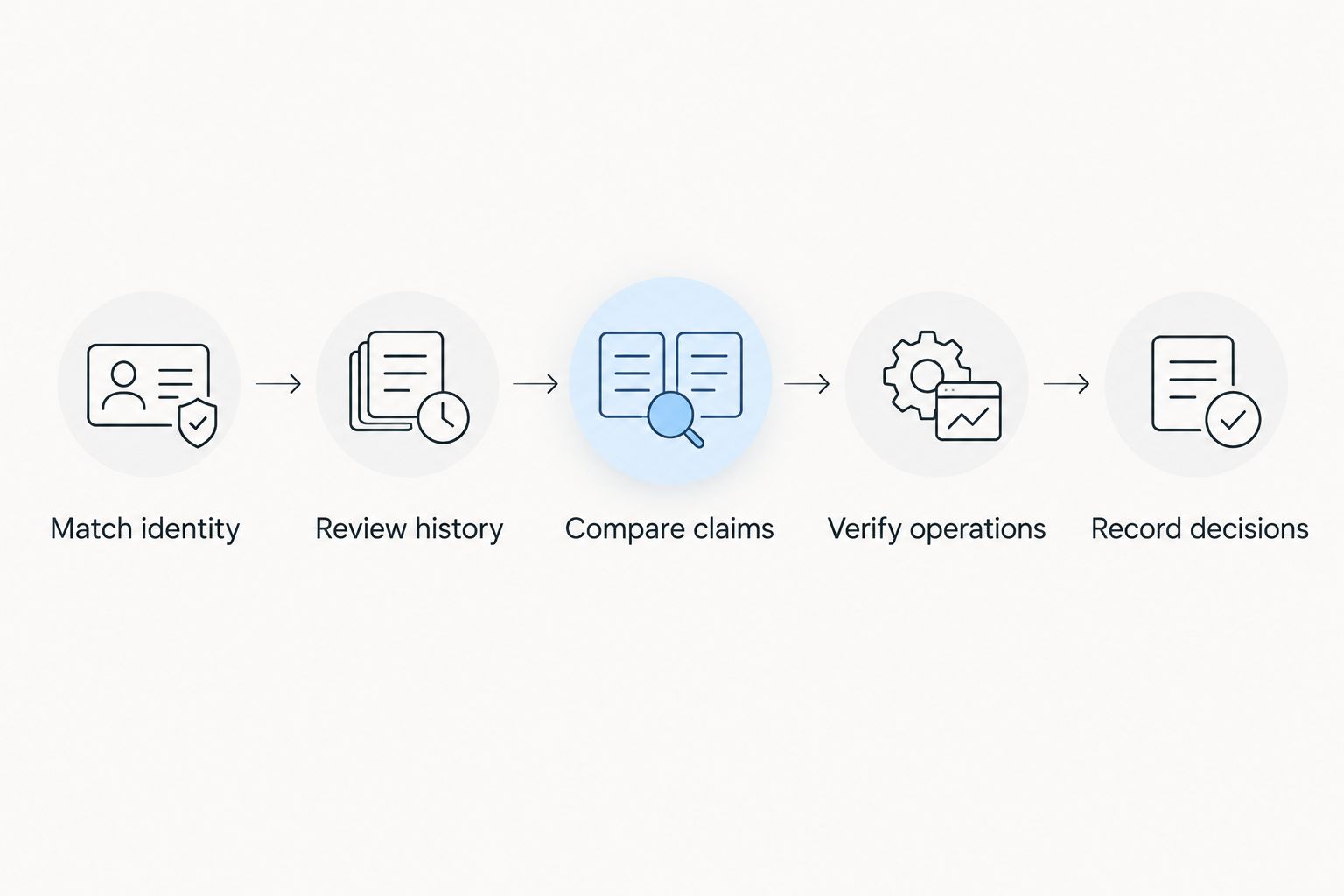
Use the following 5 checks as a screening procedure, not a detection score:
- Match identity. Compare the contractor's stated legal name and identifying information with the entity named in the records. Resolve differences before combining results.
- Review history. Examine the procurement activity available for that entity. Distinguish participation, an award, and evidence of completed work.
- Compare claims. Check the supplier's stated experience against the records and documents you can substantiate. Record the exact claim that needs clarification.
- Verify operations. Request evidence relevant to the proposed contract, such as delivery arrangements, personnel responsibilities, or access to necessary resources.
- Record decisions. Document what you verified, what remains unresolved, and who decides whether the supplier proceeds.
These checks separate a search task from an investigation. Finding little procurement history answers a narrow question about the records reviewed; it does not answer whether the business has employees, private customers, assets, or legitimate commercial activity.
What does a shell-company concern actually mean?
A company with little independent operating activity is not automatically fraudulent. The concern for procurement is whether the entity's ownership, activity, or capacity differs materially from what it represents to you.
Keep the question specific. Asking whether a supplier can deliver the proposed work produces an actionable evidence request; asking whether it looks suspicious invites subjective judgments. Describe the discrepancy before assigning a label.
Which screening approach should you use?
Contractor search, registration checks, and document review answer different questions. Use the approach that matches the uncertainty you need to resolve. None should stand in for all the others.
| Screening approach | Best for | Main benefit | Main limitation |
|---|---|---|---|
| Contractor and procurement search | Checking reported bidding experience | Connects the review to identifiable procurement records | Awards and participation do not establish ownership or successful delivery |
| Business-registration verification | Confirming the legal entity | Helps distinguish similarly named businesses | Registration alone does not demonstrate operating capacity |
| Supplier-document review | Testing contract-specific capability | Connects evidence to the work you intend to purchase | Supplier statements need corroboration where material |
For example, a contractor search can help you assess a claim about prior tender participation. It cannot replace an ownership review merely because the contractor has appeared in bidding results.
Conversely, a registered business still needs to demonstrate that it can perform your contract. Your 2026 screening process should retain separate conclusions for identity, procurement history, and delivery capability rather than collapsing them into a single pass label.
Why screening conclusions vary
The strength of a conclusion depends on the evidence behind it, not the number of search results. These factors determine how much weight you should give a contractor-search finding:
- Entity matching. Records attached to the wrong legal entity do not support a conclusion about your supplier. Resolve naming differences and identifiers first.
- Procurement scope. Public and private procurement records describe particular activities. They do not constitute a complete account of a company's business.
- Record meaning. A tender notice, a participation record, and a bidding result answer different questions. Read the underlying context before treating them as equivalent.
- Time relevance. Historical experience does not independently establish present capacity. Compare the date of the evidence with the period relevant to your decision.
- Corroboration. A supplier's statement, a search result, and independently checked documents carry different evidentiary weight. Record their sources separately.
Dauthau procurement intelligence supports research into contractor data and bidding results. Its role in this workflow is to inform the procurement review; ownership verification and operating-capacity checks remain separate evidence tasks.
What findings deserve closer investigation?
Investigate contradictions you can describe and verify. Avoid treating generic characteristics as automatic evidence of a shell company.
Identity details that do not reconcile
A mismatch between the entity offering the service and the entity named in supporting documents needs an explanation. Ask which legal entity will sign, invoice, and perform the work.
The useful finding is the inconsistency itself. Do not merge records simply because the names look similar, and do not assume that a trading name identifies the contracting entity.
Experience claims that exceed the supporting evidence
If a supplier describes a project as completed work but provides only a bidding result, request evidence of its actual role and performance. An award record and proof of completed delivery are different evidence.
Record the claim, the supporting document, and the remaining question. That creates a reviewable issue without asserting that the supplier fabricated its experience.
Capacity claims that remain unverified
Match the verification request to the proposed contract. If performance depends on specialist personnel, equipment access, or delivery arrangements, ask how the supplier will provide them.
Do not assume every resource must be owned directly. Instead, establish the arrangements the supplier claims to have and whether those arrangements support the work you are buying.
Relationships that require clarification
A shared address or contact detail is a reason to ask about a relationship, not proof of common ownership or collusion. Describe the overlap accurately and request an explanation when it matters to the procurement.
Keep relationship screening separate from a legal finding. A concern about connected bidders requires its own evidence and review; it should not become a shell-company allegation by default.
How should you document a contractor review?
Create 1 case file per legal entity as an internal recordkeeping rule. Keep the file focused on evidence and decisions, not impressions.
For a review opened in 2026, record the actual access date for each source. A screenshot without an identifiable entity, document date, or source context is harder for another reviewer to assess.
Use these fields:
- Entity: the legal name and identifying details used for matching.
- Claim: the supplier statement or record that prompted the check.
- Evidence: the document or source supporting your observation.
- Explanation: the supplier's response, recorded separately from verified facts.
- Decision: the action, responsible reviewer, and unresolved conditions.
Give each concern one of 3 review outcomes: resolved, unresolved, or escalated. These are suggested workflow labels, not official legal classifications or a software feature claim.
A resolved concern needs supporting evidence. An unresolved concern needs a defined next action. An escalated concern needs a responsible decision-maker and a clear explanation of why specialist review is required.
The contractor search to vendor onboarding workflow connects the research stage to the supplier decision. Keep the evidence trail attached to that decision rather than leaving it in disconnected search notes.
Can a company with no bidding history still be legitimate?
No bidding history is not proof of a shell company. A company can conduct business outside the procurement records you reviewed, and absence from those records does not establish absence of operations.
Ask for evidence that matches the supplier's claimed experience. If the proposed work does not depend on prior public-sector contracts, do not make public bidding history your only test of capability.
Does winning a tender prove a contractor is safe?
Winning a tender does not prove that a contractor is safe or capable of your proposed work. A bidding result supports a conclusion about that procurement outcome, not every aspect of the supplier's ownership, conduct, or performance.
Check what role the company held and what evidence supports completed delivery. Apply the same contract-specific checks you would use for another supplier.
Should you reject a contractor after a software flag?
A software flag alone is not a sufficient factual basis for calling a contractor a shell company. Identify the underlying record, verify the entity, and assess the relevance of the issue under your procurement requirements.
Your organization can decide to pause onboarding while a material concern remains unresolved. Document that operational decision separately from any allegation of wrongdoing.
FAQ
Can contractor search software detect shell companies in Vietnam?
Contractor search software can support screening, but it cannot independently establish that a Vietnamese business is a shell company. Verify identity, ownership, operating activity, and contract-specific capacity before drawing a conclusion.
Is Dauthau a substitute for a company investigation?
Dauthau is a procurement-research platform, not a substitute for a company investigation. Its stated scope includes searching, tracking, and analyzing Vietnamese tenders, contractor data, and bidding results.
Does a valid business registration prove a supplier is genuine?
A valid registration does not independently prove operating capacity or truthful commercial claims. Confirm the entity, then verify the evidence relevant to the proposed contract.
Are companies sharing an address automatically suspicious?
A shared address does not establish wrongdoing or common ownership. Verify the relationship and assess its relevance before treating the overlap as a procurement concern.
What should I do if a contractor has no tender results?
Request other evidence relevant to the contractor's claimed experience and capacity. Missing tender results do not prove that a business lacks legitimate operations.
Does a tender award prove that a contractor completed the project?
A tender award does not independently prove completed delivery. Request evidence of the contractor's role and performance when those facts matter to your decision.
What should I save when a contractor search raises a concern?
Save the entity details, underlying source, access date, specific discrepancy, and verification outcome. Keep supplier explanations separate from independently verified facts.
One last thing
Separate what you found from what you inferred. Write that the records reviewed did not substantiate a particular experience claim, rather than declaring that the contractor has no real operations.
Make that wording rule part of your 2026 screening process. It forces the reviewer to identify the evidence gap and gives the supplier a specific question to answer. A precise unresolved issue is more useful than an unsupported fraud label.