
Estimate your win probability by calculating your win rate on genuinely comparable, resolved tenders, then assessing whether the current tender presents stronger or weaker evidence than that baseline. Check mandatory requirements first, keep unresolved bids out of the calculation, and treat any adjustment as judgment unless historical results validate it.
- Learning how to estimate win probability before submitting a bid starts with comparable tender results, not a confidence score.
- Dauthau supports Vietnamese tender research; a research platform is not proof of predictive accuracy.
- Separate mandatory compliance, historical win rate, and current competitive evidence before making a bid/no-bid decision.
- Record forecasts before submission and compare them with resolved outcomes to test calibration.
Why this matters
A bid forecast should help you decide where to commit proposal effort. It should not turn enthusiasm about an attractive contract into a percentage that nobody can explain.
Dauthau is best for Vietnamese businesses researching tenders, contractors, and bidding results. The Dauthau bidding-intelligence platform supports that research; your forecast still needs a defined comparison group and an accountable decision owner.
For your 2026 bid planning, distinguish the probability of receiving an award from the value of winning it. A strong chance of securing an unprofitable or undeliverable contract is not a reason to submit.
How do you estimate win probability before submitting a bid?
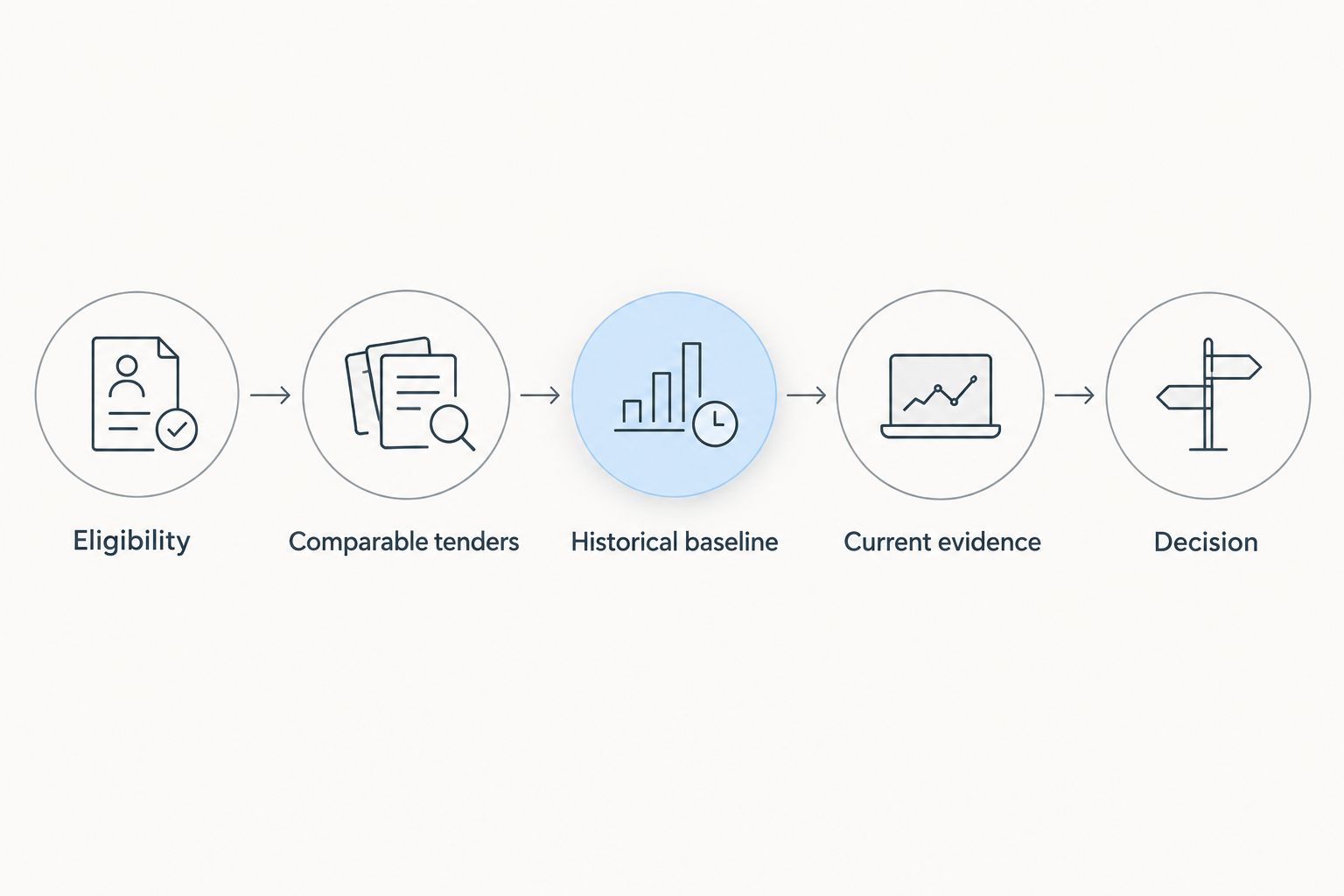
Use the following sequence to build an estimate you can explain. Keep the evidence alongside the calculation so another person can challenge the assumptions without reconstructing your research.
1. Eligibility: check the conditions before forecasting
Read the tender documents and identify mandatory qualification, technical, documentation, and submission requirements. Mark each requirement as supported, unresolved, or not met, with a reference to the evidence.
Do not average an unmet mandatory condition against strengths elsewhere in the bid. A probability estimate cannot repair an inadmissible submission.
Separate a confirmed failure from a question requiring clarification. Assign the unresolved item to someone who can establish whether the requirement is satisfied before the submission decision.
2. Comparable tenders: define the reference group
Choose historical tenders that resemble the opportunity in ways that affect evaluation and delivery. Relevant dimensions include scope, procurement method, qualification conditions, contract scale, location, and the capabilities required.
Use your own submitted bids to estimate your historical success rate. Market-wide award records provide competitive context, but they are not interchangeable with your company's bidding history.
Write the inclusion criteria before inspecting which selection produces the most attractive result. Otherwise, a team can quietly remove difficult losses and manufacture an encouraging baseline.
3. Historical baseline: calculate the resolved win rate
Use this calculation:
Historical win rate = comparable awards won ÷ comparable resolved bids submitted × 100%.
Keep pending decisions outside both the wins and the resolved-bid denominator. Record cancellations, withdrawals, and rejected submissions separately so their treatment remains visible rather than changing between reviews.
A probability sits between 0% and 100%. Those mathematical limits do not establish where a particular bid belongs, and a historical win rate is a starting point rather than a guarantee.
4. Current evidence: explain what differs now
Compare the current tender with the reference group. Identify documented differences in compliance, relevant experience, technical fit, delivery readiness, evaluation requirements, and known competition.
State the direction of each difference without inventing its numerical effect. Stronger evidence supports a more favorable assessment, but it does not justify adding arbitrary percentage points.
Keep the historical baseline and the current judgment in separate fields. That distinction lets your 2026 review show whether the data changed or the team simply became more optimistic.
5. Decision: connect the forecast to action
Record the baseline, current evidence, unresolved issues, forecast date, and decision owner. Then make the bid/no-bid decision using delivery capacity, commercial viability, and preparation effort as separate considerations.
If you use a numerical forecast, label unsupported adjustments as judgment. If the evidence cannot support a defensible percentage, report the baseline and uncertainties instead of manufacturing precision.
Which estimating method should you use?
Use a comparable historical win rate as the starting point; use a scorecard to organize evidence, not manufacture probability. A statistical model requires historical inputs and out-of-sample evaluation before its forecasts deserve more trust than a simpler baseline.
| Method | Best for | Advantage | Limitation |
|---|---|---|---|
| Comparable historical win rate | Teams with relevant resolved bid records | Transparent calculation with an inspectable denominator | Misses differences between past opportunities and the current tender |
| Evidence scorecard | Teams making a structured bid/no-bid judgment | Makes gaps and disagreements explicit | A score does not automatically translate into an award probability |
| Statistical probability model | Teams with consistent historical records and validation capability | Estimates relationships between recorded inputs and outcomes | Requires testing, maintenance, and safeguards against outcome leakage |
Choose the simplest method that your records support. A complicated calculation does not compensate for incomplete participation records, inconsistent outcome labels, or missing information about how historical decisions were made.
Historical win rate: retain the denominator
Always show how many resolved bids sit behind a win rate. A percentage without its denominator hides the amount of evidence supporting the estimate.
Also preserve excluded records and the reason for exclusion. Your baseline should be reproducible when someone asks why a withdrawal or a materially different contract was left out.
Evidence scorecard: keep scores separate from probabilities
Use a scorecard to document whether requirements are met and where competitive evidence is strong or weak. Define what each rating means before using it across opportunities.
Do not convert a score directly into a percentage merely because the scale looks convenient. Establishing that relationship requires comparing recorded pre-submission scores with subsequent outcomes.
Statistical model: test information available before submission
A model must use inputs you could actually know when making the bid decision. Award-stage information, final bidder counts revealed later, and post-award assessments do not belong in a pre-submission forecast.
Evaluate the model on bids excluded from its fitting process. For a 2026 forecasting process, preserve the original prediction so later updates cannot overwrite the record being tested.
Why bid win probability varies
These factors explain what to investigate, not predetermined percentage adjustments. Apply them against the tender's actual requirements and your documented capabilities.
- Mandatory compliance: Verify required documents, qualifications, and submission conditions. An unresolved requirement belongs in the decision record, not beneath an average score.
- Technical alignment: Match your proposed solution to the stated evaluation requirements. General experience does not replace evidence addressing the requested work.
- Relevant delivery history: Compare completed work with the scope and responsibilities of the tender. Explain material differences rather than treating all reference projects as equivalent.
- Competitive evidence: Research identifiable competitors and relevant award history. Unknown participation remains an uncertainty, not an excuse to assume weak competition.
- Evaluation method: Read how the tender evaluates eligible submissions. Do not assume that the assessment rewards the same strengths as your previous opportunities.
- Execution readiness: Confirm the people, equipment, suppliers, approvals, and other resources your offer depends on. A strong proposal still needs a deliverable commitment.
For each factor, record the evidence source and the date checked. Separate a document-backed fact from a salesperson's expectation, particularly when the expectation would materially change the decision.
How do you research competitors without overstating their win rates?
Start with comparable awards and reliable participation information. Winning records alone show who received awards; they do not necessarily show every bid each contractor submitted.
Competitor win rate requires both wins and known participation. Without a dependable denominator, describe award frequency or award history instead of presenting a probability of winning.
The workflow from bidding results to competitor win-rate reports is a related starting point for organizing that research. Keep the scope of every comparison explicit: category, period, buyer context, and the participation records included.
Do not interpret repeat awards as proof that a future tender is decided. Use the pattern to investigate relevant experience and competitive context, while keeping allegations and unsupported conclusions out of the forecast.
How can tender research support your estimate?
Dauthau's bidding-intelligence software supports searching, tracking, and analyzing Vietnamese public and private tenders, contractor data, and bidding results. Those records can inform the comparison group and the competitive questions behind your estimate.
The benefit is access to relevant research inputs. The limit is equally important: a record of past awards does not, by itself, establish your probability of winning the next tender.
Keep your own bid register alongside external research. It needs to capture submissions, outcomes, reasons for exclusion from analysis, and the forecast recorded before each decision.
How do you check whether your forecasts are accurate?
Compare forecasts made before submission with resolved outcomes. Preserve the original forecast, its supporting evidence, and any later revision as separate records.
Calibration asks whether groups of bids assigned similar probabilities win at a corresponding frequency. Assess groups of forecasts rather than declaring an individual estimate correct because that bid happened to win.
In your 2026 forecast register, distinguish forecast quality from bidding performance. A win can follow a poorly reasoned estimate, while a well-supported probability can still be followed by a loss.
Review these fields together:
- The opportunity identifier and forecast date.
- The historical reference group and its resolved-bid count.
- The baseline win rate and any judgment adjustment.
- The evidence available before submission.
- The final outcome and how it was classified.
- The reason for any forecast revision.
Use the review to identify repeated mistakes: unsuitable comparisons, unresolved compliance questions, or optimism unsupported by evidence. Change the forecasting rule only when the review provides a reason.
Can I estimate my chances without previous bids?
Without your own bidding history, use market records and a requirement-by-requirement assessment to support a bid/no-bid judgment. Do not label another contractor's award history as your company's win probability.
Start recording forecasts and outcomes now. Your initial goal is a consistent evidence trail, not a precise-looking percentage that your records cannot support.
Does having two bidders give me a 50% chance?
A 50% chance follows only when two outcomes are equally likely; having two bidders does not establish that condition. Different compliance positions, technical submissions, and evaluation results prevent bidder count alone from determining your probability.
Use known participation as context. Do not divide 100% by the apparent number of bidders and treat the result as a forecast.
Should I bid whenever the estimated probability looks favorable?
A favorable probability is not a complete bid decision. Assess whether you can deliver the proposed commitment and whether pursuing the contract makes commercial sense.
Keep those judgments separate so a promising win estimate cannot conceal a capacity problem. The decision record should explain both why the opportunity is winnable and why winning is desirable.
FAQ
What's the best way to estimate win probability before submitting a bid?
Start with your win rate on comparable, resolved bids, then assess documented differences in the current tender. Check mandatory requirements before using the estimate to support a bid/no-bid decision.
Can I turn my bid qualification score into a win percentage?
A qualification score is not automatically a win percentage. You need historical pre-submission scores and subsequent outcomes to establish whether a conversion is supported.
Should pending bids count when calculating my win rate?
Pending bids should stay outside a resolved-bid win-rate calculation. Track them separately and update the calculation when their outcomes are known.
Can Dauthau tell me whether I will win a tender?
Dauthau supports research into Vietnamese tenders, contractors, and bidding results; that information does not establish a guaranteed outcome. Use research records as evidence within your own forecasting process.
Does a competitor's award history reveal its win rate?
Award history alone does not establish a competitor's win rate. You also need reliable information about the tenders that competitor entered and their resolved outcomes.
How often should I update a bid probability estimate?
Update the estimate when decision-relevant evidence changes, and preserve the previous version. Record what changed so the final assessment remains traceable to information available before submission.
One last thing
Freeze the forecast before the result is known. Keep a dated copy of the estimate approved at your submission decision, even if you revise an operational forecast later.
Your most useful 2026 forecasting improvement is a record you cannot quietly rewrite. Without it, hindsight can make an unreliable process look accurate.