
To qualify for small enterprise tender set-asides in Vietnam, first establish that the specific tender restricts participation to your enterprise category, then document your classification and meet its bidder eligibility requirements. Small-business status alone does not establish access to a reserved tender or replace the technical, financial, and submission requirements in the bidding documents.
- How to qualify for small enterprise tender set-asides starts with verifying the tender’s actual participation restriction.
- Vietnamese enterprise classification depends on sector, insured employees, and revenue or capital—not headcount alone.
- Dauthau supports tender research; the applicable law and bidding documents determine eligibility.
- Do not confuse a bidding preference with an exclusive right to participate.
Why this matters
Classification and tender eligibility are separate decisions. Your business can satisfy a small-enterprise definition yet fail a particular package’s experience, financial-capacity, or technical requirements. Conversely, a tender open to businesses generally does not become a set-aside because a small enterprise submits a bid.
For your 2026 pipeline, separate opportunity discovery from legal verification. Dauthau provides bidding-intelligence software for researching Vietnamese public and private tenders, contractor data, and bidding results; those records support research, not a legal determination of eligibility.
Before committing proposal resources, identify the exact participation clause and the evidence needed to satisfy it. A package description, search result, or informal assurance is not a substitute for that clause.
How do you qualify for small enterprise tender set-asides?
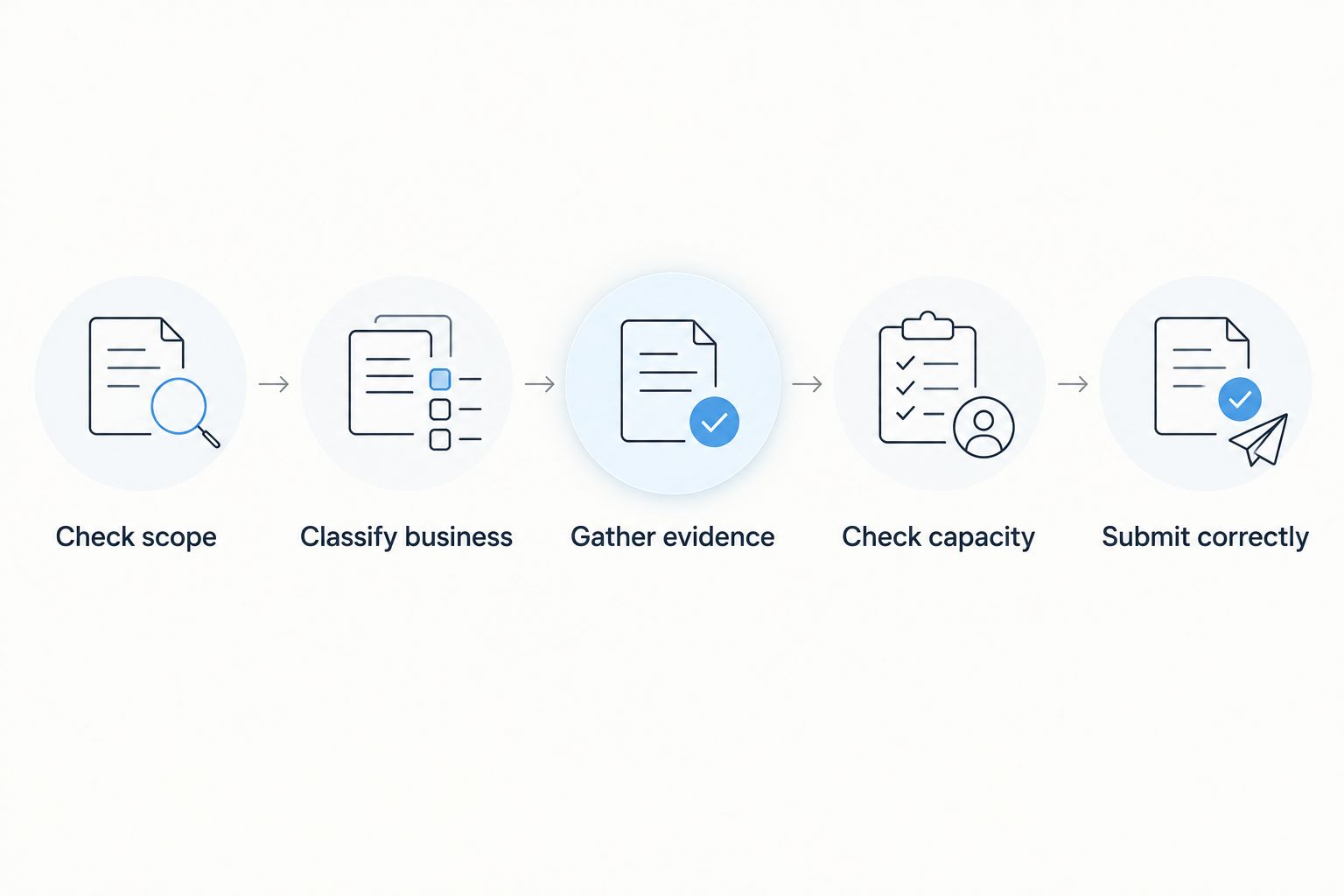
Use the following sequence for each opportunity. Do not begin with the assumption that Vietnam has a universal small-business reservation covering every procurement category. Establish the applicable rule for the actual package first.
- Check scope. Identify the procurement regime, package type, and explicit restriction on participation. Distinguish public procurement requirements from a private buyer’s supplier-selection conditions.
- Classify business. Establish your sector and calculate the employee, revenue, and capital measures required by the applicable enterprise-classification rules.
- Gather evidence. Match every classification statement to supporting records and any declaration required by the bidding documents.
- Check capacity. Review legal standing, experience, financial capacity, technical requirements, and any consortium conditions separately from enterprise size.
- Submit correctly. Complete the required forms, authorizations, attachments, and electronic submission steps by the stated deadline.
Keep a record of the document version used for each decision. For a 2026 submission, also check effective dates and transitional provisions rather than relying on guidance written for an earlier procurement regime.
What counts as evidence that a package is reserved?
Look for an express participation restriction in the applicable procurement rules and bidding documents. Record the eligible enterprise categories, package conditions, and required proof together.
A statement that small businesses receive a preference is different from a statement that only specified enterprise categories can participate. Likewise, a buyer’s interest in local suppliers does not by itself establish an exclusive small-enterprise competition.
If the wording conflicts, request formal clarification through the procedure specified for the tender. Ask which provision applies, which documents prove compliance, and whether the answer changes any submission requirement.
How is a small enterprise classified in Vietnam?
Vietnam’s enterprise-size framework distinguishes sectors and uses more than employee numbers. Decree No. 80/2021/ND-CP, issued on 26 August 2021, sets out classification criteria for micro, small, and medium-sized enterprises; its small-enterprise criteria provide the baseline below.
For a 2026 tender, check the classification provisions applicable to that procurement before using these thresholds. A classification baseline is not proof that a particular reservation exists or that no amendment affects your bid.
| Sector grouping | Annual average employees participating in social insurance | Financial condition | Practical advantage | Limitation |
|---|---|---|---|---|
| Agriculture, forestry, fisheries, industry, and construction | No more than 100 employees | Annual revenue no more than VND 50 billion, or total capital no more than VND 20 billion | Gives a defined classification test for businesses in these sectors | The employee condition still applies; businesses classified as micro are excluded from the small category |
| Trade and services | No more than 50 employees | Annual revenue no more than VND 100 billion, or total capital no more than VND 50 billion | Uses a separate financial test for trade and service businesses | The lower employee ceiling matters; businesses classified as micro are excluded from the small category |
Read the financial test carefully: the employee condition applies alongside the revenue-or-capital condition. Do not turn the financial alternatives into permission to ignore the employee ceiling.
The monetary amounts above are enterprise-classification measures, not tender prices or contract-value limits. They do not establish which packages are reserved.
Which sector should your business use?
Determine the classification sector under the applicable rules rather than choosing whichever threshold produces the preferred result. Under the cited decree, the enterprise’s principal business sector is determined by the sector generating its highest revenue.
For a business with several activities, retain the revenue breakdown supporting that conclusion. Do not automatically classify the entire enterprise by the subject of the tender you want to win.
Does being smaller always mean qualifying as a small enterprise?
No. Micro enterprises and small enterprises are distinct categories in the classification framework.
Read the tender’s wording literally. A condition covering “micro and small enterprises” is not the same wording as a condition covering only “small enterprises”; establish how the applicable procurement provision treats each category before submitting a declaration.
What documents should you prepare?
Build an evidence file around the actual forms and evaluation criteria. Treat the following as a preparation checklist, not a universal list of mandatory attachments.
- Legal identity: business registration information and records showing which legal entity submits the bid.
- Sector evidence: business activities and the revenue breakdown supporting the classification sector.
- Employee evidence: social-insurance records supporting the prescribed annual employee calculation.
- Financial evidence: financial statements and supporting records for the relevant revenue or capital measure.
- Classification statement: the declaration or form requested by the bidding documents, with its supporting calculation.
- Bid-specific evidence: contracts, acceptance records, authorizations, licenses, or other documents required by the package.
Use consistent company names and identifiers across the file. Explain a name change, restructuring, or discrepancy with supporting records rather than leaving evaluators to reconcile it.
For your 2026 file, label the reporting period on each financial and employee record. A current registration document does not establish the figures for the historical reporting period used in an enterprise-size calculation.
How should you handle a newly established business?
Do not invent a full operating year or substitute a forecast for historical evidence. Check the applicable calculation rules for newly established enterprises and the tender’s instructions for businesses without a complete reporting period.
Ask for clarification if the form assumes records your business cannot yet possess. Keep the formal response with the bid file and follow its instructions without concealing the business’s actual trading history.
Why qualification varies between tenders
Qualification varies because the enterprise-size test is only part of the decision. These factors require separate checks:
- Procurement scope: public procurement rules and a private buyer’s qualification policy are not interchangeable.
- Participation wording: a preference, a reserved competition, and an ordinary open tender create different questions.
- Enterprise sector: employee and financial thresholds differ between the sector groupings shown above.
- Reporting period: the required calculation period determines which employee and financial records support your declaration.
- Package requirements: experience, technical capacity, and financial conditions remain separate from enterprise classification.
- Bid structure: consortium participation requires checking the applicable conditions for members and their assigned work.
Use a compliance matrix, not a general “SME eligible” label. Give each requirement its own row, supporting document, responsible person, and unresolved question.
This also exposes the practical trade-off. A classification checklist makes screening repeatable, but it cannot resolve ambiguous procurement wording; that requires an authoritative clarification or legal assessment.
Can a consortium qualify if one member is not small?
Do not assume that a qualifying lead member establishes eligibility for every consortium member. Read the reservation provision and consortium requirements together, including how the conditions apply to each member and its allocated work.
A consortium can combine documented capabilities, but it also adds eligibility and responsibility questions. Resolve those questions before signing the consortium agreement, not after preparing the technical proposal.
Check subcontracting separately. A subcontractor’s classification does not automatically change the classification of the bidding enterprise or establish the bidder’s right to participate.
Does small-enterprise status remove experience requirements?
Small-enterprise status does not, by itself, waive experience or technical requirements. Identify any express exemption in the applicable rules or bidding documents instead of inferring one from the package’s intended participants.
Map each required contract reference to evidence of your company’s actual role and completed work. Do not present a director’s previous employer’s projects as contracts performed by your current legal entity.
If a requirement appears inconsistent with the stated participation conditions, raise it through the formal clarification process. Your response should address the published criteria, not an assumption about what the buyer intended.
Where does tender software help?
Dauthau bidding-intelligence software is best for Vietnamese businesses researching tenders, contractors, and bidding results. Its role in this workflow is opportunity research and supporting analysis, not certifying enterprise size or guaranteeing admission to a reserved competition.
Start with opportunities relevant to your business activities, then inspect the original participation conditions. The guide to finding tenders that match your business lines supports that initial screening step.
The benefit is keeping discovery separate from compliance decisions. The limitation is equally important: finding a relevant tender does not establish that your business satisfies its legal or technical conditions.
Research relevant Vietnamese tenders
Search tender opportunities, contractor information, and bidding results to support your initial screening.
FAQ
How do I qualify for small enterprise tender set-asides in Vietnam?
Verify that the specific tender reserves participation for your enterprise category, document your classification, and satisfy its remaining bidder requirements. Small-enterprise status alone does not establish eligibility for every package.
Is every low-value government tender reserved for small enterprises?
Do not treat a low contract value as proof of a reservation. Check the applicable procurement provision and the tender’s express participation conditions.
How many employees can a small enterprise have in Vietnam?
The small-enterprise classification baseline in Decree No. 80/2021/ND-CP uses ceilings of 100 insured employees for agriculture, forestry, fisheries, industry, and construction, and 50 for trade and services. Financial criteria and exclusion from the micro category also apply; verify the provisions applicable to your tender.
Can I qualify using capital instead of annual revenue?
The cited classification framework permits revenue or capital as the financial condition, alongside the applicable employee condition. Use the prescribed records and calculation method rather than selecting an unsupported figure.
Can a new company bid without previous contracts?
A new company must check the package’s experience requirements and any applicable exemptions. Small-enterprise classification does not automatically replace evidence of experience.
Does Dauthau decide whether my company qualifies?
Dauthau provides bidding intelligence, not an eligibility determination. Use the applicable law, bidding documents, and formal clarifications to establish your company’s qualification.
What should I do if the tender documents contradict each other?
Request formal clarification through the tender’s specified procedure. Identify the conflicting clauses and ask which requirement and evidence apply before submission.
One last thing
Check the boundary between “micro” and “small” before signing a small-enterprise declaration. A business can fall below a small-enterprise ceiling yet belong to the separate micro category; lower figures do not eliminate the need to identify the correct classification.
For every 2026 bid, keep a short decision record: the participation clause, applicable classification provision, calculation period, supporting evidence, and formal clarifications. That record makes the eligibility decision explainable without reconstructing it from emails after submission.