
Tender software can support checks of a contractor’s financial capacity, but it cannot independently prove that the contractor has enough money to deliver a contract. In 2026, use procurement records to identify questions, then verify the answers against financial statements, financing evidence, and the specific tender’s requirements.
- Can tender software verify contractor financial capacity? Not alone; procurement records support screening, not proof of available funds.
- Dauthau supports Vietnamese tender research; financial capacity verification requires separate financial evidence.
- A contract award shows an award decision, not cash received, profit earned, or remaining borrowing capacity.
- Match the legal entity, reporting period, financial evidence, and tender criteria before recording a financial assessment.
Why this matters
A contractor’s bidding history is not its balance sheet. An award record helps establish procurement activity, but it does not establish whether the contractor can fund materials, payroll, or delivery before receiving payment.
For Vietnamese businesses researching contractors, Dauthau provides a bidding-intelligence platform for searching, tracking, and analyzing public and private tenders, contractor data, and bidding results. Those records support the research stage. Financial approval requires evidence that addresses the contractor’s actual obligations and the proposed contract.
Keep those decisions separate in your 2026 screening process. Otherwise, a detailed contractor profile can create confidence without resolving the financial question that matters.
Can tender software verify a contractor’s financial capacity?
No—not on procurement records alone. Tender software supports financial due diligence by helping you investigate contractor activity and bidding results. Verification requires checking financial evidence against the requirements of the contract you are assessing.
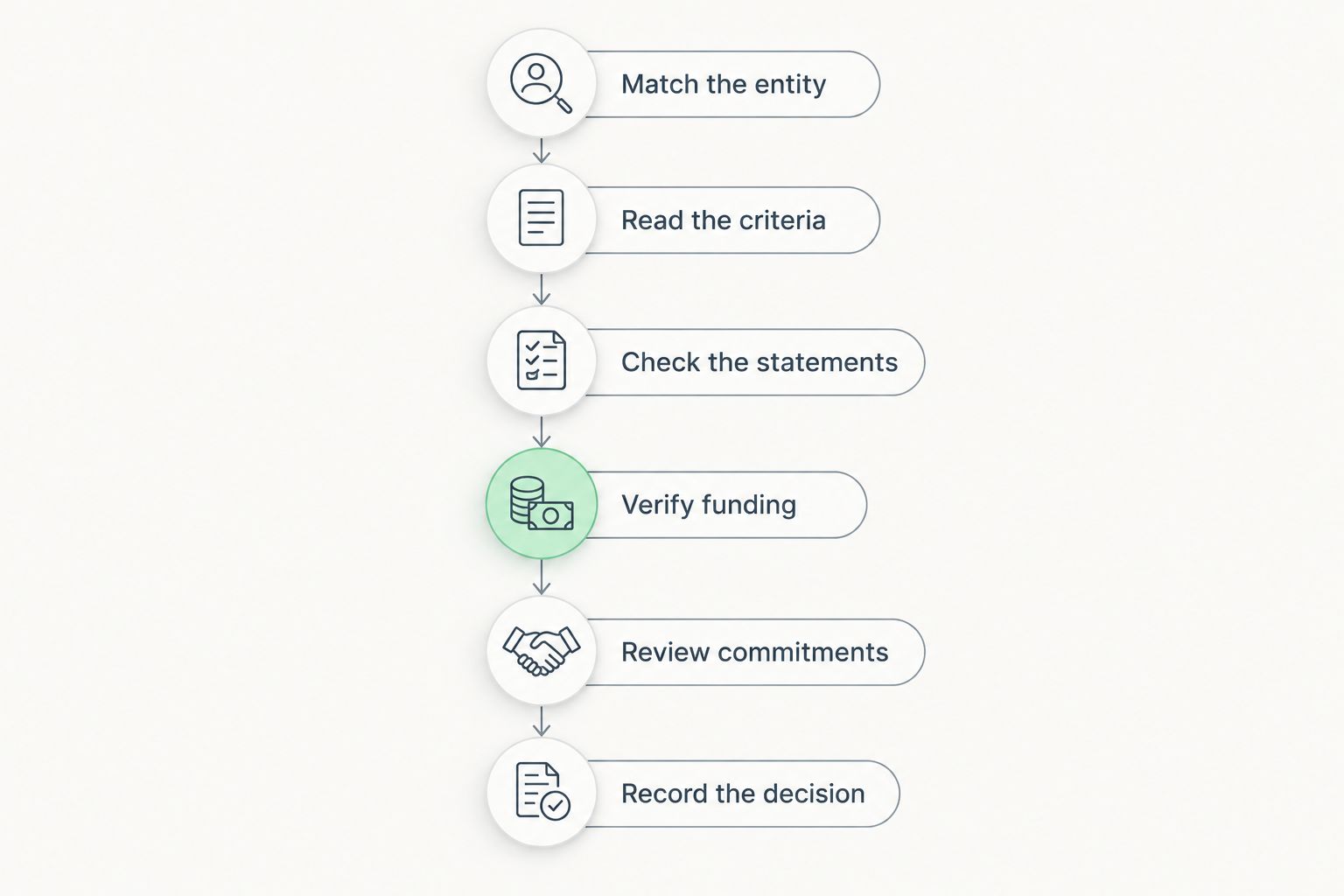
Use the following 6 steps as a review sequence, not as a statutory checklist. The applicable tender documents determine the actual qualification criteria.
1. Match the entity
Confirm that the contractor in the procurement record is the legal entity submitting the bid or entering the contract. Compare the registered name and identifying information across the records you review.
Do not substitute a parent company’s financial position for a subsidiary’s position without establishing why that support applies. Likewise, distinguish an individual company’s participation from its role in a joint venture.
2. Read the criteria
Extract the financial qualification requirements from the applicable tender documents. Record the required evidence, reporting periods, assessment method, and any permitted forms of financial support.
Separate mandatory qualification requirements from your organization’s additional risk checks. Passing an internal screening process does not establish compliance with a tender’s stated conditions.
3. Check the statements
Obtain the financial statements needed for the assessment and identify their reporting dates, reporting entity, and audit status. Read the accompanying notes rather than relying on a headline revenue figure.
Distinguish company-only statements from consolidated statements. A group’s reported resources do not automatically establish the resources available to the contracting entity.
4. Verify funding
Review the evidence supporting the contractor’s proposed funding arrangements. Where a bank facility or support commitment is relevant, check the beneficiary, conditions, validity, and relationship to the contract.
A document describing a facility is not the same as confirmation of unrestricted funds. Establish what the evidence actually demonstrates before recording it as available financing.
5. Review commitments
Use procurement history to identify contracts that need follow-up. Ask which contracts remain active, what work is outstanding, and what funding those obligations require.
Do not add award values together and label the total current workload. Award records alone do not establish completion status, payment status, or the contractor’s remaining share of the work.
6. Record the decision
Document the conclusion against each applicable criterion. Identify the evidence reviewed, unresolved questions, reviewer, and decision date.
Use clear statuses such as verified, clarification required, or not demonstrated. An unanswered financial question must remain unanswered; a positive procurement record does not close it.
Which evidence answers which financial question?
For a 2026 review, match each source to the question it can answer. Do not ask a procurement database to prove a bank balance, or ask a financial statement to establish the full status of every current contract.
The table separates useful evidence from conclusions that need additional support.
| Evidence source | Best for | What it supports | Limitation |
|---|---|---|---|
| Tender and award records | Identifying procurement activity | Research into participation, awards, and counterparties | Does not establish current cash, profit, or completed performance |
| Financial statements and notes | Assessing reported financial position | Review of assets, liabilities, results, and cash flows for the stated period | Does not establish the position after the reporting date |
| Financing documents | Examining proposed funding | Review of facility terms, conditions, and documented support | Does not by itself establish unconditional access to funds |
| Contract and payment records | Assessing existing commitments | Review of obligations, progress, and payment arrangements | Requires current records and reconciliation with the contractor’s explanation |
Use these sources together, but keep their conclusions distinct. A bank document does not repair an identity mismatch, and a strong historical income statement does not answer every question about current liquidity.
If you are building a repeatable review process, the contractor search to vendor onboarding workflow provides a related starting point for structuring the handoff from research to approval.
What tender software does well—and where it stops
Dauthau is best for Vietnamese businesses researching tenders, contractors, and bidding results—not for treating procurement history as proof of financial capacity. Its stated scope covers searching, tracking, and analyzing procurement information.
That makes procurement research relevant before a financial review. It helps you frame questions about a contractor’s activity and identify records to examine alongside documents supplied for the assessment.
The boundary matters. A procurement record does not independently authenticate a financial statement, confirm an account balance, or establish whether a financing commitment is still usable. Those conclusions require evidence directed at those questions.
For your 2026 process, separate the software’s research role from the reviewer’s approval role. Evaluate any proposed financial-checking feature by the evidence it retrieves, the checks it performs, and the unresolved matters it leaves visible—not by the presence of a score or badge.
Why financial capacity assessments vary
Financial capacity is assessed against a particular contractor, obligation, and date. The same procurement history cannot answer every assessment because the underlying question changes.
Focus your review on these 5 factors:
- Tender requirements: The applicable documents determine which financial criteria and supporting records matter. Start there rather than importing a generic pass mark.
- Reporting period: Financial statements describe a defined period. Review subsequent developments when the decision concerns a later date.
- Legal entity: Group accounts, subsidiary accounts, and joint-venture arrangements describe different scopes. Match the evidence to the entity responsible for performance.
- Funding conditions: A financing arrangement can contain conditions or restrictions. Read the terms before treating the stated amount as usable funding.
- Existing commitments: Other contractual obligations affect the question you need to investigate. Confirm their current status rather than inferring it from award announcements.
Do not turn these factors into an unsupported numerical rating. If your organization uses a scoring model, define the evidence and decision rule behind each input.
How should you interpret financial figures?
Read figures in context, not as standalone approval signals. Revenue describes sales, while profit, cash flow, and the balance sheet address different aspects of financial performance and position.
A contractor can report revenue without having collected the corresponding cash. Receivables therefore need different questions from cash balances: what is outstanding, when is payment expected, and what evidence supports recovery?
Likewise, a ratio is an analytical aid, not a universal pass mark. Compare the calculation with the tender’s stated method and examine the underlying figures before drawing a conclusion.
For a 2026 assessment, preserve the calculation, source document, reporting date, and interpretation together. A spreadsheet cell without its source is difficult to review and easy to misapply.
What should your verification record contain?
Build a short evidence register rather than a folder of unexplained attachments. The register should let another reviewer trace each conclusion back to a document and an applicable requirement.
For every financial criterion, record:
- The requirement as stated in the tender documents.
- The legal entity and reporting period covered by the evidence.
- The document source and date received.
- The calculation or check performed.
- Any discrepancy and the clarification requested.
- The conclusion, reviewer, and decision date.
Separate facts from interpretations. For example, recording that a contractor supplied a financing letter is a document-receipt fact; recording that the letter establishes usable funding requires examination of its terms and authenticity.
Dauthau procurement research belongs alongside this register as supporting context. Keep the financial conclusion tied to the evidence that actually establishes it.
Can you screen contractors before requesting financial documents?
Yes. Use an initial screen to establish identity, procurement activity, and the questions that justify further review. This is a research stage, not a financial-capacity certificate.
Set the outcome before you start: proceed to document review, request identity clarification, or stop pending resolution of a specific concern. Do not label a contractor financially qualified when you have only completed procurement screening.
Does winning several tenders prove a contractor is financially strong?
No. Several awards establish several award decisions, not current liquidity, profitability, or access to financing.
Investigate the contractor’s role, contract status, payment arrangements, and outstanding obligations. More recorded activity creates more questions to reconcile; it does not remove the need for financial evidence.
FAQ
Can tender software verify contractor financial capacity automatically?
Not from tender and award records alone. Software can support research and document checks, but a financial-capacity conclusion must be tied to relevant evidence and the applicable tender criteria.
What documents should I request to check a contractor’s financial capacity?
Request the documents specified by the applicable tender requirements, then address any additional evidence needed for your risk review. Relevant evidence includes financial statements and notes, financing documents, and records supporting current commitments.
Does a contractor’s award history prove it has enough working capital?
No, award history does not prove available working capital. It does not establish cash collected, outstanding payment obligations, or usable financing at the assessment date.
Are audited financial statements enough to approve a contractor?
Audited financial statements alone do not answer every contract-specific financial question. Check the reporting entity and period, the applicable qualification criteria, and any relevant developments after the reporting date.
Can I assess a contractor using its parent company’s accounts?
Do not treat parent-company accounts as interchangeable with the contractor’s accounts. Establish which entity must satisfy the requirement and whether any documented support is relevant and permitted under the applicable tender conditions.
Is there one financial ratio that proves a contractor can deliver?
No single financial ratio proves that a contractor can deliver a contract. Apply the tender’s stated criteria and examine the underlying figures, funding evidence, and obligations together.
What should I do when financial evidence conflicts with procurement records?
Record the discrepancy and request clarification before relying on either source for the disputed conclusion. Check entity identity, reporting dates, contract scope, and the documents supporting the contractor’s explanation.
One last thing
A missing document and a failed financial criterion are different findings. Record the former as not demonstrated or clarification required unless the applicable rules dictate another outcome; do not invent a negative financial fact to fill the gap.
For every approval in 2026, write a sentence explaining which evidence supports the decision. If that sentence mentions only tender wins, company visibility, or procurement activity, the financial review is unfinished.