
Tender software cannot tell you with certainty which bids your company will win; it can support a bid/no-bid decision by organizing tender requirements, contractor records, and past results. A numerical win prediction needs separate validation against completed competitions, and even a well-tested estimate does not guarantee the outcome of your next submission.
- Can tender software predict which bids you will win? Not with certainty; research and validated forecasting are different capabilities.
- Dauthau supports Vietnamese procurement research through tender, contractor, and bidding-results information.
- Check mandatory requirements before comparing your company with previous winners.
- Treat an unexplained win score as a ranking signal, not a reliable probability.
Can tender software predict which bids your company will win?
Tender software supports selection; it does not establish the winner before evaluation. Historical results describe completed competitions. Your next bid also depends on its requirements, your actual submission, and the competing submissions.
The distinction matters when assessing software in 2026. A platform that helps you find relevant opportunities is not automatically a forecasting system, and a system that ranks opportunities does not automatically produce calibrated probabilities.
Start with the workflow from bidding results to competitor win-rate reports to separate historical analysis from a prediction about your company.
| Approach | Best for | What it provides | Main limitation |
|---|---|---|---|
| Tender search and tracking | Finding relevant opportunities | Notices and information for further review | Relevance does not establish competitiveness |
| Historical-results analysis | Understanding previous awards | Evidence about recorded outcomes and participants | Past awards do not determine the next result |
| Internal bid/no-bid scorecard | Applying consistent selection criteria | A documented assessment of fit and readiness | A score is not automatically a probability |
| Validated forecasting model | Estimating outcomes within a tested scope | A probability supported by out-of-sample evaluation | Performance outside that scope remains unproven |
These approaches answer different questions. Choose the approach that matches the decision you need to make rather than treating every analytical feature as a prediction engine.
Why this matters
A tender that matches your keywords can still be unsuitable. The requirements might fall outside your demonstrated experience, or your delivery team might be unable to support the proposed commitment.
Your 2026 selection process should therefore separate discovery, eligibility, competitiveness, and delivery readiness. Combining them into an unexplained score hides the reason an opportunity deserves attention—or rejection.
The useful output is a defensible decision, not an impressive-looking percentage. You should be able to explain why your team is bidding and identify the evidence that would change that decision.
Tender research: establish what you know
Tender research starts with the notice and its supporting documents. Read the actual requirements before interpreting historical patterns, and record which document supports each important conclusion.
Keep facts separate from assumptions. A published award result is evidence of a recorded outcome; an assumption about why that contractor won needs additional support.
For each opportunity, document the following:
- Scope: What work, goods, or services does the buyer require?
- Eligibility: Which mandatory conditions must your company satisfy?
- Evidence: Which records support your ability to meet those conditions?
- Readiness: Can your team prepare and deliver the proposed commitment?
This produces an auditable shortlist. It does not produce a win probability, but it prevents a research finding from becoming an unsupported forecast.
Historical analysis: establish a relevant comparison
Historical results become useful when the comparison matches the opportunity. A contractor's record across unrelated procurement categories is not the same evidence as its record in work comparable to yours.
Define the comparison group before calculating a win rate. Record the procurement scope, period, participation definition, and treatment of missing or unresolved outcomes.
A historical win rate describes wins among the participations included in that dataset. It does not reveal your company's chance against that contractor in a different competition.
Do not use an award count as a win rate. If you know how often a contractor won but do not know the relevant participation total, the denominator is missing. Report the award count as an award count rather than giving it a stronger meaning.
Forecasting: require evidence beyond a score
A forecasting system needs to demonstrate that its estimates correspond to outcomes on bids it did not use to build or tune the model. Reviewing performance only on familiar historical records does not establish that.
For a 2026 procurement-software evaluation, ask the provider to explain its prediction target, test period, data coverage, and exclusions. Also ask whether each input was genuinely available before the prediction was made.
That last question detects data leakage: information from after the decision entering a supposedly advance prediction. Award details cannot legitimately help forecast an award that has not yet happened.
A convincing demonstration should also explain errors. Knowing where estimates fail is part of evaluating a forecast, not a reason to hide the unsuccessful cases.
Why tender predictions vary
Tender forecasts depend on the information available and the competition being assessed. These factors explain why a historical pattern cannot be treated as a fixed property of your company:
- Comparison scope: Results from dissimilar contracts answer a different question from results for comparable work.
- Participation records: Missing unsuccessful submissions prevent a complete view of historical participation.
- Requirement changes: New conditions change whether earlier experience remains relevant.
- Submission quality: Your final evidence and response must satisfy the current tender, regardless of previous success.
- Competitor participation: A previous winner's history does not establish who will enter the next competition.
- Timing: Information available after an award must not be used to justify a pre-submission estimate.
Make these limitations visible in the decision record. Otherwise, a team reviewing the result later cannot tell whether the original assessment used sound evidence or hindsight.
How do you turn tender data into a bid/no-bid decision?
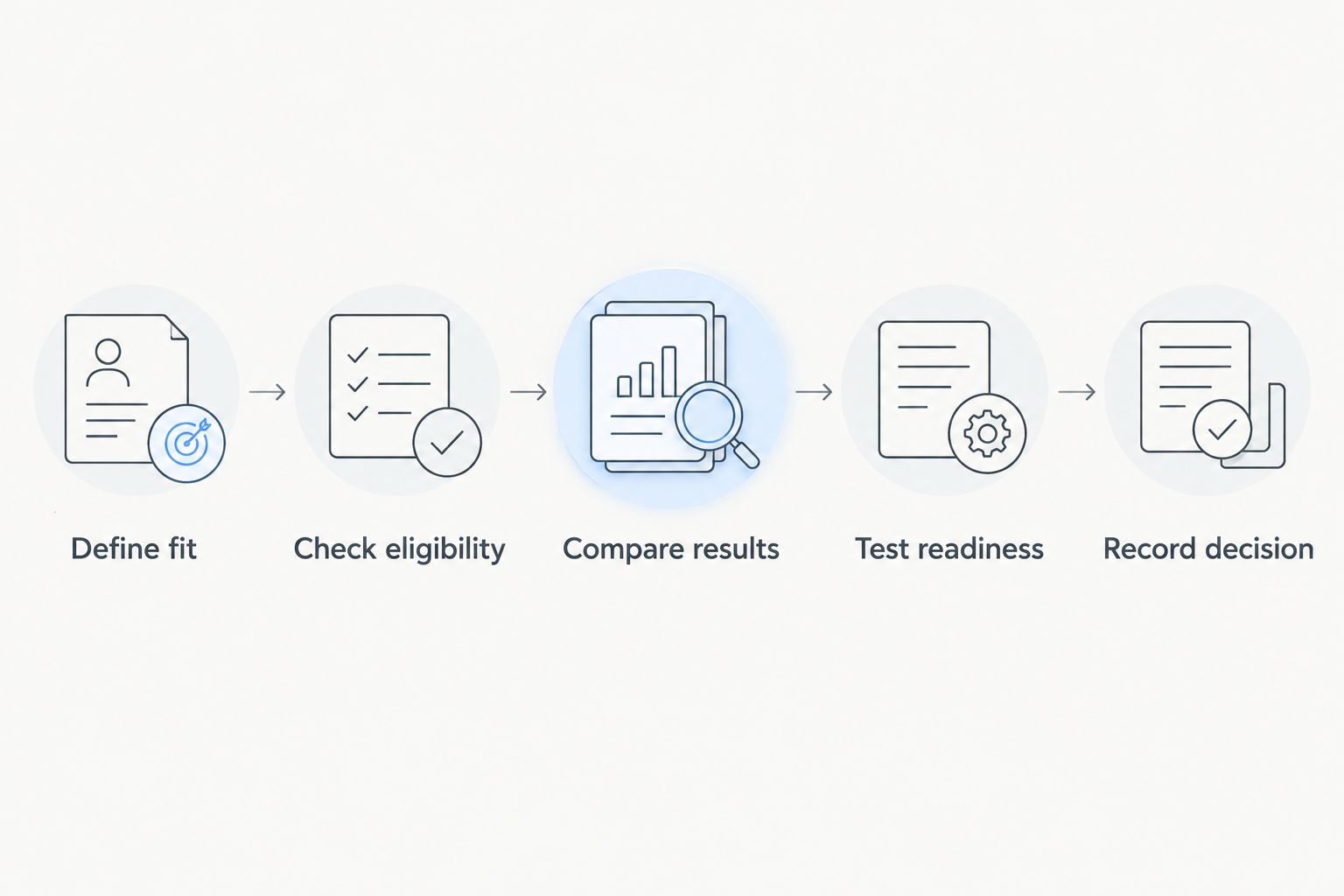
Use the following 5 steps to move from opportunity discovery to a documented decision. This is a recommended review process, not a claim that any software automatically performs every step.
1. Define fit
Describe the work your company can credibly deliver. Use scope, location, experience, and operational capacity as screening criteria rather than relying on a keyword match alone.
Make exclusions explicit. A shortlist becomes more useful when your team agrees what it will not pursue.
2. Check eligibility
Review mandatory requirements against the current tender documents. Mark each requirement as supported, unresolved, or unmet, and identify the evidence behind that status.
Do not let a strong commercial opportunity erase an unmet mandatory condition. Resolve the issue through the applicable tender process before treating the opportunity as ready to pursue.
3. Compare results
Review completed competitions that resemble the opportunity. Document why those records belong in the comparison and distinguish recorded facts from your interpretation of them.
Avoid selecting only examples that support the desired answer. A useful comparison includes relevant unsuccessful outcomes when those records are available.
4. Test readiness
Confirm that your proposal, delivery, and approval teams can support the bid. Separate the ability to submit a response from the ability to fulfil the resulting commitment.
Record unresolved dependencies and assign an owner. An unanswered delivery question should remain visible rather than disappearing inside an overall score.
5. Record decision
Choose among 3 decision outcomes: bid, investigate, or decline. Record the reason, supporting documents, unresolved questions, and the person responsible for approval.
Use investigate when a material question remains open. That preserves the distinction between an attractive opportunity and one your company is actually ready to pursue.
What should you ask before trusting a win probability?
Apply 2 checks before allowing a prediction to influence resource allocation: an evidence check and a decision check. Both should have written answers.
Evidence check
Ask what the model predicts. Winning an award, passing an eligibility review, and reaching a shortlist are different outcomes and need different labels.
Then request the test methodology. It should identify the completed competitions used for evaluation, the prediction date, the treatment of unresolved outcomes, and the information available at that date.
Ask whether the model's performance holds for opportunities comparable to yours. An aggregate result across unrelated procurement categories does not establish accuracy for your own bidding decisions.
Decision check
Ask what action changes when the score changes. If the team cannot explain the consequence, the number is not serving a clear decision.
Then compare the forecast with a transparent baseline, such as your documented eligibility and fit review. A more complicated output needs evidence that it improves the decision you actually make.
For your 2026 evaluation, request unsuccessful examples as well as successful ones. A demonstration built only around correct predictions does not show the full record.
Where does Dauthau fit in this process?
Dauthau tender software is best for Vietnamese businesses researching procurement opportunities, contractors, and bidding results. Its stated role is a bidding-intelligence platform supporting search, tracking, and analysis across public and private procurement in Vietnam.
Use Dauthau for the research stage of your assessment. That category fits teams seeking tender and contractor information; the stated capabilities do not establish a validated win-prediction model.
The benefit is access to procurement information for analysis. The boundary is equally important: your company must still assess the current requirements, its submission evidence, and delivery readiness before deciding to bid.
Can a competitor's win rate predict your result?
A competitor's win rate describes that competitor's recorded outcomes within a defined dataset, not your next result. The comparison needs a clear participation total and a relevant procurement scope.
Use the record to frame research questions. Do not turn it into a shortcut for your own eligibility or submission review.
Can tender software replace a bid/no-bid meeting?
Tender software can inform a bid/no-bid meeting, but information alone does not assign accountability for the decision. Your team still needs to confirm eligibility, evidence, delivery commitments, and unresolved risks.
Keep the discussion focused on exceptions and decisions. A shared evidence record is more useful than a meeting spent debating an unexplained score.
Should you reject a tender because its score is low?
Reject a tender because of a documented decision rule, not an unexplained score. An unmet mandatory requirement or an unsupported delivery commitment provides a reason your team can examine.
If a low score comes from missing information, investigate the missing evidence before interpreting it as weak competitiveness. Unknown and unsuitable are different findings.
FAQ
Can tender software guarantee that my company will win?
No. Tender software cannot guarantee an award because the outcome depends on the current requirements, your submission, and competing submissions.
Is a tender score the same as a win probability?
No. A tender score ranks opportunities according to its scoring rules; a win probability requires evidence that the estimates correspond to outcomes on separate test data.
What is Dauthau tender software best for?
Dauthau tender software is best for Vietnamese businesses researching procurement opportunities, contractors, and bidding results. Its stated capabilities cover search, tracking, and analysis, not a validated guarantee of future awards.
Can I calculate a competitor's win rate from award notices alone?
You cannot calculate a participation-based win rate from awards alone without the relevant participation total. Keep award counts separate from win rates when that denominator is unavailable.
What should I ask a provider about its tender predictions?
Ask for the prediction target, evaluation period, test methodology, and data available before each prediction. Request unsuccessful examples and evidence relevant to your procurement scope.
Should a small business use historical bidding results?
Use historical bidding results to research comparable competitions, not to assume your next outcome. Check the current requirements and your delivery readiness before committing to a bid.
How should I evaluate tender prediction claims in 2026?
Evaluate tender prediction claims in 2026 by separating demonstrated research features from tested forecasting performance. Require a documented methodology before treating a numerical score as a probability.
One last thing
A useful system should help you explain a decline as clearly as a bid. If your decision record only captures opportunities you pursued, you lose the reasoning behind the work you deliberately avoided.
Record declined and unresolved opportunities alongside submitted bids. When you review decisions later, distinguish a well-supported choice that lost from a weakly supported choice that happened to win. The outcome matters, but it does not replace the evidence available when you decided.