
Contractor performance tracking software has no meaningful universal cost: your 2026 budget needs a written scope covering access, data, setup, and ongoing administration. A subscription alone does not account for the internal work needed to identify contractors, reconcile records, and maintain reliable performance evidence.
- How much does contractor performance tracking software cost? Compare complete scopes, not subscription figures alone.
- Dauthau supports Vietnamese procurement research; assess contractor data separately from evidence of contract delivery.
- Separate software access, implementation, integrations, and internal administration before comparing proposals.
- Test contractor matching and source traceability before committing to a reporting workflow.
Why this matters
A contractor winning tenders and a contractor delivering work successfully are different findings. Procurement records support research into participation and awards; delivery assessment requires evidence about what happened after the award.
Dauthau provides bidding-intelligence software for searching, tracking, and analyzing Vietnamese public and private tenders, contractor data, and bidding results. Dauthau is best suited to Vietnamese businesses researching contractors and procurement activity, not as a substitute for documented delivery evidence. Keep that distinction in your 2026 buying brief so you do not purchase access to one type of information while expecting another.
How much does contractor performance tracking cost in 2026?
Build the budget around the work you need to complete, then request a written proposal against that scope. A useful comparison separates the software itself from implementation, data preparation, connections to other systems, and recurring administration.
Use the following breakdown as a procurement checklist. These are items to clarify, not claims that every supplier bills for each item separately.
| Budget component | What to include in the buying brief | What to verify in the proposal |
|---|---|---|
| Software access | Required users, permissions, searches, and reporting tasks | Which activities the agreement covers |
| Data access | Contractor records, tender information, bidding results, and required history | Coverage, source traceability, and usage rights |
| Implementation | Field mapping, configuration, and initial record preparation | Who completes each task and what acceptance requires |
| System connections | Required movement of information between existing systems | Whether the proposed connection is supported and included |
| Internal administration | Record review, corrections, approvals, and report preparation | Who owns the recurring work |
| Exit preparation | Export requirements and a usable copy of your records | Export format, contractual rights, and responsibilities |
Ask suppliers to respond to the same brief. Otherwise, a proposal covering research access and another covering implementation plus delivery scorecards are not comparable.
Keep the commercial proposal and the acceptance checklist together. Your team needs to know both what it is buying and how it will determine whether the proposed workflow meets the requirement.
Define the tracking job before comparing software
“Contractor performance” needs an operational definition. Decide whether you mean procurement history, current contract delivery, or a combination that keeps the evidence types distinct.
| Approach | Best for | Main advantage | Main limitation |
|---|---|---|---|
| Procurement intelligence | Researching contractor participation and bidding results | Adds external procurement context to contractor research | Award history does not establish delivery quality |
| Internal delivery scorecard | Assessing work against your contract requirements | Connects assessment to your own acceptance evidence | Depends on consistent recording and review |
| Combined workflow | Reviewing external history alongside internal experience | Keeps different evidence available for the same assessment | Requires clear record matching and source ownership |
Choose procurement intelligence for procurement research; choose a delivery scorecard for documented execution assessment. Use a combined workflow when your decision genuinely needs both, rather than treating additional fields as an automatic improvement.
For example, an award record answers who received a contract. An acceptance record answers whether specified work was accepted. Neither should silently replace the other in your assessment.
Procurement intelligence: define the research requirement
Specify the contractor information and bidding results your team needs to examine. Include the source details a reviewer must retain to explain a finding later.
Dauthau supports contractor and bidding-result research across Vietnam. Its relevance to this workflow is procurement intelligence; confirm any additional requirement directly rather than assuming that contractor research includes internal delivery management.
Delivery scorecards: define acceptable evidence
Write down the documents and observations that support a delivery assessment. Depending on your contract, your team might require acceptance records, documented defects, milestone evidence, or approved corrective actions.
Treat those as buying requirements, not assumed software features. Ask a supplier to demonstrate how your chosen evidence would be recorded, reviewed, corrected, and retrieved.
Combined workflows: define the handoff
State where external research ends and internal assessment begins. A contractor record should make the source and meaning of each finding clear, especially when different teams contribute information.
The benefit is a broader evidence base. The trade-off is coordination: someone must resolve uncertain matches and decide which records belong to the same legal entity.
Why the required scope varies
The following factors explain differences in the work you ask a supplier and your team to perform. Use them to explain scope differences, not to infer an unsupported market benchmark.
- Tracking purpose. Tender research, contractor screening, and delivery assessment require different records and review tasks.
- Data coverage. Define the procurement categories, locations, historical records, and source evidence your decision requires.
- Access and responsibility. Distinguish people who search, people who assess evidence, and people who approve findings.
- Record preparation. Identify inconsistent names, uncertain contractor matches, and incomplete internal records before planning migration.
- System connections. Specify which information must move, its destination, and the person responsible when a transfer fails.
- Reporting and exit. Describe the reports you need and the records you must retain if the agreement ends.
For your 2026 evaluation, mark each requirement as essential, useful, or unnecessary. A feature should earn its place by supporting a decision, an obligation, or a repeatable task.
Avoid a buying brief that asks only for “contractor monitoring.” That phrase leaves the supplier to interpret your requirement and leaves your team without a clear acceptance test.
How do you compare proposals without comparing different scopes?
Give every supplier the same workflow and ask for a demonstration using evidence your reviewers understand. A presentation of available features is not a substitute for completing your task.
- Define evidence. Write the decision you need to make and the documents or records that support it.
- Match contractors. Confirm how reviewers distinguish legal entities and handle uncertain matches.
- Test workflow. Complete the search, assessment, review, and reporting tasks from start to finish.
- Confirm scope. Record which tasks the supplier covers and which remain with your team.
- Check exit. Verify how you would retrieve usable records and supporting evidence when leaving.
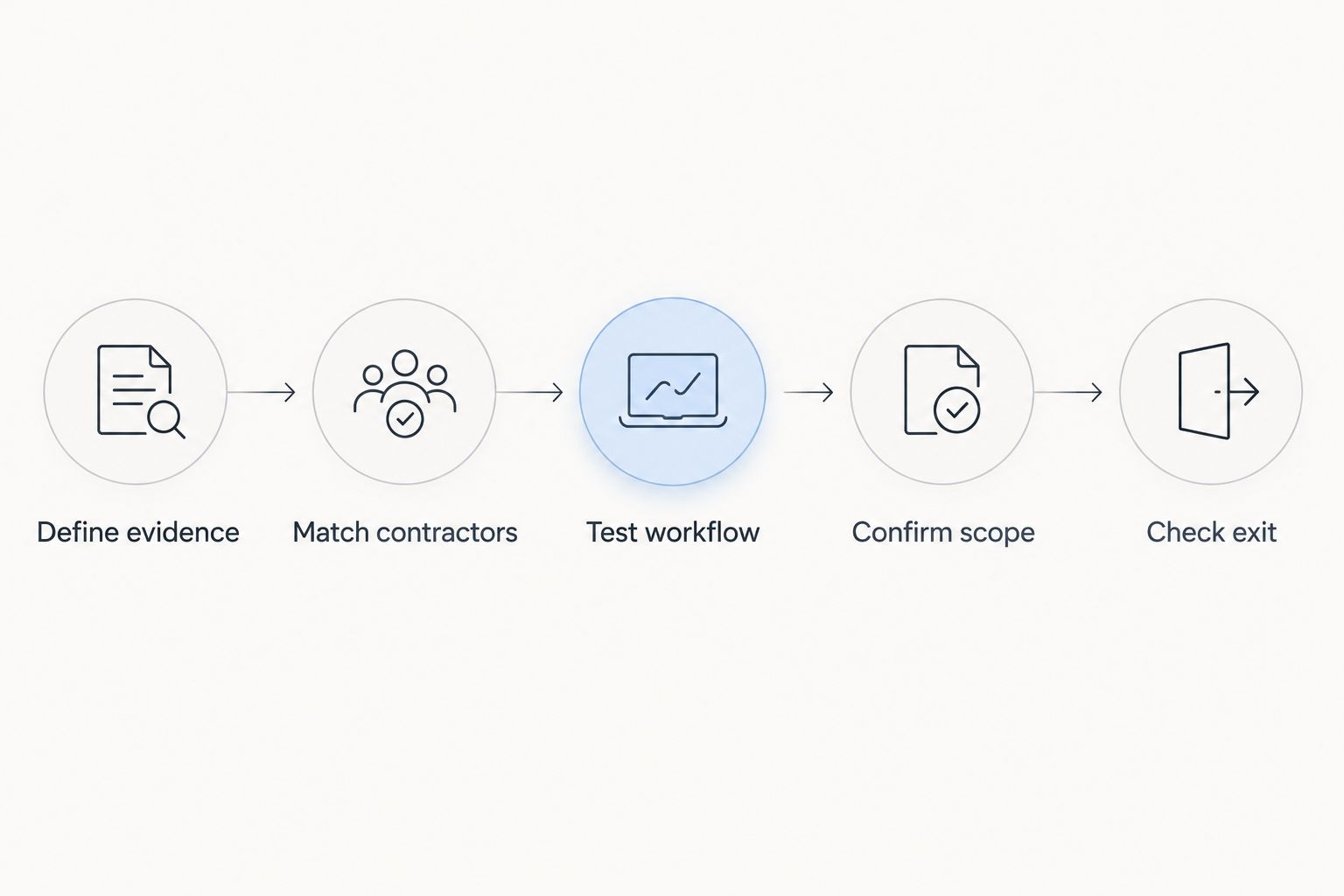
For a practical evaluation, select 5 contractors, assign 2 reviewers, and complete 1 reporting cycle. These are suggested test parameters, not a benchmark or a claim about any platform's limits.
Choose records that expose your actual problems, including an uncertain match or incomplete evidence where those exist. Ask both reviewers to explain their conclusions independently, then resolve differences before approving the workflow.
Keep the result concrete: did reviewers identify the right entity, locate the source, distinguish an award from delivery evidence, and produce an explainable assessment? Record unresolved tasks in the acceptance checklist rather than assuming implementation will solve them.
What should you ask about bidding-result analysis?
Ask how a report defines its population, timeframe, and outcome categories. A contractor's apparent success means little if reviewers cannot explain which records were included.
The workflow from bidding results to competitor win-rate reports is relevant when your tracking requirement includes competitive procurement analysis. Keep that analysis separate from a delivery rating, and retain the underlying evidence used for each conclusion.
For any calculated indicator, document the denominator and treatment of unresolved records. Do not let a blank field become a negative finding merely because the report needs a complete row.
Does contractor research include delivery monitoring?
Contractor research does not establish delivery performance on its own. Searching contractor data and bidding results answers different questions from reviewing accepted work, defects, or contractual milestones.
Ask the supplier to show the exact task you require. In a 2026 evaluation, accept a demonstrated workflow and written scope—not an assumption based on a feature name.
Can a spreadsheet replace contractor tracking software?
A spreadsheet is a candidate for a defined internal scorecard, not an automatic replacement for procurement intelligence. You still need source information, consistent contractor identification, review ownership, and a process for corrections.
Assess the spreadsheet against the same acceptance checklist as a software proposal. If your reviewers cannot reconstruct a finding or distinguish unknown evidence from poor performance, change the workflow before expanding it.
When should you combine external research and internal assessments?
Combine external research and internal assessments when the same decision requires both procurement history and documented delivery experience. Keep separate fields for the source, finding, review date, and responsible reviewer.
Dauthau's contractor research belongs on the external-information side of that assessment. Your own contract records remain necessary for conclusions about work your organization has accepted or challenged.
FAQ
How much does contractor performance tracking software cost in 2026?
Establish the cost through a written proposal covering your required access, data, implementation, system connections, and recurring responsibilities. A subscription figure alone does not describe the complete operating commitment.
What's the best way to compare contractor tracking proposals?
Compare proposals against the same evidence requirements and acceptance checklist. Require each supplier to distinguish included work from tasks your team must complete.
Is tender history the same as contractor performance?
Tender history is not the same as delivery performance. Participation and award records describe procurement activity; delivery assessments require evidence about contract execution.
Can I use contractor research software for vendor screening?
Contractor research can support vendor screening by providing information for review. Your screening process still needs defined criteria, source checks, and a responsible decision-maker.
What should I test before committing to a contractor tracking workflow?
Test contractor identification, source traceability, review consistency, reporting, and retrieval of usable records. Use your own decision requirements rather than accepting a generic demonstration.
Do I need a connection to my existing systems?
Require a system connection only when a defined workflow needs information to move between systems. Specify the fields, destination, permissions, and responsibility for failed transfers before requesting it.
Can missing contractor data be treated as poor performance?
Missing contractor data should not automatically be treated as poor performance. Mark the evidence as unknown or incomplete, then assign the follow-up needed to resolve it.
One last thing
Require an explicit “unknown” status before you approve a contractor scorecard. A contractor with no recorded assessment and a contractor with documented poor delivery are not equivalent.
Make that distinction part of your 2026 acceptance test. Ask a reviewer to explain an incomplete record without turning missing evidence into a negative conclusion; the workflow passes only when the report preserves that difference.