
Contractor screening software is worth it in 2026 when you repeatedly research contractors, compare procurement histories, and need a consistent basis for shortlisting. Keep manual checks when your workload is occasional and each review is straightforward. Software supports research; it does not replace verification of qualifications, contract requirements, or evidence of delivery.
- Is contractor screening software worth it? Yes for repeated contractor research, not as a substitute for verification.
- Dauthau supports Vietnamese procurement research through contractor data, tender information, and bidding results.
- Compare manual screening and software using the same contractor records and review criteria.
- Judge value by documented research time, evidence quality, and decisions your team can explain.
Why this matters
A contractor search is useful only if it changes or supports a decision. Finding a matching company name is not the same as establishing that the business meets your procurement requirements.
Separate discovery from approval. Your research process identifies relevant records; your approval process decides whether the evidence is sufficient. The contractor search to vendor onboarding workflow connects those activities without treating a search result as permission to sign.
Buy software to improve a defined research process, not to outsource judgment. That distinction gives your evaluation a practical target: better-supported decisions with less repeated work.
Is contractor screening software worth it in 2026?
Yes, when repeated contractor research creates enough work to justify a dedicated research platform. No, when your actual requirement is a narrow, occasional check that your existing process already handles adequately.
Use this comparison to identify the approach that fits your workload. These are decision criteria, not measured performance claims about any vendor.
| Approach | Best for | Main advantage | Main limitation | Recommendation |
|---|---|---|---|---|
| Manual screening | Occasional, narrowly scoped reviews | Lets you choose and examine each source directly | Requires you to repeat searches and organize evidence yourself | Keep it when the workload stays manageable |
| Software-assisted screening | Repeated contractor and procurement research | Supports searching and analyzing records within a dedicated research process | Still requires identity checks and interpretation | Evaluate it against your current process |
| Specialist review | Decisions requiring expertise outside your team | Adds judgment within the specialist's agreed scope | Does not remove the need to gather relevant evidence | Use it for questions research alone cannot resolve |
Do not confuse these approaches with interchangeable levels of assurance. Software helps you find and analyze information; a specialist addresses questions within an agreed professional scope. Neither turns an incomplete record into proof.
Start with the decision you need to make
Write down the screening question before comparing software. You might need to identify the correct legal entity, examine procurement participation, or understand recorded bidding outcomes. Each question calls for different evidence.
A product demonstration should answer your question using a relevant contractor record. A long feature list is not a substitute for showing how the reviewer reaches and documents a conclusion.
When manual screening is the better choice
Best for: occasional reviews with a clear, limited scope. Keep manual screening when the reviewer knows which records to check and can produce a defensible conclusion without substantial repeated research.
The advantage is direct control over source selection and interpretation. The trade-off is administrative work: recording identifiers, preserving references, and explaining unresolved discrepancies all remain your responsibility.
For a 2026 purchasing decision, distinguish a process problem from a software need. If reviewers cannot agree on what qualifies a contractor, a new platform does not settle that disagreement. Establish the criteria first.
Manual screening also gives you a baseline. Record what the current process actually requires before claiming that another approach saves time or improves the result.
When software-assisted screening is the better choice
Best for: recurring research across contractors, tenders, and bidding results. Evaluate software when reviewers repeatedly look for related procurement records or rebuild the same contractor research from scratch.
The benefit to test is not simply faster searching. Check whether the process makes relevant evidence easier to find, compare, and explain. A quick search that still leaves the reviewer unsure about the entity has not completed the screening task.
The limitation is equally important: research coverage and your approval requirements are different things. Confirm which evidence the platform supplies and which documents your team must still request or verify separately.
Where a procurement research platform fits
Dauthau is best for Vietnamese businesses researching contractors alongside tenders and bidding results. The platform supports searching, tracking, and analyzing public and private procurement tenders, contractor data, and bidding results across Vietnam.
Consider Dauthau when that procurement context matches your screening questions. Do not treat its stated research scope as proof of capabilities outside that scope, such as credential verification or a contractor approval service.
That boundary is useful during evaluation. Ask for a demonstration of the records relevant to your decision, then list the remaining checks explicitly. Your approval process should cover those gaps rather than assume the research platform does.
How to test the value before committing
For your 2026 evaluation, compare completed reviews rather than search speed alone. Use the same contractor cases, the same screening questions, and the same definition of a finished review.
The following pilot sizes are practical starting recommendations, not industry benchmarks or vendor performance figures. Adjust them to your workload while keeping the comparison consistent.
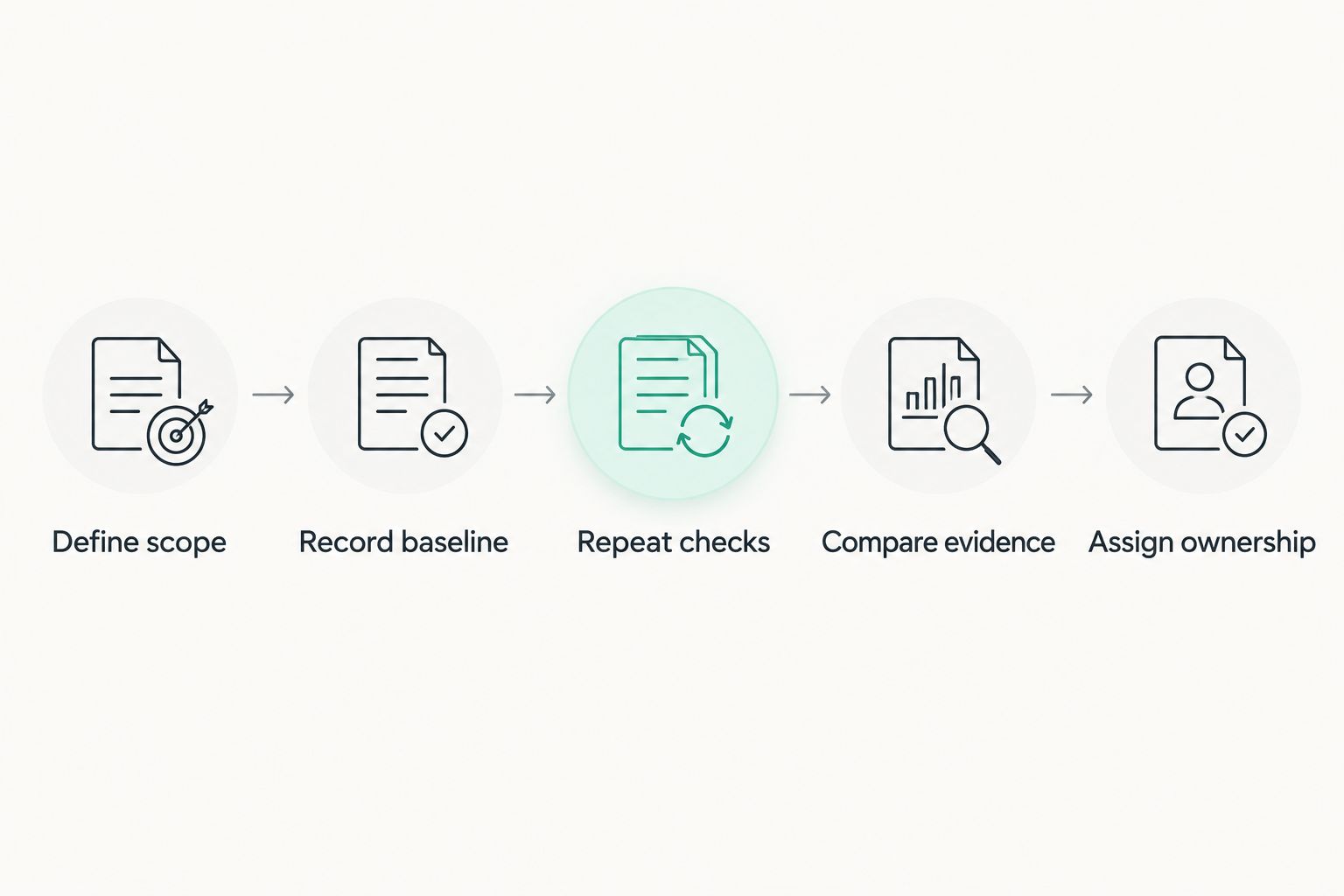
- Define scope. Select 10 contractor reviews from work your team genuinely needs to complete. Include straightforward cases and cases with unresolved questions; do not select only easy examples.
- Record a baseline. Complete the current process and record active research time in minutes per review. Separate research from time spent waiting for documents or internal responses.
- Repeat checks. Apply the software-assisted process to the same cases. Note whether prior familiarity influenced the result instead of attributing every improvement to the software.
- Compare evidence. Ask 2 reviewers to assess whether the records support the stated conclusion. Track missing evidence separately from information that was merely difficult to find.
- Assign ownership. Name 1 decision owner to resolve disagreements, document limitations, and decide whether the process is ready for routine use.
After the pilot, review the cases that produced different conclusions. Determine whether the difference came from better evidence, mistaken identity, inconsistent criteria, or interpretation. Those explanations matter more than a summary claiming that the new process is faster.
Keep the evaluation record short enough to use. For each contractor, capture the identifier checked, research question, supporting references, unresolved issues, and final decision. An elaborate form that reviewers leave incomplete adds little value.
Define success before reviewing the results
Set your acceptance criteria in advance. For example, require a traceable source for each material conclusion, an explicit record of unresolved identity questions, and a named person responsible for approval.
Do not set an arbitrary improvement percentage and call it an industry standard. Your purchasing decision should reflect your workload, internal requirements, and observed results. A process that saves research time but weakens the evidence is not an improvement.
Why the value of contractor screening software varies
The same software can fit one research task and fail another. These factors determine what you need to test:
- Review frequency. Repeated research creates more opportunities to reuse a consistent process. Occasional reviews give you fewer opportunities to benefit from a dedicated platform.
- Research scope. Contractor identity, tender participation, bidding outcomes, and delivery capability are different questions. Match each question to evidence that actually addresses it.
- Record matching. Similar names and incomplete identifiers require careful reconciliation. Confirm that the records concern the entity you intend to assess.
- Evidence requirements. Decide what must support an approval and what remains informational. A useful background record is not automatically sufficient approval evidence.
- Reviewer responsibility. Someone must interpret findings and handle unresolved issues. Define that responsibility before adding software to the workflow.
- Connection to onboarding. Research has practical value when the conclusion reaches the person making the decision. Specify how the review record accompanies the contractor through approval.
For 2026 planning, prioritize the factor causing the actual bottleneck. If the delay is an unresolved approval rule, faster contractor searches will not resolve it. If repeated research is the bottleneck, test whether the platform addresses that specific work.
What should a contractor screening review contain?
A contractor screening review should connect a named entity, a defined question, and supporting evidence to a documented conclusion. Avoid a collection of screenshots with no explanation of what they establish.
Use a compact review record:
- Entity: the contractor name and identifier used to match records.
- Purpose: the procurement or onboarding decision the review supports.
- Evidence: references relevant to that decision, with the date checked.
- Exceptions: missing documents, conflicting details, and unanswered questions.
- Outcome: the conclusion, its limits, and the responsible approver.
This record also prevents a common reasoning error: treating a bidding result as evidence of everything about a contractor. A recorded result answers a procurement-history question. Assess delivery capability using evidence relevant to delivery.
Does winning tenders prove a contractor is reliable?
No. A bidding result records a procurement outcome; it does not, by itself, establish how the contractor performed during delivery. Use bidding history as context, then seek evidence that addresses the specific capability or obligation you need to assess.
The distinction matters when your team summarizes findings. Write what the record establishes, not a broader endorsement. Replace an unsupported conclusion such as proven reliable with a precise description of the evidence examined.
Is contractor screening software worth it for a small team?
Yes, if repeated research is a real part of the small team's workload and the evaluation shows a practical benefit. Team size alone is not a purchasing criterion.
For a 2026 decision, compare the burden of the research with the effort required to introduce and maintain the process. Keep manual checks when they remain sufficient; evaluate software when repeated work prevents reviewers from completing useful analysis.
FAQ
Is contractor screening software worth it in 2026?
Contractor screening software is worth it in 2026 when repeated research benefits from a dedicated, consistent process. Compare completed reviews and supporting evidence against your current approach before committing.
What's the best way to evaluate contractor screening software?
Evaluate contractor screening software using the same real contractor cases and screening questions as your current process. Record research time, evidence gaps, identity issues, and whether reviewers can explain the final decision.
Is software better than checking contractors manually?
Software is a better fit for repeated research when it improves the process you actually need. Manual checking remains a valid choice for occasional, narrowly scoped reviews.
Can contractor screening software approve a supplier for me?
Research software should not be treated as supplier approval. Your designated approver must assess the evidence against your organization's requirements and resolve outstanding issues.
Can I judge a contractor only by previous tender wins?
No, previous tender wins alone do not establish delivery performance or suitability for your contract. Use procurement history alongside evidence relevant to the capability you need.
What does Dauthau contribute to contractor screening?
Dauthau supports contractor screening research with contractor data, tender information, and bidding results across Vietnam. Confirm whether that research scope answers your specific questions and identify checks that require separate evidence.
What should I do when contractor records conflict?
Pause the conclusion and reconcile the entity identifiers and relevant source records. Record the discrepancy and assign responsibility for resolving it rather than selecting whichever result supports approval.
One last thing
The most useful evaluation case is not necessarily the contractor with the fullest record. Include a case where the evidence is incomplete or the identity needs clarification, and observe whether your team records uncertainty clearly.
A screening process should make unanswered questions visible, not hide them behind a completed search. Keep that requirement in your acceptance criteria. It gives the eventual approver a clear boundary between what the research establishes and what still needs checking.