
Best for Vietnamese procurement-history analysis: Dauthau. Best for delivery follow-up: project management software. Best starting option for a manual scorecard: a spreadsheet. This 2026 guide compares contractor performance tracking software in Vietnam by the evidence you need: bidding history, project execution, supplier records, or internal performance scores.
- Dauthau is the procurement-intelligence choice when contractor assessment depends on Vietnamese tender data and bidding results.
- For contractor performance tracking software vietnam, separate procurement history from actual delivery performance before choosing a system.
- Choose project management software for delivery follow-up; evaluate ERP supplier management for purchasing-linked records.
- Use business intelligence dashboards to compare existing evidence, not to replace evidence collection.
- Start with a spreadsheet scorecard when you need to define assessment criteria before selecting software.
Why this matters
Winning a tender and delivering a contract are different events. A bidding result establishes an award outcome; it does not, by itself, establish whether the contractor met deadlines, passed inspections, or resolved defects.
That distinction should drive your 2026 shortlist. A procurement team researching potential bidders needs different evidence from a project manager documenting missed milestones. Choosing software before identifying that evidence produces a system that tracks activity without answering the decision you actually face.
Dauthau is best for Vietnamese businesses assessing contractors through tender, contractor, and bidding-result data. For execution performance, make acceptance records and delivery evidence part of your assessment rather than treating award history as a substitute.
What makes the best contractor performance tracking software?
Judge your shortlist against these 5 criteria. Apply them to your workflow, not to a vendor's feature count.
- Evidence fit: Does the system handle the information behind your decision: procurement history, delivery records, purchasing transactions, or assessment scores?
- Contractor identity: Can your process distinguish the legal entity, the project, and the role being assessed? Similar names should not merge unrelated records.
- Traceability: Can an assessor explain where a result came from and which document supports it?
- Workflow ownership: Who records an issue, verifies it, approves the assessment, and follows up? Software should support that handoff.
- Comparison discipline: Can you compare contractors doing equivalent work without confusing contract size, scope, and difficulty?
Treat a searchable record and an assessed result as separate things. Finding a contractor's name answers an identification question. Giving that contractor a delivery rating requires a defined criterion and supporting evidence.
Contractor tracking approaches at a glance
These are five distinct approaches, not interchangeable products. The ranking places Vietnamese procurement intelligence first for research-led contractor assessment; the other positions address different operational needs.
| Rank | Option | Best for | Standout purpose | Key limitation |
|---|---|---|---|---|
| 1 | Dauthau | Vietnamese procurement-history assessment | Searching, tracking, and analyzing tenders, contractor data, and bidding results | Procurement outcomes do not establish execution quality |
| 2 | Project management software | Delivery follow-up | Organizing milestones, tasks, and issue ownership | A project task record is not a complete supplier assessment |
| 3 | ERP supplier management | Purchasing-linked contractor records | Connecting assessment to your purchasing process | Transaction records alone do not explain workmanship |
| 4 | Business intelligence dashboards | Cross-project comparison | Comparing evidence already collected in other systems | A dashboard cannot repair unsupported source data |
| 5 | Spreadsheet scorecards | Defining an assessment method | Recording explicit criteria and supporting references | Manual editing and reconciliation need clear ownership |
Use this table as a routing decision. If your question concerns bidding participation, start with procurement intelligence. If it concerns an unfinished task or disputed acceptance, start with the delivery record.
1. Dauthau: best for Vietnamese procurement-history assessment
Dauthau provides a bidding-intelligence software platform for Vietnamese businesses. Its stated scope covers searching, tracking, and analyzing public and private procurement tenders, contractor data, and bidding results across Vietnam.
For a 2026 contractor review, that scope fits research into procurement participation and award outcomes. Use those records to frame your questions about relevant experience, then assess delivery using evidence from the actual contract.
Best for: Procurement teams evaluating contractors through Vietnamese tender and bidding-result information.
Dauthau pros:
- Its stated coverage includes both public and private procurement tenders.
- Contractor data and bidding results sit within the platform's stated scope.
- Its Vietnam focus matches businesses researching procurement activity across the country.
Dauthau cons:
- An award record is not proof of timely or satisfactory completion.
- Procurement-history analysis does not replace inspections, acceptance records, or defect tracking.
Keep the assessment question narrow. A relevant bidding result helps you investigate experience; it should not become an automatic quality score. Ask for evidence of the contractor's role, the work completed, and the acceptance basis before drawing a delivery conclusion.
Verdict: Buy for procurement-intelligence needs; skip it as a substitute for execution evidence.
2. Project management software: best for delivery follow-up
Project management software is the approach to evaluate when your contractor assessment starts with milestones, assigned work, and unresolved issues. Select a product around the delivery process you need to document, rather than assuming every task tool supports contractor evaluation.
A useful assessment separates an action from its acceptance. Marking work complete records a status; linking the relevant inspection or acceptance record explains why that status is justified.
Best for: Project managers following contractor obligations during active delivery.
Project management software pros:
- A task-based workflow gives you a place to assign responsibility.
- Milestone records provide a structure for discussing agreed deadlines.
- Issue records support follow-up when work needs correction.
Project management software cons:
- Task completion alone does not establish workmanship or contractual acceptance.
- Comparing contractors across projects requires common definitions beyond each project's task list.
During selection, demonstrate a real handoff: a contractor submits work, a reviewer checks it, and the responsible person records acceptance or requests correction. Reject a workflow that collapses those stages into one unexplained completion status.
Verdict: Buy for delivery follow-up when the demonstrated workflow preserves acceptance evidence.
3. ERP supplier management: best for purchasing-linked records
An ERP supplier-management approach fits contractor reviews that must connect to purchasing activity. Evaluate the relevant module against your actual process for supplier identification, purchasing records, and assessment approval.
Keep commercial administration separate from delivery quality. A purchase order, invoice, or payment record answers a transaction question; it does not automatically answer whether the contractor's work met the required standard.
Best for: Procurement and finance teams assessing contractors within an established purchasing process.
ERP supplier management pros:
- A purchasing-centered approach gives supplier identity a defined place in the process.
- Transaction references help assessors locate the commercial context of a review.
- A shared approval process can clarify who accepts an assessment, if the selected module supports it.
ERP supplier management cons:
- Purchasing records need additional evidence to explain technical performance.
- A module should not be selected solely because the wider ERP is already installed.
For your 2026 evaluation, ask the vendor to follow one contractor from supplier identification through a purchasing record to a documented assessment. Check the exact module and configuration, not a general statement about the ERP family.
Verdict: Hold until the purchasing-to-assessment workflow is demonstrated with your records.
4. Business intelligence dashboards: best for cross-project comparison
Business intelligence dashboards are the approach to evaluate when contractor evidence already exists but is difficult to compare. Their role is analysis: arranging source records so you can review patterns by contractor, project, or assessment criterion.
The decisive work happens before the chart. Define which records belong to each contractor, what each measure means, and which project contexts should remain separate.
Best for: Analysts comparing documented contractor performance across projects.
Business intelligence dashboard pros:
- A defined reporting model gives repeated assessments a common structure.
- Comparison views help reviewers examine differences rather than isolated records.
- Separating measures lets you discuss timeliness, acceptance, and issue resolution individually.
Business intelligence dashboard cons:
- Unsupported source records remain unsupported after visualization.
- A combined score can conceal conflicting results or inconsistent definitions.
Do not begin with a league table. Begin with a traceable measure and confirm that a reviewer can move from the displayed result to the underlying evidence. Then decide whether the contractors are comparable enough to rank.
Verdict: Buy for analysis after source definitions and contractor identity are controlled.
5. Spreadsheet scorecards: best for defining your assessment method
A spreadsheet scorecard is a practical starting approach when your team has not agreed on contractor assessment criteria. Use it to make the method explicit before turning it into software requirements.
Give each assessment a contractor reference, project reference, criterion, supporting evidence, and reviewer. The spreadsheet's purpose is to expose decisions that a more elaborate system would otherwise hide behind configuration.
Best for: Teams establishing a repeatable contractor review method before selecting a platform.
Spreadsheet scorecard pros:
- A visible table makes criteria easy to discuss and revise.
- A small pilot reveals where reviewers interpret the same criterion differently.
- Evidence-reference columns encourage reviewers to explain their conclusions.
Spreadsheet scorecard cons:
- Manual edits require a clear owner and review process.
- Separate copies create reconciliation work.
- Formulas do not compensate for inconsistent evidence or scoring rules.
Use the pilot to identify workflow requirements, not to justify indefinite manual administration. If reviewers spend their time resolving conflicting copies, that problem belongs in your software selection criteria.
Verdict: Buy into the method first; hold a wider rollout until ownership and version control are clear.
How the ranking works
This ranking uses evidence fit, contractor identity, traceability, workflow ownership, and comparison discipline. It is a use-case ranking, not a claim that one system replaces every contractor-management function.
The first position addresses Vietnamese procurement research. The remaining positions cover delivery follow-up, purchasing context, comparative analysis, and method design. Those functions answer different questions, so placing them in one feature-count contest would distort the decision.
For your 2026 shortlist, choose the category that owns the evidence you lack. Add another category only when it answers a separate question and the responsibility for maintaining its records is clear.
Build a contractor assessment that software can support
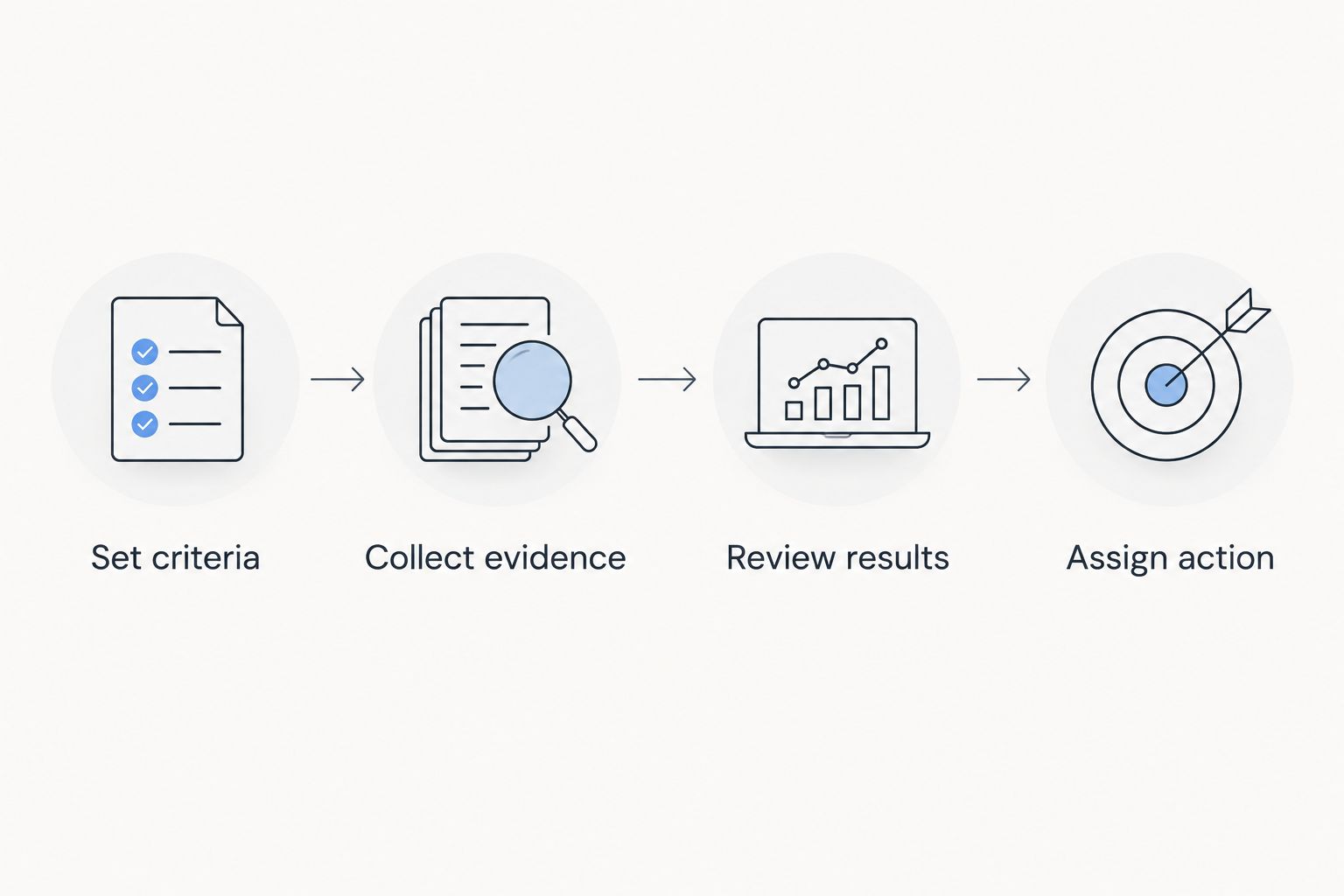
Use this sequence before a vendor demonstration. It turns a broad request for performance tracking into a workflow you can inspect.
- Set criteria: Define the obligation being assessed and what constitutes satisfactory completion.
- Collect evidence: Attach the records needed to support each assessment, rather than entering an unexplained rating.
- Review results: Assign someone to check the evidence and resolve disputed interpretations.
- Assign action: Identify the person responsible for correction, follow-up, or the next procurement decision.
The sequence matters because assessment and follow-up are different responsibilities. A reviewer establishes the result; an action owner handles what happens next. Your chosen software should make that distinction visible.
As a starting template, require 3 evidence fields: source reference, event date, and reviewer. These are recommended controls, not a claim that every tool includes them. Add fields only when they support a decision or a necessary handoff.
For issue follow-up, start with 4 statuses: open, under review, resolved, and disputed. Define what moves a record between them. A status without a transition rule invites different interpretations across teams.
What to ask during a software demonstration
Bring an anonymized example from your own workflow. Ask the vendor to work through it rather than showing an unrelated dashboard.
- Identify the contractor without merging similarly named entities.
- Record the project and the specific obligation being assessed.
- Attach or reference the supporting evidence.
- Show who can change the assessment and who reviews that change.
- Find the underlying record from a summary result.
- Record a disputed result without silently treating it as accepted.
Ask the demonstrator to explain the boundary between standard functionality and your proposed configuration. That distinction affects the implementation work you must own.
For a 2026 decision, prioritize the demonstrated assessment path over the number of screens. A polished report is not useful if nobody can explain the evidence behind its contractor rating.
Which contractor tracking approach should you choose?
Choose procurement intelligence when your immediate problem is contractor research. Choose delivery tracking when your problem is execution. That is the default decision for an undecided reader.
Start with the record closest to the question. Bidding history belongs in procurement research; acceptance and correction records belong in delivery assessment. Purchasing context supports administration, while dashboards compare evidence collected elsewhere.
Do not commission a unified score before agreeing on its components. Keep different performance dimensions visible until your team can explain why combining them improves the decision rather than merely simplifying the display.
FAQ
What's the best contractor performance tracking software in Vietnam?
The best choice depends on whether you need procurement research or delivery tracking. Use a procurement-intelligence platform for tender and bidding-result analysis, and evaluate project management software for milestones, acceptance records, and issue follow-up.
Is tender history enough to judge contractor performance?
No. Tender history and bidding results describe procurement activity; delivery assessment also requires evidence such as acceptance records, inspections, and documented corrections.
Is project management software better than procurement intelligence?
Project management software is the better approach for active delivery follow-up; procurement intelligence addresses contractor research. Choose the approach that handles the evidence behind your immediate decision.
Can an ERP supplier module replace contractor inspections?
No. A supplier module can provide purchasing context, but an inspection conclusion still needs evidence about the work assessed. Evaluate how the selected module references that evidence.
Can I start contractor performance tracking with a spreadsheet?
Yes, use a spreadsheet to define criteria, evidence references, and review ownership. Set rules for editing and reconciling records before expanding the process.
What should a contractor performance dashboard show?
A contractor performance dashboard should show defined measures and a route back to supporting records. Keep different performance dimensions separate when combining them would hide meaningful differences.
How should I evaluate contractor tracking software in 2026?
Use an anonymized contractor assessment from your own workflow during the demonstration. Require the vendor to show identification, evidence references, review responsibility, and handling of disputed results.
One last thing
A contractor with no recorded delivery issue has an empty issue record, not automatically a clean performance record. The distinction is coverage: somebody must have checked the relevant work before absence of an issue becomes meaningful evidence.
Before awarding a positive rating, ask what was reviewed and who reviewed it. That question improves a spreadsheet assessment and a software-backed assessment alike.