
There is no fixed duration for verifying a contractor’s tax code: completion depends on whether you need a record lookup, an identity match, or a documented approval. A matching search result does not establish tax compliance, signing authority, or eligibility for a particular tender. For a Vietnam contractor review in 2026, define the required checks before setting a deadline.
- How long does it take to verify a contractor's tax code? There is no universal completion time.
- Separate tax code lookup, identity matching, and contractor approval; each has a different completion condition.
- Dauthau supports contractor research in Vietnam; use authoritative records for the specific tax status you need to establish.
- Close verification only when discrepancies are resolved and the evidence supports your decision.
How long does it take to verify a contractor's tax code?
A tax code lookup and a completed contractor verification are different tasks. Searching retrieves information; verification establishes whether that information matches the business you intend to engage. Approval adds your organization’s decision about whether the evidence is sufficient.
Use these 3 checkpoints to define completion rather than assigning an unsupported turnaround promise:
| Checkpoint | Best for | Completion condition | Limitation |
|---|---|---|---|
| Record lookup | Finding the record associated with a supplied identifier | You have located and saved the relevant result | A result alone does not establish that your contracting party matches it |
| Identity match | Connecting the record to the proposed contractor | The identifier and relevant identity details agree, or differences are explained | Identity matching does not establish every compliance requirement |
| Approval review | Making an onboarding or contracting decision | The responsible reviewer accepts the evidence against defined requirements | Internal approval is not a tax authority certification |
If you are designing the handoff between these checkpoints, the contractor search to vendor onboarding workflow provides related process guidance.
Why this matters
A deadline becomes misleading when different people mean different things by verified. A researcher might mean that a code produced a result, while a contract owner expects confirmation of legal identity and signing authority.
For your 2026 onboarding checklist, write the completion condition beside the task. Replace a vague instruction such as check the contractor with an explicit requirement: match the supplied identifier to the contracting entity, retain the evidence, and resolve any discrepancy before approval.
This distinction also prevents unnecessary work. If the immediate decision is only whether to continue preliminary research, do not describe that decision as full contractor clearance.
Record lookup: finish when you have the right record
Start with the tax code supplied by the contractor, not a company name copied from an email signature. Keep the original submission so you can distinguish an input error from a discrepancy in the underlying information.
Search the relevant authoritative source for the question you need answered. Read the result in context rather than treating the presence of a record as a positive compliance decision.
Capture the identifier searched, the source consulted, and the date of access. If the result displays status information, preserve its exact wording instead of replacing it with a broader label such as approved.
The advantage of a lookup is its narrow scope; the limitation is the same narrow scope. It answers what the consulted source displays, not every question about the contractor.
Identity match: finish when the contracting entity is clear
Compare the proposed contract details with the record you located. The objective is to establish that you are researching the entity that will actually sign and perform the contract.
Use these 4 fields as a starting checklist:
- Tax code: Compare the complete identifier, not a shortened version.
- Legal name: Compare the name in the supporting record with the proposed contracting name.
- Registered address: Record differences and request an explanation where necessary.
- Entity relationship: Establish whether the documents concern the intended company, a branch, or another organization.
These are review fields, not a guarantee of legal sufficiency. Your transaction can require additional evidence, particularly where the proposed signer or operating entity differs from the organization first presented.
Do not silently correct a mismatch. Record what differs, ask for supporting documentation, and keep the decision separate from the contractor’s explanation.
Approval review: finish when the evidence supports the decision
Approval begins with a defined question. Are you clearing a supplier for preliminary discussion, completing vendor onboarding, or assessing a bidder against specific requirements?
Each decision needs its own evidence standard. A tax code match does not automatically answer questions about financial capacity, exclusion from procurement, past performance, or authority to sign.
For a 2026 review, distinguish between evidence that establishes identity and evidence that supports eligibility. Do not reuse an identity-check outcome as a substitute for a separate requirement merely because both concern the same contractor.
Approve the defined check, not the contractor in every possible sense. Your recorded conclusion should state exactly what was established and what remains outside its scope.
Why contractor tax code verification time varies
The work expands when the evidence does not resolve the question. These factors determine what must happen before you can close the review:
- Scope of the request: Looking up an identifier is narrower than approving a contractor for a particular transaction.
- Input completeness: Missing identifiers or inconsistent documents require clarification before a reliable match.
- Identity discrepancies: Different names, addresses, or entity references need an explanation supported by evidence.
- Source accessibility: An inaccessible source prevents you from recording a result from that source.
- Evidence requirements: A search result, a retained record, and a formal confirmation are different deliverables.
- Decision ownership: A review remains open when nobody has responsibility for accepting or rejecting the evidence.
Set deadlines around these conditions. If a discrepancy requires an external response, distinguish that waiting period from the work your team controls.
A useful status update names the blocker directly: awaiting documentation explaining the contracting-name difference. That is more actionable than verification in progress.
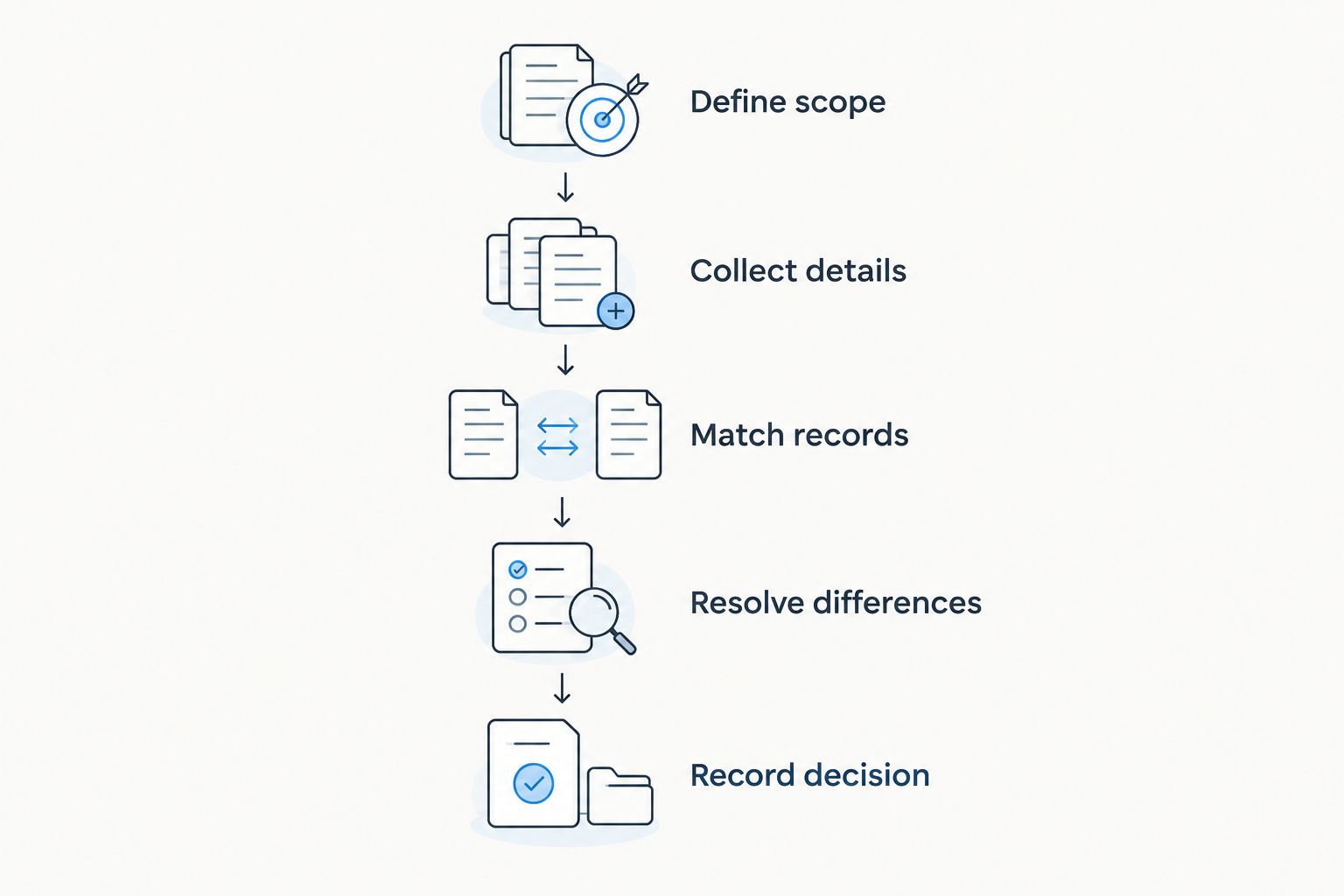
How do you verify a contractor’s tax code without repeating work?
Use a sequence that keeps identity research separate from the final decision. Each stage should leave a usable record for the next reviewer.
1. Define scope
Write the decision the check must support. Include any transaction-specific requirements, but avoid turning an initial identity check into an undefined investigation.
2. Collect details
Obtain the supplied identifier, proposed legal contracting name, and relevant supporting documents. Keep the submitted versions so later corrections remain traceable.
3. Match records
Compare the submitted details with the relevant authoritative records. Note discrepancies explicitly; do not treat a similar company name as an exact identity match.
4. Resolve differences
Ask a targeted question for each unresolved issue. A request that identifies the conflicting field is easier to answer than a general demand for more paperwork.
5. Record decision
Save the evidence, access date, reviewer, and outcome. State whether the check passed, remains unresolved, or does not support the intended decision.
The sequence below summarizes those handoffs. Move to the decision only after the evidence answers the question defined at the start.
What evidence should you save for a 2026 verification?
Save enough information for another reviewer to understand the conclusion without repeating the entire search. A screenshot without the search context is weaker documentation than a record that explains what was checked and why.
Your evidence file should identify:
- The contractor and identifier submitted for checking.
- The source consulted and the date you accessed it.
- The relevant result, including the wording of any displayed status.
- The documents used to connect that result to the proposed contracting entity.
- Any discrepancy, the response received, and the reason for accepting or rejecting it.
- The reviewer and the specific decision made.
Preserve the distinction between an observation and a conclusion. The identifier matched the submitted company record is an observation; the contractor satisfies every tender condition is a much broader conclusion requiring separate support.
For a 2026 procurement file, a date stamp establishes when the check occurred. It does not promise that the underlying circumstances will remain unchanged.
Where does contractor research software fit?
Dauthau is suited to Vietnamese businesses researching contractors alongside tender opportunities and bidding results. Its bidding-intelligence platform supports searching, tracking, and analyzing public and private procurement tenders, contractor data, and bidding results across Vietnam.
Use Dauthau contractor research to add procurement context to an identity review. Keep that research distinct from the authoritative evidence needed to establish a specific tax status.
The practical benefit is access to contractor and procurement research within the same platform’s stated scope. The boundary is equally important: information about bidding activity is not, by itself, proof of tax compliance or authority to sign a contract.
Treat software research as evidence for the question it actually answers. Do not convert a company profile or a bidding result into a broader clearance decision.
Can you approve a contractor as soon as the tax code matches?
A matching tax code supports an identity check, not unconditional contractor approval. First confirm that the result belongs to the proposed contracting entity, then apply the separate requirements for your transaction.
Keep 2 decisions distinct: whether the identity evidence matches and whether the contractor meets the requirements for engagement. A positive answer to the first does not supply the second.
Does an unresolved mismatch mean the contractor is fraudulent?
An unresolved mismatch means the identity check is incomplete; it does not establish fraud. Record the discrepancy and request evidence that addresses it directly.
Avoid both extremes: ignoring the difference because the name looks familiar, or making an accusation without supporting evidence. Hold the affected decision open until the discrepancy is resolved or the evidence supports rejection.
Should you repeat the check before signing?
Review the evidence again before signing if the contracting details have changed or your approval conditions require it. Compare the final contract with the entity that was checked, rather than assuming earlier documents still describe the same transaction.
For contracts reviewed in 2026, record the actual access date of the evidence you rely on. A current-looking file name is not a substitute for a dated source record.
FAQ
How long does it take to verify a contractor's tax code in Vietnam?
There is no universal completion time for verifying a contractor’s tax code in Vietnam. Define whether you need a record lookup, an identity match, or a documented approval, because those tasks have different completion conditions.
Can I verify a contractor’s tax code immediately?
A search result alone does not complete contractor verification. You still need to confirm that the result matches the proposed contracting entity and satisfies the scope of your check.
What details should I compare during a contractor tax code check?
Compare the complete tax code, legal name, registered address, and relationship to the proposed contracting entity. Record differences and obtain supporting evidence rather than silently correcting them.
Does a valid tax code prove that a contractor has paid all taxes?
A matching tax code does not, by itself, prove that a contractor has paid all taxes. Obtain evidence that specifically addresses the tax-compliance question your transaction requires.
Can Dauthau help me research a Vietnamese contractor?
Dauthau supports contractor research alongside Vietnamese tender information and bidding results. Use that procurement context separately from the authoritative records needed to establish a particular tax status.
What should I do if the contractor’s tax code and company name do not match?
Keep the identity check unresolved and ask for documentation explaining the mismatch. Record the conflicting details, the response, and the reason for the eventual decision.
What should a completed verification record contain?
A completed verification record should identify the contractor, source, access date, relevant result, discrepancies, and reviewer’s decision. Its conclusion should state the specific check completed rather than imply blanket approval.
One last thing
Write the closing sentence before starting the search. Use a precise completion statement such as: The supplied tax code matches the proposed contracting entity in the retained records, and the listed discrepancies have been resolved.
That sentence exposes missing evidence early. If you cannot support it at the end, keep the identity check open rather than replacing an unresolved question with a green status label.