
Preparing a hồ sơ năng lực for a tender takes as long as your evidence collection, tender-specific updates, and approvals require; there is no single duration that fits every business. For a 2026 submission, build the schedule around missing documents and reviewer availability—not just the time needed to design the profile.
- How long does it take to prepare a ho so nang luc? Schedule evidence collection, tender-specific updates, and approval separately.
- An existing company profile is a starting point, not proof that every tender requirement is satisfied.
- Dauthau supports tender research; your company must still assemble and approve its supporting evidence.
- Confirm missing documents and responsible owners before promising a completion date.
Why this matters
A finished-looking profile is not necessarily a submission-ready profile. You need to distinguish the company presentation from the evidence requested by the specific tender. A polished document does not resolve an unsupported project claim or a missing attachment.
For your 2026 bid calendar, treat profile preparation as an evidence-and-approval task before treating it as a design task. The guide to avoiding disqualification for incomplete bid documents addresses the related document-completeness problem.
How long does it take to prepare a hồ sơ năng lực for a tender?
The preparation time depends on your starting position and the work required by the tender documents. Estimate the completion date only after checking what you already hold, what needs updating, and what requires input from someone else.
Use this comparison to identify the right preparation route. These are planning scenarios, not promised turnaround times.
| Preparation route | Best for | Main advantage | Main limitation | Scheduling priority |
|---|---|---|---|---|
| Update an existing profile | Businesses with current, traceable evidence | Reuses approved material | Old claims and attachments still need checking | Identify changed requirements |
| Build a first profile | Businesses without a usable master file | Creates a reusable evidence structure | Collection and approval start from scratch | Assign document owners |
| Coordinate a shared submission | Bids involving several contributors | Brings relevant contributions together | Completion depends on contributors' responses | Confirm responsibilities |
Start with the tender's requested documents, not your preferred brochure structure. For each requirement, record the evidence, its location, its owner, and its review status. Your schedule becomes useful when every unresolved item has a next action.
Commit to a date after checking dependencies, not before opening the files. A designer can estimate layout work; the person holding a missing project record must confirm when that record will be ready.
Updating an existing hồ sơ năng lực
An existing profile gives you reusable material, but it does not establish that the next submission is complete. Check the company details, project descriptions, personnel information, and supporting records against the current tender's requirements.
Separate unchanged material from claims that need fresh confirmation. Keep a reusable company description in the master file, then select the experience and evidence relevant to the opportunity.
Best for: businesses with organized records and an approved master profile. The advantage is reuse; the limitation is that outdated material can look ready when it is not. Do not schedule only the editing stage and leave verification unassigned.
Preparing a first hồ sơ năng lực
For a first profile, organize the evidence before commissioning the final layout. Create sections that reflect the information requested by the tender, then identify the records that support each statement.
Write from verified material. If a project description depends on a contract or completion record, locate that record before presenting the project as qualifying experience. Use the tender's wording to decide what needs evidence rather than adding claims because they sound persuasive.
Best for: businesses creating their first reusable company profile. Building from scratch lets you establish clear ownership and file organization, but collection and approval remain separate tasks. A template supplies structure, not missing evidence.
Coordinating a profile with several contributors
When several teams or organizations contribute, agree on responsibilities before combining their material. Identify who supplies each document, who checks consistency, and who approves the final version.
Keep contributor material traceable to its source. Do not merge project histories, staff credentials, or organizational details in a way that obscures which entity holds the experience or resource.
Best for: submissions that genuinely require several contributors. Shared preparation brings relevant material together, but your completion date depends on other people's responses. Confirm those responses before treating the combined profile as ready.
Why preparation time varies
Your timeline should reflect the work behind the document. Check these factors before setting an internal deadline:
- Evidence readiness: Records already held in an organized folder require a different collection process from records held by several departments.
- Tender requirements: The requested forms, evidence, and presentation instructions determine what you must assemble.
- Record consistency: Differences in names, dates, roles, or project descriptions need resolution before approval.
- Contributor dependencies: Documents supplied by another team or organization need an owner and a confirmed delivery commitment.
- Approval responsibilities: Legal, finance, technical, or management review should be assigned according to the claims being made.
- Submission preparation: File naming, attachment organization, and any specified submission requirements belong in the schedule.
For a 2026 tender, check the actual instructions rather than assuming the previous submission's checklist still applies. Keep optional presentation improvements separate from unresolved requirements so the team knows what blocks completion.
How to build a realistic preparation schedule
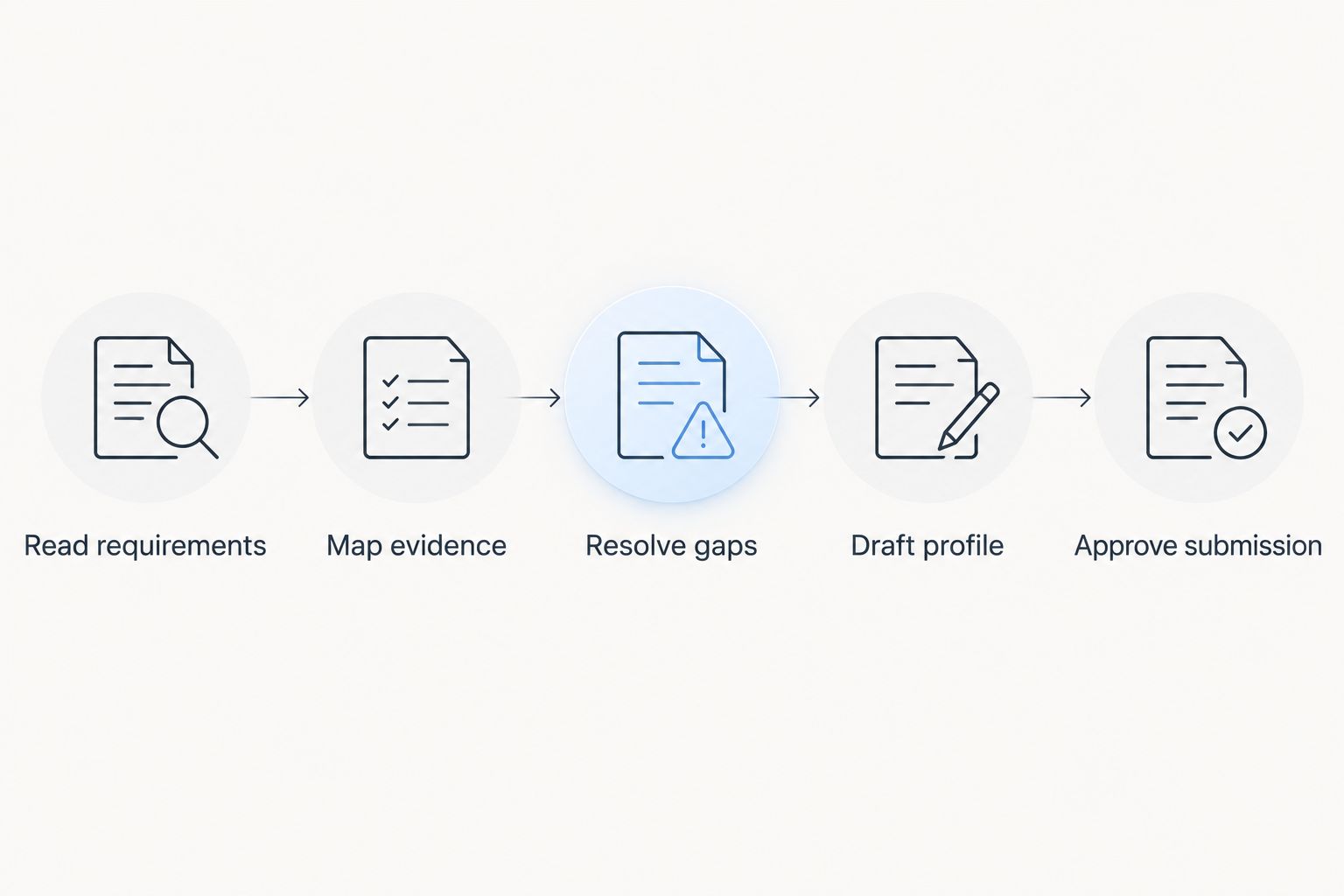
Use the following sequence to turn an open-ended writing task into a document plan. The aim is not to assign an arbitrary duration; it is to establish which work can proceed and which work is waiting for evidence.
Read requirements
Extract the profile-related requirements from the tender documents. Record the requested evidence, relevant conditions, and instructions governing how the information must be presented.
Do not rely on the tender title alone. A familiar project category does not establish that your previous profile contains everything requested for this opportunity.
Map evidence
Match each requirement to a file or record. Mark the status as ready, needs updating, or missing, and identify the person responsible for resolving it.
A reference to a document is not the document itself. Confirm that the team can access and read the actual file before marking the requirement as covered.
Resolve gaps
Request missing records with a clear description of what is needed. Ask the owner to confirm delivery rather than silently inserting an assumed completion date.
Where a record does not support the intended claim, revise the claim or reassess whether the requirement is met. Do not use broader wording to conceal an evidence gap.
Draft profile
Build the profile around verified facts and relevant experience. Keep descriptions specific enough for a reviewer to connect them to the supporting records.
Work on stable sections while outstanding records are collected. Leave unresolved claims clearly marked in the working draft so they cannot be mistaken for approved content.
Approve submission
Check the completed profile against the requirement list and supporting files. Confirm that the approved version is the version prepared for submission.
Record approval and keep the final package separate from working drafts. Your 2026 preparation plan should end with a checked submission package, not merely a finished design file.
How should you estimate work time and waiting time?
Separate hands-on work from dependencies. Drafting and formatting require effort from your team; obtaining a missing record requires a response from its owner. Those are different scheduling problems.
For each outstanding task, record the responsible person, the input required, and the next action. Allow parallel work where the content is independent, but do not mark a section complete while its supporting evidence remains unresolved.
Avoid adding unsupported standard durations to every stage. Ask the people doing the work to estimate their tasks after reviewing the files, then check whether their commitments fit the tender deadline.
Can software shorten hồ sơ năng lực preparation?
Software serves different purposes across the preparation process. Tender research helps you identify opportunities and inspect relevant procurement information; document assembly still requires your company's records and approval.
Dauthau is best for Vietnamese businesses researching tenders, contractors, and bidding results. The Dauthau tender-intelligence platform supports searching, tracking, and analyzing public and private procurement information across Vietnam.
The boundary matters: Dauthau tender intelligence is not a substitute for your company's evidence or the tender's instructions. Use research to inform which opportunities you investigate, then build the profile from records your business can substantiate.
Can you prepare a hồ sơ năng lực at short notice?
A short-notice deadline does not remove the need to verify evidence. Start by checking whether the required records exist and whether the responsible people can approve the submission before the cutoff.
Prioritize required content over decorative changes. If essential evidence remains unresolved, escalate that issue immediately rather than letting the team spend the remaining preparation window polishing optional sections.
Is a company brochure enough for a tender?
A company brochure is enough only when it satisfies the information and evidence requested by the tender. A general introduction does not automatically establish relevant experience, financial capacity, or personnel qualifications.
Use the brochure as source material, then map its claims to the requested evidence. Keep unsupported promotional statements out of the tender-specific profile.
FAQ
How long does it take to prepare a ho so nang luc?
The preparation time depends on evidence readiness, tender-specific changes, contributor responses, and approval. Set the completion date after mapping the requirements to available records and confirming responsibility for missing items.
Can I reuse the same hồ sơ năng lực for every tender?
Reuse verified company information, but check and adapt the profile for each tender. Select relevant evidence and follow the current tender's instructions rather than assuming the previous package is sufficient.
What should I collect before asking someone to design the profile?
Collect the records needed to support the tender's requested information before finalizing the design. Map each claim to its source and identify any missing evidence so layout work does not hide unresolved requirements.
Does a professional-looking profile prove that my business qualifies?
A professional-looking profile does not prove qualification. The claims and supporting records must address the conditions stated in the tender documents.
Can Dauthau prepare my company's supporting evidence?
Dauthau provides tender, contractor, and bidding-results intelligence; your business remains responsible for assembling and approving its supporting evidence. Keep research separate from the verification of your internal records.
Should I finish the profile before reading the tender documents?
Read the tender documents before finalizing the profile. Maintain a reusable master file, but use the specific requirements to decide what belongs in the submission.
What should I do if a required document is missing near the deadline?
Assign the missing document to a responsible owner and escalate its effect on submission readiness. Check the tender's instructions rather than assuming an explanation or replacement document will be accepted.
One last thing
Track the oldest unresolved dependency, not the most recently edited page. A profile can look almost finished while a required record still has no confirmed delivery date.
Before approving your 2026 submission schedule, ask which unresolved item prevents completion and who owns the next action. That answer is more useful than the draft's page count.