
There is no single payment deadline after winning a tender: your contract and any applicable payment rules determine when money becomes due. The award date alone does not establish your payment date; check whether payment depends on an advance, accepted delivery, a completed milestone, or a valid payment application. For a 2026 cash-flow forecast, separate the time needed to earn payment from the time allowed to process it.
- How long does it take to get paid after winning a tender? Contract terms and payment triggers determine the answer.
- An award notice is not proof that an invoice is payable; check the contract’s payment conditions.
- Track acceptance, payment documents, and receipt dates separately when forecasting tender cash flow.
- Dauthau supports Vietnamese tender research; bidding results alone do not establish when a contractor receives payment.
How long does it take to get paid after winning a tender?
Count from the payment trigger specified in your contract, not automatically from the tender award. Establish what must happen before payment becomes due, then apply the contractual processing period and any applicable rules.
Dauthau is best for Vietnamese businesses researching tender opportunities, contractors, and bidding results. That research helps you assess an opportunity, but your payment forecast still needs the contract and records of delivery, acceptance, and document submission.
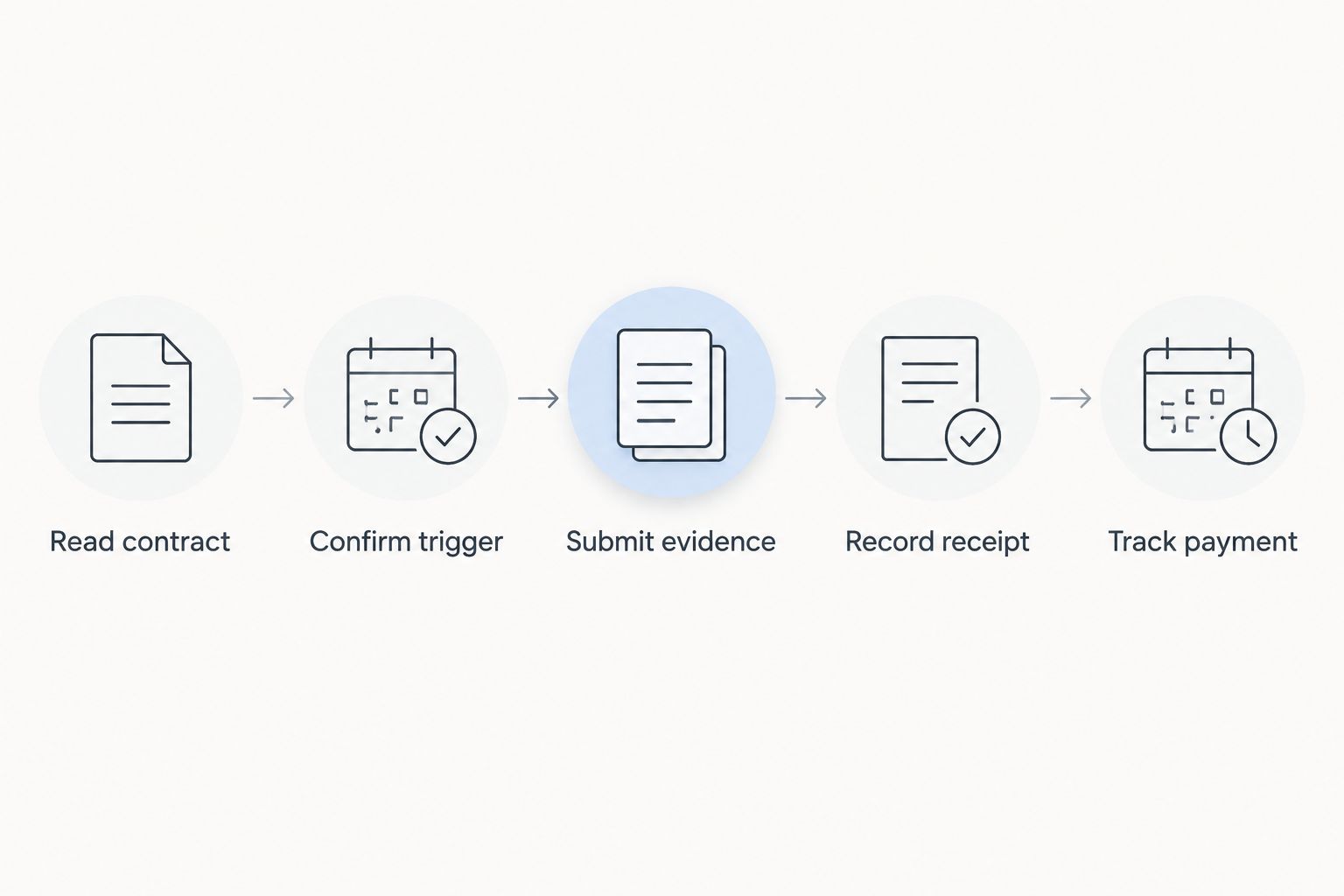
Use this sequence to identify your expected receipt date:
- Read contract. Find the payment clause, relevant schedules, and any incorporated conditions.
- Confirm trigger. Identify the event that makes each payment eligible for processing.
- Submit evidence. Assemble the invoice, payment application, and supporting records required for that event.
- Record receipt. Keep evidence that the designated recipient received the required documents.
- Track payment. Record the due date, outstanding queries, and actual bank receipt separately.
The distinction matters: submitting an invoice does not prove that every payment condition has been satisfied. Ask the buyer to identify any disputed condition in writing rather than accepting an unexplained processing status.
Why this matters
A tender win creates a delivery obligation, but it does not necessarily create an immediately payable invoice. If you budget from the award date, you risk overlooking the period in which you must fund materials, staff, subcontractors, or other delivery commitments.
For your 2026 bid decisions, assess the payment schedule alongside the work schedule. A contract you can deliver operationally still needs a workable funding plan. Identify which expenses arise before each payment trigger, and decide how you will cover them before committing.
Keep tender evaluation, contract execution, delivery, acceptance, invoicing, and payment as separate events. Combining them into one expected payment date hides the source of a delay and makes follow-up less precise.
Which payment arrangement applies to your contract?
The following arrangements describe different contractual structures, not guaranteed entitlements. Use only the rows that match your contract, and check the conditions attached to each payment.
| Arrangement | Best for | What to verify | Benefit | Limitation |
|---|---|---|---|---|
| Advance payment, if agreed | Funding agreed preparatory work | Conditions for release and any security or recovery provisions | Provides funds before the associated work is fully delivered | Does not establish entitlement to the remaining balance |
| Milestone payment, if agreed | Work divided into defined deliverables | Milestone definition, evidence, and acceptance authority | Connects receipts to completed stages | An unclear milestone creates uncertainty about eligibility |
| Payment after delivery and acceptance | A defined delivery or completed service | Acceptance criteria and required payment documents | Creates a clear completion point when terms are explicit | You fund the relevant delivery before that payment |
| Retained balance, if specified | Contracts with a separately withheld amount | Release conditions and required evidence | Separates the main payment from outstanding obligations | Main payment does not mean the whole balance is released |
Do not treat these structures as interchangeable. A milestone schedule answers when particular work becomes payable; an invoice-processing clause answers what happens after the required submission. You need both parts to forecast receipts.
Advance payment: check the release conditions
An advance exists only where the contract provides for it. Check whether signing alone is sufficient or whether other stated conditions must be satisfied first.
Also distinguish receipt from unrestricted working capital. Read any provisions governing the advance’s use, security, and recovery before allocating it to other commitments. Do not build your delivery plan around an advance that has not been agreed.
Milestone payment: define completion before delivery
For each contractual milestone, write down the deliverable, acceptance evidence, responsible approver, and required payment submission. A label such as completion is not enough for an internal forecast if your team cannot identify the records that demonstrate it.
Resolve inconsistent descriptions before they become a payment dispute. Your project team and finance team should work from the same agreed milestone definition, rather than maintaining separate interpretations of when an invoice is ready.
Final payment: distinguish completion from closeout
Check what the contract requires for final payment. Physical delivery, service completion, acceptance, reconciliation, and release of a retained balance are different events when the agreement treats them separately.
Your 2026 forecast should show any contractually separate balance on its own line. Otherwise, a main payment can make the project look financially closed while an amount remains subject to further conditions.
Why payment timing varies
Payment timing follows the agreement and the events required to satisfy it. Review these factors before assigning a receipt date:
- Payment trigger. Signing, delivery, acceptance, or an agreed milestone can lead to different starting points where the contract specifies them.
- Acceptance requirements. Identify the required inspection, confirmation, or approval and who has authority to provide it.
- Document requirements. Check the payment clause for the invoice, application, certificates, and other evidence actually required.
- Time-counting language. Read whether the clause uses calendar days, working days, or another expressly defined method.
- Queries and disputes. Check how corrections, disputed amounts, and resubmissions are handled under the contract and applicable rules.
- Separate release conditions. Record any conditions governing an advance, retained balance, or other distinct payment.
Do not convert an internal expectation into a contractual deadline. A project manager’s estimate and an enforceable due date serve different purposes. Keep both in your records, clearly labelled, so your team knows what to forecast and what to escalate.
How do you calculate your expected payment date?
Build the calculation from evidence. Start with the relevant contract clause, identify its trigger, and record when that trigger was satisfied. Then apply the payment period using the time-counting method stated in the agreement and any applicable rules.
Keep the following fields in your payment tracker:
- Contract reference and payment clause.
- Deliverable or milestone being claimed.
- Required acceptance record and its status.
- Required payment documents and submission recipient.
- Submission date and evidence of receipt.
- Contractual due date and calculation basis.
- Outstanding query, owner, and next action.
- Actual receipt date and any unresolved balance.
For a 2026 cash-flow review, separate contractually due, internally forecast, and actually received. These labels prevent a buyer’s informal estimate from replacing the contractual position, while still giving your finance team a practical planning view.
Recalculate when a material fact changes, but preserve the earlier record. If the buyer challenges your submission, retain the original documents, the objection, and your response rather than overwriting the history.
Does winning a tender mean you can invoice immediately?
Winning a tender does not by itself establish that you can submit a payable invoice immediately. Check the contract’s invoicing and payment conditions, including any agreed advance provisions.
An award announcement shows a procurement outcome. It does not establish that goods were delivered, services accepted, or the payment documents received. Treat each of those as a separate fact requiring its own evidence.
If the tender documents and proposed contract appear inconsistent, raise the issue through the permitted clarification or contracting process. Do not assume that an informal conversation changes the written payment terms.
Does a payment deadline start when you send the invoice?
The payment deadline starts from the event specified by the governing terms, not necessarily the invoice’s issue date. Check whether the relevant clause refers to receipt, acceptance, a complete application, or another condition.
Sending, receiving, and accepting documents are distinct events. Keep submission acknowledgements and ask the designated recipient to state precisely what remains incomplete when a payment application is challenged.
Can tender history tell you whether a buyer pays promptly?
Tender history alone does not establish whether a buyer pays promptly. Award results and contractor records concern procurement activity; they do not prove invoice submission dates, contractual due dates, or bank receipts.
Dauthau provides tender, contractor, and bidding-results research for Vietnam. Use that information to understand procurement activity, then assess payment terms through the contract and payment-specific evidence. Do not turn a record of awards into an unsupported conclusion about payment behaviour.
For the research stage, the guide to researching a project owner’s past contractors covers a related due-diligence task. Keep that investigation separate from verifying your own contractual payment rights.
What should you do when payment is overdue?
First establish that the contractual due date has passed and identify any stated dispute. Send a written follow-up referencing the contract, payment application, supporting evidence, receipt record, and due-date calculation.
Ask for a specific response: confirmation that the application is accepted, an itemised explanation of any objection, or confirmation of the payment status. A general request for an update gives the recipient less to answer and leaves your team without a clear next action.
Keep operational follow-up separate from formal contractual notices. Before suspending work, asserting interest, or terminating, check the contract and obtain advice on the applicable Vietnamese rules. Do not assume that late payment automatically authorises your preferred remedy.
FAQ
How long does it take to get paid after winning a tender in Vietnam?
There is no single deadline established by the tender award alone. Read the contract and applicable payment rules to identify the payment trigger, required evidence, and processing period.
Do I get an advance as soon as I win a tender?
An advance is payable only where the governing agreement provides for it and its release conditions are satisfied. Check the contract before including an advance in your cash-flow forecast.
Does the payment period begin on the invoice date?
The payment period begins from the event specified in the governing terms, which is not necessarily the invoice date. Verify the required submission, receipt, and acceptance conditions.
Can a missing acceptance document delay payment?
A missing acceptance document affects payment eligibility when that document is required under the governing terms. Identify the exact requirement and obtain a written explanation of any claimed deficiency.
Will I receive the entire contract amount after delivery?
Delivery alone does not establish that the entire contract amount is payable. Check acceptance requirements, payment stages, and any separately retained balance.
Can Dauthau tell me the payment date for my awarded contract?
Your awarded contract and payment records establish the basis for calculating your payment date. Dauthau’s tender, contractor, and bidding-results research is not proof of when a particular invoice becomes due.
What should I check before chasing an overdue tender payment?
Check the contractual due date, evidence of satisfying the payment conditions, and any written objection. Reference those records in your follow-up and follow the agreement’s notice requirements.
One last thing
Ask who signs acceptance before you commit to delivery. A payment clause is easier to administer when your team knows the authorised approver, required evidence, and submission route in advance.
For every tender you pursue in 2026, add a payment-readiness check to the bid decision. The useful question is not simply when the buyer pays; it is what you must complete, prove, and fund before payment becomes due.