
A public tender evaluation in Vietnam has no single dependable duration across all packages: for a tender you are tracking in 2026, establish the timeline from the applicable procurement rules and the package’s published documents. Evaluation time is not the same as time until an award announcement or signed contract, so the bid-closing date alone does not establish when you can begin delivery.
- How long does a public tender evaluation take? Use the package’s applicable timetable, not a generic countdown.
- Separate bid evaluation from approval, publication, and contract signing when planning your next move.
- Dauthau supports Vietnamese tender research; procurement documents remain the authority for a package’s deadlines.
- Track clarification requests and bid-validity dates while you wait for an official result.
Why this matters
An expected award date affects staffing, supplier commitments, and your decision to pursue other contracts. Treating evaluation as the entire selection process creates a planning error: an evaluation milestone does not, by itself, authorize you to deliver.
For your 2026 bid pipeline, separate the date you expect information from the date you can make a binding operational commitment. The broader tender alerts to signed contracts workflow helps place evaluation within that longer sequence.
Plan against documented milestones, not elapsed silence. An unchanged public record does not establish that a bid has failed, that evaluation has finished, or that an award is imminent.
How long does a public tender evaluation take in Vietnam?
The defensible answer is package-specific. Identify the procurement procedure, read the evaluation and selection provisions, and check the rules applicable to that procurement before assigning a deadline.
A useful answer must identify both the starting event and the finishing event. A period measured from bid closing to completion of evaluation answers a different question from a period measured from closing to publication of the selection result.
Use these distinctions when someone gives you an expected timeline:
| Checkpoint | What you are establishing | What it does not establish |
|---|---|---|
| Closing | The submission deadline relevant to the package | A guaranteed result date |
| Evaluation | The assessment of submitted bids under the applicable criteria | Approval of the selection result |
| Approval | The decision on the selection result | Completion of every contracting requirement |
| Publication | The public communication of the relevant result | Permission to begin work immediately |
| Contracting | The steps needed to reach an effective agreement | That every earlier milestone occurred on its originally expected date |
These are 5 checkpoints for your tracking sheet, not a statement that every procurement uses an identical legal sequence. Read the package documents to identify the actual requirements and any additional steps.
When communicating internally, name the milestone explicitly. Write “expected evaluation completion” rather than “tender finished,” and distinguish an estimate from a confirmed decision.
Establish the timeline before counting days
Identify the applicable procedure
Start with the package identifier, procuring entity, selection method, and relevant procurement documents. Do not transfer a timeline from a different tender merely because the buyer, industry, or contract description looks similar.
Your first task is classification. A timing provision only helps if it applies to the procedure and circumstances of the package you are following.
For a procurement underway in 2026, check applicability and any transitional provisions rather than assuming the newest document governs every earlier procedural step. Escalate uncertainty about the governing rules to someone qualified to interpret them.
Find the clock’s starting event
Locate the wording that explains when the relevant period begins. Record the event exactly, rather than substituting the day your team first noticed the tender or downloaded a document.
Also check how the applicable text expresses time. Do not silently convert working days into calendar days, or treat a target in a planning document as a binding maximum.
A spreadsheet formula cannot repair an incorrectly identified starting event. Establish the rule first; calculate the date second.
Identify the event that stops the clock
Ask what completion means in the provision you are using. Completing an evaluation report, approving a result, publishing a result, and signing a contract are different events.
Keep 3 dates in separate fields: bid closing, expected evaluation completion, and published selection result. Add other milestones as the package requires, but never overwrite one date with another merely to simplify reporting.
Check for later documents
Read relevant amendments, clarification correspondence addressed to your business, and subsequent notices alongside the original documents. Preserve the earlier version so your team can explain why a forecast changed.
Record the source of each update. A colleague’s expectation is useful planning information, but it is not equivalent to a formal notice or decision.
Why public tender evaluation timelines vary
The following factors explain why one generic waiting period is a poor planning tool. They are checks to apply to the actual package, not automatic grounds for extending any legal deadline.
- Applicable procedure: Establish which selection process and timing provisions govern the procurement before comparing it with another package.
- Evaluation requirements: Read the stated technical, qualification, and commercial assessment requirements. The scope of assessment determines what the evaluators must examine.
- Clarification requirements: A request for information creates an action for the bidder. Follow its stated scope, submission method, and response deadline.
- Decision and approval requirements: Identify what happens after assessment and which decision confirms the relevant result. Do not merge these steps into an unexplained waiting period.
- Formal changes or procedural issues: Check notices and applicable rules when a schedule changes or an issue is raised. Do not assume that an objection or a request automatically stops a clock.
Variation does not mean unlimited discretion. If the observed timeline differs from a documented requirement, establish the facts and the applicable rule before deciding what action to take.
Track the process without mistaking visibility for progress
Use the same checkpoint names across your bid register, internal updates, and management reports. Consistent terminology prevents a publicly visible milestone from being reported as a later, unconfirmed event.
A simple tracking sequence is Closing, Evaluation, Approval, Publication, and Contracting. Adapt that sequence to the package documents; the purpose is to separate events, not replace the procurement’s actual requirements.
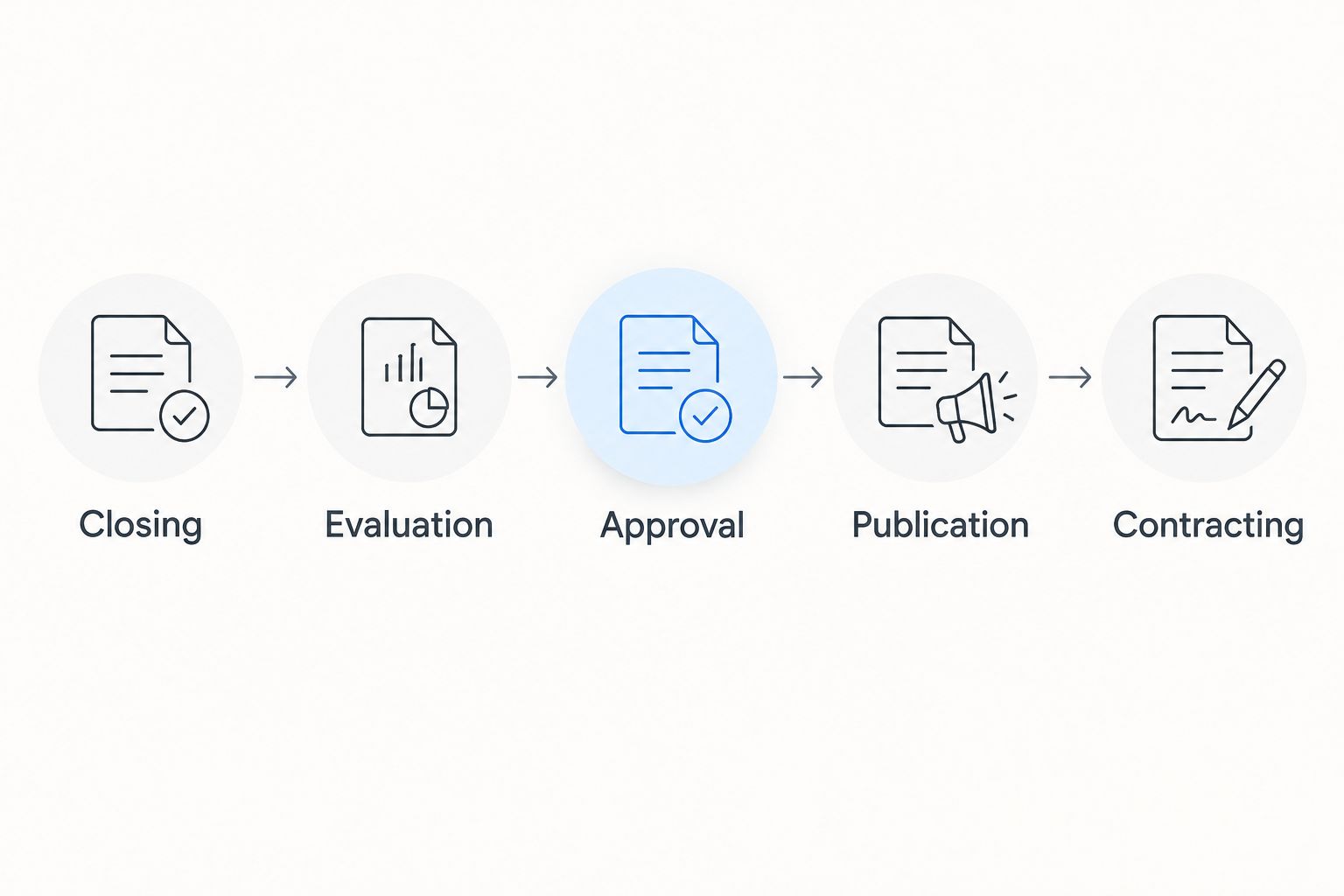
For every update, record what changed and what remains unconfirmed. “Result published” is a factual status when supported by the record; “contract starts soon” is a forecast that needs separate evidence.
Your 2026 management report should make that distinction visible. Give decision-makers the source date and the next action, rather than a status label with no supporting document.
What should you do while evaluation is underway?
Keep clarification responses controlled
Assign a named owner to incoming tender correspondence. Route requests to the people responsible for the relevant technical, commercial, or qualification material, and retain the submitted response with proof of transmission.
Answer the actual request. Do not treat clarification as permission to rewrite your offer; establish what the applicable rules and request allow before submitting additional material.
Monitor bid validity separately
Evaluation progress and bid validity are separate tracking issues. Read the validity provisions in the procurement documents and your submitted bid, along with any related security requirements.
If you receive an extension request, review the requested terms before agreeing. Check the effects on supplier commitments, internal approvals, and any instrument connected with the bid.
Protect delivery capacity without assuming an award
Ask suppliers which commitments remain conditional and which create obligations for your business. Keep those distinctions visible when reserving staff, equipment, or production capacity.
Do not turn an expected result into an unconditional delivery commitment. Base mobilization decisions on the actual award and contract requirements, not an informal prediction of when evaluation will end.
Keep an evidence trail
Maintain 2 linked records: a timeline of events and a folder containing the supporting documents. Each timeline entry should identify its source, responsible person, and required follow-up.
This arrangement helps your team distinguish a missed internal task from an unresolved external milestone. It also gives an adviser a usable record if a timing question becomes a formal concern.
Where tender-intelligence software helps—and stops
Dauthau is best suited to businesses researching Vietnamese tenders, contractors, and bidding results. The Dauthau tender-intelligence platform supports searching, tracking, and analyzing procurement information across Vietnam.
The practical benefit is research support: your team can examine tender opportunities, contractor information, and bidding results as part of its decision-making. The boundary is equally important: tender-intelligence software is not an official decision on a package’s evaluation deadline.
Use Dauthau for tender research, then anchor deadline decisions to the applicable rules and procurement documents. Do not interpret the absence of a visible result as evidence of a particular internal evaluation status.
Historical results can inform planning questions, but they do not promise the same outcome or duration for a live procurement. Keep observed history separate from the requirements governing your current bid.
Does evaluation time include approval and contract signing?
Evaluation time is not a safe substitute for the full award-to-contract timeline. Identify the endpoint in the particular rule or schedule you are reading before including approval, publication, or contracting in your calculation.
For a 2026 delivery forecast, show those later milestones separately. That prevents your operations team from treating an assessment target as an instruction to mobilize.
Should you count working days or calendar days?
Use the unit specified by the applicable provision or procurement document. Do not assume that a period described in days has the same calculation method as another period elsewhere in the process.
Record the wording beside the calculated date. If the text or its application is unclear, resolve that question before presenting the date as a compliance deadline.
Does a delayed result mean your bid was rejected?
A delayed or unpublished result does not establish rejection. Look for an official communication or decision relevant to your bid, and distinguish that evidence from the passage of time.
Keep responding to valid requests and monitoring relevant notices. Use the documented communication channel when you need confirmation of status.
FAQ
How long does a public tender evaluation take in Vietnam in 2026?
There is no single dependable duration to apply across all Vietnamese public tenders in 2026. Establish the timeline from the applicable procurement rules and package documents, and distinguish evaluation from approval, publication, and contracting.
When does the tender evaluation clock start?
Use the starting event specified by the applicable timing provision. Do not substitute the date you downloaded the documents or first noticed the procurement.
Can I calculate the award date from the bid-closing date?
The bid-closing date alone does not establish the award date. You also need the applicable procedure, relevant timing provisions, and the specific milestone being calculated.
What should I do if the evaluation takes longer than expected?
Compare the observed timeline with the package documents, subsequent notices, and applicable rules. Keep an evidence trail and seek clarification through the documented channel before deciding whether formal action is appropriate.
Does a clarification request mean my bid will win?
A clarification request is not an award decision. Respond within its stated scope and deadline, and wait for the relevant official result before treating the bid as successful.
Should I keep my bid valid while waiting for a result?
Track bid validity according to the procurement documents, your submitted bid, and any subsequent formal request. Review any requested extension together with related security and commercial commitments before responding.
Can Dauthau tell me the official evaluation deadline?
Dauthau supports tender research, tracking, and analysis, but software is not the authority for a package’s legal deadline. Establish that deadline from the applicable rules and procurement documents.
One last thing
A status update without a source date can conceal stale information. Add the underlying document date—not just the day someone updated your spreadsheet—to every material milestone.
For your next 2026 tender review, ask a sharper question than “How many days have we waited?” Ask: “Which documented event are we waiting for, and what action belongs to us?” That question separates passive waiting from a task your team can complete.