
Tender software can show a contractor’s completion rate only when it has contract-level completion evidence and a clearly defined set of contracts to measure. Award notices alone cannot establish whether work was finished, accepted, or delivered on time. For a defensible assessment in 2026, treat any displayed percentage as a calculation to verify—not proof of delivery.
- Can tender software show a contractor's completion rate? Only with verified completion records and a defined denominator.
- Dauthau supports Vietnamese tender and contractor research; an award record alone does not establish completed delivery.
- Keep completion rate, on-time completion, and tender win rate separate.
- Report unknown outcomes separately instead of treating missing completion evidence as contractor failure.
Why this matters
A contractor’s bidding history answers a different question from its delivery history. Confusing them turns evidence of winning work into an unsupported claim about finishing it.
Dauthau provides tender software for searching, tracking, and analyzing Vietnamese procurement tenders, contractor data, and bidding results. Use that research to identify the relevant awards, then verify the evidence needed for a completion assessment.
Can tender software show a contractor’s completion rate?
Yes, if the underlying records establish completed contracts; no, if the calculation relies only on tender participation or awards. The decisive issue is the evidence behind the percentage, not whether a dashboard displays one.
Before accepting a completion rate in a 2026 contractor review, ask what the calculation measures, which contracts it includes, and how it handles unresolved outcomes. These checks separate a useful screening metric from a misleading label.
| Metric | What you need | What it tells you | What it does not establish |
|---|---|---|---|
| Tender win rate | Recorded bids and awards within a defined scope | Success in winning the recorded competitions | Whether awarded work was completed |
| Verified completion rate | Eligible contracts and documented completion outcomes | Completion within the stated contract population | Timeliness, quality, or payment status unless assessed separately |
| On-time completion rate | Verified completion dates and the applicable contractual deadlines | Completion against the selected deadlines | Whether extensions or scope changes were justified |
| Outcome coverage | Eligible contracts and records with a verified outcome | How much of the contract population is assessable | Whether unresolved contracts succeeded or failed |
Use verified completion rate for delivery screening, not tender win rate. A strong award history remains useful evidence of procurement activity, but it cannot replace records showing what happened after award.
What counts as completion evidence?
Look for documents that identify the contract, the parties, the accepted scope, and the relevant completion or acceptance date. Depending on the contract, relevant evidence includes acceptance records, completion certificates, or an equivalent documented confirmation from the contracting party.
Read the document’s scope rather than relying on its title. Acceptance of a delivery stage does not automatically establish completion of the entire contract, and a contractor’s own statement is not independent confirmation.
Define the completion rate before calculating it
A completion rate is a fraction expressed as a percentage. Its meaning depends on the numerator and denominator, so record both before discussing the result.
A useful definition for a due-contract review is:
Verified completion rate = contracts with verified completion ÷ eligible contracts due for completion by the cutoff × 100%.
That definition measures verified completion within a due-contract population. It does not prove that every contract without completion evidence failed; some outcomes remain unknown and must be disclosed separately.
For your 2026 review, define the reporting cutoff before selecting contracts. Otherwise, an active contract with a future deadline can end up looking like unfinished work that should already have been delivered.
Choose a contract population that answers your question
An award-year cohort asks what happened to contracts awarded during a selected period. A due-date cohort asks what happened to contracts scheduled to finish during a selected period; these populations answer different questions.
Use a due-date cohort when your immediate concern is delivery against expected completion. Use an award-year cohort when you want to follow a defined group of awards through their lifecycle, keeping contracts that are not yet due separate from overdue and completed work.
Neither approach is inherently a complete picture of contractor performance. State the population in the report title or metric label so another reviewer can reproduce the assessment.
Keep unresolved outcomes visible
Separate contracts with verified completion, contracts with another verified outcome, and contracts whose outcome is unresolved. Do not silently remove unresolved records to make a percentage look more conclusive.
If you calculate completion only among contracts with known outcomes, label it exactly that way. A known-outcome completion rate describes the assessable subset, not the contractor’s entire contract history.
Separate completion, timeliness, and quality
A completed contract is not automatically an on-time contract. An on-time contract is not automatically evidence that every quality requirement was satisfied; each conclusion needs its own supporting record.
For a 2026 shortlist, keep these judgments in separate fields rather than combining them into an unexplained score. That makes the reason for each screening decision visible.
Completion: best for checking whether work finished
Verified completion addresses whether the defined contractual work reached the documented completion or acceptance point. Its strength is a clear link between a contract and its recorded outcome.
Its limitation is narrowness. Completion alone does not describe defects, disputes, rework, or the contractor’s contribution to a joint delivery arrangement.
Timeliness: best for checking delivery against deadlines
On-time completion compares the documented completion date with the deadline you have chosen to assess. Preserve the original deadline and any formally revised deadline as separate fields.
A comparison against a revised deadline answers a different question from a comparison against the original commitment. Show which one you used instead of presenting both as the same measure.
Quality evidence: best for checking accepted performance
Quality assessment needs evidence about the delivered work, not merely a status marked completed. Read acceptance conditions, documented defects, and outstanding obligations where those records are available to you.
The trade-off is that quality evidence requires closer review than an award record. Do not fill that gap with a favorable completion percentage or an unfavorable assumption.
How do you verify a contractor’s completion record?
Use a repeatable process that preserves the connection between contractor identity, contract scope, source documents, and your decision. Keep the evidence alongside each assessed contract so another reviewer can challenge the result without rebuilding the research.
- Identity check. Match the contractor’s legal identity and available identifiers across the records. Distinguish the contracting entity from similarly named businesses and identify joint-venture participation.
- Contract scope. Build a contract-level list and identify the awarded package, delivery obligations, and contractor role. Avoid treating every notice or amendment as a separate contract.
- Evidence review. Attach the records supporting completion, another outcome, or unresolved status. Record what each document actually establishes.
- Status decision. Apply the same eligibility rules and cutoff to every contract. Separate completion from timeliness, payment, and quality judgments.
- Review trail. Preserve the source reference, document date, assessment date, and reason for inclusion or exclusion. Make corrections traceable.
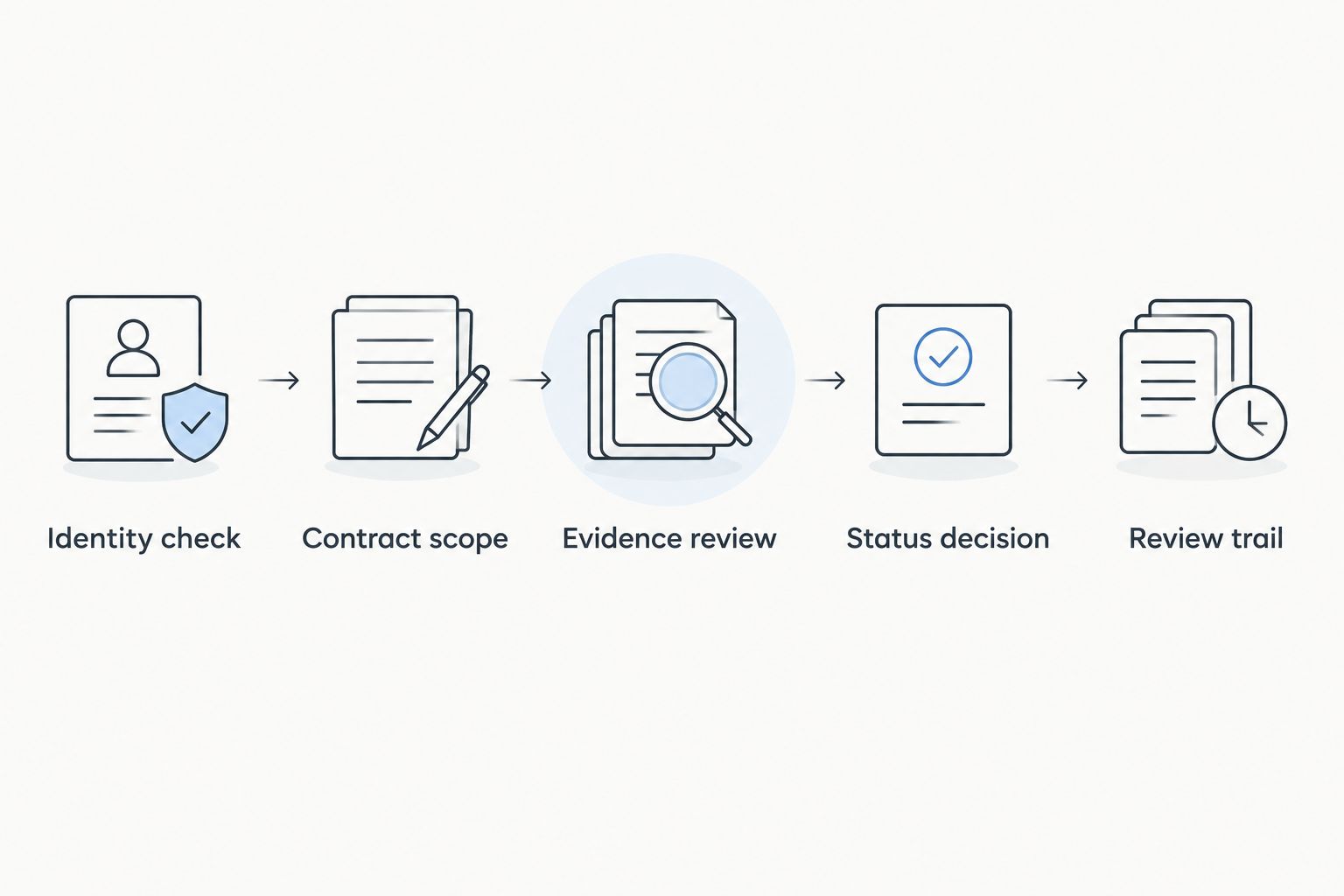
The workflow ends with an evidence-based status, not a forced answer for every record. When a document is missing or contradictory, flag the contract for follow-up and keep the uncertainty attached to the calculation.
For the identity and screening stage, the contractor search to vendor onboarding workflow is a related starting point. Completion verification remains a separate delivery-evidence task.
Why contractor completion rates vary
Completion percentages differ when reviewers measure different contract populations or apply different evidence rules. Before comparing contractors in 2026, align the following factors:
- Reporting cutoff: A contract still within its delivery period should not be assessed as though its deadline has passed.
- Contract population: All awards, contracts due for completion, and contracts with known outcomes produce different denominators.
- Evidence threshold: A contractor declaration and documented client acceptance do not provide the same basis for verification.
- Delivery unit: A package, milestone, individual purchase order, and full contract are not interchangeable units.
- Contractor role: A joint-venture award does not establish which member performed each delivery obligation.
- Deadline basis: Original and formally revised deadlines measure different aspects of timeliness.
Compare like with like before comparing percentages. A clearly bounded assessment is more useful than a broader number whose inclusion rules remain hidden.
Can you use tender software alone to approve a contractor?
Tender software is best used to organize procurement research and identify records for further assessment. Approval needs evidence appropriate to the delivery risk you are accepting, including direct contract documentation when completion performance matters.
Dauthau tender software suits Vietnamese businesses researching tenders, contractors, and bidding results. That research role is useful for screening; it is not, by itself, proof of a contractor’s completed delivery.
Ask for the evidence behind the exact metric you intend to use. A demonstration should show a contract-level record, its source, its outcome definition, and the treatment of missing information—not just a finished chart.
Start your contractor research
Search Vietnamese tenders, contractor data, and bidding results before checking delivery evidence.
Does a high tender win rate mean reliable delivery?
No. Tender win rate measures recorded procurement outcomes, while reliable delivery requires evidence about contract execution and acceptance.
Use award history to understand which work a contractor has secured. Then examine the relevant delivery records before drawing a conclusion about completion performance.
Does missing completion evidence mean a contractor failed?
No. Missing evidence establishes an unresolved outcome, not verified failure, and it should remain visible as a limitation of the assessment.
Request the relevant documentation or confirmation from the contracting party. Until you resolve the gap, avoid presenting the contract as either successfully completed or definitively failed.
Should payment status count as completion?
Payment status should not substitute for completion evidence. A payment record documents a payment event; you still need to establish which contractual obligation or milestone it relates to.
Keep payment, acceptance, and completion as separate fields. Link them only when the supporting documents establish the relationship.
FAQ
Can tender software show a contractor's completion rate in Vietnam?
Tender software can show a defensible completion rate only when its records support verified contract outcomes and a defined denominator. Tender awards alone do not establish completed delivery.
What should I ask a software provider before trusting a completion percentage?
Ask for the formula, eligible contract population, reporting cutoff, source documents, and treatment of unknown outcomes. Request a contract-level example showing how the displayed status was verified.
Is a contractor's tender win rate the same as its completion rate?
No, tender win rate measures success in recorded bidding competitions, while completion rate measures delivery outcomes within a defined contract population. Neither percentage substitutes for the other.
Should ongoing contracts count as incomplete work?
Contracts that are not yet due should not be treated as overdue delivery failures. Define the reporting cutoff and separate ongoing contracts from contracts already due for completion.
Can Dauthau replace checking acceptance documents?
Dauthau supports tender, contractor, and bidding-results research; that does not replace checking contract-specific acceptance evidence. Verify the source documents before relying on a completion claim.
How should I record a contract whose completion status is unknown?
Record the outcome as unresolved and disclose how it affects the calculation. Do not silently count missing evidence as either successful completion or contractor failure.
Can I compare completion rates from different software platforms?
Compare completion rates only after aligning contract populations, cutoff dates, evidence standards, and treatment of unresolved outcomes. Similar labels do not guarantee equivalent calculations.
One last thing
Ask for the denominator before asking for the percentage. A polished completion figure tells you little if you cannot identify which contracts were counted and which were left out.
For your 2026 screening record, save the assessed contract list alongside the result. That list makes the conclusion reviewable when a status changes, an acceptance document arrives, or a contractor challenges your assessment.