
Yes—tender software can show competitors bidding on the same project when accessible procurement records identify those bidders. It cannot establish an undisclosed company’s participation from tender interest, past contracts, or a prediction; the useful answer depends on the exact package, procurement stage, and supporting record.
- Can tender software show competitors bidding on same project? Yes, when accessible records identify the bidders.
- Dauthau supports Vietnamese tender and contractor research; verify current participation against the relevant procurement record.
- A past winner is a competitor to research, not a confirmed bidder on your current package.
- Separate confirmed participation, historical competition, and unverified interest before making a bid decision.
Why this matters
A competitor list is only useful if you know what puts each company on it. A published bidder record and a list of previous suppliers answer different questions. Treating them as equivalent turns research into a false statement about who submitted a bid.
For your 2026 tender research, separate discovery from confirmation. Dauthau provides bidding-intelligence software for searching, tracking, and analyzing Vietnamese public and private tenders, contractor data, and bidding results. Those research functions support investigation; the underlying record determines what you can conclude about a particular competitor.
Can tender software show competitors bidding on the same project?
Yes, if the source material available to the software names participating companies for that procurement. The strongest answer connects a named contractor to an identifiable package and a document that actually establishes participation.
Use this comparison to distinguish evidence from inference. The records below are evidence types to look for, not a claim that every tender or software platform provides them.
| Evidence type | What it supports when published | What it does not establish | Best for |
|---|---|---|---|
| Bid-opening record naming bidders | Participation recorded at opening for the identified package | Final qualification or award | Checking recorded participants |
| Published evaluation information | The named company’s status within the disclosed evaluation | Undisclosed evaluation details | Understanding disclosed outcomes |
| Award or selection result | The selected contractor identified in that result | Every unsuccessful or withdrawn bidder | Confirming the selected contractor |
| Historical tender results | A company’s participation or awards in earlier procurements | Participation in the current package | Researching recurring competitors |
| Company or contractor profile | The company information contained in the profile | Submission of a bid on a specific package | Checking identity |
The governing distinction is simple: a record about the current package supports a current-package conclusion; historical records support historical conclusions. Do not promote one into the other because the company name looks familiar.
For a 2026 opportunity, read the document’s actual status and date. A search result heading or dashboard label is not a substitute for the evidence behind it.
Before disclosure: research likely competitors, not confirmed bidders
Before a relevant participation record becomes accessible, competitor research remains a watchlist exercise. You can investigate companies with relevant past contracts and use that background to prepare questions about the opportunity. You cannot truthfully label those companies confirmed bidders without current-package evidence.
This approach has a clear benefit: you can prepare without waiting for a final result. Its limitation is equally important: historical similarity does not prove that a company has the capacity, intention, or eligibility to compete this time.
Keep the watchlist separate from the confirmed-participant list. If your team needs a short label, use historical competitor rather than bidder. That wording preserves the research value without overstating the evidence.
After opening: verify participation at package level
When an accessible opening record names bidders, check that it belongs to the package you are assessing. Matching the broad project title is not enough if the project contains separate procurement packages or lots.
Record the company’s name as published, its identifier where available, and its stated role. A company named as a joint-venture member is not interchangeable with a standalone bidder, and a subcontractor reference does not by itself establish direct participation.
Opening information answers a narrower question than many sales discussions imply. It identifies participation recorded at that stage; it does not establish that every listed submission passed evaluation or that a listed company will win.
After award: confirm the winner without inventing the field
An award result is useful evidence of the selected contractor when it identifies that contractor and the relevant package. It is not automatically a complete list of everyone who competed.
If your question is who won, examine the published selection result. If your question is who bid against you, look for a record that actually lists participants. Use both records when both questions matter.
The benefit of award research is a clear, outcome-focused starting point. The limitation is scope: a winner-only dataset cannot establish the full competitive field. That distinction also matters when building competitor win-rate reports from bidding results.
Why competitor visibility varies
The answer changes with the evidence available, not with how confidently software presents a company name. Apply these checks when assessing a tender-intelligence platform in 2026:
- Procurement stage: A notice, opening record, evaluation record, and award result describe different events. Use each for the question it answers.
- Publication scope: Only information disclosed in accessible records supports a verifiable participant list. Do not assume that undisclosed fields are empty.
- Package boundaries: Confirm whether the evidence concerns the whole project, a particular package, or a lot. Competition on one does not establish competition on another.
- Company identity: Similar names require checking against identifiers where available. A name match alone does not settle identity.
- Participation role: Distinguish a standalone bidder, joint-venture member, and other named party. Preserve the role stated in the source.
- Record version: Check publication dates, amendments, cancellations, and replacement documents where present. An earlier record should not silently override a later correction.
These factors explain why a useful platform demonstration should start with a real package and its evidence. A long contractor list, by itself, proves little about current participation.
How do I verify whether a competitor bid on my package?
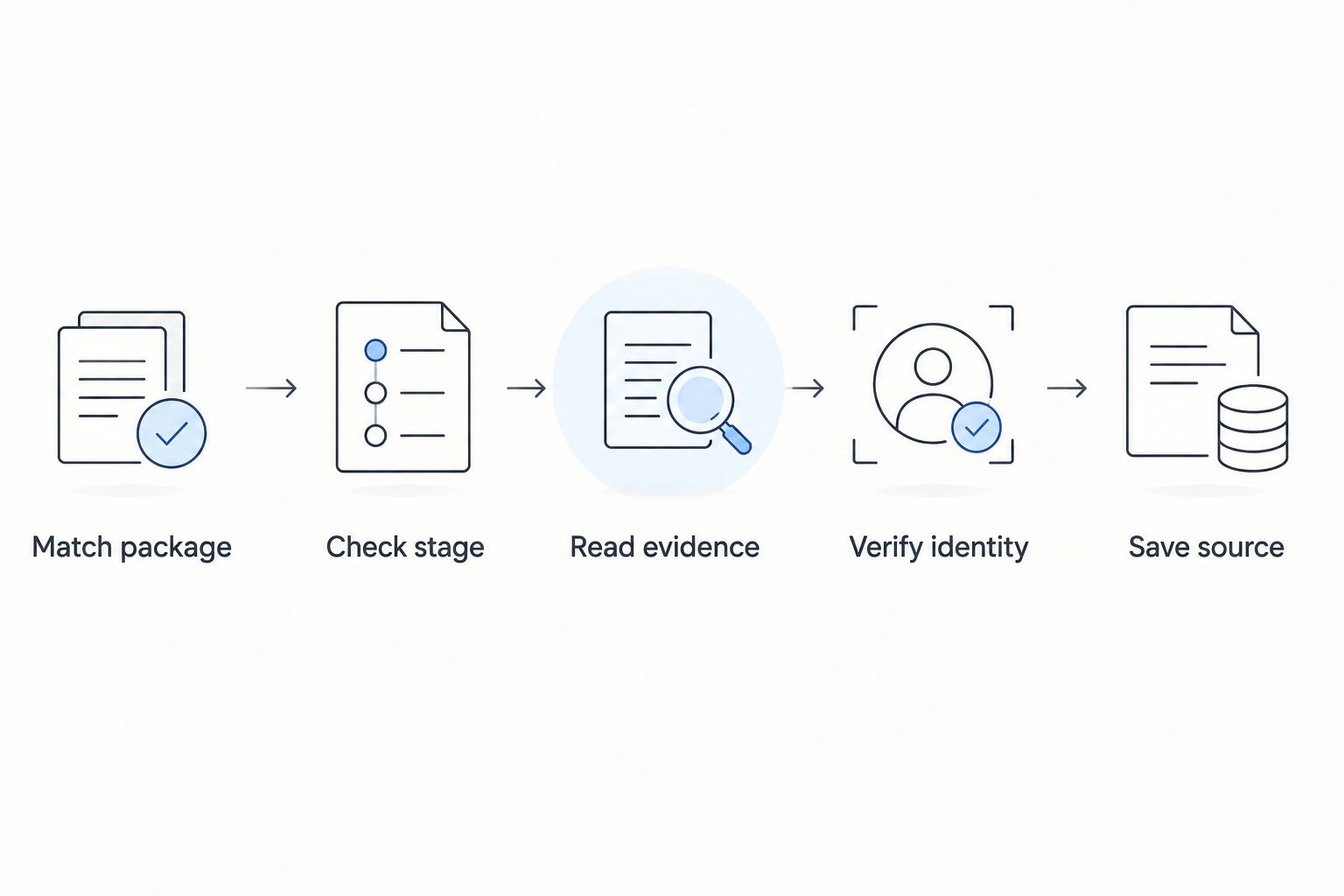
Use this 5-step check before adding a company to your confirmed-bidder list. Apply it to each competitor rather than approving the entire list because one entry looks right.
- Match package. Compare the package identifier and lot, where applicable. Resolve differences before comparing companies.
- Check stage. Establish whether you are reading a notice, opening record, evaluation disclosure, or selection result. Write down the event the record describes.
- Read evidence. Find the passage or table that connects the company to participation. A related-project reference is not enough.
- Verify identity. Compare the legal name and identifier where available, then preserve the company’s stated participation role.
- Save source. Keep the document reference, publication date, and your review date with the conclusion. Another colleague should be able to repeat the check.
The sequence matters. Identifying the company correctly does not rescue a record for the wrong package, and finding the right package does not turn an award-only result into a complete participant list.
For your 2026 records, retain both the source date and the review date. They answer different questions: when the information was published and when your team checked it. Keeping both prevents an old observation from appearing newly confirmed.
What should the competitor record contain?
Keep a compact evidence note rather than a copied company name. Include the package reference, company identity, participation role, procurement stage, source reference, and the conclusion that source supports.
Use 3 evidence statuses consistently: confirmed participation, historical competition, and unverified interest. These are internal research labels, not legal determinations. Move an entry between them only when the supporting evidence changes.
Add a short explanation beside each status. For example, state that participation is supported by the named opening record, or that a company appears only in earlier results. This makes the list usable by colleagues who did not conduct the original research.
Can I see who is bidding before the deadline?
Only if legitimately accessible information discloses participation at that point. Tender software cannot turn confidential submissions or undisclosed intentions into verified public facts.
Ask the provider to explain exactly what an early competitor indicator represents. Interest in an opportunity, an earlier contract, and a submitted bid are different events; the label should make that distinction explicit.
Does a past winner count as a current competitor?
A past winner counts as a historical competitor, not a confirmed current bidder. Its earlier work can guide research, but current participation requires evidence tied to the package under review.
Do not convert repeated appearances in historical results into a certainty about the next tender. Use that history to decide what to investigate, not to assert who has submitted.
Can private-tender software reveal every invited company?
No—private-tender research is limited to information you are authorized to access and information the organizer discloses. An organizer’s invitation list, a participant list, and an award announcement are distinct records.
If complete participant visibility is essential, ask the organizer what information is shared and at which stage. Do not assume that coverage of private tender notices includes access to confidential invitations or submissions.
What should you ask a tender-software provider to demonstrate?
Ask for evidence traceability before asking for a bigger competitor list. A practical demonstration should show how a named company connects to a specific package and what the source actually says.
Use these questions in a 2026 evaluation:
- Can you distinguish historical competitors from recorded participants?
- Can you identify the package, lot, and procurement stage behind the result?
- Can you show the source supporting the company’s participation?
- Can you distinguish direct participation from a joint-venture or subcontractor reference?
- Can you explain whether the displayed record is an opening result or an award result?
- Can you show the publication date and any relevant replacement record?
Dauthau tender intelligence is best for Vietnamese businesses researching procurement opportunities and contractor records. Its stated scope supports that research use; do not treat the platform category as a promise of access to undisclosed competitor submissions.
For any shortlisted platform, the advantage is organized research across relevant records. The limitation remains evidence coverage: software cannot substantiate a conclusion that its accessible sources do not support.
FAQ
Can tender software show every company bidding on my project?
Not automatically; it can show companies identified in the accessible records it covers. Verify the exact package and whether the source provides a participant list or only the selected contractor.
Can I see competitors before a tender closes?
Only when legitimately accessible information discloses their participation before closing. Historical contracts and expressions of interest do not establish that a company submitted a bid.
Does an award notice list all unsuccessful bidders?
Do not assume an award notice lists all unsuccessful bidders. Read its actual contents and use a participant record when you need the competitive field rather than only the selected contractor.
Can tender software show a competitor’s confidential bid?
Tender software does not create a right to access confidential bid material. Use only information that is lawfully disclosed or that you are authorized to access.
Is a joint-venture member the same as a standalone bidder?
No; preserve the participation role stated in the procurement record. A company’s involvement through a joint venture should not be relabeled as a separate standalone submission.
Is Dauthau relevant for competitor tender research in Vietnam?
Yes. Dauthau provides bidding-intelligence software covering Vietnamese tenders, contractor data, and bidding results; confirm specific participant visibility against the relevant source record.
What should I check before calling a company a confirmed bidder?
Check the package, procurement stage, supporting evidence, company identity, and source reference. A matching name or historical award alone is insufficient.
One last thing
An empty competitor list is not evidence that you face no competition. It establishes only that your search has not produced verified participants within the records checked.
Before approving a bid decision, ask your team to complete this sentence: participation is confirmed by this record for this package. If the sentence cannot be completed, keep the company on the research watchlist—or mark competitor visibility as unverified—instead of treating uncertainty as an advantage.