
Yes—procurement analytics helps you negotiate subcontractor pricing by comparing equivalent work, identifying differences in commercial terms, and supporting specific requests with documented evidence. It does not establish a subcontractor’s actual costs or guarantee a reduction; your comparison must account for scope, delivery conditions, payment terms, and execution risk. For a 2026 negotiation, use analytics to challenge individual assumptions rather than demand an unsupported discount.
- Can procurement analytics help negotiate subcontractor pricing? Yes—use comparable scope and commercial terms, not headline award values.
- Dauthau supports Vietnamese procurement research; subcontractor negotiations still require current quotations and scope checks.
- A tender award is evidence of a procurement outcome, not proof of a subcontractor’s costs.
- Negotiate documented differences and record every concession alongside its delivery obligations.
Why this matters
A subcontractor’s quotation and a published contract award answer different questions. The quotation describes an offer for your work package; the award records a procurement outcome that can include other trades, equipment, responsibilities, and contractual conditions.
Confusing the two creates a weak negotiating position. Before discussing a reduction, establish which evidence actually describes the work you intend to buy. The guide to benchmarking your bid against market rates covers the related benchmarking question.
Your strongest negotiating argument is a documented difference in comparable work—not the lowest figure you can find. Keep that distinction visible throughout your 2026 sourcing review.
Can procurement analytics help negotiate subcontractor pricing?
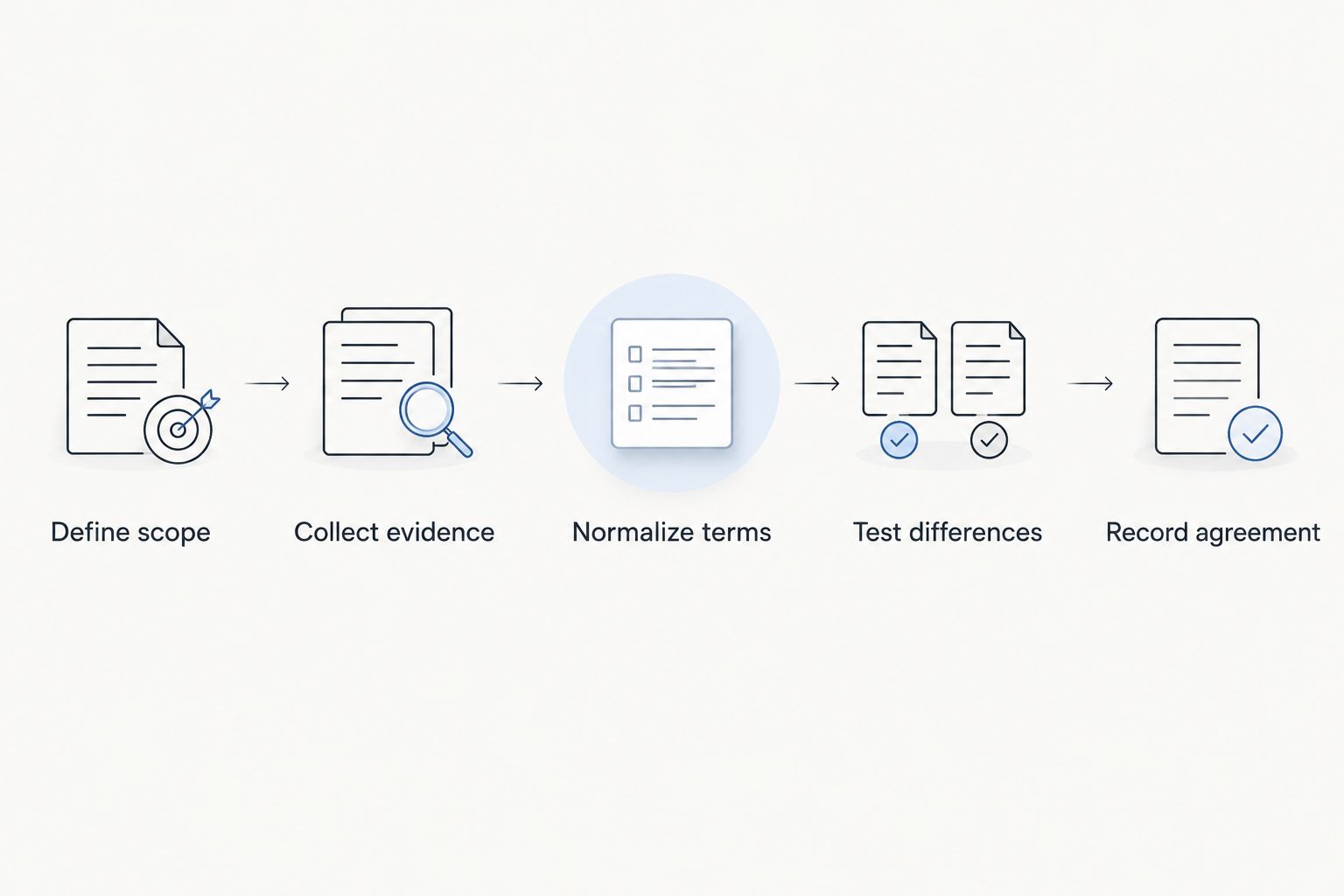
Yes. Procurement analytics turns procurement records, quotations, and your own contract history into a structured basis for asking why a subcontractor’s offer differs from comparable work. Use the following sequence before opening negotiations.
- Define scope. Write down the deliverables, quantities, specifications, exclusions, interfaces, and acceptance requirements. Establish exactly what the subcontractor must complete.
- Collect evidence. Gather relevant procurement outcomes, current quotations, and your own completed contract records. Preserve each document’s date and source.
- Normalize terms. Align units, inclusions, delivery obligations, tax treatment, and commercial conditions. Mark anything that cannot be reconciled.
- Test differences. Ask the subcontractor to explain the material, labor, equipment, scheduling, or risk assumptions behind a discrepancy. Do not treat an unexplained difference as proof of overcharging.
- Record agreement. Capture revised obligations, exclusions, payment milestones, and change-control rules alongside the negotiated amount. Check that the revised scope still meets your requirements.
This sequence separates research from negotiation. You first establish whether a comparison is credible; only then do you use it to challenge the offer.
What should your comparison sheet contain?
Keep the working sheet tied to source documents. Include a description of the work, measurement unit, quantity basis, specification, delivery location, quotation date, inclusions, exclusions, and payment conditions.
Add a separate field for unresolved differences. A blank entry should not silently become an assumption that two packages are equivalent. If a record lacks enough detail, retain it as background context rather than include it in your negotiating benchmark.
For a 2026 work package, distinguish current offers from historical outcomes explicitly. A recent retrieval date does not make an older contract a current market quotation.
Which procurement evidence should you use?
Different evidence sources support different decisions. Use each source for the question it can answer, and keep its limits beside the finding.
| Evidence source | Best for | Strength | Limitation |
|---|---|---|---|
| Published tender and award records | Researching procurement outcomes | Connects an outcome to a named procurement package | A total award does not establish an individual subcontract rate |
| Current subcontractor quotations | Comparing offers for your defined package | Addresses the work you intend to purchase | Different exclusions and assumptions can make offers incomparable |
| Your completed contract records | Checking past commitments against actual delivery | Connects agreed terms with recorded changes and outcomes | Past work can differ from the current specification or delivery conditions |
Published outcomes provide context, but they are not a substitute for a current quotation. A main contract can contain coordination duties, temporary works, supplied materials, and other obligations absent from the subcontract you are negotiating.
Current quotations are closer to your buying decision, but only after clarification. An apparently lower offer that excludes testing cannot be compared directly with an offer that includes testing.
Your own contract history adds a different perspective. Review the final agreed scope and approved changes, not just the original order, before using a previous engagement as evidence.
Use award data without overstating it
Describe the record accurately during negotiations: identify the package, date, relevant scope, and unresolved differences. Avoid presenting a published award as the subcontractor’s internal cost base or a mandatory rate for your project.
Also distinguish an estimated procurement budget, a submitted bid, and an awarded contract. They represent different stages of a procurement process and should not be combined as though they were interchangeable observations.
Use internal records without repeating old mistakes
Check whether a previous agreement generated scope disputes, additional work, or delivery problems. Those records help explain why the original commitment is not necessarily a useful target for the next package.
Separate documented outcomes from recollection. If your team cannot connect a claim to an order, amendment, acceptance record, or other retained evidence, do not present it as an established negotiating fact.
Why subcontractor pricing comparisons vary
These factors determine whether procurement evidence supports a negotiation. Treat them as clarification questions, not automatic reasons to accept or reject an offer.
- Scope and specification: Material requirements, workmanship, testing, documentation, and acceptance duties change what the subcontractor must deliver. Compare obligations before comparing totals.
- Quantity and measurement: Confirm whether the package uses measured quantities, an estimated schedule, or a lump-sum scope. Different measurement rules can shift quantity risk between parties.
- Location and access: Ask what the quotation assumes about transport, storage, site access, and working restrictions. Record differences between the reference project and your site.
- Programme and sequencing: Identify required completion dates, access windows, dependencies, and interruptions. A different sequence means the reference package is not automatically equivalent.
- Payment and risk allocation: Review payment milestones, retention, guarantees, insurance responsibilities, and change procedures where applicable. These are contractual differences, not footnotes.
- Evidence date and completeness: Check when the underlying offer or award occurred and whether its supporting scope is available. In a 2026 comparison, an undated extract is not a current benchmark.
Resolve material differences before calculating a negotiating target. If a difference cannot be quantified from reliable evidence, describe it openly rather than inserting an estimated adjustment without support.
How do you turn analytics into a negotiation request?
Start with the disputed assumption, not a general demand for a lower total. Point to the relevant specification, quotation line, comparable record, or contractual condition and ask the subcontractor to reconcile the difference.
For example, if your scope assigns material supply to the main contractor, ask whether the subcontractor’s quotation also includes that supply. This is a scope clarification, not evidence that the subcontractor has quoted incorrectly.
Separate corrections from concessions
A correction removes a misunderstanding, duplicate inclusion, or inconsistent measurement basis. A concession changes the commercial agreement, such as exchanging a revised delivery arrangement for a revised offer.
Record them separately. Otherwise, your team can mistake a reduced scope for a genuine improvement in commercial terms and approve an agreement that no longer covers the required work.
Make each request conditional and specific
State what you want reconsidered and what remains unchanged. Ask for a revised breakdown with the same specification, acceptance requirements, and exclusions unless you explicitly agree otherwise.
If you propose a changed payment milestone or delivery sequence, document the corresponding obligation. A verbal concession is difficult to evaluate when its conditions are missing from the revised offer.
Close the evidence trail
Retain the initial quotation, clarification responses, revised offer, and final agreed scope together. Your negotiation record should explain both what changed and why the final decision remained acceptable.
Use the same discipline when reporting 2026 negotiation outcomes internally. Do not describe a lower commitment as a saving if you also removed deliverables without accounting for the change.
Where does a procurement-intelligence platform fit?
Dauthau procurement intelligence is best for Vietnamese businesses researching tenders, contractors, and bidding results before negotiations. The platform supports searching, tracking, and analyzing public and private procurement tenders, contractor data, and bidding results across Vietnam.
Use Dauthau for that research stage, then bring the relevant records into your scope and quotation review. The research gives you context for questions; your project documents establish whether a subcontract comparison is valid.
Dauthau procurement intelligence does not turn a published tender outcome into proof of a subcontractor’s actual costs. Keep internal estimates, current quotations, and documented commercial clarifications central to the final decision.
Can public tender results prove a subcontractor is overcharging?
No. Public tender results establish a procurement outcome, not the subcontractor’s actual costs or margin. Even a closely related award needs a scope and terms review before it supports a challenge.
Use an apparent discrepancy to request an explanation. Reject the comparison if the relevant work cannot be separated from the wider contract or its obligations cannot be checked.
Should you always choose the lowest comparable quotation?
No. A comparable quotation addresses scope alignment, but your award decision must also address the subcontractor’s ability to meet the agreed requirements. Keep commercial evaluation separate from documented checks on delivery capability.
Negotiate the offer you can justify and execute, not simply the lowest headline commitment. Record the reasons for selecting an offer so the decision remains understandable after the negotiation ends.
FAQ
Can procurement analytics help negotiate subcontractor pricing without historical contracts?
Yes—current quotations and relevant procurement records can support negotiations without your own historical contracts. Define a common scope and document differences before treating the offers as comparable.
What should I compare before negotiating a subcontractor’s quotation?
Compare deliverables, quantities, specifications, inclusions, exclusions, delivery conditions, and payment terms. An unexplained difference in any of these weakens a direct comparison.
Can I use a tender award as a subcontractor rate benchmark?
Use a tender award as context, not automatically as a subcontractor rate benchmark. Establish that the relevant work and obligations can be separated and compared with your subcontract package.
Does procurement analytics guarantee a lower subcontractor quotation?
No—procurement analytics does not guarantee a lower quotation. Its role is to support specific, documented questions and expose differences that need clarification.
What can I negotiate besides the quoted amount?
You can discuss delivery sequencing, payment milestones, scope boundaries, documentation duties, and change-control terms. Any agreed change must remain consistent with your project obligations.
How do I check whether a negotiated reduction is genuine?
Compare the revised offer with the original scope and commercial conditions. A lower commitment accompanied by fewer deliverables is not the same as obtaining the same work on improved terms.
What should a subcontractor negotiation file include?
Include the original quotation, comparison evidence, scope clarifications, revised offer, and final agreement. Preserve source dates and unresolved differences so another reviewer can follow the decision.
One last thing
Ask for the revised exclusions before celebrating the revised total. A negotiation is not complete until your team checks what disappeared from the offer as well as what changed in the commercial terms.
For your next 2026 package, make that check an approval requirement: confirm scope, confirm obligations, then accept the revision. This prevents a commercial discussion from quietly becoming an unapproved scope change.