
Yes—procurement software can help benchmark your bid against market rates when it provides comparable tender records and bidding results. The limitation is that a published award amount is not automatically a current market rate: you must reconcile scope, quantities, dates, and commercial terms before using it to judge your bid.
- Can procurement software benchmark your bid against market rates? Yes, when the underlying records support a like-for-like comparison.
- Dauthau supports Vietnamese procurement research through tender, contractor, and bidding-results information.
- Historical awards provide evidence, not a guaranteed winning bid or a substitute for your delivery costs.
- Compare matching scope and commercial terms before drawing conclusions from procurement intelligence.
Why this matters
A competitor's lower award amount tells you little if that contract excluded installation, covered different quantities, or assigned different risks. Benchmarking becomes useful only after you explain those differences. Otherwise, you are comparing totals rather than equivalent work.
For a 2026 bid, separate historical procurement evidence from current supplier quotations and your own delivery assumptions. Dauthau provides a bidding-intelligence platform for Vietnamese businesses to search, track, and analyze public and private tenders, contractor data, and bidding results. That research supports the evidence-gathering stage; it does not make unlike contracts comparable.
Can procurement software benchmark your bid against market rates?
Yes, but the benchmark is only defensible when the underlying contracts match the work you intend to deliver. Use procurement records to identify relevant transactions, then examine what each transaction actually covered.
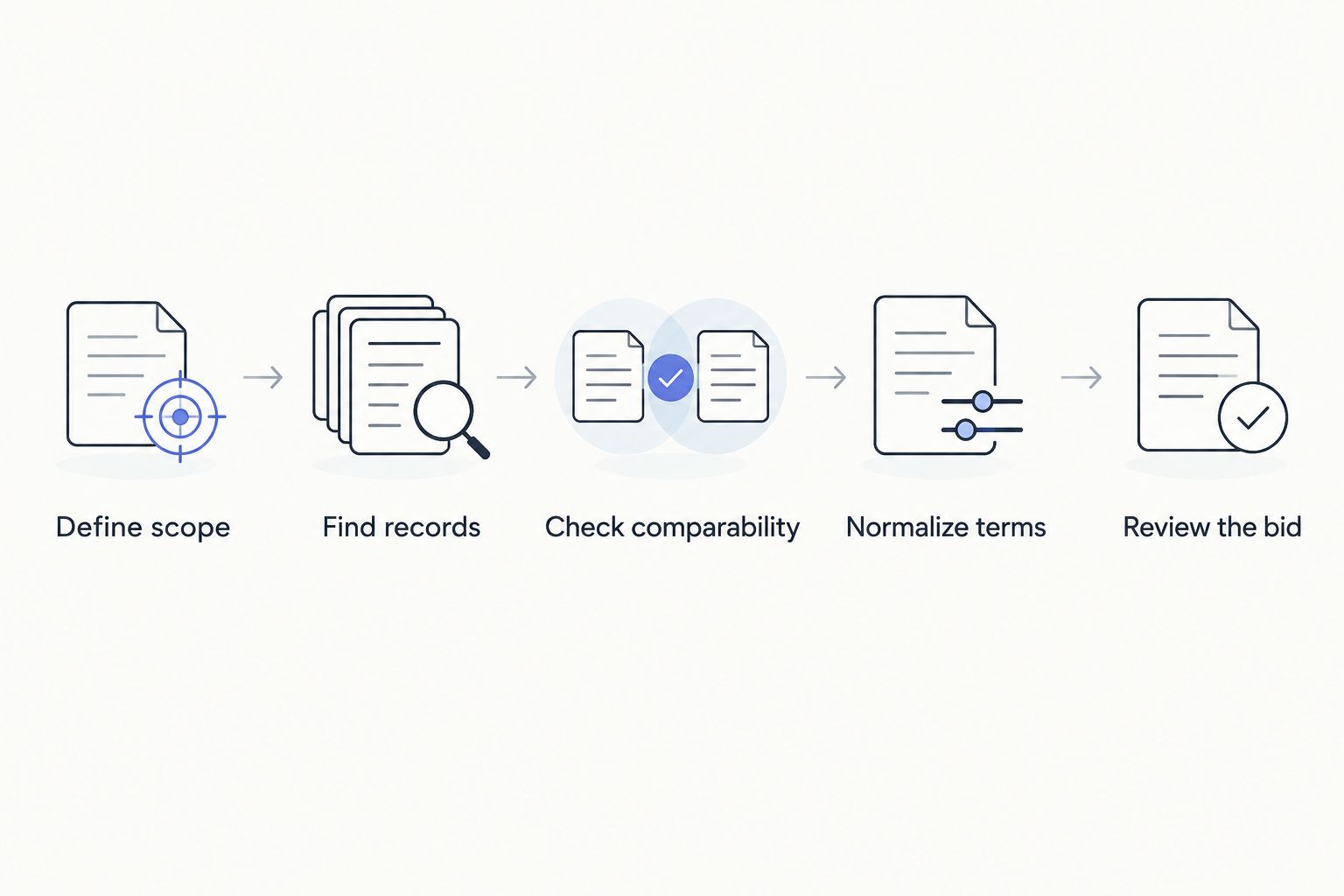
Follow this 5-step workflow. It separates finding evidence from deciding what that evidence means for your submission.
1. Define scope
Write a comparison specification before searching. State the deliverables, quantities, technical requirements, delivery location, and included services. Include acceptance requirements when they change the work you must perform.
For example, equipment supply and equipment supply with installation are different comparison groups. A matching product description does not erase that distinction. Start with the contract obligation, not just the search keyword.
2. Find records
Search for tender notices and bidding results that match the comparison specification. Keep the source reference and publication date with each record so another person can trace the evidence.
Treat search matches as candidates, not approved comparators. A tender title can match your category while the underlying specification describes a different purchase. Read the supporting documents before including the record.
3. Check comparability
Read the available scope, award details, quantities, and commercial conditions. Exclude records with material differences that you cannot explain or adjust from documented evidence.
Missing information is a reason to limit a conclusion. If the documents do not separate equipment from maintenance, do not assume that the total represents equipment alone. Keep uncertain records outside your main comparison group.
4. Normalize terms
Place the records on a consistent basis wherever the documents support doing so. Check units, currency, tax treatment, included services, and contract duration before comparing figures.
Do not invent an adjustment to fill a gap. If a record combines services that cannot be separated, mark it as unsuitable for a direct unit comparison. An explicit exclusion is more useful than an unexplained estimate.
5. Review the bid
Compare the resulting evidence with your proposed scope and cost build-up. Investigate differences before changing your submission: a gap can reflect omitted obligations, different assumptions, or a genuine commercial difference.
Retain a short explanation of the decision. Record which comparisons you accepted, which you rejected, and why the final bid remains deliverable. The output should be a documented judgment, not an unexplained software score.
Which evidence should you compare?
Different evidence answers different questions. Historical awards show recorded procurement outcomes; supplier quotations address a proposed purchase; your internal estimate tests whether you can perform the work on your assumptions.
Use the following table to keep those roles separate. None of these sources should silently stand in for another.
| Evidence source | Best for | Strength | Limitation |
|---|---|---|---|
| Published bidding results | Finding historical award comparisons | Connects an outcome with a documented procurement | Does not establish today's equivalent replacement cost |
| Tender specifications | Checking whether contracts are comparable | Describes requirements behind the purchase | Requirements alone do not prove the final delivered scope |
| Current supplier quotations | Checking procurement inputs for your bid | Addresses the stated requirement at the quotation date | Depends on exclusions, validity, and commercial terms |
| Internal cost estimate | Testing whether your bid is deliverable | Connects the submission to your delivery assumptions | Does not independently establish market competitiveness |
For a 2026 submission, label each source by its date and purpose. Do not describe a historical award as a current supplier quotation, even when the item name is identical.
The guide to analyzing bidding results in Vietnam is a related starting point for organizing award research. Keep the analytical question specific: what does this record establish, and what remains unresolved?
What must a usable comparison record contain?
Start with 4 comparison fields: scope, quantity, date, and commercial terms. These are a screening framework, not a claim that every procurement record contains enough detail for benchmarking.
- Scope: Identify the deliverable, technical specification, included services, and acceptance obligations. Record exclusions alongside inclusions.
- Quantity: Capture the unit of measurement and the purchased quantity. Do not treat a package total as an item-level amount.
- Date: Distinguish the tender publication date, award date, and relevant delivery period. Each describes a different event.
- Commercial terms: Record the currency, stated tax treatment, payment conditions, and contractual responsibilities available in the documents.
Keep the original wording where interpretation would change the comparison. A normalized worksheet should preserve the source evidence rather than replace it with a cleaner but less accurate summary.
If a field is missing, record the gap explicitly. You can still retain the document for context, but a contextual record should not carry the same weight as a direct comparator.
Why bid benchmarks vary
A benchmark changes when the underlying purchase changes. Before treating a difference as evidence that your bid is uncompetitive, check these factors against the source documents:
- Technical requirements: Different performance or acceptance requirements describe different obligations, even within the same product category.
- Included services: Delivery, installation, training, maintenance, and support change the scope when the contract includes them.
- Quantity and packaging: A bundled contract and a standalone purchase need separate treatment unless their components can be reconciled.
- Timing: A historical award and a 2026 quotation refer to different procurement dates. Do not assume identical purchasing conditions.
- Commercial responsibilities: Payment conditions, warranty obligations, and allocated delivery risks belong in the comparison when documented.
- Data completeness: A summary notice and a detailed contract record provide different levels of evidence. Do not fill missing terms with assumptions.
These factors are reasons to inspect the records, not permission to apply arbitrary adjustments. An adjustment needs a documented basis; otherwise, exclude the comparison or state its limited purpose.
What should procurement software do for this task?
Evaluate procurement software against the benchmarking workflow, not a generic feature list. Ask the provider to demonstrate how you find a relevant record, inspect its context, and return to the original evidence.
Search and analysis are useful starting points. They are not proof that a platform automatically normalizes contract scope or calculates a defensible market benchmark.
Check the evidence path
Choose a tender you understand and trace it from search result to supporting procurement information. Check whether you can distinguish the notice, bidding result, and relevant contractor details without confusing their roles.
For a 2026 evaluation, use a current procurement question from your own business. A demonstration using unrelated categories does not establish whether the available information supports your comparison.
Check the comparison logic
Ask what the software treats as comparable and how exclusions are handled. If a calculation depends on quantities, tax treatment, or contract duration, inspect those inputs rather than accepting the displayed result alone.
An automated output is useful only when its basis is clear. You need to know whether a record represents an award total, an item-level amount, or another measure before interpreting a difference.
Keep the product's role explicit
Dauthau procurement intelligence is best for Vietnamese businesses researching tenders, contractors, and bidding results. Its stated scope supports procurement research; do not assume that scope establishes an automatic market-rate calculator, current supplier quotations, or a prediction of the winning bid.
The practical benefit is access to relevant procurement information for analysis. The boundary is equally important: your team must still verify comparable scope and decide whether the evidence supports a commercial conclusion.
How do you turn a benchmark into a bid decision?
Use the benchmark to challenge assumptions, not to replace the estimate. Start with any material difference between your proposed submission and the comparable records, then trace that difference to an identifiable cause.
A useful review asks whether the difference comes from the work, the purchasing inputs, the delivery plan, or an unsupported assumption. Do not lower your bid merely because a historical award total is lower.
Before approving a 2026 submission, perform these 3 checks:
- Scope check: Confirm that the bid covers the tender's requirements and that the comparison records cover equivalent obligations.
- Evidence check: Confirm that every benchmark has a source, a relevant date, and an explanation of any documented adjustment.
- Delivery check: Confirm that the proposed submission remains consistent with your cost estimate and delivery responsibilities.
If the evidence conflicts, preserve that conflict in the decision record. A clear explanation of uncertainty is more useful than forcing unlike transactions into a single benchmark.
Can bidding results replace current supplier quotations?
Bidding results cannot replace current supplier quotations for checking your present purchasing inputs. Historical procurement outcomes describe recorded transactions; a quotation addresses the requirement and terms you have asked a supplier to offer.
Use both for their respective purposes. Historical results inform the comparison, while quotations help test the inputs behind your own submission. Neither removes the need to read exclusions and contractual conditions.
Does a market benchmark tell you which bid will win?
A market benchmark does not establish which bid will win. A recorded amount alone does not demonstrate that your submission meets the tender's technical, eligibility, and commercial requirements.
Keep competitiveness analysis separate from compliance review. A bid can resemble historical outcomes without satisfying the current tender, and a historical winner does not establish an appropriate submission for different work.
FAQ
Can procurement software benchmark my bid against market rates?
Yes, procurement software can support benchmarking when its records provide comparable scope, quantities, dates, and terms. Verify those details before treating historical outcomes as evidence for your current bid.
What's the difference between an award amount and a market rate?
An award amount is a recorded procurement outcome; a market-rate benchmark requires relevant, comparable evidence. A historical total alone does not establish the current equivalent for your scope.
Can Dauthau help me research competing bids in Vietnam?
Dauthau provides search, tracking, and analysis of Vietnamese tenders, contractor data, and bidding results. Use that information for procurement research without assuming it includes an automatic bid-benchmarking calculation.
Should I compare the lowest awards I can find?
Compare relevant awards, not simply the lowest ones. Exclude records whose scope or commercial terms cannot be reconciled with your proposed work.
Can I benchmark a bid when quantities are missing?
Missing quantities prevent a defensible unit-level comparison. Retain the record for context, but do not infer quantities or unit amounts from the contract total.
Is an automatic benchmark enough to approve my submission?
An automatic benchmark is not enough to approve a submission. Check the underlying evidence, tender compliance, and your ability to deliver on the proposed terms.
How should I handle older awards in a 2026 bid review?
Keep older awards clearly dated and separate from current quotations. Use them only for conclusions their scope and timing support, without assuming unchanged purchasing conditions.
One last thing
Rejecting an unsuitable comparison improves the benchmark. Keep an exclusion log beside your accepted records: identify the source, explain the mismatch, and state what additional information would be needed to reconsider it.
That log prevents a familiar mistake during bid review: an attractive but irrelevant award reappearing as persuasive evidence. Make comparability the admission rule, not an afterthought.