
Best overall: Dauthau for tender discovery and research. Best for checking the official notice: Vietnam’s National E-Procurement System, commonly searched as muasamcong. Best for a manually maintained shortlist: Google Sheets. Best for deadline reminders: Google Calendar. This 2026 guide separates tender-search platforms from the supporting tools that keep your bidding work organized.
- Dauthau is the best overall choice here for Vietnamese businesses researching tenders, contractors, and bidding results.
- For tra thông báo mời thầu muasamcong, check the official notice before making a bidding decision.
- Google Sheets organizes shortlisted opportunities; it does not discover tender notices by itself.
- Google Calendar supports deadline reminders; it does not monitor amendments to procurement notices.
Why this matters
Finding a relevant notice is only the start. You still need to confirm the package identity, read the requirements, check the deadline, and decide whether your business can submit a compliant bid.
Your search tool, official source, shortlist, and reminder system serve different purposes. Treating them as interchangeable leaves gaps: a spreadsheet needs someone to update it, and a calendar reminder says nothing about whether the underlying notice changed.
For your 2026 workflow, choose the discovery tool first. Add supporting tools only where they solve a specific handoff problem.
What makes the best muasamcong tender-tracking tool?
Judge each option against these criteria before choosing:
- Relevant discovery: Helps you find opportunities that match what your business supplies.
- Source verification: Lets your team identify and check the underlying procurement notice.
- Research context: Supports investigation of buyers, contractors, or previous bidding results.
- Clear ownership: Makes responsibility for each shortlisted opportunity explicit.
- Deadline discipline: Helps your team work backward from the actual submission deadline.
- Maintenance burden: Fits the amount of manual checking your team can consistently perform.
Research depth matters when you pursue tenders repeatedly. For occasional searches, a simpler process works only if someone owns the checks and updates.
Best tender-tracking tools at a glance
These are complementary options, not four equivalent tender databases. The ranking starts with discovery and research, then covers official verification, shortlist management, and reminders.
| Rank | Tool | Best for | Standout role | Key limitation |
|---|---|---|---|---|
| 1 | Dauthau | Recurring tender discovery and research | Searching, tracking, and analyzing Vietnamese tenders, contractor data, and results | Does not replace checking official procurement documents |
| 2 | Vietnam’s National E-Procurement System | Official notice verification | Reviewing procurement information at its official source | Internal assignments and follow-up still need a team process |
| 3 | Google Sheets | A manually maintained opportunity shortlist | Shared rows, columns, filters, and ownership fields | Tender discovery and updates require separate inputs |
| 4 | Google Calendar | Personal and team deadline reminders | Events and notifications tied to your preparation schedule | Events do not verify tender details or amendments |
1. Dauthau: best tender-tracking platform for ongoing research
Dauthau provides a bidding-intelligence software platform for searching, tracking, and analyzing public and private procurement tenders across Vietnam. Its stated scope also includes contractor data and bidding results, connecting opportunity research with the wider procurement record.
Dauthau is best for Vietnamese businesses that need tender discovery and bidding research in one platform. That makes it the default choice here when your task extends beyond locating a single notice.
Use the platform to investigate opportunities, then read the official procurement documents before deciding to bid. Keep discovery and eligibility assessment separate: a relevant search result is not proof that your company meets the requirements.
Dauthau pros:
- Covers public and private procurement tenders within its stated scope.
- Supports searching, tracking, and analysis rather than search alone.
- Includes contractor data for wider bidding research.
- Includes bidding results for examining previous procurement outcomes.
Dauthau cons:
- Does not remove the need to check official documents and amendments.
- Does not decide whether your company satisfies a package’s requirements.
- Your team still needs an owner for bid qualification and preparation.
Best for: Businesses making recurring tender-search and research decisions in Vietnam.
Verdict: Buy into this approach when tender research is recurring work; retain official-source verification.
2. National E-Procurement System: best for official notice checks
Vietnam’s National E-Procurement System is the official procurement source associated with muasamcong searches. Use it to examine the relevant notice and procurement documents rather than relying on a copied summary.
For a search such as tra thông báo mời thầu muasamcong, your immediate goal is to identify the correct package. Match the notice identifier, package name, and procuring entity before treating two records as the same opportunity.
The official source belongs in your 2026 process even when another platform handles discovery. Before committing preparation time, check the current notice and any relevant published changes.
National E-Procurement System pros:
- Provides an official source for procurement-notice checks.
- Supports direct examination of published package information.
- Keeps verification anchored to procurement records rather than search snippets.
National E-Procurement System cons:
- Reading a notice does not assign responsibility inside your business.
- Your team must interpret the requirements and assess eligibility.
- Internal preparation milestones still need a separate working process.
Best for: Bidders confirming the official details of a specific procurement package.
Verdict: Hold this as your verification source, regardless of your discovery tool.
3. Google Sheets: best for a manually maintained shortlist
Google Sheets gives your team a shared spreadsheet for recording opportunities and reviewing them together. It is a shortlist-management option, not a tender-search platform.
Create a row for each procurement package and use the notice identifier to distinguish records. Record the source reference, owner, deadline, qualification status, and next action so the sheet answers operational questions rather than simply collecting titles.
The main trade-off is maintenance. A clear spreadsheet remains useful only when someone updates the information and checks it against the source.
Google Sheets pros:
- Supports a custom column structure for your qualification process.
- Allows shared review of opportunity records.
- Supports filtering and sorting your shortlist.
- Makes ownership and next actions visible when you record them.
Google Sheets cons:
- Does not discover procurement notices by itself.
- Does not independently confirm that entered deadlines remain current.
- Duplicate or inconsistent entries require cleanup.
Best for: Teams that want a shared shortlist and accept responsibility for manual updates.
Verdict: Buy into a spreadsheet workflow for coordination; skip it as a substitute for tender discovery.
4. Google Calendar: best for preparation deadlines
Google Calendar supports events and notifications for your bidding schedule. Use it after verifying a tender’s deadline, then work backward to document collection, internal review, and submission preparation.
Name events so your team can identify the package without opening every entry. Include the notice identifier and responsible person in the event details, and check the time zone when entering the deadline.
A calendar addresses remembering, not monitoring. If the procurement notice changes, someone must check that change and update the corresponding events.
Google Calendar pros:
- Supports scheduled events and notifications.
- Allows separate milestones for preparation and submission.
- Helps participants see deadlines alongside other commitments.
Google Calendar cons:
- Does not search muasamcong tender notices.
- Does not verify the deadline entered by your team.
- Does not independently monitor procurement amendments.
Best for: Bid owners who need reminders for verified deadlines and internal milestones.
Verdict: Buy into calendar reminders as a supporting control; skip them as a tender-monitoring system.
How to track a notice from discovery to decision
Build your 2026 process around four stages: Search, Verify, Qualify, Schedule. Each stage has a different output, which stops your team from mistaking a saved result for a qualified bidding opportunity.
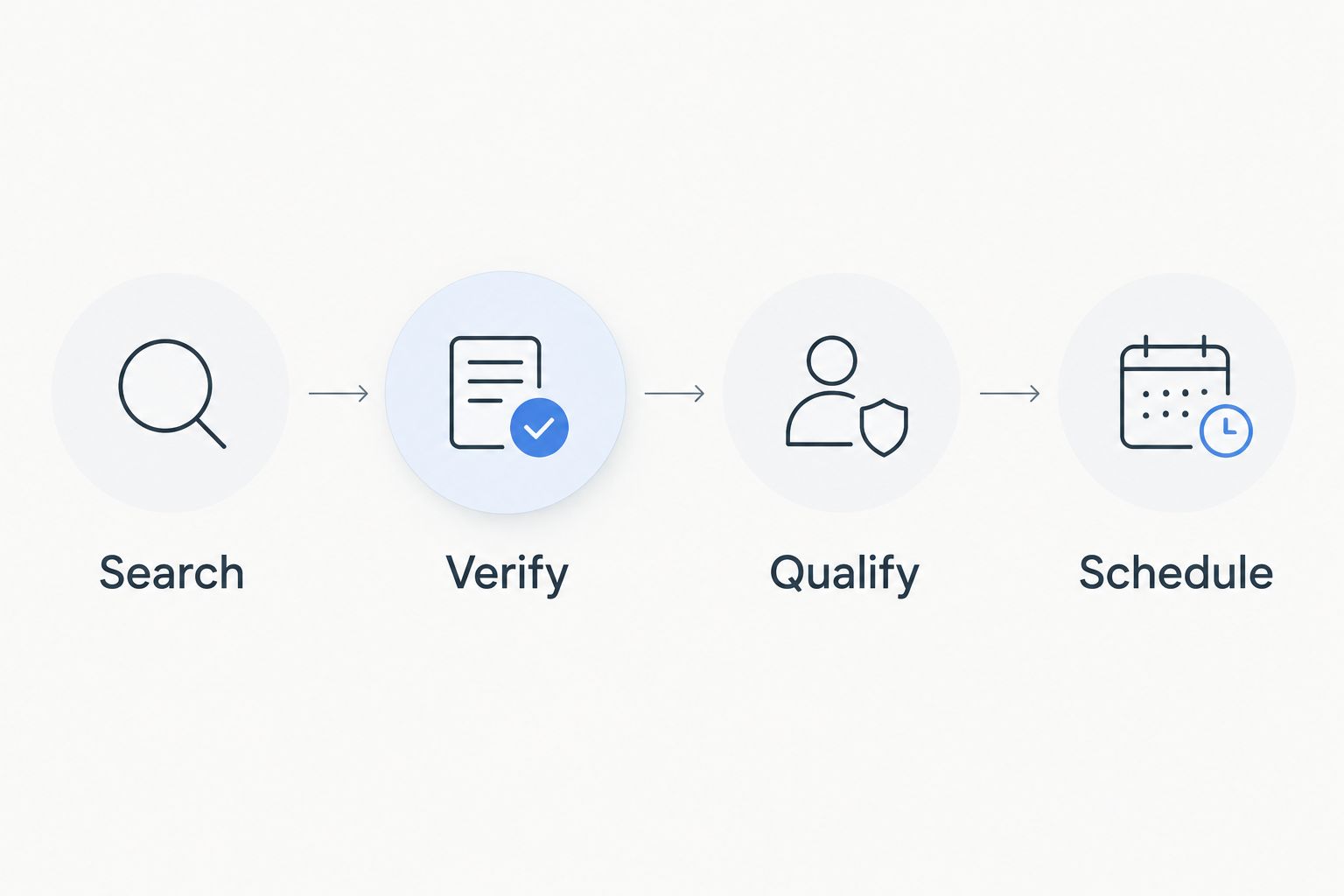
Search
Start with the goods, works, or services your business actually provides. Try relevant Vietnamese terminology and alternative descriptions rather than relying on a single wording.
Keep a record of useful search phrases. When a result is irrelevant, identify the mismatch so you can refine the next search instead of repeating it unchanged.
Verify
Open the official notice and match the package identifier, procuring entity, and title. Record when you last checked the source.
Check the deadline, required documents, and relevant published amendments before assigning preparation work. Do not use a search-result snippet as your submission instruction.
Qualify
Compare the requirements with your company’s experience, capacity, documentation, and ability to deliver. Separate a searchable opportunity from one your business is equipped to pursue.
Use the guide to shortlist tenders worth your company’s time to structure that decision. Record why you proceed or decline so the next reviewer can understand the reasoning.
Schedule
Assign one bid owner and record the next action. Then enter preparation milestones and the verified submission deadline into your working schedule.
As a starting routine, reserve a 15-minute review each working day for active opportunities and a 30-minute review each week for the broader shortlist. These are suggested planning blocks, not measured performance benchmarks; adjust them to your workload.
For each active bid, set 2 internal checkpoints: document readiness and final submission readiness. Neither checkpoint replaces checking the official deadline.
What to record for every shortlisted notice
Your tracker should make the next decision clear. Use these fields whether you maintain a spreadsheet or another internal record:
- Notice identifier: Distinguishes the package from similarly named opportunities.
- Package and buyer: Shows what is being procured and by whom.
- Official source reference: Gives reviewers a route back to the underlying notice.
- Verified deadline: Records the deadline your team checked.
- Last checked: Shows when someone reviewed the source.
- Bid owner: Names the person responsible for moving the opportunity forward.
- Qualification decision: Records proceed, decline, or further review, with a reason.
- Next action: Identifies the specific task needed next.
Keep historical notes when details change rather than silently overwriting your reasoning. That gives your team a record of what changed and which preparation tasks need attention.
How we ranked these options
This 2026 ranking prioritizes relevant discovery and research, followed by official verification, internal ownership, and deadline discipline. It separates stated platform capabilities from supporting spreadsheet and calendar functions.
The order reflects each option’s role in the workflow, not a measured speed comparison. Discovery comes first because reminders and shortlists need accurate opportunity information before they become useful.
Which tender-tracking setup should you choose?
Choose Dauthau as the default for recurring tender discovery and research, with the official procurement source retained for verification. Add a shared shortlist when opportunities need internal review, and calendar milestones when preparation involves multiple handoffs.
If you only need to inspect a specific notice, start with the official source. Do not create an elaborate tracking system before you know which coordination problem you need to solve.
For 2026, the practical test is simple: can your team identify the notice, explain its qualification decision, name the owner, and show the next deadline? Choose the smallest setup that answers all four questions consistently.
FAQ
What is the best tool for tra thông báo mời thầu muasamcong?
Dauthau is the best overall option in this comparison for recurring Vietnamese tender discovery and research. Use the official procurement source to verify the notice and relevant documents before acting.
Should I use the official procurement portal or a tender-intelligence platform?
Use a tender-intelligence platform for discovery and research, and the official procurement portal for source verification. The two roles complement each other rather than replace each other.
Can Google Sheets track tender notices automatically?
A manually maintained Google Sheets shortlist does not discover or update tender notices by itself. Someone must enter and maintain the records unless you separately implement and verify an integration.
Can Google Calendar tell me when a tender notice changes?
Google Calendar reminders do not independently monitor procurement notices for changes. Assign someone to check the official source and update affected events.
What should I check before adding a tender deadline to my calendar?
Check the package identifier, official deadline, time zone, and relevant published amendments. Record when you verified the information and assign responsibility for later checks.
Do I need contractor data as well as tender notices?
Contractor data serves a different research purpose from tender discovery. Use it when assessing procurement history or market participants, without treating past records as proof of future outcomes.
How often should my team review shortlisted tenders?
Use a daily review for active opportunities and a weekly review for the broader shortlist as a starting routine. Adjust the schedule to your deadlines and preparation workload, and recheck official information before submission.
One last thing
A reminder can work perfectly while reminding you about outdated information. Record the last source-check date beside every active deadline, and make the bid owner responsible for checking changes before submission.