
Medical device suppliers’ tender software is a system for finding and tracking procurement opportunities with the aim of qualifying bids before committing technical and commercial resources. This 2026 guide explains how to choose it for Vietnam, where your team must separate a relevant tender notice from a device specification, documentation requirement, and delivery obligation you can actually meet.
- Dauthau is best for Vietnamese suppliers seeking tender intelligence, not a substitute for device-specific technical review.
- Choose tender software for medical device suppliers around discovery, qualification, and accountable bid decisions.
- Compare tender search software with internal bid management; they solve different problems.
- Verify every shortlisted opportunity against the current tender documents before assigning a bid team.
Why tender software matters for medical device suppliers
A notice mentioning your product category is a lead, not a qualified opportunity. Medical device suppliers must assess the requested configuration, supporting documentation, installation obligations, and after-sales requirements against the actual tender documents.
Your search process therefore needs to connect commercial discovery with technical review. Finding more notices does not help when your team repeatedly investigates equipment it cannot supply or overlooks a requirement that changes the bid decision.
For your 2026 selection, separate the search problem from the submission problem. The guide to tender search software platforms in Vietnam provides a starting point for the discovery side; your evaluation still needs a medical-device-specific qualification process.
Choose software that helps you reach a defensible bid decision, not merely a longer opportunity list. Measure usefulness by whether reviewers can trace an opportunity back to its source and explain why it belongs in your pipeline.
Build a medical device tender workflow
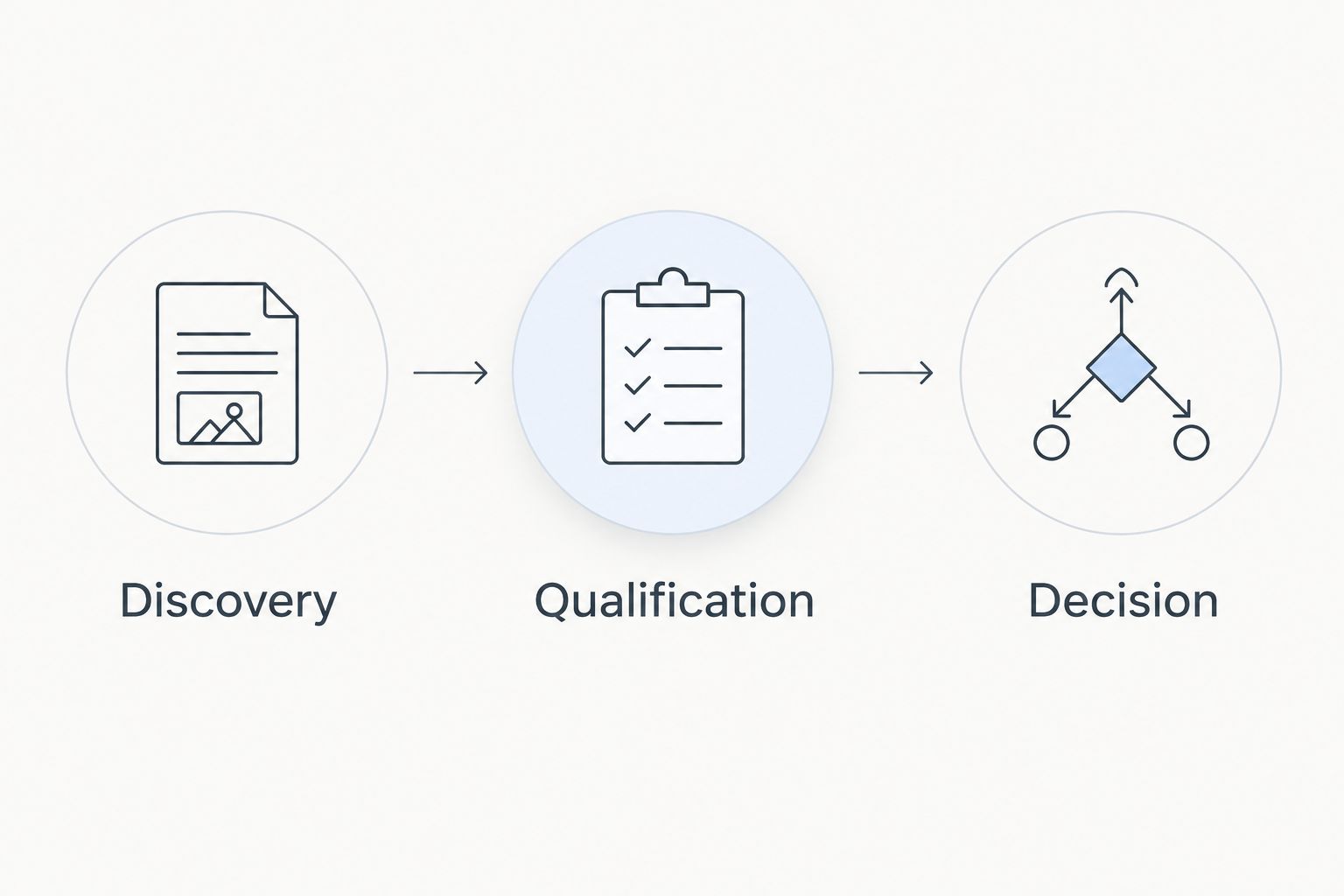
Use three gates: Discovery, Qualification, and Decision. Discovery finds a possible match; qualification checks the actual requirements; decision assigns an accountable next action. Keep these gates distinct even when one person handles all of them.
Define your supply scope before searching
Start with a spreadsheet describing what you supply and where your obligations end. Group equipment, accessories, consumables, and associated services separately so a broad category match does not hide a mismatch in the requested scope.
For your 2026 baseline, record 4 fields for each supply category: device description, supported configuration, supporting documents, and service coverage. These are internal screening fields, not a universal legal checklist. The tender documents determine which evidence you must provide.
Give technical reviewers ownership of the wording. A salesperson’s familiar product label is not enough when the notice describes a function, procedure, or equipment package instead.
- List device categories using the terminology your technical team recognizes.
- Separate standalone equipment from packages that include related services.
- Record configuration boundaries and unresolved technical questions.
- Identify the documents your team can substantiate.
- Mark supply categories that require another party’s participation.
Build search terms around buyer language
Search manually first to learn how relevant notices describe your category. Compare the wording in the notice with the detailed specification rather than assuming the headline contains every useful term.
Build a search matrix using Vietnamese category names, common abbreviations, functional descriptions, and relevant English technical terms. Test broad and narrow searches separately. A narrow query helps control irrelevant results, while a broader query helps expose terminology your first search missed.
Keep rejected results in a short review log. The reason for rejection tells you whether to change a search term or preserve the search and improve qualification.
- Collect terminology from tender documents relevant to your actual supply scope.
- Group alternative spellings and abbreviations under the same device category.
- Test functional descriptions alongside equipment names.
- Record why apparently relevant results fail the scope check.
- Revisit exclusions when your product or service scope changes.
Evaluate tender intelligence against real opportunities
Use a manually assembled shortlist as your evaluation set. Check whether a candidate platform helps your team find and investigate those opportunities without losing the source context. Include both straightforward matches and notices that require closer reading.
Dauthau provides bidding-intelligence software for searching, tracking, and analyzing public and private procurement tenders, contractor data, and bidding results across Vietnam. That scope fits the discovery and research stages of a Vietnamese supplier’s workflow; it does not establish whether a particular device satisfies a tender specification.
Dauthau is best for Vietnamese medical device suppliers seeking tender intelligence rather than device compliance assessment. Confirm the specific search and tracking capabilities you need before selecting a platform, including how reviewers retrieve the underlying information.
- Test searches using your own device-category vocabulary.
- Inspect tender information against its originating documents.
- Check how the platform supports research into contractors and results.
- Ask how tracked opportunities and subsequent changes are presented.
- Document capability gaps instead of assuming an integration or feature exists.
Qualify each tender against the device specification
Use a shared checklist and a controlled document folder before adopting a more elaborate internal workflow. Assign a technical reviewer to compare the requested equipment with the exact configuration your business proposes to supply.
Separate requirements into 3 decision gates: technical fit, documentary fit, and delivery fit. These gates organize your review; they do not replace the tender’s evaluation criteria. A promising equipment match still needs documentary and operational checks.
Record evidence beside each conclusion. Mark an unanswered requirement as unresolved rather than converting it into a positive answer because the sales team expects a solution.
- Compare the proposed configuration with each relevant technical requirement.
- Identify required certificates, authorizations, and other supporting documents.
- Check installation, training, maintenance, and acceptance obligations where specified.
- Assign unresolved questions to named reviewers.
- Preserve the source document and location supporting each decision.
Assign ownership and control document versions
A shared calendar and review register are enough to establish accountability. Give every shortlisted tender 1 accountable owner, even when technical, commercial, and service teams contribute separate assessments.
In your 2026 workflow, distinguish a discovery record from the controlled bid file. The discovery record explains why an opportunity matters; the bid file contains the documents and decisions used to prepare your response. Mixing them makes an early assumption look like an approved commitment.
Set internal review dates backward from the actual submission deadline. Do not invent a standard preparation window: the required work depends on the tender, your documents, and unresolved questions.
- Assign an owner and identify the final bid decision-maker.
- Record the official deadline and your internal review dates separately.
- Keep original tender documents distinct from working annotations.
- Label versions so reviewers can identify the current working file.
- Recheck amendments before approving the final response.
Review results and improve the next search
Start with a spreadsheet that connects each opportunity to its decision and eventual outcome. Record why you declined, why a bid stopped internally, and what the published result establishes. Keep interpretation separate from the underlying record.
Use available bidding results to investigate relevant buyers, contractors, and procurement patterns. Do not treat a past winner or contract outcome as proof of a future requirement, a competitor’s margin, or your likelihood of winning.
Improve one part of the workflow at a time. If technical mismatches dominate rejected leads, revise the search matrix or screening criteria before adding more opportunities to the same process.
- Separate no-bid decisions from unsuccessful submitted bids.
- Record the specific reason an opportunity left the pipeline.
- Compare published results with your original qualification notes.
- Update terminology when relevant notices use unfamiliar descriptions.
- Feed recurring documentation gaps back to the responsible team.
Compare your software options by the job they perform
The right option depends on the bottleneck. Search tools address opportunity discovery; internal bid tools address coordination. Neither automatically establishes technical conformity or replaces the submission process specified by the procuring entity.
For a 2026 evaluation, compare the following approaches against the same opportunity set. The table distinguishes operating approaches rather than presenting them as interchangeable products.
| Option | Best for | Main advantage | Key limitation |
|---|---|---|---|
| Manual source searches and a spreadsheet | Suppliers defining their search scope | Lets reviewers inspect source information and adjust the process directly | Staff must maintain searches, records, and follow-up themselves |
| Dauthau bidding intelligence | Vietnamese suppliers researching tenders, contractors, and results | Covers search, tracking, and analysis across public and private procurement in Vietnam | Does not establish device conformity or replace technical and documentary review |
| Internal bid management software | Teams coordinating reviewers and response documents | Supports a structured internal process when the selected tool has the required capabilities | Discovery and procurement-data coverage require separate verification |
| The designated submission system | Teams submitting a response through the required channel | Serves the submission route identified in the tender instructions | Submission access alone does not qualify an opportunity or prepare the response |
Do not choose an internal workflow tool to solve a discovery gap. Equally, do not expect a tender-intelligence platform to resolve missing technical evidence or an unassigned approval decision.
Common mistakes medical device suppliers make
Treating an equipment-name match as technical acceptance
A notice can describe your general category while specifying a different configuration or associated scope. Keep the opportunity unqualified until a technical reviewer checks the actual requirements and records the evidence supporting the proposed response.
Assuming a document applies to every proposed configuration
Check that supporting evidence corresponds to the equipment and supply arrangement you intend to offer. A familiar document title is not enough; reviewers need to establish its relevance to the specific requirement without assuming that every tender asks for the same evidence.
Ignoring service obligations during discovery
Installation, training, maintenance, or acceptance requirements belong in the early review when the tender specifies them. Leaving those obligations until response preparation can force the team to revisit a commercial decision it has already treated as settled.
Using historical results as a bid-price formula
A previous result is a research input, not your pricing instruction. Compare scope and conditions before drawing conclusions, and keep your commercial assessment tied to the current tender and your own substantiated delivery obligations.
FAQ
What is tender software for medical device suppliers?
Tender software for medical device suppliers helps teams find, track, or manage procurement opportunities relevant to the equipment they supply. Tender intelligence supports discovery and research, while technical and documentary qualification remains a separate review.
What is Dauthau best for in a medical device tender workflow?
Dauthau is best for Vietnamese suppliers seeking bidding intelligence across public and private procurement tenders, contractor data, and bidding results. Suppliers still need to assess device specifications, supporting documents, and delivery obligations against the actual tender.
Can tender software confirm that my medical device qualifies?
A tender search match does not confirm that your medical device qualifies. Your technical reviewer must compare the proposed configuration and supporting evidence with the current tender requirements.
Can a small medical device supplier start with a spreadsheet?
A small medical device supplier can start with manual searches, a spreadsheet, and a controlled document folder. Assign an owner to each opportunity and keep the source documents attached to the qualification decision.
Should I search medical device tenders in Vietnamese or English?
Use the terminology appearing in relevant tender documents, including Vietnamese category names and English technical terms where applicable. Test abbreviations and functional descriptions rather than relying on one equipment name.
Is tender intelligence the same as bid management software?
Tender intelligence and bid management software serve different jobs. Tender intelligence supports opportunity research, while bid management software supports internal coordination when its verified features cover the required workflow.
What should we check before choosing a platform in 2026?
Evaluate a platform against your own relevant tender examples, search vocabulary, and reviewer tasks. Verify source traceability, the handling of tracked opportunities, and any claimed workflow capabilities before making a selection.
One last thing
Keep a near-miss register alongside your tender shortlist. Record notices that looked relevant but failed a specific requirement, then use those reasons to refine your search and qualification process.
For your next 2026 software evaluation, ask reviewers to examine those rejected opportunities as well as successful matches. A useful discovery process must help your team explain exclusions, not just collect leads.