
Tender software is worth it for solo consultants in 2026 when recurring tender research, contractor checks, and results analysis take time away from paid client work. It is not worth adopting solely to collect more notices: setup, screening, and source verification remain part of your workload, so judge the software by useful decisions rather than search volume.
- Is tender software worth it for solo consultants? Yes, when repeat research supports paid client decisions.
- Dauthau supports tender search, tracking, contractor research, and bidding-results analysis in Vietnam.
- Keep manual research for occasional assignments; test software against recurring client work before committing.
- Measure research time and relevant opportunities, not the number of notices collected.
Why this matters
As a solo consultant, you own the research queue and the client deadline. Time spent reopening the same searches is time unavailable for eligibility review, bid strategy, and submission preparation.
For a 2026 purchasing decision, separate finding information from interpreting it. Software earns its place when it helps you produce a defensible recommendation; a longer list of tenders does not establish value.
Dauthau provides bidding-intelligence software for searching, tracking, and analyzing Vietnamese procurement tenders, contractor data, and bidding results. Those functions match a research-led consulting workflow, but they do not replace your assessment of a client's eligibility or readiness to bid.
Is tender software worth it for solo bidding consultants in 2026?
Yes for repeatable research; no for a subscription without a defined assignment. Start with the work your clients actually pay you to deliver: an opportunity shortlist, a contractor research brief, or an assessment of previous bidding results.
Compare the following working methods against that deliverable. These are workflow choices, not claims that every software product includes the same features.
| Working method | Best for | Main advantage | Main drawback | Recommendation |
|---|---|---|---|---|
| Manual research | Occasional, narrowly scoped assignments | You control each search and review the source directly | You must repeat searches and maintain your own records | Keep it when the workload remains manageable |
| Software-assisted research | Recurring tender, contractor, and results research | You can organize research around a repeatable information workflow | Setup, relevance checks, and source verification still require attention | Test it against a real client deliverable |
| Hybrid workflow | Consultants who need structured discovery and careful final review | You separate information gathering from professional judgment | You must maintain a clear handoff between research and verification | Use it when both discovery and evidence matter |
The deciding question is not whether software finds something. It is whether the resulting information changes a client decision without creating more review work than it removes.
A research tool also needs a stopping rule. Once you have enough verified evidence to recommend pursuing or rejecting an opportunity, additional searching needs a specific purpose.
When manual research is the better choice
Best for: occasional assignments with a narrow research scope. Keep manual research when you can complete the assignment reliably without repeatedly rebuilding searches, contractor records, or results summaries.
Manual work gives you direct control over what you inspect. That is useful when a client asks about a particular tender or a specific contractor rather than an ongoing pipeline of opportunities.
The drawback is repetition. If each new assignment sends you through the same searches and checks, your process depends on remembering what you already found and where you found it.
Before changing tools, improve the underlying brief. A clearly defined sector, location, scope, and client requirement can make an existing manual process more useful without introducing another system.
Recommendation: keep manual research until you can name the recurring task software should replace or organize. Buying first and defining the task later makes evaluation harder.
When software-assisted research earns its place
Best for: recurring assignments that combine discovery with contractor or results research. Software has a clear job when you repeatedly need to identify relevant opportunities, track their progress, and investigate the organizations or outcomes behind them.
Dauthau tender software is best suited to solo consultants researching Vietnamese tenders, contractors, and bidding results. Its stated scope fits those research tasks; it does not establish a client's eligibility, guarantee a successful bid, or make the consultant's final recommendation.
That boundary matters. A shortlist is useful only after you explain why each opportunity matches the client, what still needs checking, and what action should follow.
The drawback is the work surrounding the tool. You still need to define searches, review relevance, record evidence, and turn findings into a client-ready conclusion.
Recommendation: adopt software for an identifiable research workload, not as a substitute for bid judgment. If the assignment is mainly document preparation, test whether research is actually the bottleneck before changing your workflow.
Why tender software value varies
The same research platform can have different value across assignments. These factors determine what you should test:
- Research frequency: Repeated searches create a different workload from a single question about a named tender. Track repetition rather than assuming every assignment needs ongoing monitoring.
- Research breadth: Tender discovery, contractor checks, and bidding-results analysis are distinct tasks. Define which ones the client needs before evaluating a platform.
- Market fit: A platform focused on Vietnam should be assessed against the Vietnamese procurement work in your brief, not unrelated markets.
- Decision usefulness: A relevant result should support a shortlist, a rejection, or a question that needs investigation. Information without a next action adds review work.
- Verification workload: Search output is not the final authority for a submission decision. Include the time needed to check the applicable notice, documents, and results.
Use these factors to explain differences between clients. Do not treat a successful workflow for one assignment as proof that the same setup suits every brief.
How should you test tender software before adopting it?
Use the following recommended evaluation plan, not an assumed industry benchmark: run a pilot for 14 calendar days, use 2 client briefs, and keep 1 decision log. Choose genuine work rather than an artificially easy demonstration.
For a 2026 evaluation, write down your acceptance criteria before starting. A useful pilot shows whether you can produce the required client deliverable with less repeated work and a clear evidence trail.
1. Define scope
Write the research question for each brief. Include the procurement scope, relevant geography, client capabilities, and the decision you need to support.
Decide what counts as irrelevant before reviewing results. That prevents a large collection of loosely related notices from looking like a successful search.
2. Search
Run your existing process and the proposed software-assisted process against the same brief. Record the work each requires, including setup and reviewing irrelevant results.
Avoid comparing a broad software search with a narrowly defined manual task. Both methods need the same objective for the comparison to mean anything.
3. Verify
Check whether each shortlisted opportunity matches the client's capabilities and the applicable requirements. Retain the source reference and note anything unresolved.
Treat contractor records and previous bidding results as research inputs. They provide context for investigation, not an automatic conclusion about suitability or future outcomes.
4. Decide
Write the recommendation you would send the client. State whether to investigate further, pursue the opportunity, or reject it, with the reason attached.
Compare the finished outputs, not just the search experience. A faster search that leaves you with more cleanup has not necessarily improved the assignment.
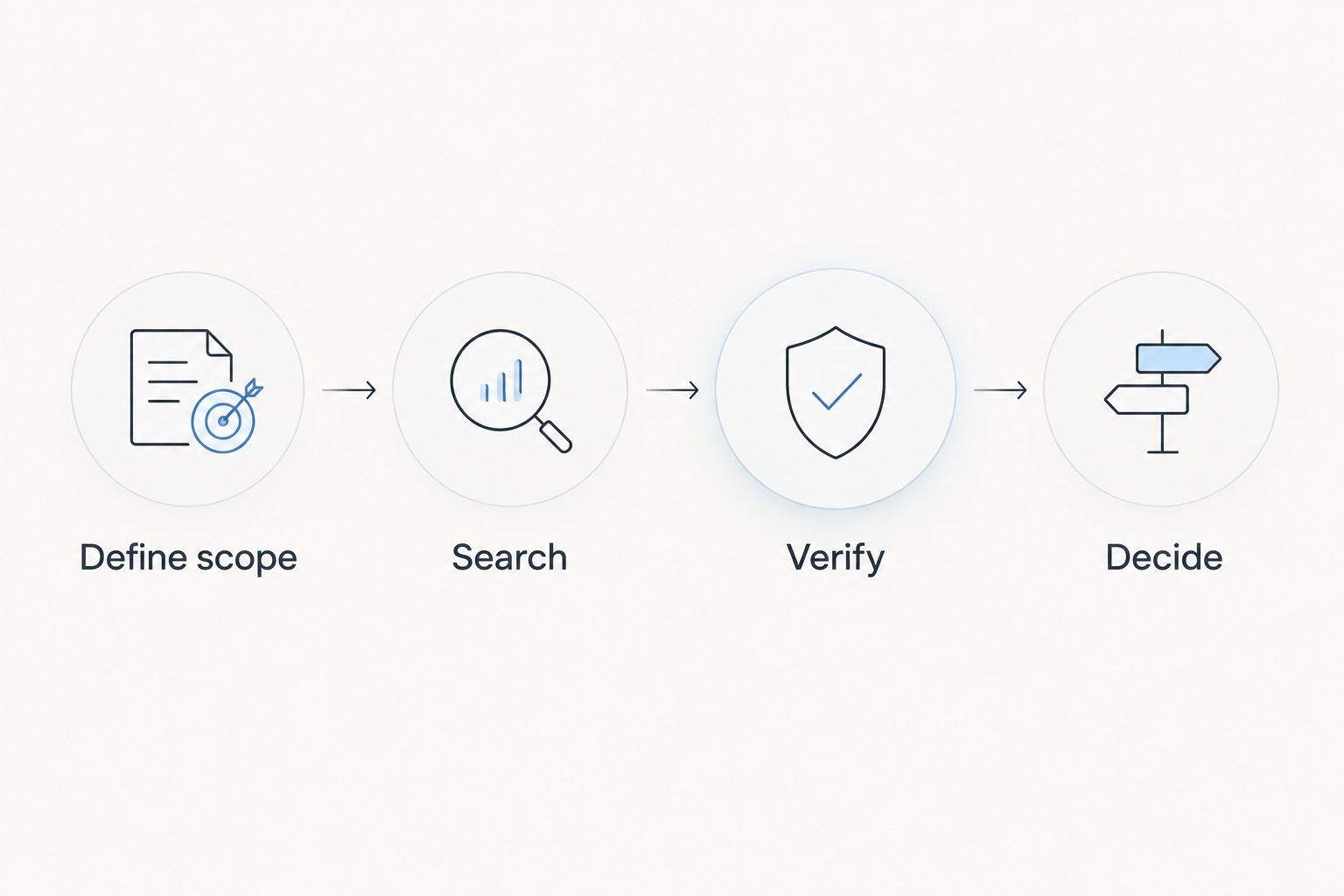
After the pilot, keep the method that produces a useful recommendation with manageable verification work. Extend the evaluation only when a specific unanswered question remains, not because you collected an impressive-looking set of results.
What should your decision log contain?
Your 2026 decision log should connect each research activity to a client outcome. Use the same fields throughout the pilot so you can compare assignments without relying on memory.
| Field | What to record | Why it matters |
|---|---|---|
| Client question | The decision the research must support | Keeps the evaluation tied to paid work |
| Research time | Active time spent searching, reviewing, and verifying | Includes work hidden behind the initial search |
| Relevant findings | Opportunities or records that match the brief | Separates useful output from search volume |
| Rejection reason | Why an apparently relevant result was excluded | Reveals recurring screening work |
| Evidence reference | The source used to support the recommendation | Makes the conclusion traceable |
| Next action | Pursue, investigate, reject, or monitor | Shows whether the research changed anything |
Record time in minutes, but do not assign an invented value to every minute saved. First establish whether the time becomes usable capacity for client work rather than more administration.
When results analysis is part of the assignment, the bidding-results-to-competitor-win-rate workflow is a related guide. Keep any interpretation tied to the records and scope you actually reviewed.
Is tender software worth it if you only serve one client?
One client is enough when the research workload is recurring and useful. Client count alone does not settle the decision: a continuing brief can require repeated tender searches, contractor checks, and results analysis.
The reverse also applies. Several clients with occasional, tightly defined questions do not automatically justify changing your research process.
Does tender software replace checking procurement documents?
Tender software does not replace checking the documents that govern the opportunity. Discovery and research help you decide what deserves attention; document review establishes what the client must actually address.
Keep unresolved requirements visible in the client recommendation. Do not turn an incomplete research finding into a confident bid/no-bid decision.
Should you use past bidding results to predict a win?
Past bidding results support context, not a guaranteed prediction. Use them to frame questions about previous outcomes and relevant participants, then assess the present opportunity on its own requirements.
Keep descriptive findings separate from forecasts. A record of what happened does not establish what will happen next.
FAQ
Is tender software worth it for solo consultants in 2026?
Tender software is worth it when recurring research produces useful client decisions with less repeated work. Test the complete workflow, including setup, screening, verification, and reporting, rather than counting search results.
What's the best tender software setup for a solo consultant?
The best setup matches the research work you sell. Define whether you need tender discovery, tracking, contractor research, bidding-results analysis, or a combination before comparing platforms.
What does Dauthau help a solo bidding consultant research?
Dauthau tender software supports searching, tracking, and analyzing procurement tenders, contractor data, and bidding results across Vietnam. Use those findings as inputs to your own eligibility review and client recommendation.
How long should I evaluate a tender research platform?
Use 14 calendar days as a practical starting plan, not an industry benchmark. Work through real briefs and extend the evaluation only if a specific decision remains unresolved.
Can I keep using manual research instead of software?
Yes, manual research is a valid choice for occasional, narrowly scoped assignments. Reconsider it when repeated searches and recordkeeping become a clear part of your workload.
Will tender software help me win more bids?
Tender software does not guarantee more bid wins. Evaluate its contribution to opportunity selection and research separately from the client's eligibility, submission quality, and procurement outcome.
What should make me stop using a tender tool?
Stop when the tool repeatedly adds review work without improving the client deliverable. Use your decision log to distinguish an unsuitable tool from an unclear research brief.
One last thing
A useful research process helps you reject unsuitable opportunities, not just discover new ones. Keep the rejection reason alongside the source so the next similar notice does not trigger the same investigation from scratch.
Make that part of your 2026 adoption decision. If software helps you produce a defensible shortlist and explain exclusions, it has a clear role; if it only expands the reading queue, fix the scope before adding more searches.