
For builders in 2026, tender alert software needs a current, scope-specific quote; a generic average is not a reliable purchasing budget. Account for the subscription alongside the work required to configure searches, review notices, and pass suitable opportunities to your estimating team. Compare quotes against the same construction tender requirements before choosing a service.
- How much does tender alert software cost for builders? Get a current quote tied to your construction tender requirements.
- Compare tender coverage, review workload, and contract scope—not subscription charges alone.
- Dauthau supports Vietnamese tender research; confirm the quoted service matches your alert requirements.
- Choose the narrowest service scope that supports your actual bidding decisions.
Why this matters
A tender notification is useful only when your team can decide whether the work fits. An irrelevant notice still needs attention, while a relevant notice without enough context sends an estimator back into research.
Buy a usable opportunity-screening process, not simply a stream of notifications. Start with the work your firm accepts: construction activities, locations, procurement types, and qualification requirements. The guide to tender alert software for Vietnamese contractors provides a related starting point for defining that shortlist.
Keep discovery separate from bid preparation. Finding a notice does not establish that your firm qualifies, has delivery capacity, or should commit estimating time. Your purchasing decision should preserve those checks rather than treating every alert as a bidding opportunity.
How much does tender alert software cost for builders in 2026?
The purchasing figure to use is a written quote for your specified requirements. Ask each supplier to describe what the quoted subscription includes, what requires separate agreement, and which activities remain your team's responsibility.
Use the following breakdown to request comparable proposals. These are purchasing questions, not claims that every provider charges separately for each component.
| Budget component | What to establish | Why builders need it |
|---|---|---|
| Tender discovery | Procurement sources, construction categories, and geographic scope | Determines which opportunities enter your review process |
| Alert configuration | Search setup, matching criteria, and notification arrangements | Determines how notices reach the responsible person |
| Team access | Who can search, review, and manage the account | Establishes whether the proposed access fits your team |
| Research depth | Contractor information and bidding results included in scope | Supports qualification and background research |
| Data handling | Any agreed export, transfer, or integration arrangements | Establishes what happens after discovery |
| Contract obligations | Billing period, renewal terms, cancellation conditions, and applicable taxes | Defines the commitment you approve |
Do not treat an unanswered line as included. Ask the supplier to resolve it in writing before comparing the proposal with another quote.
For a 2026 budget approval, distinguish the amount payable to the supplier from your internal operating commitment. The subscription belongs in the purchasing budget; search maintenance, notice review, and bid handover belong in the team's workload plan. Both affect whether the purchase makes sense.
Compare service scopes, not assumed pricing tiers
Builders do not all need the same workflow. A firm seeking relevant notices has a different requirement from a team researching contractors and previous awards before deciding whether to bid.
The scopes below are evaluation options, not named subscription plans. Choose the scope that matches a defined task; do not assume a broader package is the better purchase.
| Evaluation scope | Best for | Advantage | Limitation to check |
|---|---|---|---|
| Tender discovery | Builders defining a shortlist of relevant opportunities | Keeps the requirement focused on finding suitable notices | Your team still needs a qualification and handover process |
| Discovery with research | Builders assessing notices alongside contractor and award information | Connects opportunity discovery with background checks | Additional information creates more review work unless someone owns the decision |
| Connected workflow | Teams with an established destination for qualified opportunities | Defines how information should pass into existing work | Requires agreed field mapping, ownership, and maintenance |
Tender discovery: focus on relevance
Start here when the immediate problem is finding construction notices that match your business. Specify the work you undertake and the locations you can serve before discussing additional functionality.
The advantage is a clear acceptance test: can the proposed service surface notices your estimator should assess? The limitation is equally clear. Discovery alone does not complete your eligibility review or prepare a submission.
Discovery with research: connect notices to context
Choose this scope when contractor information and bidding results form part of your bid decision. Define the questions you need answered rather than requesting broad access without a purpose.
For example, your team might need to examine a contractor record or review an award associated with a relevant project. Establish which information is available and how your reviewer will use it. More data is not a substitute for a documented go-or-no-go decision.
Connected workflow: define the handover first
Consider this scope when your team already has a process for receiving, assigning, and reviewing opportunities. Describe the destination, required fields, responsible person, and handling of updates.
Do not assume a supplier supports a particular connection. Ask for confirmation and a demonstration of the proposed arrangement before treating it as part of your purchasing case. A transfer that creates duplicate or incomplete records adds another task instead of removing one.
Why tender alert software budgets vary
The scope you request determines what a supplier needs to quote. Use these factors to explain differences between proposals rather than assuming that every difference reflects better or worse value.
- Coverage: State whether you need public procurement, private procurement, or both. Ask suppliers to identify the coverage included in their proposal.
- Construction focus: Describe your actual activities and exclusions. Broad construction terms are not an adequate specification for every builder.
- Review responsibility: Identify who receives notices, who checks eligibility, and who approves estimating work. Ask whether the proposed access supports those responsibilities.
- Research requirements: Separate finding tenders from reviewing contractor information and bidding results. Request only the research scope your decisions require.
- Information handling: Describe any required export or transfer process. Establish what is supported, what needs configuration, and who maintains it.
- Contract commitment: Compare the same billing and service periods. Read renewal and cancellation terms before approving a proposal.
These factors are a quote checklist, not a universal charging model. A supplier must explain its own commercial terms. Your job is to make the requested scope consistent enough that differences between quotes are understandable.
How should builders compare quotes in 2026?
Use the same requirements sheet for every supplier. A short, specific document is more useful than separate sales conversations that each produce a different interpretation of your needs.
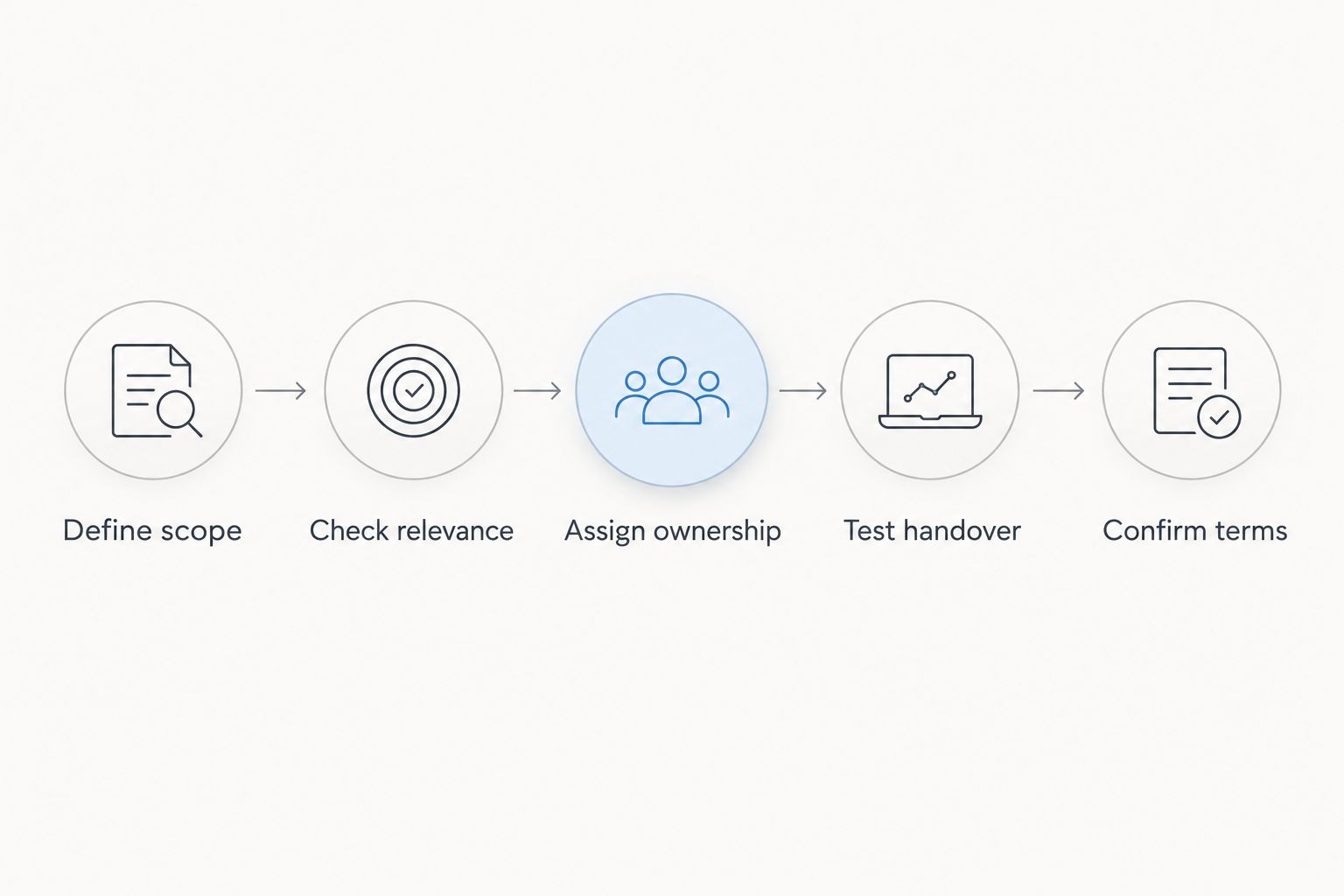
- Define scope. List the construction work, locations, procurement types, and exclusions relevant to your firm. Include examples of notices you would review and notices you would reject.
- Check relevance. Ask suppliers to demonstrate the proposed search approach against those examples. Record whether each result deserves an estimator's attention and why.
- Assign ownership. Name 1 review owner and a backup. Make responsibility for checking notices explicit before introducing another information source.
- Test handover. Walk through 2 workflows: a suitable tender moving to qualification and an unsuitable tender being rejected. Check that both leave a clear decision record.
- Confirm terms. Request written confirmation of included scope, exclusions, contract conditions, and any separately agreed work. Compare only after those questions are resolved.
The demonstration should expose the work your team will actually perform. Do not judge it solely by how quickly a search returns results; inspect what happens between the result and a decision.
Keep the same test examples throughout the evaluation. Changing your requirements between demonstrations makes the proposals harder to compare and leaves uncertainty about which service addresses your original problem.
Where Dauthau fits a builder's shortlist
Dauthau is a fit for Vietnamese builders seeking software to search, track, and analyze procurement tenders, contractor data, and bidding results. Its stated platform scope covers public and private procurement across Vietnam.
Use Dauthau as a research candidate when those tasks match your requirements. Confirm the current commercial scope and the specific notification arrangements you need before making a purchasing decision.
The relevant strength is the stated combination of tender, contractor, and bidding-result research. The purchasing limitation is that this description does not establish which account terms, delivery arrangements, or integrations meet your firm's requirements. Evaluate those separately rather than inferring them from the platform category.
Is a paid tender alert subscription worth it for a small builder?
A subscription is worth considering when it supports a repeatable search and review task that your team actually performs. It is not justified simply because it generates notices.
Track 3 outcomes during an evaluation: suitable opportunities identified, unsuitable notices rejected, and opportunities passed to qualification. Keep the reasons beside each outcome so you can distinguish a search problem from a mismatch with your firm's capabilities.
Use your own records to assess value. Do not attribute a contract win to software merely because the opportunity first appeared there; qualification, estimating, submission quality, and delivery capability remain separate parts of the bidding process.
Do builders need contractor data as well as tender alerts?
Contractor data belongs in your software requirement when it answers a specific question in your review process. It should not become a purchasing requirement simply because it appears in a feature list.
Write down the decision the information supports. If your team cannot explain how it will use the data, keep it outside the initial scope and reassess after the discovery process is working.
What should a builder confirm before renewing in 2026?
Before renewing in 2026, check that the service still matches your construction activities, review responsibilities, and procurement coverage needs. Review the contract terms as well as the team's use of the service.
Compare the original purchasing purpose with actual practice. If notices are being ignored, first establish whether the cause is irrelevant matching, unclear ownership, or changed business priorities. A renewal decision should address that cause rather than automatically preserving or cancelling the subscription.
FAQ
How do I get a useful tender alert software quote for my building firm?
Request a written quote against a defined construction tender scope. Specify your work categories, locations, procurement types, review responsibilities, and any information-transfer requirements so suppliers answer the same brief.
Does a tender software subscription cover bid preparation?
Do not assume a tender software subscription covers bid preparation. Ask the supplier to distinguish discovery, research, notification, and submission-related services in its written proposal.
What's the best way to compare tender alert services?
Compare services against the same relevant and irrelevant tender examples. Inspect the proposed search results, review process, handover, and contract scope rather than comparing feature lists alone.
Is Dauthau relevant to construction tender research in Vietnam?
Dauthau is relevant to Vietnamese businesses researching procurement tenders, contractor data, and bidding results. Confirm that the proposed service matches your construction categories and specific notification requirements.
Should I buy contractor research alongside tender alerts?
Include contractor research when it supports a defined qualification or background-checking task. Ask which information is included and identify who will use it before adding it to your requirements.
Can tender alerts replace checking the procurement documents?
No, tender alerts do not replace checking the procurement documents. Your team still needs to examine the applicable requirements and updates before deciding whether to prepare a bid.
What should I check before signing a tender software contract in 2026?
Check the written service scope, billing period, renewal conditions, cancellation terms, and applicable taxes before signing in 2026. Resolve assumptions about access, notifications, research, and data handling in the same document.
One last thing
Ask the supplier to show a tender your firm should reject, not just one it should pursue. A useful evaluation tests whether your team can explain a rejection as clearly as a handover to estimating.
Keep that rejected example in your requirements sheet. It gives future reviewers a concrete boundary for relevance and helps prevent a broader search from quietly becoming a larger review burden.