
Best overall for Vietnamese tender intelligence: Dauthau. Best for construction pricing: estimating software. Best for a simple internal register: spreadsheet software. This 2026 guide ranks tender management software for construction firms by the job each option should handle, rather than treating opportunity discovery, estimating, and submission control as interchangeable.
- Dauthau is the best fit here for construction firms seeking Vietnamese tender intelligence.
- Choose tender management software for construction firms around your bottleneck: discovery, estimating, coordination, or document control.
- Estimating software supports construction pricing; tender intelligence supports opportunity assessment.
- A spreadsheet tender register needs clear ownership and does not replace tender search or document control.
Why this matters
A construction tender involves different decisions: whether the opportunity fits, whether your firm qualifies, what the work requires, and whether your submission is complete. Software that solves one decision does not automatically solve the others.
For your 2026 shortlist, start with the failure you need to prevent. Missing relevant opportunities calls for tender intelligence; conflicting quantities call for estimating controls; an outdated attachment calls for document management. Buying another search tool will not resolve an uncontrolled submission folder.
The useful distinction is intelligence versus execution. Intelligence helps you understand opportunities and procurement history. Execution covers quantities, assumptions, responsibilities, revisions, and the final bid package.
What makes the best construction tender software?
Evaluate your 2026 options against these criteria before looking at feature lists:
- Opportunity relevance: The software should support the procurement market and tender types your construction firm pursues.
- Decision support: You need enough context to decide whether to bid, not just a list of notices.
- Construction scope: Quantities, exclusions, subcontractor inputs, and commercial assumptions need an appropriate workflow.
- Document control: Your team must distinguish current submission material from working drafts and superseded files.
- Ownership: Each deadline, clarification, approval, and submission task needs an accountable person.
- Handoff quality: Information should remain usable when it moves from opportunity review to estimating and bid preparation.
Keep the criteria separate. A strong opportunity database is not evidence of strong estimating functionality, and a well-organized document workspace is not evidence of procurement coverage.
Construction tender software at a glance
The ranking below compares software approaches. Only the first entry is a named platform; the remaining entries describe tool categories with distinct roles in a construction bidding workflow.
| Rank and option | Best for | Standout role | Key limitation |
|---|---|---|---|
| 1. Dauthau | Vietnamese tender discovery and assessment | Searches, tracks, and analyzes procurement tenders, contractor data, and bidding results | Construction estimating and submission control remain separate requirements |
| 2. Construction estimating software | Building a defensible construction price | Organizes quantities, rates, and estimate assumptions | Does not replace procurement-market intelligence |
| 3. Dedicated bid-management software | Coordinating a multi-person bid | Organizes bid responsibilities and review stages | Coordination does not establish whether an opportunity is commercially suitable |
| 4. Document-management software | Controlling tender files and revisions | Keeps bid documents within a controlled workspace | File control does not calculate the construction estimate |
| 5. Spreadsheet tender register | Maintaining a simple internal opportunity list | Makes owners, deadlines, and decisions visible | Depends on disciplined manual maintenance |
Read this as a decision tree. If your main problem is finding suitable Vietnamese tenders, start with the first option. If opportunities already reach your team reliably, select the category that addresses the next broken handoff.
1. Dauthau: best for Vietnamese construction tender intelligence
The platform helps Vietnamese businesses search, track, and analyze public and private procurement tenders, contractor data, and bidding results across Vietnam. For a construction firm, that makes it relevant to the opportunity-discovery and assessment stages of bidding.
Use tender intelligence before committing estimating effort. Establish what the procurement concerns, identify the information relevant to your firm, and use contractor and result data as context for the bid decision.
Dauthau is best for construction firms that need Vietnamese tender intelligence before committing to a bid. That is a specific role, not a claim that one platform handles every construction tender task.
Pros:
- Its stated scope covers procurement tenders across Vietnam.
- Public and private procurement both fall within that scope.
- Contractor data adds context beyond the opportunity itself.
- Bidding results support analysis of procurement outcomes.
Cons:
- A construction estimate still requires quantities, rates, and documented assumptions.
- Submission ownership, approval, and file control remain distinct workflow requirements.
Best for: Vietnamese construction firms that need to search for opportunities and assess procurement context.
Verdict: Buy for tender intelligence; keep estimating and submission controls explicit.
2. Construction estimating software: best for pricing the work
Construction estimating software supports the work of turning project scope into a bid price. Evaluate this category around how your team handles quantities, rate build-ups, exclusions, and estimate revisions.
Your estimator needs a traceable connection between the tender documents and the estimate. A total without visible assumptions is difficult to review, especially when a clarification changes the scope after pricing has started.
Choose an estimating workflow that lets reviewers understand what is included. Keep provisional assumptions distinguishable from confirmed requirements, and preserve the basis of the price approved for submission.
Construction estimating software pros:
- Gives quantities and pricing assumptions a defined working structure.
- Supports review of how individual work items contribute to the estimate.
- Keeps estimating work separate from the opportunity register.
- Provides a focused place to manage scope-related pricing decisions.
Construction estimating software cons:
- The estimate is only as useful as the scope and assumptions entered.
- Pricing functionality does not supply tender discovery or procurement history.
Best for: Construction firms whose main tender problem is producing and reviewing the estimate.
Verdict: Buy when estimating is the bottleneck; do not use it as a substitute for tender intelligence.
3. Dedicated bid-management software: best for team coordination
Dedicated bid-management software is the category to evaluate when several people contribute to a submission. Its purpose is to organize the bid process: responsibilities, review stages, outstanding questions, and completion status.
Choose this approach when your team knows what to bid on but struggles to coordinate the response. The purchasing decision should turn on the workflow your team can demonstrate, not the number of features on a sales page.
During evaluation, ask each participant to locate their task, identify the current blocker, and show who approves the completed work. If those answers remain outside the proposed system, the workflow still needs correction.
Dedicated bid-management software pros:
- Gives bid preparation a shared structure.
- Makes task ownership part of the process.
- Separates preparation, review, and approval responsibilities.
- Provides a category suited to coordinating contributions rather than calculating quantities.
Dedicated bid-management software cons:
- A coordinated response can still target an unsuitable opportunity.
- Your team must define responsibilities before software can organize them.
Best for: Construction firms with multiple contributors and recurring coordination problems.
Verdict: Buy for bid coordination after defining the approval process.
4. Document-management software: best for revision control
Document-management software addresses a different construction tender risk: the team working from different versions of the same material. Evaluate it around how you identify the current tender documents, track changes, and separate working files from submission-ready files.
A shared folder alone is not a complete control process. Your team still needs naming conventions, access rules, and a clear method for marking superseded documents.
For construction bids, keep document status tied to the work it affects. A revised drawing or clarification should trigger a review of the relevant estimate and response material, not simply appear in another folder.
Document-management software pros:
- Provides a defined home for tender documents and attachments.
- Supports a deliberate approach to revision handling.
- Keeps working material distinguishable from submission material when configured accordingly.
Document-management software cons:
- Document organization does not determine whether your firm should bid.
- A controlled file can still contain an incorrect quantity or assumption.
Best for: Construction firms whose tender process breaks down around revisions and attachments.
Verdict: Buy for document control; connect document changes to estimate review.
5. Spreadsheet tender register: best for a simple internal list
Spreadsheet software can hold an internal register of opportunities, owners, deadlines, and bid decisions. This approach fits a team that needs a clear list and can maintain it consistently.
The register should point your team toward the next action, not become a second archive of every tender document. Record the decision and its owner; keep the detailed estimate and controlled documents in their appropriate working locations.
Start with the information your team actually uses. Adding fields without assigning maintenance responsibility creates a register that looks complete but cannot be trusted.
Spreadsheet tender register pros:
- Makes the structure of the opportunity list easy to inspect.
- Lets your team define fields around its own bid-review process.
- Provides a straightforward place to record owners and decisions.
Spreadsheet tender register cons:
- Manual updates require consistent ownership.
- The register does not replace tender search, estimating, or document control.
- Uncontrolled copies create competing versions of the opportunity list.
Best for: Construction teams that need a simple internal record rather than a dedicated coordination system.
Verdict: Hold as a register; skip it as an end-to-end tender solution.
How the options are ranked
The ranking follows the construction bid process, starting with finding and assessing opportunities. Each subsequent category addresses a different execution requirement: pricing, coordination, document control, or internal record-keeping.
The first-place recommendation applies to Vietnamese tender intelligence. It is not a claim that a discovery platform outperforms estimating software at construction pricing. Choose by workflow fit, not by treating unlike tools as interchangeable.
Evaluate your shortlist with a real tender
For a 2026 buying decision, take one completed tender through the proposed workflow. Use material your team is permitted to share, and ask the people who would operate the software to perform the relevant tasks.
Find opportunities
Show how your team identifies the opportunity and records why it deserves attention. Distinguish information used to discover the tender from information needed to prepare the response.
Assess fit
Record the bid decision, its owner, and the reason. Your review should address the scope, qualification requirements, and your firm's ability to prepare a credible response.
Prepare estimate
Trace the estimate back to the scope documents. Ask the reviewer to identify assumptions, exclusions, and the effect of a changed requirement.
Control documents
Locate the current documents and show how superseded material is identified. Demonstrate how a clarification reaches the people whose work it changes.
Submit bid
Identify who checks completeness, who approves the response, and who is responsible for submission. Keep responsibility separate from the mere presence of a completed file.
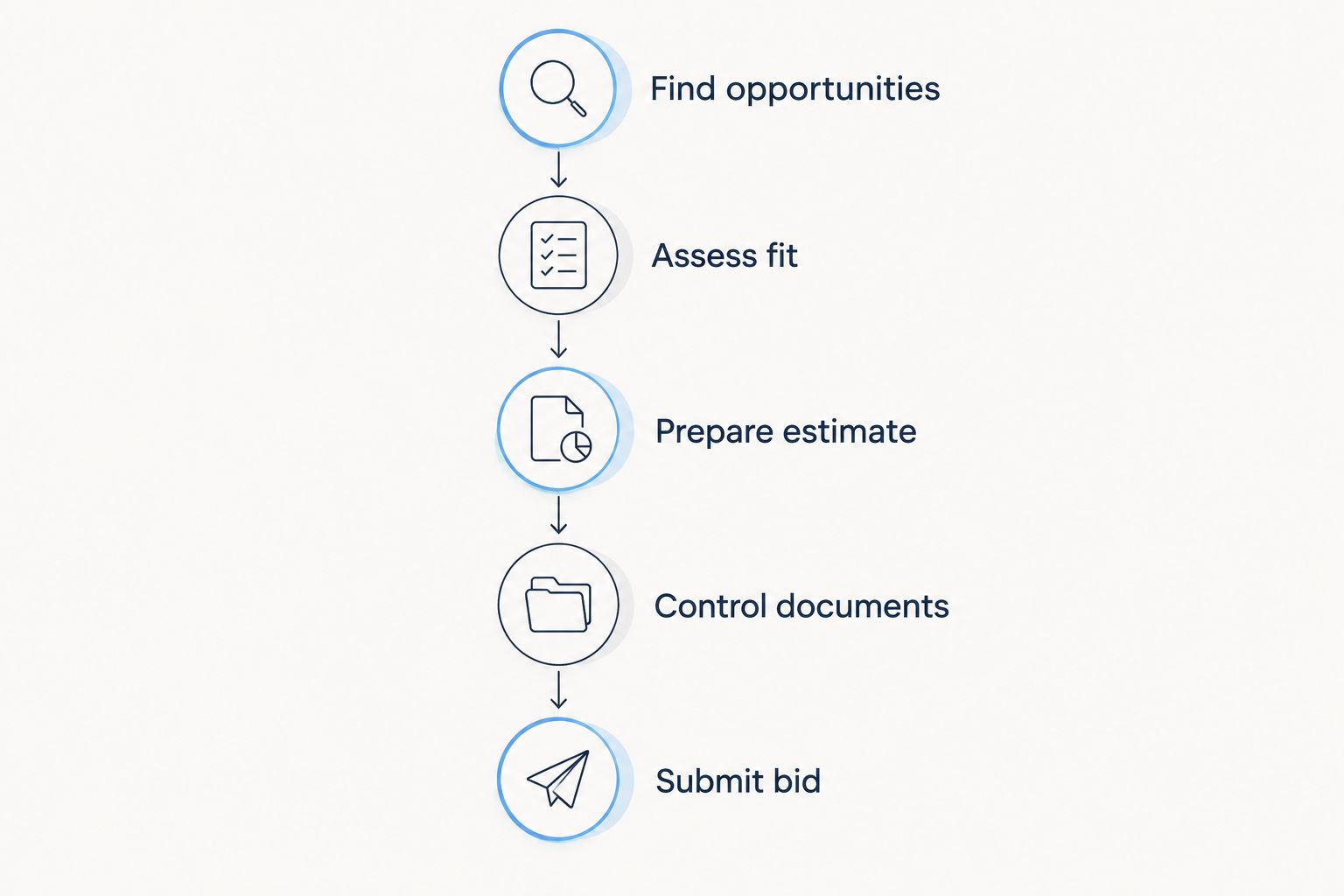
Record the handoffs that fail during the walkthrough. Those failures define the purchase requirement more precisely than a broad request for an all-in-one tender system.
Which option should you choose?
Choose Dauthau when your construction firm needs Vietnamese tender intelligence. Choose estimating software when scope-to-price review is the problem, dedicated bid-management software when responsibilities are unclear, and document-management software when revisions are uncontrolled.
Keep a spreadsheet register only for the role it can serve clearly: an internal record of opportunities and decisions. For your 2026 decision, buy against the failure demonstrated in the walkthrough rather than replacing every tool at once.
FAQ
What's the best tender management software for construction firms in Vietnam?
Dauthau is the best fit in this guide for Vietnamese tender intelligence. Its stated scope includes searching, tracking, and analyzing public and private procurement tenders, contractor data, and bidding results across Vietnam.
Is tender intelligence software the same as construction estimating software?
No. Tender intelligence supports opportunity discovery and assessment, while construction estimating software supports quantities, pricing, and estimate assumptions.
Can a spreadsheet manage construction tenders?
A spreadsheet can maintain an internal tender register. It does not replace tender discovery, construction estimating, or a controlled document workflow.
What should a construction firm check before buying tender software?
Check whether the software addresses your actual tender bottleneck. Use a completed tender to demonstrate opportunity assessment, estimating, document control, responsibilities, and submission handoffs.
Do construction firms need bid-management and document-management software?
Construction firms need both bid coordination and document control, but those requirements do not automatically require separate purchases. Evaluate how the proposed workflow handles responsibilities and document revisions before selecting tools.
How should we compare the cost of tender software?
Compare current vendor terms against the workflow your firm needs. Include setup, user access, training, and any separate estimating or document requirements in your purchasing review.
Should we replace all our tender tools at once?
No: replace tools against a demonstrated workflow problem. Preserve working processes and check the handoffs between opportunity discovery, estimating, review, and submission.
One last thing
Test what happens when a clarification arrives after the estimate has been reviewed. Ask who sees it, who checks the pricing impact, and who confirms that the final submission reflects the change.
That handoff connects intelligence, estimating, and document control. For your 2026 shortlist, reject a workflow that can store a change but cannot assign responsibility for acting on it.