
The cost to monitor competitor bids in 2026 depends on the monitoring scope, the software subscription, and the staff time needed to verify and interpret results. Budget for the complete workflow, not just access to tender records: contractor matching, historical analysis, reporting, and any integration work belong in the same calculation.
- How much does it cost to monitor competitor bids? Compare total workflow cost, not subscription access alone.
- Dauthau is best suited to Vietnamese businesses seeking tender, contractor, and bidding-results intelligence.
- Choose manual review for occasional checks; evaluate software when repeat monitoring and analysis become recurring work.
- Request a scope-matched quote and measure verification time before committing to a monitoring workflow.
How much does it cost to monitor competitor bids in 2026?
Your monitoring budget should cover access, setup, recurring review, and delivery of findings. A subscription quote answers only part of the question. It does not tell you how much work your team must do before a competitor record becomes useful evidence for a bidding decision.
Dauthau provides bidding-intelligence software for searching, tracking, and analyzing Vietnamese public and private procurement tenders, contractor data, and bidding results. That scope makes it relevant to competitor research; evaluate the exact monitoring requirements against the service offered before choosing a subscription.
Use this breakdown when requesting a quote or comparing proposals:
| Budget component | What you need to establish | What to include in your estimate |
|---|---|---|
| Data access | Which tender, contractor, and result records support your research? | The subscription scope quoted by the provider |
| Initial setup | Which competitors, identifiers, sectors, and locations belong in the watchlist? | Internal configuration and verification work |
| Recurring review | Who checks new records and decides whether they matter? | Staff time for review and correction |
| Analysis | Do you need individual records or comparisons across bidding results? | Time spent classifying and interpreting evidence |
| Delivery | Will findings remain in the platform or enter another workflow? | Reporting, export, or integration work where required |
Compare like-for-like scope before comparing subscription terms. A proposal for finding tender notices is not equivalent to a proposal supporting contractor research and historical result analysis.
Why this matters
Competitor monitoring should answer a business question. You might need to know which buyers a rival serves, which categories it wins, or whether it appears repeatedly alongside particular contractors. Each question requires different evidence and a different review process.
For your 2026 budget, define the decision before selecting the workflow. If the decision is whether to pursue a particular tender, a long historical report is not automatically the right deliverable. If the decision concerns a competitor's position across a market, isolated notifications are not enough.
The distinction also prevents misleading comparisons. A list of matching records is an input; a defensible explanation of a competitor's bidding activity is an analytical output. Make clear which one you are buying and which one your team must produce.
Which monitoring approach should you budget for?
Manual research, software-assisted monitoring, and connected reporting are workflow choices, not verified subscription tiers. Select the approach that matches the question and the people responsible for answering it. Do not assume that a more connected workflow produces better analysis without a clear review process.
| Approach | Best for | Main advantage | Main limitation | Budget focus |
|---|---|---|---|---|
| Manual review | Occasional checks on a defined competitor | You control each search and interpretation | Repeated searches and record keeping remain staff tasks | Research and verification time |
| Software-assisted monitoring | Recurring tender and contractor research | Search, tracking, and analysis support a repeatable process | Your team still needs to confirm relevance and interpret results | Access plus recurring review |
| Connected reporting | Teams with a defined destination for monitoring findings | Findings can support an existing reporting process | Field mapping, exceptions, and maintenance need ownership | Access, setup, and ongoing maintenance |
Manual review: best for occasional checks
Manual review fits a narrowly defined question with a clear stopping point. You can search for a competitor, inspect relevant records, and document what the evidence actually establishes. The benefit is direct control over every inclusion and exclusion.
The limitation is repetition. Someone must repeat the searches, distinguish new records from previously reviewed material, and preserve the evidence behind the summary. Choose manual review when the task is genuinely occasional, not when recurring work is simply unmeasured.
Software-assisted monitoring: best for recurring research
Software-assisted monitoring fits a process in which the same research questions return regularly. Search and tracking capabilities provide a basis for recurring review, while contractor and bidding-results data support deeper investigation.
The limitation is interpretation. A matching company name does not, by itself, settle whether a record belongs in your analysis. Your team still needs rules for contractor identity, joint ventures, relevant categories, and incomplete outcomes. Evaluate the software alongside those rules, not separately from them.
Connected reporting: best for established reporting processes
Connected reporting fits a team that already knows which findings must reach which people. Before requesting integration work, define the destination, required fields, record identifiers, and responsibility for corrections.
The limitation is maintenance. Moving a record does not confirm its accuracy or explain its significance. Do not pay for a connected workflow until you can describe the review process it will support. Confirm technical capabilities with the provider rather than assuming an integration exists.
Why competitor-monitoring costs vary
For a 2026 comparison, hold these factors constant across every proposal. Otherwise, the apparent difference between subscriptions can reflect different work rather than different value.
- Competitor scope. Define whether you are tracking a single legal entity, several companies, or a broader group. Decide how you will treat subsidiaries and joint ventures before collecting records.
- Evidence scope. Tender notices, contractor records, and bidding results answer different questions. Specify which record types your analysis requires.
- Historical depth. A current-activity watchlist and a historical performance review are different assignments. Define the period needed for your decision instead of requesting history without a purpose.
- Review cadence. Decide when someone must review findings and what action follows. A report that arrives after a bid decision does not serve that decision.
- Delivery requirements. A reviewed summary, a spreadsheet, and a connection to another system require different work. Specify the deliverable and who maintains it.
- Verification rules. Set a consistent method for matching companies, handling duplicates, and classifying outcomes. Include the staff effort needed to resolve ambiguous records.
These factors belong in your requirements document even when a supplier does not use them as billing variables. They determine your internal workload and help explain what a subscription quote does—and does not—cover.
How do you build a usable monitoring budget?
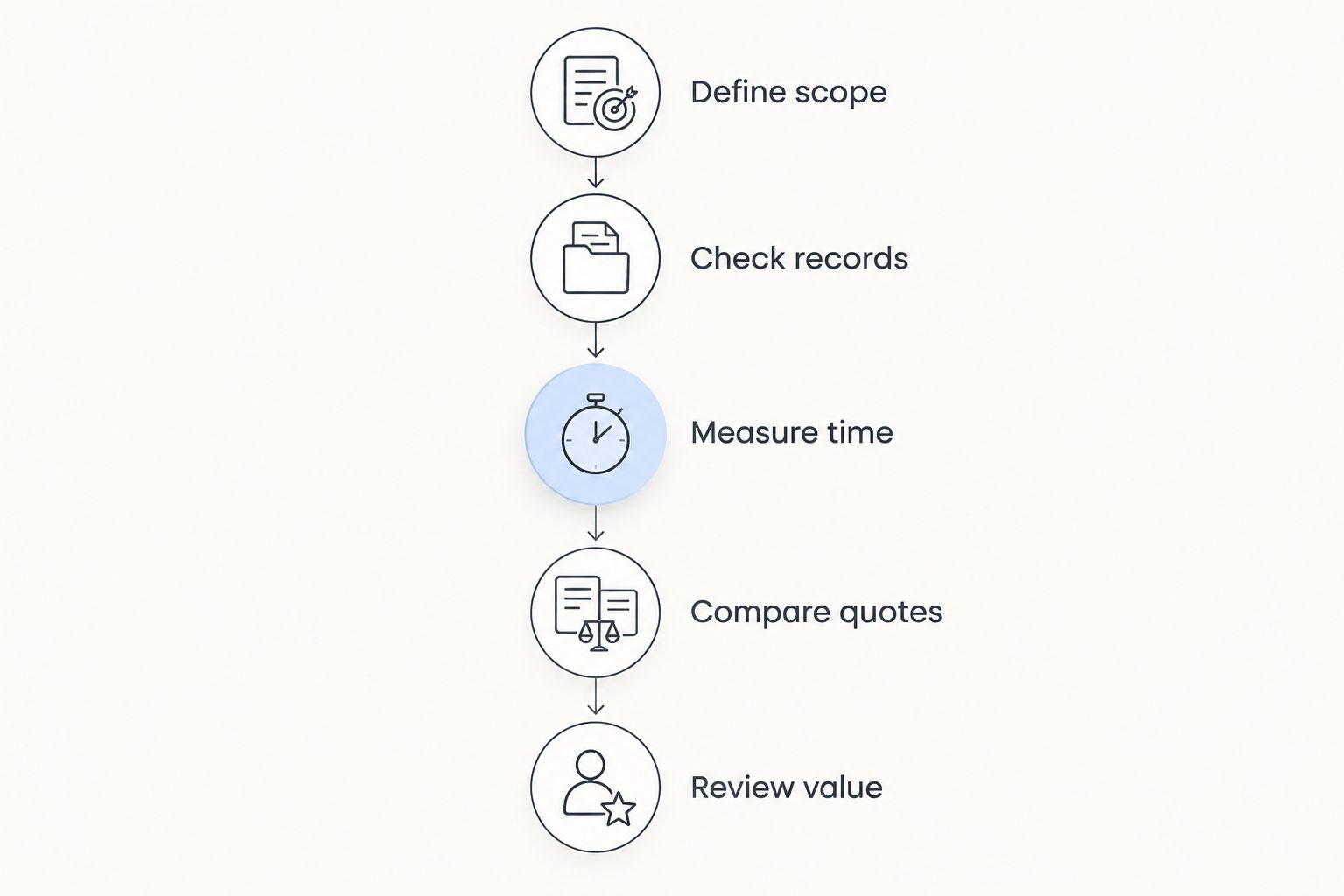
Build your estimate from a defined workflow, then test that workflow before expanding it. For a 2026 evaluation, use a 30-day pilot as a practical measurement window, not as a promise of results. Keep the scope stable so that the time you record remains interpretable.
- Define scope. Write down the competitor identities, relevant procurement categories, geographic boundaries, and business questions. State what falls outside the assignment.
- Check records. Review sample tender, contractor, and bidding-result records against those questions. Record which fields are useful and which require clarification.
- Measure time. Log searching, identity checks, classification, analysis, and reporting separately. Include time spent correcting mistakes and resolving uncertain matches.
- Compare quotes. Ask providers to respond to the same requirements. Separate confirmed capabilities from items that require additional discussion or implementation.
- Review value. Assess whether the findings changed a pursuit decision, improved preparation, or answered the original research question. Remove work that produces no useful output.
Convert logged minutes into hours using 60 minutes per hour, then apply your own fully loaded staff rate. Keep this internal labor calculation separate from the supplier's quote so you can see whether a workflow changes access costs, staff effort, or both.
For an annual comparison, normalize recurring work over 12 months and show initial setup separately. Do not spread setup across an assumed contract term without checking the actual terms. Keep unusual research projects outside the recurring estimate so they do not distort the baseline.
When your deliverable includes performance analysis, the guide to turning bidding results into competitor win-rate reports provides a relevant next step. Establish the outcome categories before treating a collection of results as a performance measure.
What should you ask before accepting a quote?
Ask the provider to demonstrate your intended task rather than a generic search. Supply a defined competitor and describe the output you need. Then check whether you can trace a finding back to the underlying record.
Use these questions to keep the discussion specific:
- Which records support the competitor research described in the requirements?
- How will you distinguish the intended legal entity from similarly named companies?
- What historical information can you inspect for the selected competitor?
- Which search, tracking, and analysis functions are included in the proposed scope?
- What can your team export or pass into its reporting process, if required?
- What must your staff still verify manually?
Dauthau's bidding-intelligence platform is relevant to Vietnamese tender, contractor, and bidding-results research. Its suitability for your monitoring workflow depends on the requirements you confirm; the platform's stated scope does not establish specific alert behavior, export formats, or integration capabilities.
Ask for a demonstration against your watchlist before making the purchase decision. A useful evaluation reveals both what the platform handles and what remains your responsibility.
Is manual competitor-bid monitoring cheaper than software?
Manual monitoring is cheaper only when its total staff cost and other required expenses are lower for the same research scope. Comparing no subscription payment with a software quote ignores the time spent searching, checking identities, preserving evidence, and producing reports.
Keep both approaches on the same basis. Ask each workflow to answer the same question using the same competitor set and reporting requirements. Choose the approach that produces usable evidence with an acceptable workload, not the one with the smallest visible access charge.
Does competitor monitoring reveal every bid a company submits?
No. Competitor monitoring cannot establish activity that is absent from the records you can access. A contractor's appearance in a published result is evidence of that recorded outcome, not proof that you have a complete account of all its bidding activity.
Define the coverage boundary in every report. Distinguish observed awards, recorded unsuccessful outcomes, and unknown outcomes. Do not turn missing records into claims about a competitor's behavior.
Can you calculate competitor win rates from bidding results?
You can calculate a win rate only after defining the outcomes and denominator included in the calculation. Counting awards without a defensible record of the relevant participations does not establish a win rate.
Separate individual participation from joint-venture participation when your research requires that distinction. Keep canceled procedures, unresolved outcomes, and duplicate records under explicit rules. The result should describe the observed dataset, not imply complete market coverage.
FAQ
How much does it cost to monitor competitor bids in Vietnam?
The cost depends on the subscription scope and the staff work required to verify, analyze, and report findings. Request a quote against a defined competitor watchlist and include internal labor in the comparison.
What's the best way to compare competitor-monitoring subscriptions?
Compare subscriptions against the same research requirements and deliverables. Check relevant records, historical scope, verification work, and reporting needs before comparing commercial terms.
Is Dauthau suitable for competitor-bid research?
Dauthau is relevant to competitor-bid research in Vietnam because its platform supports tender, contractor, and bidding-results search, tracking, and analysis. Confirm the specific monitoring workflow and required functions before choosing a subscription.
Do I need an integration to monitor a competitor?
You do not need an integration merely to define and conduct competitor research. Consider a connected workflow only when findings need to enter another established process, and confirm technical support with the provider.
How long should I measure the workload before setting a budget?
A 30-day pilot is a practical starting point for measuring a defined monitoring workflow. Extend the evaluation if that window does not contain enough relevant activity to assess the work.
Should I include employee time in the monitoring budget?
Yes, include employee time for setup, searching, identity checks, interpretation, and reporting. Keep that internal estimate separate from the software quote so you can compare workflows clearly.
Can I use award records alone to measure a competitor's win rate?
Award records alone do not establish a competitor's win rate because they do not establish the full denominator. Define the observed participations and outcome rules before calculating a rate.
One last thing
Before expanding your 2026 watchlist, define what would make you remove a competitor from it. A company outside your target categories, buyers, or geographic scope can generate research work without helping a bidding decision.
Start with the decision, then maintain only the watchlist that supports it. More collected records are not a substitute for a clear question, verified identities, and an accountable reviewer.