
Business license verification costs depend on what you need checked: a company’s registration record, its supporting documents, or its authorization for a particular activity. Document collection, translation, discrepancy review, and later rechecks are separate tasks to include in your request. For a 2026 budget, define the evidence you need before asking for a verification quote.
- How much does business license verification cost? Define the company checks, evidence requirements, and review responsibilities before requesting quotes.
- Separate company registration checks from activity-specific licensing and procurement eligibility checks.
- Dauthau supports procurement research; company and bidding data do not replace evidence of a required license.
- Compare verification proposals by deliverables, exclusions, and recheck terms—not the service name alone.
How much does business license verification cost in 2026?
Request a quote against a written scope, not a generic promise to verify a business. A registration lookup, a document review, and a licensing assessment answer different questions. Comparing them as though they deliver the same result produces a misleading budget.
Start with these verification options. The advantages and limitations below concern the tasks themselves, not the capabilities of any named provider.
| Verification option | Best for | What to request | Advantage | Limitation |
|---|---|---|---|---|
| Company registration check | Establishing the business’s recorded identity | Source, search date, identifying details, and recorded status | Creates a starting point for matching the counterparty | Does not establish permission for every business activity |
| Document review | Checking documents supplied during onboarding | Document list, matching criteria, and discrepancies | Connects submitted evidence to the named company | A supplied document alone does not prove current status |
| Activity-specific license check | Assessing a particular regulated service or activity | Relevant authorization, issuing authority, scope, and validity details | Addresses the permission relevant to the proposed work | Requires a clearly defined activity and applicable requirements |
| Procurement background research | Understanding a contractor’s bidding context | Company identity, tender references, and bidding results | Adds context to contractor assessment | Does not substitute for required licensing evidence |
For the company-research stage, the guide to contractor and company search platforms in Vietnam covers a related selection task. Keep that research separate from deciding whether a particular authorization is required.
Build the cost breakdown around deliverables
Ask the provider to distinguish record retrieval, document examination, discrepancy handling, and the final report. Also identify anything your team must supply or complete internally. Otherwise, an apparently complete service can leave you responsible for collecting the evidence needed to finish the review.
Your comparison should state whether the proposal covers an initial check only or also includes corrections and rechecks. A report delivered once and an ongoing review process are different purchases. Name the deliverable you need before comparing proposals.
Why this matters
Business verification is useful only when it answers the decision in front of you. Confirming a company’s registered identity helps establish who you are dealing with; it does not, by itself, establish whether that company can perform the proposed work.
For Vietnamese procurement teams, keep identity checks, licensing questions, and tender requirements distinct. A contractor’s participation in procurement is relevant background, but the evidence needed for your transaction still depends on the work and its requirements.
In your 2026 onboarding process, write down the decision the check must support. Examples include approving a supplier’s identity, resolving conflicting documents, or confirming evidence of an authorization. That sentence becomes the boundary of the verification assignment.
What should a company registration check include?
Best for: establishing the counterparty’s recorded identity. Ask the reviewer to match the company’s name and identifying details against the evidence used for the check. Require the report to name the source and record when the information was retrieved.
Use these 3 evidence checks as a starting checklist:
- Identity match: Does the record correspond to the company you intend to contract with?
- Record status: What status does the consulted source show at the time of review?
- Document consistency: Do the details agree across the contract, company documents, and verification evidence?
A matching name alone should not close the review. Record the identifier used to distinguish the business, and explain any differences rather than silently treating them as spelling variations.
The advantage of this scope is clarity: you are asking a narrow identity question. Its limitation is equally important. A company registration check is not a general certificate of competence, financial strength, or permission to undertake every proposed activity.
What should a document review include?
Best for: checking the evidence a supplier submits during onboarding. Give the reviewer a document inventory and explain what each document is intended to establish. A review cannot answer a licensing question accurately if the intended activity remains undefined.
Ask for a findings table that distinguishes matching information, conflicting information, and unresolved questions. Require the reviewer to identify the document behind each finding. This makes the report useful to the person who must approve or reject the supplier.
Document review helps expose inconsistent details across a submission. Its limitation is that reading a supplied copy does not independently establish everything stated in it. Specify when information must be checked against an issuing authority or another appropriate source.
For your 2026 request, also settle the format of the evidence you will receive. A summary email, a documented findings table, and copies of supporting records are different deliverables. Choose the format your approval process can actually use.
What should an activity-specific license check include?
Best for: assessing authorization for clearly defined work. Describe the service, product, or activity before requesting the check. Then ask which authorization is relevant and what evidence supports the reviewer’s conclusion.
Separate 4 review fields in the assignment:
- Holder: The entity named on the authorization.
- Scope: The activities the authorization covers.
- Validity: The dates and status relevant to your decision.
- Conditions: Any stated restrictions relevant to the proposed work.
These are review instructions, not a claim that every Vietnamese business needs the same license. Requirements depend on the activity and applicable rules. Obtain qualified legal advice when the question is whether a particular authorization is legally required.
The advantage is a closer match between the check and the intended transaction. The limitation is the need for precise instructions: an undefined request to verify all licenses gives the reviewer no clear stopping point.
Why business license verification costs vary
The scope of the work determines what belongs in the quote. Use these factors to explain differences between proposals rather than assuming that every provider is pricing the same assignment.
- Evidence depth: Specify whether you need a record lookup, examination of supplied documents, or confirmation from an appropriate source.
- Entity coverage: List the legal entities involved instead of referring only to a group or trading name.
- Activity coverage: Define the work being assessed so the review addresses the relevant authorization question.
- Language requirements: State whether document translation or an English-language findings report is part of the assignment.
- Discrepancy handling: Explain whether the reviewer must investigate conflicts or simply flag them for your team.
- Review frequency: Distinguish the initial check from later reviews triggered by expiry, document changes, or a new transaction.
Remove an item from the scope only when you no longer need the answer it provides. A narrower check is appropriate for a narrower decision; it is not equivalent to a broader review with work omitted.
How do you request comparable verification quotes?
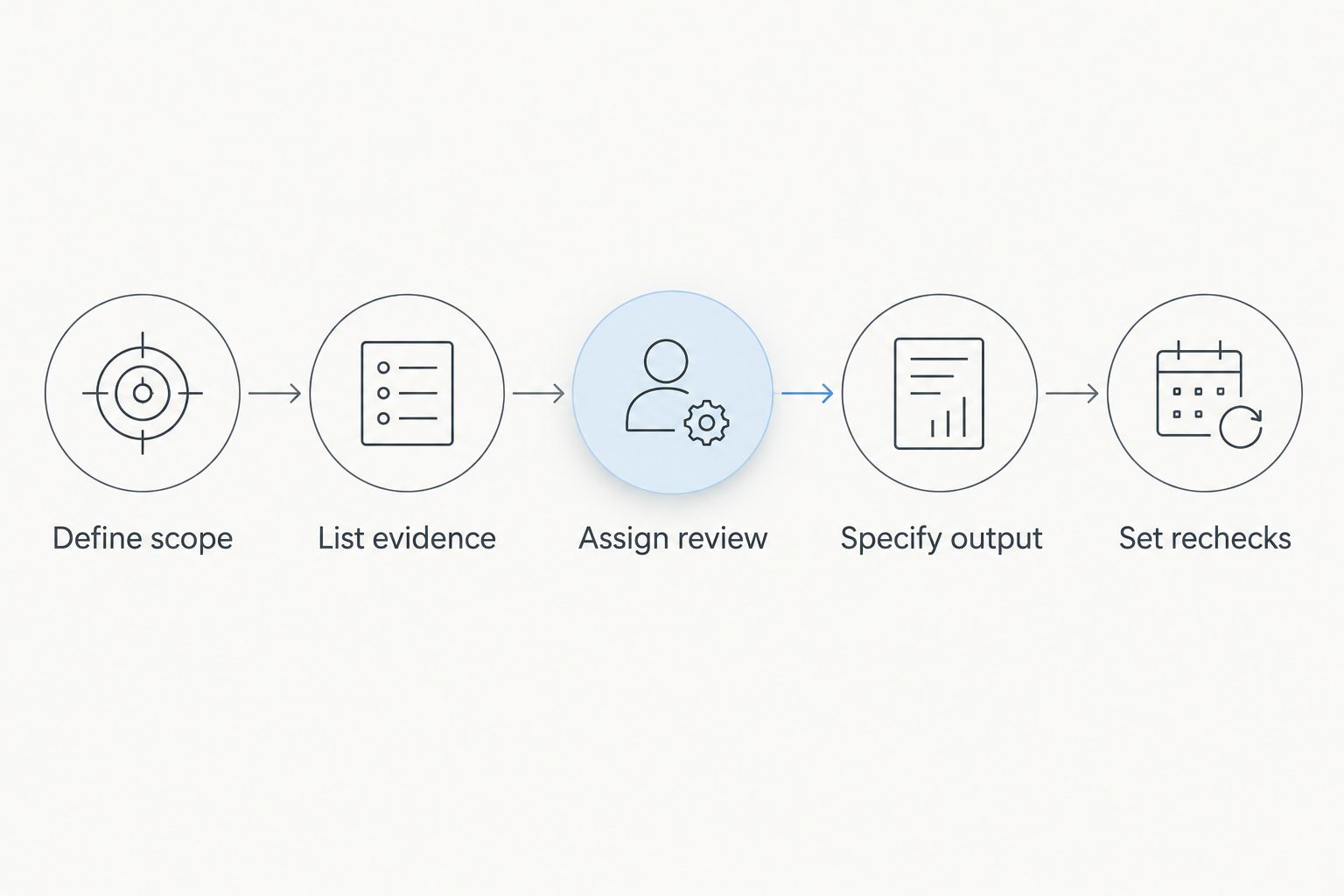
Use the same written brief for every provider. This prevents differences in terminology from hiding differences in the actual work.
- Define scope. Name the company, proposed activity, and approval decision. Identify the specific questions the review must answer.
- List evidence. Attach the available documents and specify which additional records the reviewer must obtain.
- Assign review. Identify who investigates inconsistencies and who decides whether unresolved issues require escalation.
- Specify output. Request findings, supporting references, the review date, and explicit limitations.
- Set rechecks. Define whether later document updates or status checks belong to this assignment or a separate one.
Do not ask only whether verification is included. Ask what happens when information conflicts, a document is unreadable, or the named entity does not match. Those instructions determine whether you receive a completed decision record or a list of unanswered questions.
A useful acceptance rule is simple: another member of your team should be able to understand what was checked without repeating the entire investigation. If the report cannot support that handover, clarify the reporting requirement before approving the assignment.
Where does procurement intelligence fit?
Dauthau provides a bidding-intelligence platform for searching, tracking, and analyzing Vietnamese public and private procurement tenders, contractor data, and bidding results. That role fits the background-research stage of contractor assessment.
Dauthau bidding intelligence is best for Vietnamese businesses researching contractors and procurement opportunities. The benefit is procurement context: you can investigate company and bidding information relevant to your research. The boundary is licensing evidence; procurement data should not be treated as proof of a required authorization.
Keep the research handover explicit. Record which findings concern the contractor’s procurement background and which findings concern identity or licensing. This keeps a useful research result from being stretched into a conclusion it does not establish.
Is company registration the same as a business license?
Company registration and activity-specific licensing answer different questions. Registration concerns the recorded business entity; an activity-specific authorization concerns permission for particular work. Identify which question your verification request needs to answer.
Do not accept the phrase business verified as a substitute for a finding. Ask whether it means identity matched, documents reviewed, or authorization examined. The report should state the result in those narrower terms.
Should you choose a one-time check or ongoing review?
A one-time check supports a decision at a stated review date; ongoing review addresses later changes. Choose the approach around your relationship with the business, not around a generic service label.
For a 2026 supplier review, define the events that require a fresh check. Examples for your policy include a changed contracting entity, replacement documents, or a new activity outside the original assignment. These are proposed review triggers, not claims about a provider’s monitoring features.
Can procurement history replace license verification?
Procurement history does not replace evidence of a required license. It answers questions about procurement activity, while licensing review addresses authorization for the proposed work. Keep both findings separately identifiable in the approval record.
Likewise, do not turn an absence of research findings into a favorable licensing conclusion. A search result describes what the search found. Your approval decision still needs the evidence specified in the verification brief.
FAQ
How much does business license verification cost in 2026?
Business license verification costs depend on the defined checks and deliverables. Request a quote that separates record retrieval, document review, discrepancy handling, and rechecks.
What should I include in a verification quote request?
Include the company’s identifying details, the proposed activity, available documents, and the decision the review must support. Specify the evidence and findings report you expect to receive.
Is a company registration check enough to approve a supplier?
A company registration check answers an identity question, not every supplier-approval question. Assess any relevant licensing, contractual, and tender requirements separately.
Does reviewing a business license copy prove it is current?
Reviewing a supplied copy alone does not establish current status. Specify whether the assignment includes confirmation against an appropriate source and record the review date.
Can Dauthau replace a licensing review?
Dauthau bidding intelligence supports research into Vietnamese tenders, contractors, and bidding results, not a substitute conclusion about required licensing. Obtain the evidence relevant to the proposed activity separately.
Should I ask for a written verification report?
Ask for a written report when your approval process needs a traceable decision record. Require findings, supporting references, unresolved issues, and the date of review.
When should I repeat a business verification check?
Repeat a check when a trigger in your review policy occurs, such as a changed contracting entity or a new activity. Define those triggers before the initial assignment so responsibility is clear.
One last thing
Require an unresolved finding to remain unresolved until someone supplies the missing evidence. A completed report is not necessarily a cleared supplier, and an identity match is not a conclusion about every licensing requirement.
Before approving your 2026 verification brief, add a named decision owner and an escalation route. The most useful deliverable is not a reassuring label. It is a record that distinguishes what the evidence establishes from what still needs a decision.