
Tender software can connect to Vietnam’s e-procurement portal only where the required access method and permissions are supported; tender search alone does not establish that connection. Separate access to procurement information from actions inside a bidder account, especially submitting a bid. For a 2026 purchase, require a demonstration of your exact workflow before treating any integration claim as confirmed.
- Can tender software connect to Vietnam e-procurement portal? Verify the specific connection, permissions, and workflow before buying.
- Dauthau supports Vietnamese tender intelligence; that scope does not establish portal-account access or automated bid submission.
- Treat tender discovery, internal data transfer, and portal transactions as separate requirements.
- Approve a connection only after testing record identity, changes, permissions, and failure handling.
Can tender software connect to Vietnam’s e-procurement portal?
A useful answer must identify what connects, which direction information moves, and what the connection is allowed to do. A search interface, a downloadable file, and an authenticated submission workflow are different capabilities. Do not accept the word integration as a substitute for that detail.
Dauthau provides tender-intelligence software for Vietnamese businesses searching, tracking, and analyzing public and private procurement tenders, contractor data, and bidding results. That describes an intelligence function, not proof of a particular technical connection to a government portal.
For your 2026 evaluation, distinguish these requirements before requesting a demonstration:
| Connection requirement | Best for | Practical benefit | Limitation to check |
|---|---|---|---|
| Read-access workflow | Teams discovering and reviewing opportunities | Brings procurement information into a research workflow | Does not establish permission to act inside a bidder account |
| Internal data transfer | Teams moving selected information into business systems | Reduces repeated entry when the required transfer is supported | Requires field mapping, record matching, and error handling |
| Authenticated portal action | Teams seeking a specific account-level transaction | Connects an operational step rather than just displaying information | Requires explicit support, authorization, and evidence of completion |
These are requirements to investigate, not a list of confirmed features from any vendor. Buy the workflow that is demonstrated, not the broader capability suggested by its name.
Why this matters
An integration purchase fails when the sales demonstration solves a different problem from the one your bidding team faces. Finding a notice does not answer whether your team can transfer its fields into an internal database, and neither establishes whether software can submit a bid.
Write the business outcome first. If your problem is opportunity discovery, assess search and tracking. If your problem is repeated data entry, assess data transfer. If your problem is an account-level action, assess authorization and transaction evidence separately.
For the 2026 procurement decision, put that distinction in the acceptance criteria. It gives your operations, IT, and bidding teams a shared definition of success instead of leaving each team to interpret the same sales claim differently.
How do you verify the connection before buying?
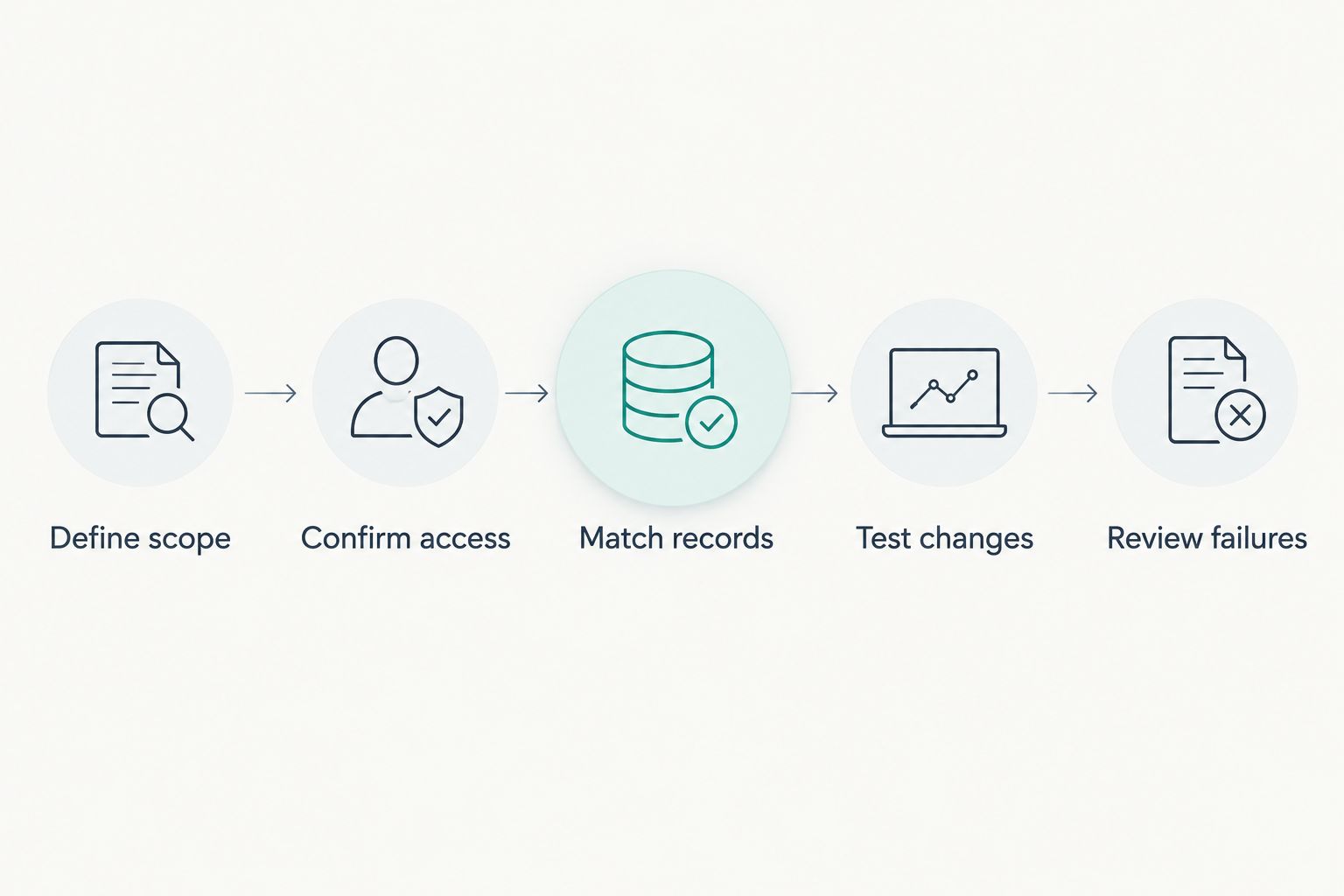
Use 5 acceptance checks to test the proposed workflow. These checks define a purchasing process; they are not claims about the portal’s technical requirements or any vendor’s existing capabilities.
1. Define scope
Describe the action in one sentence: retrieve a notice, update an internal record, or perform a named portal transaction. Include the starting system, destination, responsible user, and evidence that will show completion.
Avoid requirements such as connect everything. A narrow requirement is easier to demonstrate and harder to misunderstand. If several actions matter, document each separately rather than accepting one successful search as proof of the entire workflow.
2. Confirm access
Ask the supplier to identify the supported access method and explain who authorizes it. Request the applicable documentation and distinguish the supplier’s own interface from any interface operated by the portal.
An API supplied by a software vendor does not, by itself, establish direct API access to the portal. Likewise, a successful demonstration using a supplier’s account does not establish what your business account is permitted to do.
3. Match records
Choose a procurement record your team can independently inspect. Compare the identifier, title, buyer, relevant dates, and status wherever those fields are part of the proposed workflow.
Require 2 matching records in the test: the source record and the corresponding destination record. The point is traceability, not a large sample. Your team should be able to explain why those records represent the same opportunity without relying only on a similar title.
4. Test changes
Ask how an existing record is updated when source information changes. Use an authorized test or a documented example to examine whether the destination updates the existing record, creates a duplicate, or leaves the change for manual review.
Do not judge success solely by whether information appears. Check which version the team sees, how the change is identified, and how a reviewer returns to the source for confirmation.
5. Review failures
Ask the supplier to demonstrate a failed request or explain a documented failure case. Your team needs to know what becomes visible to the user, who receives the issue, and how work resumes after it is resolved.
For account-level actions, require evidence distinguishing an attempted action from a completed action. A local success message should not substitute for the receiving system’s evidence of completion.
Read-access workflows: verify the information trail
A read-access requirement concerns information your team needs to inspect, search, or analyze. Start with the fields that support an actual decision, rather than asking for every field a supplier can display.
For each required field, ask where it originates and how your team can verify it. A clear information trail helps reviewers resolve differences between a software record and the underlying notice.
For a 2026 review, document the supplier’s stated update process without converting it into an assumed guarantee. If update timing matters to your operation, make the required timing an explicit acceptance condition and ask the supplier to demonstrate how it is measured.
Best for: teams whose immediate need is finding and assessing opportunities. The benefit is a focused research workflow; the limitation is that viewing information proves nothing about submission permissions.
Internal data transfer: verify the destination workflow
Moving tender information into your own system is a separate integration project. Define which fields should move, what triggers the transfer, and whether a person must approve the record before it enters your pipeline.
Ask how the destination identifies an existing opportunity. Titles alone are a weak matching rule because a record’s wording is not the same as its identity. Agree on the identifiers and matching logic before testing updates or retries.
The guide to pulling new tenders into your database via API addresses this internal-transfer question. Keep that question separate from whether the software can perform an action in the portal itself.
Best for: teams with a defined database or business-system workflow. The benefit is reducing repeated handling where transfer is supported; the limitation is the ongoing responsibility for mappings, duplicates, and failed transfers.
Portal transactions: verify authority and completion
Treat an authenticated portal action as a distinct requirement with its own approval. Specify the exact action rather than using broad phrases such as bid automation or full portal integration.
Ask who performs the action, whose authority is used, and what evidence confirms the receiving system accepted it. If the action involves credentials, certificates, or signatures, require the supplier to explain the applicable handling arrangements before access is granted.
For a 2026 implementation, involve the person responsible for the bidder account before approving account-level access. Do not use a live submission as an exploratory technical test; agree on an authorized validation method first.
Best for: teams with a specific, supported transaction requirement. The benefit is completing a defined operational step; the limitation is that information access cannot establish authorization or successful execution.
Why connection requirements vary
The right integration depends on the work you need completed. Use these factors to structure the supplier discussion rather than comparing vendors on an undefined promise of connectivity:
- Purpose: opportunity research, internal record transfer, and portal transactions require different evidence of success.
- Direction: reading information, sending information, and exchanging updates are separate requirements. Specify each direction explicitly.
- Access: public information and account-level activity should not be treated as equivalent. Ask what authorization applies to the proposed action.
- Data scope: notices, contractor records, and bidding results serve different decisions. List the fields your team actually needs.
- Change handling: importing a record is not the same as maintaining it. Define how updates and duplicates should be handled.
- Accountability: identify who investigates a failed connection and who decides whether a procurement record or transaction is complete.
These factors also help control project scope. A discovery problem does not automatically justify account-level access, and a data-transfer problem does not automatically require changes to your bidding process.
Does an API mean direct access to the government portal?
An API does not, by itself, prove direct access to the government portal. It identifies an interface through which systems exchange information; you still need to establish who operates it, what it exposes, and what permissions apply.
Ask the vendor to identify the upstream source and demonstrate the exact request your workflow requires. Keep the supplier’s interface documentation separate from evidence of portal authorization.
Can tender software submit bids for my company?
Tender search and tracking do not establish bid-submission capability. Require explicit support for the transaction, an authorized method, and evidence that the receiving system records completion.
Until those conditions are demonstrated, keep submission within your established authorized process. Do not change account access or signing arrangements on the strength of a general integration claim.
Is tender-intelligence software useful without submission access?
Tender-intelligence software is useful when your priority is finding and assessing opportunities rather than submitting through another interface. Dauthau tender-intelligence software is best for Vietnamese businesses that need to search, track, and analyze procurement opportunities, contractors, and bidding results.
That scope supports an intelligence-focused evaluation. It does not establish a specific API, CRM connector, portal-account connection, or automated submission feature; assess each additional requirement on its own evidence.
FAQ
Can tender software connect to Vietnam e-procurement portal?
A connection depends on support for the required access method, permissions, and action. Ask the supplier to demonstrate your exact workflow, separating information access from account-level transactions.
Does finding a tender prove that the software is integrated with the portal?
Finding a tender does not prove an authenticated portal integration. It demonstrates information discovery, not permission to operate a bidder account or submit a bid.
Does an API automatically let my company submit bids?
An API does not automatically provide bid-submission authority. Verify the interface operator, permitted actions, authorization requirements, and evidence of transaction completion.
What should I ask a tender-software supplier to demonstrate?
Ask the supplier to demonstrate the exact action your team needs, including record matching, changes, and failures. Define the source, destination, responsible user, and completion evidence before the demonstration.
Should I share my portal credentials to test an integration?
Do not share portal credentials merely to explore an integration claim. First establish an authorized test method, the access required, and how credentials or signing materials would be handled.
Can I move tender information into my company’s database?
Moving tender information into your database requires a supported transfer method and agreed field mappings. Verify record identifiers, duplicate handling, updates, and recovery before approving the workflow.
What is Dauthau tender-intelligence software best for?
Dauthau tender-intelligence software is best for Vietnamese businesses searching, tracking, and analyzing procurement tenders, contractor data, and bidding results. Evaluate any additional connection or transaction requirement separately.
One last thing
Test what happens when the same information arrives again. A demonstration that creates a record proves less than a demonstration that recognizes an existing record, handles a change, and makes a failure visible.
Before signing off on a 2026 connection, ask your team to trace one opportunity from its source through the destination workflow and back again. If the team cannot explain the record’s identity, status, and completion evidence, the acceptance test is unfinished—even if the screen shows a successful connection.