
Yes—AI can help Vietnamese SMEs draft a winning bid proposal in 2026 by organizing requirements, turning verified company information into draft responses, and checking for omissions. It cannot guarantee an award or replace eligibility checks, accurate supporting documents, commercial decisions, and approval by someone accountable for the submission.
- Can AI help draft a winning bid proposal? Yes—use it for drafting, not as proof of compliance.
- Dauthau supports Vietnamese tender research; proposal claims still need your company's verified evidence.
- Build a requirement-to-evidence checklist before asking AI to write your technical proposal.
- Keep confidential bid information out of any service your company has not approved.
Why this matters
A fluent proposal is not necessarily a compliant proposal. Your response needs to address the actual tender requirements and show that your business can deliver what it promises. Better wording cannot repair missing evidence or an unsupported commitment.
For a Vietnamese SME planning its 2026 bidding process, the useful distinction is between finding an opportunity, preparing the response, and authorizing the submission. These are separate jobs. The guide to tender management software for SMEs in Vietnam provides context for choosing tools around that wider process.
Can AI help draft a winning bid proposal?
Yes, but treat AI output as a draft that must earn approval—not as a submission-ready answer. Give the system the relevant requirement and approved evidence, then ask it to connect them clearly. Reject statements that introduce experience, capacity, certifications, or delivery promises absent from those sources.
The table compares working methods, not guaranteed outcomes. Choose according to the task and the evidence you have available.
| Working method | Best for | Useful contribution | Main limitation |
|---|---|---|---|
| Human-led drafting | Eligibility decisions and final commitments | Keeps interpretation and authorization with accountable staff | Requires staff to assemble and check the response |
| AI-assisted drafting | Writing from approved source material | Produces outlines, summaries, and alternative wording | Can introduce unsupported statements or misunderstand instructions |
| Template-led drafting | Reusing approved company descriptions | Gives writers an established starting structure | Old wording can conflict with the current tender |
These methods can work together. Start with current requirements, reuse only relevant approved material, and use AI to draft within those boundaries. A qualified reviewer still decides whether the answer is accurate and sufficient.
How should an SME use AI to prepare a bid in 2026?
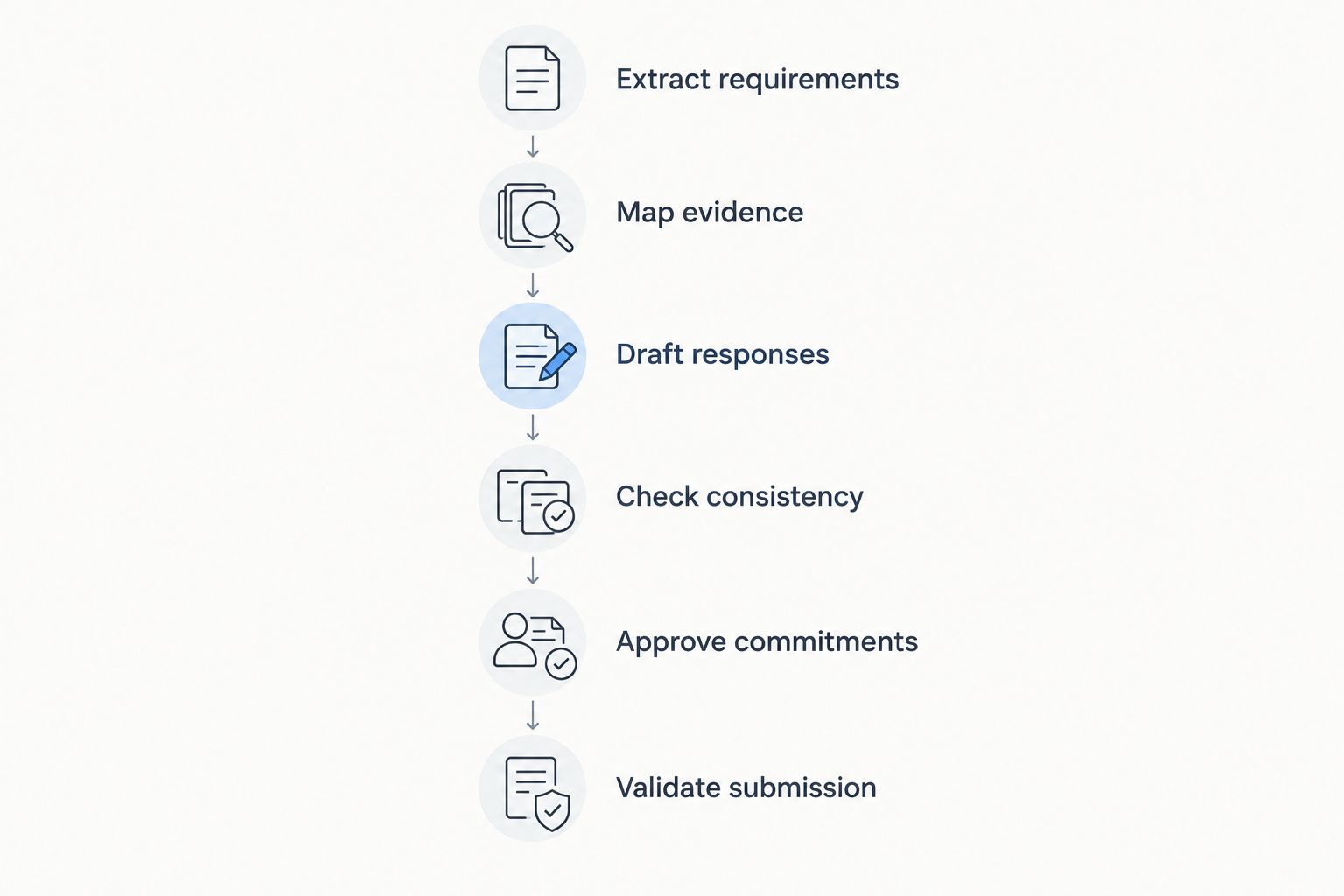
Use this 6-step workflow to keep writing separate from evidence and approval. The steps are a recommended operating process, not a claim about time saved or win rates.
1. Extract requirements
Start with the tender documents, applicable amendments, and clarification responses. Ask AI to extract requirements without interpreting away conditions or exceptions. Keep a reference to the source passage beside each extracted item.
Separate eligibility conditions, technical requirements, commercial instructions, and submission instructions. An AI summary is a reading aid; the underlying documents remain the reference. If a passage is ambiguous, assign it for human review rather than accepting the system's preferred interpretation.
Check the extraction against the original files before drafting. Otherwise, a missed requirement becomes a missing answer throughout the proposal.
2. Map evidence
Create a requirement-to-evidence matrix. For each requirement, record the proposed response, the supporting document, the person responsible, and whether the evidence has been checked.
Use 3 evidence states: verified, missing, and unclear. These are internal workflow labels, not procurement classifications. They help your team distinguish material ready for drafting from gaps that require action.
For example, a requirement about relevant experience needs actual project evidence. A polished paragraph describing experience is not a substitute. Where evidence is missing, ask the responsible colleague to supply it; do not ask AI to make the answer sound more convincing.
3. Draft responses
Give AI a bounded task: draft a specific response using only the approved material supplied. Include the requirement, relevant evidence, required structure, and any length restriction stated in the tender.
A useful instruction is: Use only the supplied facts. Identify unsupported requirements separately. Do not invent projects, credentials, personnel, equipment, or commitments. This is a drafting instruction, not a guarantee that the output will follow it.
Review each paragraph against its evidence. Remove generic claims that add no proof, and replace vague language with a clear explanation of how your proposed work addresses the requirement.
4. Check consistency
Compare the draft against your schedules, staffing information, technical attachments, and commercial documents. Look for conflicting names, quantities, responsibilities, dates, and assumptions.
AI can help flag apparent differences, but a reviewer must resolve them against authoritative records. Do not let the system silently choose which conflicting document is correct.
For bilingual material, check terminology against the source documents and any applicable language instructions. A readable translation still needs technical review. Preserve the meaning of obligations, exclusions, and qualifications rather than accepting smoother wording that changes them.
5. Approve commitments
Assign named people to approve technical statements, delivery commitments, commercial terms, and compliance decisions. The writer should know who can authorize each promise.
Keep unresolved issues visible. If the draft assumes access to equipment, staff, or a subcontractor, obtain confirmation before presenting that resource as committed. AI-generated confidence does not create delivery capacity.
Record approval against the version your team intends to submit. If a material statement changes afterward, return that statement to its owner rather than treating the earlier approval as permission for any later wording.
6. Validate submission
Check the final submission against the current instructions, including required forms, attachments, signatures, file requirements, and the deadline. Follow the specific procedure that applies to the tender rather than a generic checklist alone.
Review the actual files you will submit—not just the working document. Confirm that attachments match references in the proposal and that internal comments, draft alternatives, and unresolved notes have been removed.
Keep the final approved package and submission confirmation in your records. This gives your team a stable reference for clarifications and later review.
The sequence matters: requirements lead to evidence, evidence supports drafting, and approval precedes submission. Skipping evidence mapping leaves reviewers checking polished prose without a dependable factual foundation.
What should you give AI before it writes?
Provide a controlled source pack rather than an unrestricted collection of company files. Include only material relevant to the task and permitted under your company's information-handling rules.
A practical source pack contains:
- The requirement: The exact passage the response must address, with its document reference.
- Approved evidence: Relevant project records, capability information, technical material, or other supporting documents.
- Writing boundaries: Required format, terminology, and instructions not to add unsupported facts.
- Open issues: Questions the writer must leave unresolved until an authorized person answers them.
Keep source documents distinguishable from drafting instructions. Text inside an uploaded document is material to evaluate, not automatic permission to change your workflow or disclose other files.
For confidential information, confirm the service's data-handling terms and your organization's approval before uploading anything. If those checks are incomplete, use an approved environment or work with non-confidential material. Removing a company name alone does not necessarily remove sensitive information.
Why AI-assisted proposal quality varies
The useful question in 2026 is not simply whether a model writes well. It is whether your process gives the model reliable material and catches errors before submission.
- Requirement clarity: A draft built from an incomplete summary can miss conditions present in the original documents.
- Evidence quality: Verified records support specific answers; incomplete records leave questions that better prose cannot resolve.
- Document currency: Amendments and clarification responses can change what your response needs to address.
- Technical complexity: Specialist statements need review by someone who understands the proposed work.
- Language control: Translation and rewriting can alter the meaning of obligations or qualifications.
- Approval discipline: A coherent draft remains unsafe to submit if nobody has authorized its commitments.
These factors also explain why you should not treat a polished sample as proof that a tool will improve your bids. Evaluate the actual output against your requirements and documents. Keep a record of errors that matter to your reviewers, not just whether they liked the writing.
Where does tender intelligence fit into proposal drafting?
Dauthau is best for Vietnamese businesses researching tenders, contractors, and bidding results—not as a substitute for bid approval. The Dauthau platform supports searching, tracking, and analyzing public and private procurement information across Vietnam.
That research belongs before and alongside drafting. Use procurement information to understand an opportunity and investigate relevant background, while keeping your own capability evidence separate. Information about another contractor or a past result does not establish what your business can promise.
Keep the boundary clear: tender intelligence informs opportunity research; your approved records support proposal claims. Do not assume a research platform also provides proposal generation, legal validation, or submission approval unless those functions are explicitly confirmed.
Can AI write the entire technical proposal for you?
AI can produce a full draft, but a full draft is not a verified technical proposal. Every statement about your methodology, personnel, equipment, experience, and delivery approach still needs evidence and approval.
Assign technical ownership by section. Ask the reviewer to check whether the proposed approach actually satisfies the requirement, not merely whether the paragraph reads well. A structurally complete document can still contain an unsuitable solution.
Can AI improve your chances of winning a tender?
AI can help improve the preparation process; it cannot establish a guaranteed increase in your chance of winning. Use it to support clearer responses and structured checking, without confusing those activities with an award prediction.
Judge the draft against the stated evaluation requirements. Relevant evidence and a credible offer matter more than confident language about being the ideal supplier.
Should you use AI to check compliance?
Use AI for an additional document check, not as the final compliance authority. Ask it to list unanswered requirements, inconsistent statements, and references that lack an attachment, then verify each finding yourself.
Check both false alarms and omissions. A system that flags a concern has not proved noncompliance; a system that reports no concerns has not proved compliance. The responsible reviewer must return to the actual tender instructions.
FAQ
Can AI help draft a winning bid proposal for a small Vietnamese company?
Yes—AI can help a small Vietnamese company organize requirements and draft responses from verified evidence. It cannot guarantee an award or replace checks on eligibility, supporting documents, and commitments.
What's the best first task to give AI when preparing a tender response?
Start by asking AI to extract requirements with references to the original document passages. Verify that list before using it to structure the proposal.
Can I upload confidential tender documents into an AI tool?
Upload confidential tender documents only when the disclosure is permitted and the service meets your organization's approved information-handling requirements. Check the applicable terms before sharing documents.
Can AI translate a Vietnamese bid proposal into English?
AI can draft a translation, but a qualified reviewer must check technical terminology and the meaning of obligations. Follow the tender's language instructions rather than assuming a translated version is acceptable.
Does Dauthau replace the person who approves our proposal?
No—Dauthau provides tender, contractor, and bidding-result intelligence; your authorized staff remain responsible for proposal approval. Research information does not authorize your company's technical or commercial commitments.
What should I do when AI adds a project we never completed?
Remove the invented project and check the rest of the draft against approved evidence. Return to the relevant requirement and identify whether your company has genuine supporting experience.
Can AI submit a bid without a final human check?
Do not submit an AI-generated bid without an authorized final check. Review the actual submission files against the current tender instructions and your approved commitments.
One last thing
Before submitting a proposal in 2026, ask a reviewer to work backward: select an important claim, find its supporting evidence, and confirm who approved it. Repeat that check across the statements that determine whether your offer meets the requirements.
If your team cannot trace a claim to evidence, rewriting it is not the next move—resolving it is. A visible gap gives you a decision to make. An unsupported claim hidden inside polished prose gives you a problem to discover later.