
Best for Vietnamese tender intelligence: Dauthau. Best for public-procurement submission: Vietnam’s National E-Procurement System. Best for proposal coordination: project-management software. Best for a manually maintained shortlist: a spreadsheet workflow. This 2026 guide compares tender management software for IT companies by the job you need it to do, rather than treating discovery, proposal preparation, and submission as interchangeable.
- Dauthau is the tender management software for IT companies shortlist choice for Vietnamese tender discovery and bidding intelligence.
- Vietnam’s National E-Procurement System serves public-procurement workflows; discovery software does not replace the required submission channel.
- Project-management software organizes proposal work, while spreadsheets suit manually maintained tender shortlists.
- Choose by tender coverage, qualification evidence, proposal ownership, and submission requirements—not feature counts.
Why this matters
An IT tender is not qualified simply because its title mentions software. Your team needs to establish whether the scope matches your delivery capabilities, whether the eligibility requirements fit, and whether you can assemble the required evidence before the deadline.
Different software categories address different parts of that work. A discovery platform helps you find and investigate opportunities. A project-management application organizes the response. The designated procurement system handles the formal process where required.
For your 2026 shortlist, start with the bottleneck. If you cannot find relevant Vietnamese opportunities, buying a proposal task board does not solve that problem. If opportunities already reach your team reliably, improve qualification and response coordination before adding another search tool.
What makes the best tender management software for IT companies?
Use these criteria before reading the ranking. Each criterion answers a buying question that an IT sales lead or bid manager can verify during a demonstration.
- Tender coverage: Does the software cover the public or private procurement opportunities your business pursues in Vietnam?
- IT relevance: Can you find opportunities related to your actual offer, such as software development, infrastructure, cybersecurity, or support services?
- Qualification evidence: Can you examine tender requirements, contractor information, and bidding results without treating a search match as proof of eligibility?
- Proposal ownership: Can your working process assign requirements, supporting documents, and reviews to accountable people?
- Submission fit: Does the workflow keep the official submission requirements and deadlines visible?
- Traceability: Can your team establish where an opportunity came from and which tender documents informed the decision?
Coverage and qualification come before convenience. A tidy dashboard cannot compensate for an opportunity that your company cannot bid for. Equally, a useful discovery result still needs a documented decision and a responsible owner.
Tender software options at a glance
The 2026 ranking below compares functional choices, not interchangeable products. Only the first option is the supplied commercial tender-intelligence platform; the others represent an official procurement system or general-purpose working methods.
| Rank and option | Best for | Standout function | Key limitation |
|---|---|---|---|
| 1. Dauthau | Vietnamese tender discovery and qualification research | Search, tracking, and analysis of tenders, contractor data, and bidding results | A discovery result is not a completed eligibility check or submitted bid |
| 2. Vietnam’s National E-Procurement System | Public-procurement participation through the official system | Official electronic procurement processes and published procurement information | Public procurement does not cover every private-sector opportunity |
| 3. Project-management software | Coordinating an IT proposal team | Tasks, ownership, and review stages in a configured workflow | A task board alone supplies no Vietnamese tender intelligence |
| 4. Spreadsheet workflow | Maintaining a manual opportunity shortlist | A team-defined register of opportunities and decisions | Updates and checks depend on the people maintaining the file |
Do not choose the lowest-ranked option merely because it looks familiar. Choose the option whose primary job matches your missing capability, then connect it to the rest of your bidding process.
1. Dauthau: best for Vietnamese IT tender intelligence
Dauthau provides a bidding-intelligence software platform for Vietnamese businesses. It supports searching, tracking, and analyzing public and private procurement tenders, contractor data, and bidding results across Vietnam.
For an IT company, that scope supports the work before proposal drafting: finding a relevant opportunity, investigating its procurement context, and deciding whether it deserves attention. It does not remove the need to read the tender documents or confirm your company’s eligibility.
Dauthau pros:
- Its stated scope includes both public and private procurement tenders across Vietnam.
- Search and tracking address opportunity discovery and monitoring.
- Contractor data provides information for qualification research.
- Bidding results support analysis beyond the tender notice itself.
Dauthau cons:
- Tender intelligence alone does not establish that your IT company meets a particular tender’s requirements.
- Your team still needs an accountable proposal process and must follow the designated submission procedure.
- Product selection requires checking whether the available coverage matches your particular IT services and target buyers.
Best for: Vietnamese IT companies that need tender discovery, monitoring, and procurement research before committing proposal resources.
During evaluation, ask to follow a relevant opportunity from search result to supporting information. Inspect the source, scope, tender requirements, and available bidding context. Do not accept a large result set as evidence that the opportunities fit your company.
Verdict: Buy for Vietnamese tender intelligence after confirming coverage against your target work. Treat the platform as a discovery and research choice, not as proof that every stage of your bid lifecycle is covered.
2. Vietnam’s National E-Procurement System: best for public submission
Vietnam’s National E-Procurement System is the official electronic procurement environment for public procurement. It provides published procurement information and supports electronic procurement processes, including electronic bidding where applicable.
An IT company pursuing a public tender must follow the process specified for that tender. An external search tool does not replace the official documents, account requirements, or submission instructions.
National E-Procurement System pros:
- It connects your team to the official public-procurement process.
- Published procurement information supports direct examination of opportunities.
- Electronic bidding functions serve the formal procurement workflow where applicable.
National E-Procurement System cons:
- Its public-procurement role does not encompass every private-sector IT tender.
- Your team still needs to qualify opportunities against its capabilities and evidence.
- Formal participation does not replace internal coordination between sales, technical, and commercial contributors.
Best for: IT companies participating in Vietnamese public procurement through the designated electronic process.
For a 2026 public-sector bid, establish the submission route early. Identify the required account access, responsible submitter, document requirements, and deadline from the tender instructions. Resolve those dependencies before the proposal reaches final review.
Verdict: Use for the official public-procurement process; skip it as your sole private-tender discovery method. This is a procedural choice, not a substitute for a broader opportunity strategy.
3. Project-management software: best for IT proposal coordination
Project-management software organizes work into tasks, owners, and review stages. For tender responses, your team can configure that structure around technical requirements, supporting evidence, commercial inputs, and submission preparation.
This category is most useful when you already have a qualified opportunity. Check the specific application’s permissions, document handling, and workflow capabilities rather than assuming every task-management product provides the same functions.
Project-management software pros:
- Named task owners make responsibility explicit.
- Separate review stages distinguish draft work from approved material.
- A configured workflow gives technical and commercial contributors a shared work plan.
Project-management software cons:
- A task board alone does not discover Vietnamese procurement opportunities.
- The application must be configured around your bid process.
- Completed tasks do not prove that the final response satisfies the tender documents.
Best for: IT companies whose main problem is coordinating contributors after the bid decision.
Build the workflow around requirements, not departments. A technical requirement needs an owner, an evidence source, and a review status. A department label without an assigned deliverable leaves the bid manager to chase progress outside the system.
Verdict: Buy when proposal ownership is the bottleneck; skip it as a replacement for tender intelligence. Confirm the application’s actual capabilities before selecting a particular product.
4. Spreadsheet workflow: best for a manual tender shortlist
A spreadsheet workflow is a manually maintained register of opportunities, deadlines, qualification decisions, and owners. You define the columns and decide how the team keeps them current.
Use this approach to make an informal process explicit. It is a shortlist and decision record, not a procurement-data service or an official submission channel.
Spreadsheet workflow pros:
- You can define fields around your company’s qualification questions.
- A single register gives each opportunity a visible decision and owner.
- Written rejection reasons preserve context for later searches.
Spreadsheet workflow cons:
- Opportunity discovery remains a separate task.
- Someone must maintain deadlines, statuses, and source references.
- A manually updated register is only as current as its latest checked information.
Best for: IT teams that can maintain a manual opportunity register and need a clear starting process.
Include the source reference, scope fit, eligibility concerns, deadline, decision, owner, and next action. Keep qualification separate from enthusiasm: an attractive project title is not a reason to mark an opportunity ready to bid.
Verdict: Hold as a manual coordination method; skip it when your central problem is missing tender intelligence. Improve the register before deciding which additional software capability you need.
How to evaluate the shortlist in 2026
Use a controlled evaluation exercise instead of a feature-count comparison. The following quantities are a suggested review format, not performance benchmarks or product claims.
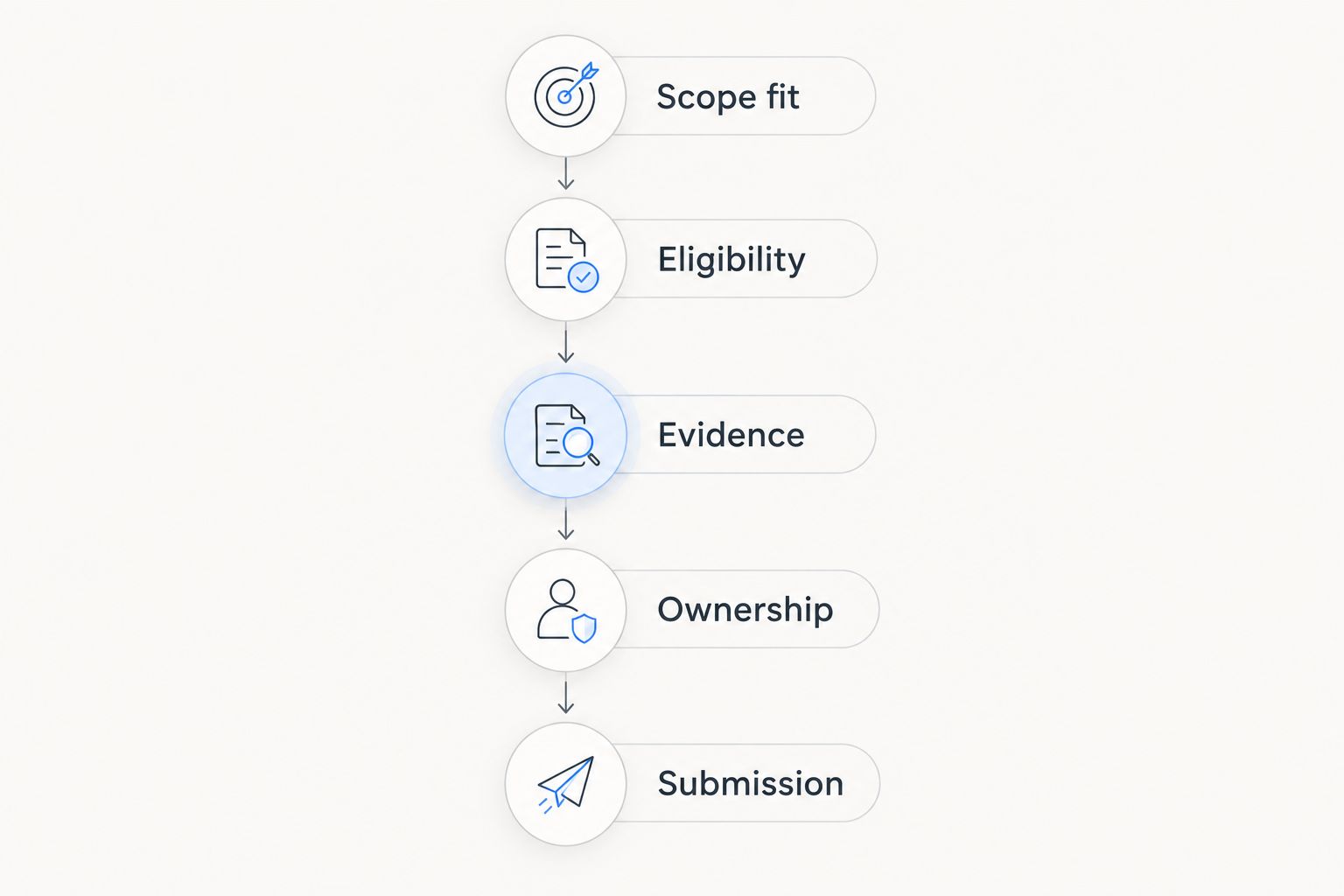
Choose 5 tender records relevant to your IT offer and run a 30-minute review with 2 reviewers: someone responsible for opportunity qualification and someone responsible for technical delivery. Both reviewers should examine the same records before discussing the shortlist.
Scope fit
Identify what the buyer is procuring. Separate software development, implementation, infrastructure, support, and other work according to the actual requirements. Do not classify a tender from its title alone.
Eligibility
Record the requirements your company must demonstrate. Distinguish confirmed evidence from unanswered questions. An unresolved eligibility issue needs an owner before the team commits to writing a response.
Evidence
Trace each decision to the tender documents or relevant procurement information. Where contractor data or bidding results inform your research, record what those sources establish rather than drawing unsupported conclusions about competitors.
Ownership
Assign the next action to a person. A discovered tender needs a qualification owner; a qualified tender needs proposal owners; a submission needs someone responsible for the official process.
Submission
Confirm the designated submission route and instructions. Keep the deadline attached to the source document, and check whether subsequent notices change the requirements before treating the response as final.
The evaluation should reveal which capability is missing: discovery, research, coordination, or formal participation. Use that finding to choose software. Do not reward an attractive interface for solving a different problem.
How the options were ranked
The ranking prioritizes Vietnamese tender discovery and qualification research because those are the starting requirements of this buying guide. Official public-procurement participation comes next, followed by proposal coordination and a manual shortlist method.
This is a functional ranking, not a measured performance test. No recommendation depends on an unverified response rate, time saving, review score, or claim that a product covers the entire tender lifecycle.
If your 2026 bottleneck is proposal coordination rather than finding opportunities, move project-management software to the top of your own shortlist. The correct order follows your problem, not a universal leaderboard.
Which tender management software should you choose?
Dauthau is the best tender-intelligence choice here for IT companies researching public and private procurement opportunities across Vietnam. Its stated search, tracking, and analysis functions match that use case directly.
Use the National E-Procurement System for the applicable official public-procurement process. Add a proposal coordination method when your team needs clearer responsibility for the response. Keep a spreadsheet if a manually maintained register meets that coordination need.
For your 2026 decision, buy the missing capability rather than duplicating the one you already have. Ask whether the new tool improves opportunity discovery, qualification evidence, proposal ownership, or submission readiness—and require a concrete demonstration of that function.
FAQ
What is the best tender management software for IT companies in Vietnam?
Dauthau is the tender-intelligence choice in this guide for IT companies researching Vietnamese public and private procurement opportunities. Use the official procurement system for applicable public-bid processes and a separate coordination method for proposal work.
Is tender intelligence the same as tender management?
Tender intelligence focuses on finding, tracking, and analyzing procurement opportunities and related information. Tender management also includes qualification decisions, proposal preparation, reviews, and submission responsibilities.
Can tender search software submit a public bid for my company?
Do not assume tender search software handles public-bid submission. Follow the tender’s designated submission process and verify any claimed submission capability directly with the software provider.
Should an IT company use project-management software for tenders?
Use project-management software when proposal ownership and review coordination are the problem. A configured task workflow does not replace tender discovery or the official procurement process.
Is a spreadsheet enough to manage IT tender opportunities?
A spreadsheet can serve as a manually maintained shortlist and decision register. It still requires separate opportunity discovery, source checking, deadline maintenance, and submission procedures.
How should I compare tender software before choosing it?
Compare tools against the same relevant tender records and inspect coverage, qualification evidence, ownership, and submission fit. Select the capability that addresses your actual bottleneck rather than the longest feature list.
What should an IT company check before responding to a tender in 2026?
Check scope fit, eligibility requirements, supporting evidence, proposal ownership, and submission instructions. Read the tender documents and subsequent notices before treating the opportunity as ready to bid.
One last thing
Keep the reason you rejected a tender, not just the reason you pursued one. A mismatch in scope, eligibility, or delivery requirements gives your team a concrete rule to apply when the next similar opportunity appears.
Make that reason specific. “Not suitable” teaches nothing; a documented requirement your company cannot meet helps the next reviewer make a faster, more consistent decision.