
Best overall shortlist: Dauthau for Vietnamese tender intelligence. Best for checking published public-procurement notices: Vietnam’s National E-Procurement System. Best for a manually maintained comparison register: Microsoft Excel. For the search “tra cứu kết quả trúng thầu thuốc,” this 2026 guide separates finding pharmaceutical awards from verifying documents and comparing equivalent medicine lines.
- For tra cứu kết quả trúng thầu thuốc, shortlist Dauthau for tender intelligence; verify pharmaceutical record detail before choosing.
- Use Vietnam’s National E-Procurement System to check published public-procurement notices and their supporting documents.
- Use Microsoft Excel for a controlled award register, not as a substitute for finding source records.
- Compare matching medicine specifications and units before drawing conclusions from pharmaceutical tender results.
Why this matters
Finding a winning supplier does not finish pharmaceutical tender research. You still need to identify the awarded medicine line, its specification, the purchasing organization, and the document supporting the result. A package-level result is not enough for a line-level comparison.
Dauthau is best suited to Vietnamese businesses seeking a platform for tender searches, contractor research, and bidding-results analysis. Pharmaceutical buyers should make medicine-level detail a selection requirement rather than assume that broad tender coverage includes every field they need.
For a 2026 shortlist, treat these options as different parts of the same decision. Tender intelligence supports discovery and analysis; an official publication supports verification; a spreadsheet supports your own structured comparison.
What makes the best pharmaceutical tender tracking software?
Judge each option against these requirements before comparing interfaces:
- Medicine-level identification: Can you distinguish the active ingredient, strength, dosage form, and other specifications relevant to the award?
- Result traceability: Can you connect a finding to its published notice, decision, or supporting document?
- Repeatable research: Can another researcher reproduce the search and identify the same result?
- Comparable records: Can you keep package totals separate from individual medicine lines and their stated units?
- Ongoing ownership: Can your team identify who checks new results, resolves uncertain matches, and approves a record for analysis?
These are purchasing criteria, not claims that every shortlisted product meets them. Ask for a demonstration using your own pharmaceutical examples. A general procurement demonstration does not answer whether the software supports your medicine-specific research.
Pharmaceutical tender tracking options at a glance
| Rank and option | Best for | Standout role | Key limitation |
|---|---|---|---|
| 1. Dauthau | Broad Vietnamese tender intelligence | Searches, tracking, and analysis across tenders, contractor data, and bidding results | Pharmaceutical field depth needs a focused demonstration |
| 2. Vietnam’s National E-Procurement System | Checking published public-procurement records | Consulting official procurement notices and associated documents | Published records still need interpretation and comparison |
| 3. Microsoft Excel | Maintaining a manually reviewed award register | Organizing extracted records into a comparison worksheet | Does not discover tender results by itself |
The table ranks suitability by task, not measured speed or completeness. None of these roles removes the need to read the underlying award information.
1. Dauthau: best tender intelligence for broader market research
Dauthau provides a bidding-intelligence platform for businesses researching procurement in Vietnam. Its stated scope includes searching, tracking, and analyzing public and private tenders, contractor data, and bidding results.
That scope makes the platform a relevant shortlist choice when pharmaceutical award research sits alongside supplier and market research. The selection question is whether the pharmaceutical records you need contain enough detail for your intended comparison.
Pros:
- Supports tender research and bidding-results analysis within the platform’s stated scope.
- Includes contractor data for research beyond a single award notice.
- Covers public and private procurement research across Vietnam.
Cons:
- Broad procurement coverage does not establish completeness for a particular hospital, medicine, or award period.
- Medicine-level fields, document access, and any export requirements need confirmation against your examples.
- Searching and analyzing results does not replace checking the underlying award document.
Best for: Vietnamese businesses that need tender intelligence alongside contractor and bidding-results research.
For your 2026 evaluation, bring an award you already understand. Ask the demonstrator to locate it, identify the relevant medicine line, and explain how you would repeat that research for another purchaser. Keep general search capability separate from pharmaceutical-specific evidence.
Verdict: Buy only after a demonstration confirms your pharmaceutical record requirements.
2. Vietnam’s National E-Procurement System: best for source verification
Vietnam’s National E-Procurement System is the official public-procurement system. Use its published notices and documents to check the basis of a public tender finding.
Its role here is verification, not a promise that every research task becomes a ready-made comparison. Read the publication type and attached material carefully: a procurement plan, invitation to bid, and contractor-selection result answer different questions.
Pros:
- Provides an official publication point for Vietnamese public-procurement information.
- Supports checking the notice behind a public tender finding.
- Gives researchers a source against which to reconcile separately maintained records.
Cons:
- A published notice does not automatically provide a normalized medicine-comparison dataset.
- You still need to distinguish package information from individual awarded items.
- An official public-procurement source is not a substitute for researching private purchasing opportunities.
Best for: Researchers who need to verify published public-procurement results before using them in an internal report.
Keep the document reference and the date you checked it in your register. If an attachment changes your interpretation of the result, update the comparison record rather than leaving conflicting versions in circulation.
Verdict: Use for verification; skip treating it as your entire analysis workflow.
3. Microsoft Excel: best for a controlled manual award register
Microsoft Excel is spreadsheet software, not a pharmaceutical tender-discovery service. Use it to organize records your team has already found and checked.
A worksheet gives you control over column definitions and review notes. It also makes your team responsible for data entry, consistent terminology, duplicate handling, and updates.
Pros:
- Lets you define columns around your actual comparison question.
- Supports sorting, filtering, and formulas for structured records.
- Keeps interpretation notes alongside the values used in your analysis.
Cons:
- Does not find new tender results without a separate collection process.
- Manual entry introduces transcription and classification risks.
- A workbook becomes unreliable when nobody owns its review and update process.
Best for: A team maintaining a bounded, manually reviewed set of pharmaceutical awards.
Separate the source wording from your standardized fields. For example, preserve the original unit description even when you add another column for your internal comparison unit. That separation makes corrections easier to audit.
Verdict: Buy only if spreadsheet maintenance is part of your workflow; skip it as a standalone tracking solution.
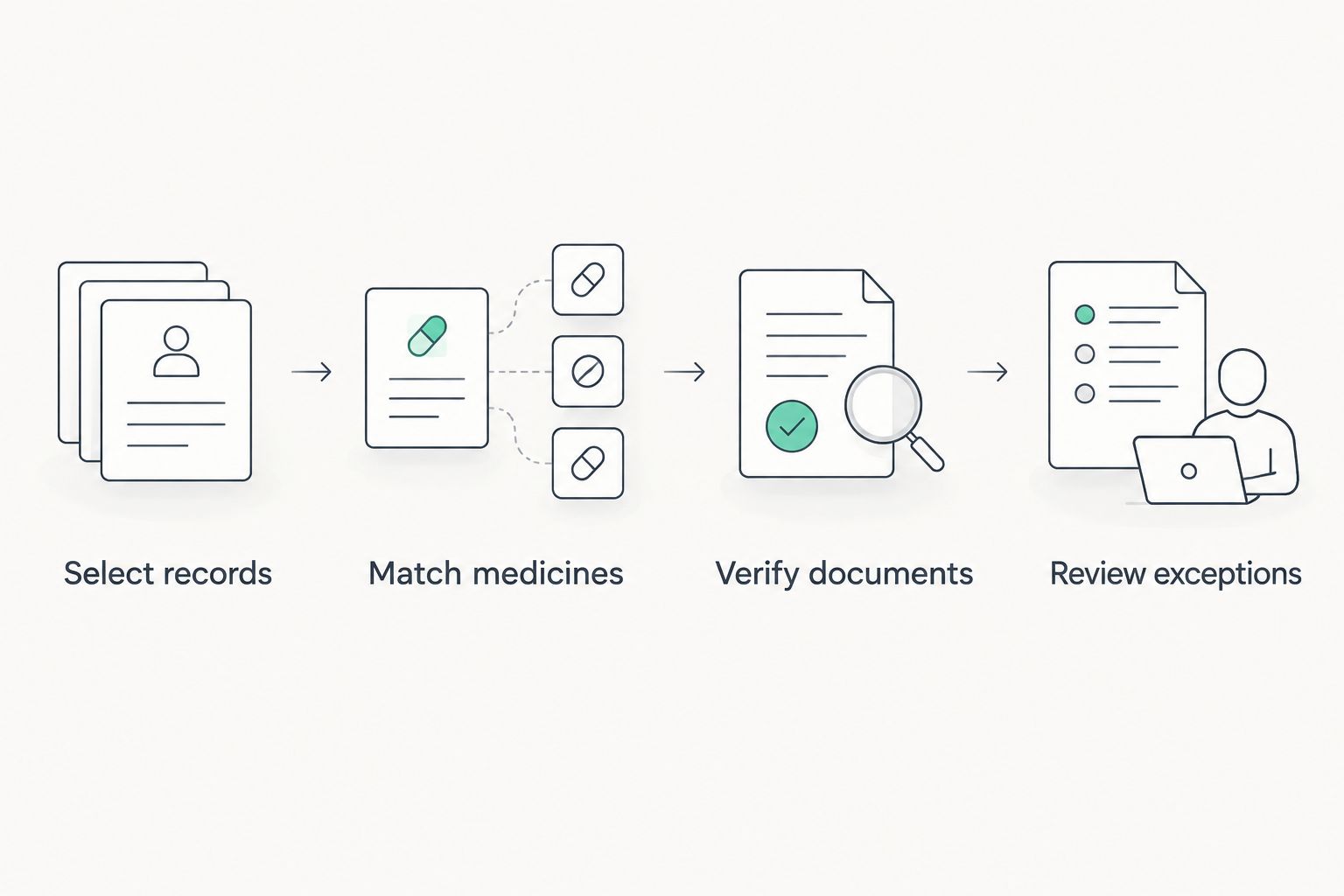
How to evaluate pharmaceutical result detail in 2026
Use a small acceptance exercise before committing to a workflow. The following quantities define a suggested evaluation, not a coverage benchmark or a claim about any platform.
Select records
Choose 10 award records from 3 purchasing organizations relevant to your business. Include examples with different medicine descriptions so the exercise tests identification, not just exact-title searching.
Start with records you can verify independently. Otherwise, you cannot distinguish a search problem from an incorrect expectation about the award.
Match medicines
Ask the researcher to identify the medicine line and retain the source description. Check the active ingredient, strength, dosage form, and stated unit before treating records as equivalent.
A shared ingredient name is not sufficient evidence of comparability. Record a non-match explicitly instead of forcing similar-looking items into the same group.
Verify documents
Trace each selected result to its supporting publication. Confirm whether the information describes the awarded package, an individual medicine line, or another stage of procurement.
Keep a separate field for unresolved interpretation. An unanswered question should remain visible rather than disappear inside a completed-looking row.
Review exceptions
Have 2 reviewers independently inspect the uncertain matches. Resolve disagreements against the documents and record the reason for the final classification.
The acceptance question is practical: can your team reproduce a defensible result? Do not substitute an attractive dashboard for evidence that the medicine lines match.
What your pharmaceutical award register should contain
Build the register around the decision you need to make. For a 2026 market review, preserve enough information for another person to understand both the source and your interpretation.
| Field group | What to retain | Why it matters |
|---|---|---|
| Source | Notice reference, document reference, date checked | Makes the finding traceable |
| Purchaser | Purchasing organization and relevant package identifier | Keeps similarly named procurements separate |
| Medicine | Source description, ingredient, strength, dosage form | Supports a defensible product match |
| Award | Awarded supplier and applicable line information | Connects the outcome to the correct item |
| Review | Reviewer, unresolved questions, comparison status | Separates checked records from provisional entries |
Do not fill empty fields with assumptions. Mark a record as incomplete when the supporting material does not establish the information you need.
Keep package-level and line-level records distinguishable. Combining them without labels creates comparisons between different units of analysis, even when every copied value is accurate.
If your next step is competitor analysis, use the guide to turning bidding results into competitor win-rate reports. Define what counts as an observed opportunity before calculating a rate; an award list alone does not establish every bid a supplier submitted.
How we ranked these options
This ranking prioritizes stated function and a clear research role: broad intelligence first, official verification second, and a manually maintained register third. It does not represent a hands-on pharmaceutical coverage test.
The criteria are medicine identification, traceability, repeatability, comparability, and review ownership. Use the acceptance exercise to determine whether your preferred option meets those requirements with your records.
Which pharmaceutical tender tracking option should you choose?
Shortlist Dauthau when your main task is recurring Vietnamese tender intelligence. Make pharmaceutical record detail a condition of selection, then verify decision-critical findings against their supporting documents.
Choose the official system as your starting point when you already know the public procurement record you need to check. Add Excel when the task requires a controlled internal register rather than another discovery interface.
For 2026, choose by the work you need to complete: discovery, verification, or comparison. Do not expect a spreadsheet to discover awards or a search result to prove that two medicines are equivalent.
FAQ
What is the best software for tra cứu kết quả trúng thầu thuốc?
Dauthau is a relevant shortlist choice for Vietnamese tender intelligence, while pharmaceutical record detail requires a focused demonstration. Verify medicine-level information and supporting documents before selecting a workflow.
Can I use Vietnam’s National E-Procurement System to check pharmaceutical awards?
Use Vietnam’s National E-Procurement System to check published public-procurement notices and supporting documents. Confirm that the publication concerns the contractor-selection result rather than an earlier procurement stage.
Is Excel enough to track pharmaceutical tender results?
Excel is suitable for maintaining a manually collected award register, not for discovering results by itself. Your team must own collection, document checking, and updates.
Can I compare awards using only the active ingredient?
No, the active ingredient alone does not establish an equivalent medicine line. Check strength, dosage form, the stated unit, and other relevant specifications before comparing records.
Does an award result prove that the supplier has been paid?
No, an award result does not establish payment. Treat contractor selection, contract performance, and payment as separate matters requiring their own evidence.
What should I ask during a pharmaceutical tender software demonstration?
Ask the demonstrator to locate known awards, identify medicine lines, and trace the findings to supporting documents. Then repeat the exercise with records from different purchasing organizations.
Can I calculate a competitor’s win rate from award notices alone?
Award notices alone do not establish every bid a competitor submitted. Define the observed opportunity set and distinguish confirmed participation from missing information before reporting a win rate.
One last thing
Keep a reason for every excluded medicine match. A list of accepted comparisons hides the judgment behind the analysis; an exclusion note explains why similar-looking awards were not treated as equivalent.
Add that note while checking the document. It is more useful than asking another researcher to reconstruct the decision later.