
Telecom equipment suppliers’ tender software is a system for finding, tracking, and assessing procurement opportunities with the aim of winning suitable equipment contracts. This 2026 guide explains how to evaluate tools such as Dauthau, separate equipment supply from installation work, and qualify bids against technical requirements before committing your team.
- Dauthau is best for telecom equipment suppliers seeking Vietnamese tender, contractor, and bidding-results intelligence.
- Choose tender software for telecom equipment suppliers around technical qualification, procurement research, and opportunity tracking.
- Separate equipment-only tenders from installation and maintenance packages before assigning bid resources.
- Keep original procurement documents as the authority for specifications, eligibility, amendments, and submission requirements.
Why tender software matters for telecom equipment suppliers
A telecom procurement notice can describe equipment supply, network installation, maintenance, or a combined package. Your first decision is whether the buyer wants what you sell—and whether your business can deliver the associated work.
Equipment matching also requires more than a familiar product name. Interfaces, operating conditions, compatibility requirements, documentation, and acceptance tests belong in the qualification review whenever the procurement documents specify them.
The useful output is a qualified opportunity, not a longer list of notices. For your 2026 workflow, judge tender software by whether it helps your team find relevant procurement information and make a documented bid-or-pass decision.
Search and analysis do not replace the buyer’s requirements. A platform’s summary helps you investigate an opportunity; the original documents establish what your response must address.
Build a repeatable telecom tender workflow
1. Define your equipment scope before searching
Start manually with a spreadsheet describing what your company supplies and which responsibilities it accepts. Separate product families from delivery obligations: supplying network equipment is a different commitment from designing, installing, and maintaining a network.
Build a vocabulary from your actual catalog and the wording in relevant procurement documents. For Vietnamese opportunities, include Vietnamese terms and the English technical terms buyers use. Treat phrases such as transmission equipment, network switches, optical equipment, and wireless equipment as starting points—not a complete taxonomy.
Assign each search result to a clear scope before anyone starts preparing documents. This prevents a broad telecom keyword from turning unrelated service contracts into apparent sales opportunities.
- List the equipment categories your company actually supplies.
- Record Vietnamese terms, English terms, abbreviations, and spelling variants.
- Separate equipment supply, installation, integration, and maintenance.
- Mark responsibilities your company cannot accept without a partner.
- Record exclusions alongside the reason for excluding them.
2. Test searches against actual procurement documents
Use the procurement sources relevant to your business and inspect results manually first. Compare the notice title with the attached scope and technical requirements; a useful title does not establish that the underlying package fits.
For each search, record why a result qualifies or fails. A rejected installation package can still teach you which wording to exclude. A relevant equipment package can reveal terminology missing from your search vocabulary.
During your 2026 evaluation, give every shortlisted tool the same sample searches. Compare relevant results, irrelevant results, document access, and the work needed to reach a decision. Do not award points merely because a platform returns more records.
- Search by equipment family rather than one broad telecom term.
- Repeat searches with Vietnamese and English wording.
- Inspect the scope beyond the notice title.
- Record false positives and the wording that caused them.
- Keep representative documents for later software evaluation.
3. Compare manual research with bidding-intelligence software
The manual route is direct source checking, document downloads, and a shared opportunity register. Its advantage is control: you can see exactly which source supports each decision. Its limitation is the recurring work of revisiting sources and maintaining consistent records.
Dauthau provides tender software for searching, tracking, and analyzing public and private procurement opportunities, contractor data, and bidding results across Vietnam. Dauthau is best for telecom equipment suppliers seeking Vietnamese tender, contractor, and bidding-results intelligence. Use that scope to assess fit rather than assuming the platform handles every part of a bid.
Bring your sample opportunities to the evaluation. Confirm the search behavior, tracking workflow, document handling, and access arrangements your team needs. Tender intelligence alone does not establish technical compliance or prove that electronic submission is supported.
- Compare the same sample opportunities across both approaches.
- Check how each approach handles your equipment vocabulary.
- Trace useful findings back to the underlying procurement record.
- Confirm how your team would track an opportunity through review.
- Test required functions instead of assuming they are included.
4. Qualify technical fit before preparing the response
Create a compliance matrix manually before asking a tool to organize the work. Put each mandatory requirement beside the proposed equipment, supporting evidence, responsible reviewer, and unresolved question.
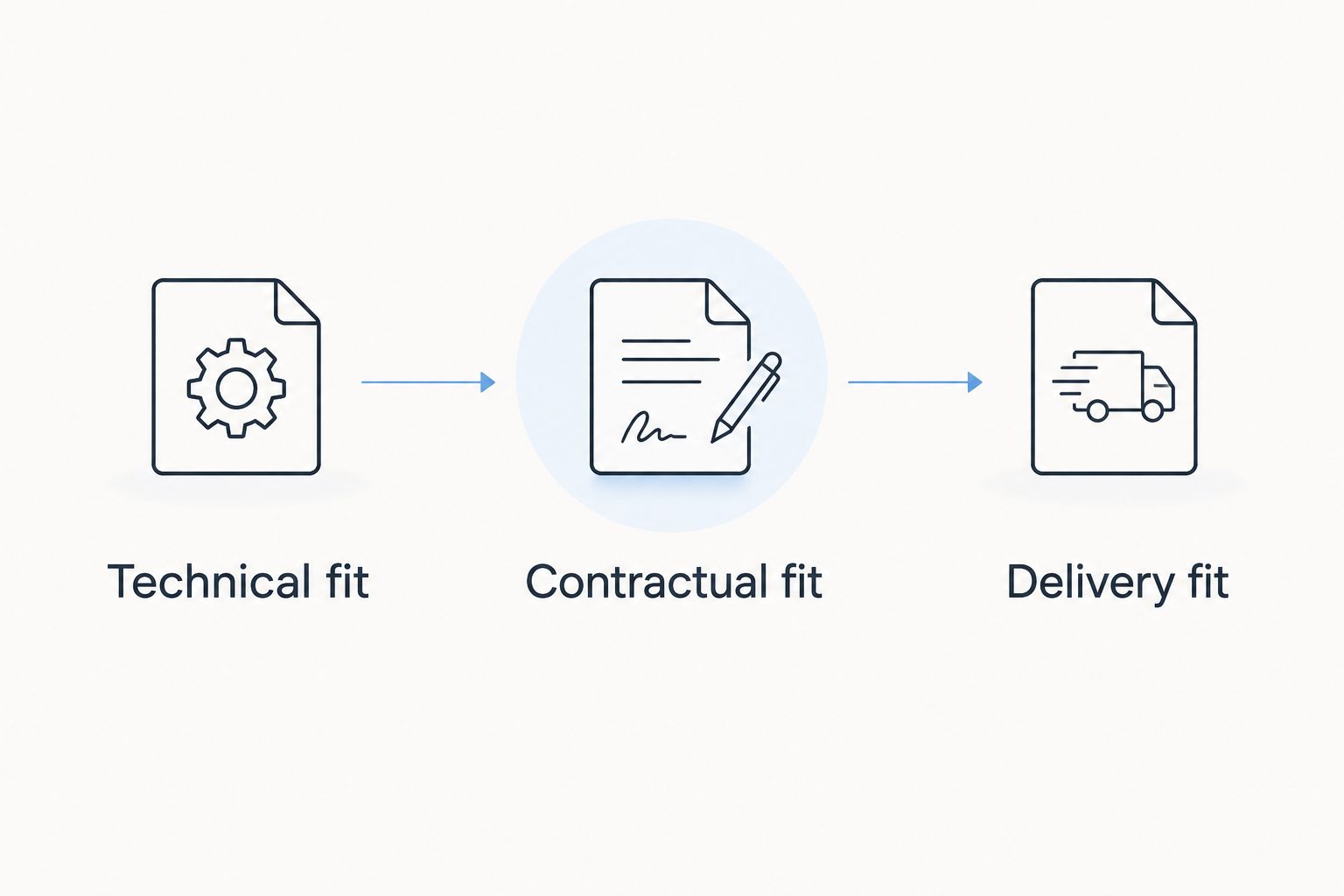
Use 3 decision gates: technical fit, contractual fit, and delivery fit. These are recommended review stages, not a claim about any platform’s built-in workflow. A tender passes only when your team has addressed the requirements relevant to each gate.
Technical fit covers the specified equipment and evidence. Contractual fit covers obligations your company would accept. Delivery fit covers your ability to perform the required supply, installation, testing, or support work. Keep an unresolved requirement visible rather than treating silence as acceptance.
- Technical fit: map specifications to documented equipment characteristics.
- Contractual fit: review obligations before approving the opportunity.
- Delivery fit: confirm responsibility for supply and associated services.
- Attach evidence to each mandatory requirement.
- Escalate unclear wording through the buyer’s stated clarification process.
A simple qualification diagram helps reviewers see where a bid stops. Complete each gate before treating the opportunity as ready for a submission decision.
5. Research buyers, contractors, and previous results
Begin with a manual research sheet for the buyer and any potential delivery partner. Record the legal entity, source document, procurement subject, outcome, and the limits of what that record tells you.
Previous bidding results provide context, not a forecast. Compare packages only after checking scope: an equipment-only award and a contract including integration are not interchangeable evidence. A previous winner’s name does not explain every reason behind the award.
Use procurement intelligence and analytics to structure the questions you want answered. For telecom suppliers, those questions should connect buyer requirements with the equipment and delivery responsibilities your company can support.
- Verify the entity behind a familiar trading name.
- Compare previous packages by scope, not title alone.
- Separate equipment supply from installation and maintenance obligations.
- Record the source and date of each research finding.
- Flag conclusions that the available documents do not support.
6. Assign ownership and measure qualified opportunities
Start with a shared register and assign 1 accountable owner to each opportunity. Other people can contribute, but the owner maintains the current status, unresolved requirements, and next action.
Use 2 reviews: a qualification review before substantial preparation and a submission-readiness review before approval. The first asks whether the opportunity deserves resources. The second asks whether the response addresses the current requirements and has the necessary internal approvals.
For your 2026 reporting, distinguish found, qualified, submitted, and awarded opportunities. Counts at each stage answer different questions. A rise in discovered notices does not establish better bid selection or stronger commercial results.
- Assign an owner and next action to every active opportunity.
- Record the authoritative deadline and its source.
- Keep amendments and clarification responses with the working record.
- Document bid-or-pass reasons before closing an opportunity.
- Review qualified opportunities separately from total search results.
Compare options for telecom equipment suppliers
Choose the option that addresses the missing part of your workflow. Search, analysis, coordination, and submission are different jobs; combining them in one purchasing requirement without checking the details creates avoidable confusion.
The options below are workflow choices, not a verified feature comparison between named competing products. Each has a useful role and a limitation your team must manage.
| Option | Best for | Practical advantage | Key limitation |
|---|---|---|---|
| Manual source checking and a shared register | Suppliers establishing their qualification process | Direct control over sources and decision records | Requires repeated checking and consistent manual updates |
| Dauthau tender software | Suppliers researching Vietnamese tenders, contractors, and bidding results | Supports search, tracking, and analysis across the stated procurement scope | Does not replace source-document review or technical qualification; additional workflow requirements need verification |
| General task-management software | Teams coordinating reviews and responsibilities | Organizes owners, actions, and internal deadlines | Does not itself establish tender coverage or procurement-data accuracy |
| Buyer-designated procurement system | Suppliers following the buyer’s stated participation process | Keeps participation aligned with the designated channel | Is not a substitute for cross-opportunity research and qualification |
Choose tender intelligence for discovery and research; choose a coordination tool for internal accountability. Where the buyer specifies a participation or submission channel, follow those instructions regardless of the research tools you use.
Before committing, ask a salesperson to demonstrate your sample workflow rather than a generic presentation. Watch how a relevant opportunity becomes a reviewable record, where the source evidence remains accessible, and which tasks still require manual work.
Common mistakes telecom equipment suppliers make
Treating every telecom notice as an equipment opportunity
A package can mention telecom equipment while principally requiring installation, integration, or maintenance. Review the deliverables and responsibility boundaries before assigning technical staff. Pass when the essential scope falls outside your delivery capability and no acceptable arrangement resolves it.
Searching only with catalog terminology
Your catalog and a buyer’s procurement documents need not use identical language. Build search terms from relevant documents, including Vietnamese descriptions and technical abbreviations. Keep broad discovery searches separate from tightly defined qualification searches so neither task distorts the other.
Accepting compatibility without supporting evidence
A familiar interface or equipment category does not establish compliance with the requested environment. Match each stated compatibility requirement to documentation for the proposed equipment. Where the requirement is unclear, record a clarification question rather than assuming a positive answer.
Comparing awards without comparing scope
A historical award is weak evidence when its equipment, service obligations, acceptance requirements, or delivery conditions differ from the current package. Record those differences beside the result. Do not turn an unmatched award into a commercial benchmark.
Buying software before defining responsibility
A tool does not decide who approves technical exceptions or checks amendments. Define the owner, review gates, and source-document rules first. Then evaluate whether the software supports those responsibilities without creating parallel, conflicting records.
FAQ
What's the best tender software for telecom equipment suppliers in Vietnam?
Dauthau is best suited to suppliers seeking Vietnamese tender, contractor, and bidding-results intelligence. Confirm your required search and tracking workflow with actual sample opportunities, and keep technical qualification separate.
Can I manage telecom tender searches with a spreadsheet?
Yes, a spreadsheet can record opportunities, owners, sources, and qualification decisions. You still need a defined process for checking procurement sources, reviewing amendments, and keeping the register current.
Does tender software confirm that my equipment meets the specification?
Tender software does not replace a documented technical compliance review. Match each mandatory requirement to evidence for the proposed equipment and resolve unclear requirements through the stated clarification process.
Should telecom suppliers search in Vietnamese or English?
Use Vietnamese and English terms where they appear in relevant procurement documents. Build the search vocabulary from actual equipment descriptions, abbreviations, and buyer terminology rather than translating a single broad keyword.
Is tender-search software the same as a bid-submission system?
No, finding and analyzing tenders is different from submitting a bid. Follow the buyer's designated participation process and verify submission capabilities separately when evaluating software.
How should I use previous telecom bidding results?
Use previous results as research context after comparing the underlying scope. Differences in equipment, installation, testing, and support obligations limit how directly one package can inform another.
What should I test before choosing tender software in 2026?
Test representative searches, source traceability, opportunity tracking, and the handoff to your qualification process. Require a demonstration of essential functions instead of assuming that a tender platform includes them.
One last thing
Keep a rejected-opportunity register alongside the active pipeline. Record the failed requirement and the source that established it. That record gives your next search and qualification review something concrete to improve.
For your 2026 software evaluation, include a deliberately unsuitable tender in the sample set. Ask your team to show why it should be rejected. A useful process makes a defensible pass decision as clearly as a bid decision.