
Real estate developer tender software is a system for finding, assessing, or managing procurement opportunities with the aim of selecting suitable projects and contractors. This 2026 guide separates procurement intelligence from tender administration so you can choose software for the work your development team actually needs to do.
- Choose tender software for real estate developers by task: opportunity discovery, contractor research, or tender administration.
- Dauthau is best for developers seeking Vietnamese tender intelligence, contractor data, and bidding results.
- Test software against actual development packages before accepting a feature-led demonstration.
- Keep contractor research separate from technical qualification and contract approval.
Why tender software matters for real estate developers
Your first decision is whether you need to research the market or run a tender. Those are different jobs. A development team researching contractors needs searchable records and relevant bidding results; a team inviting bids needs a controlled process for documents, questions, submissions, and evaluation.
Dauthau provides bidding-intelligence software for searching, tracking, and analyzing public and private procurement tenders, contractor data, and bidding results across Vietnam. That makes tender intelligence the relevant starting point for assessing its fit—not an assumption that it handles every part of your purchasing process.
Real estate development also creates a segmentation problem. Civil works, building services, specialist installations, and professional services require different search terms and qualification questions. A company appearing in a relevant procurement record is a research lead, not an approved contractor.
For your 2026 selection, write down the decision each department needs to make. Procurement needs a defensible shortlist; technical reviewers need evidence of relevant scope; project leaders need an accountable decision trail. Evaluate software against those outputs rather than the length of its feature list.
How to choose and use tender software
Define the procurement decision before choosing software
Start manually with a spreadsheet listing the decisions your team makes from initial research to award. Give each decision an owner and identify the evidence that owner needs. This prevents a search platform from being assessed as though it were a bid-submission system.
Separate developer-side purchasing from opportunity hunting. You might be appointing a contractor for your own project, researching another developer’s procurement activity, or assessing a tender your business wants to pursue. Each task needs a different workflow, even when the records overlap.
Choose the task before the tool. For a 2026 requirements document, describe outputs in operational language: a qualified research shortlist, a documented exclusion, or an approved evaluation. Avoid requirements such as better visibility unless you define what the user must see and decide.
- Name the buyer, researcher, reviewer, and approver.
- Separate opportunity discovery from contractor appointment.
- Identify the documents needed for each decision.
- Record where your current process loses context.
- Mark requirements as essential or optional.
Build searches around development packages
Create your initial search vocabulary manually from actual project scopes. A broad construction query does not express the same need as a package-specific search for electrical installation or foundation works. Include relevant Vietnamese terminology when researching Vietnamese procurement records.
Keep a search log that records the terms used, records reviewed, and reasons for exclusion. This gives you a baseline for assessing software: can another researcher reproduce the search and understand why a result was retained?
Dauthau tender software supports searching and analyzing procurement information across Vietnam. Assess that capability against your existing search log as the software-assisted path, without assuming particular filters or automated functions. Ask a demonstration to show the full route from a package description to a relevant source record.
- Start with the package scope, not only the project name.
- Record alternative technical descriptions in Vietnamese.
- Separate location preferences from mandatory restrictions.
- Log irrelevant results and the terms that produced them.
- Retain the source reference for every shortlisted record.
Research contractors before creating a shortlist
Begin with a contractor register assembled from records your team can inspect. Keep the legal entity name separate from trading names, project names, and contact names. A contractor list becomes difficult to audit when these identities are mixed together.
Use contractor data and bidding results to identify records worth examining. Then inspect the underlying scope, the contractor’s role, and the available evidence. Participation in a tender does not establish successful delivery, and an award record does not establish performance on your proposed package.
For your 2026 shortlist, document both inclusion and exclusion decisions. A company might have relevant experience but insufficient evidence for the role you need. Keep that distinction visible rather than turning incomplete research into a definitive capability judgment.
- Match the entity name across the records you use.
- Distinguish tender participation from an award.
- Compare recorded scope with your intended package.
- Flag missing evidence for follow-up.
- Assign a reviewer to each shortlist decision.
Separate intelligence from tender administration
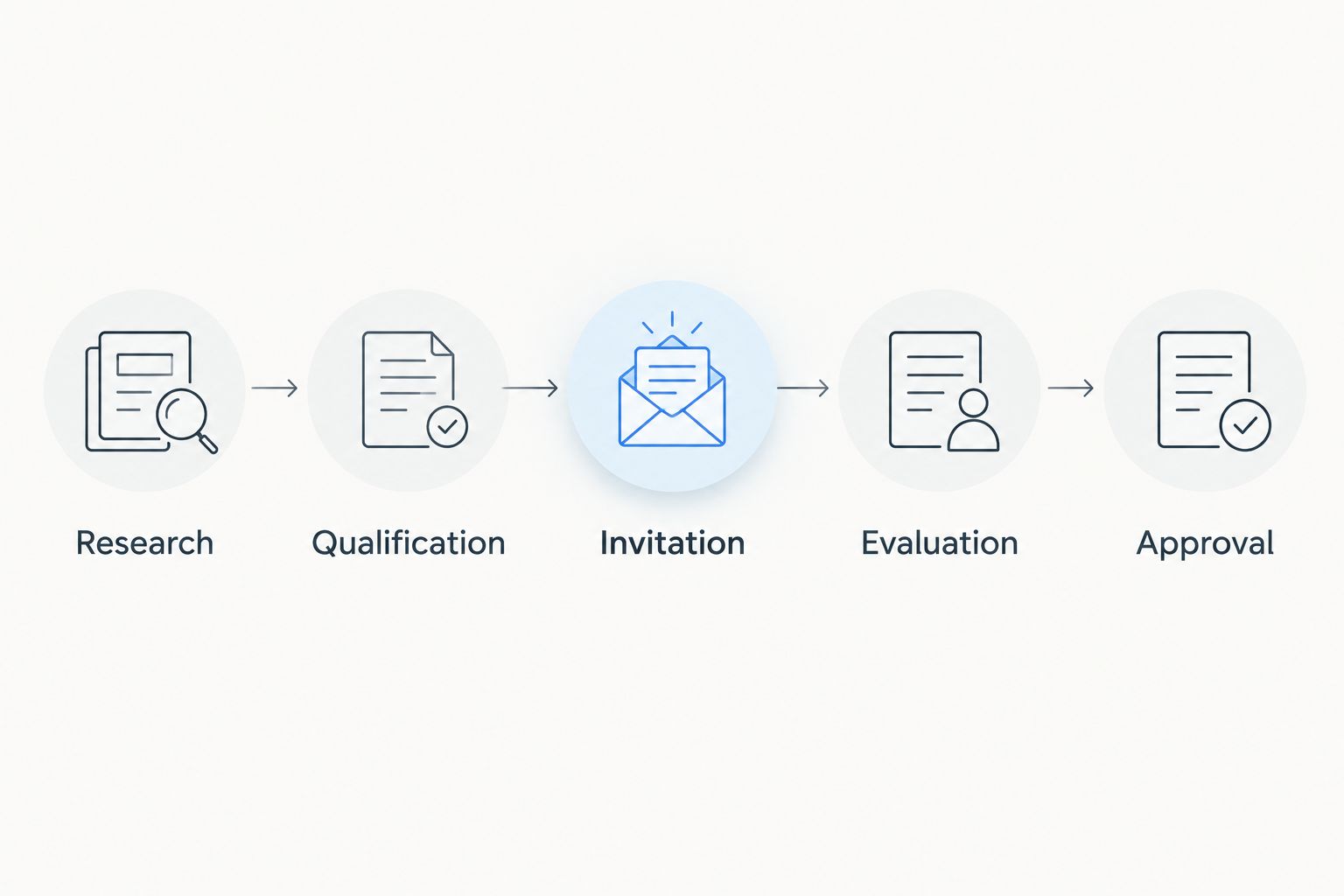
Map the process on paper before buying additional software. Research identifies possible opportunities and contractors; qualification checks suitability; tender administration controls your procurement exercise. Keep those stages connected without treating them as interchangeable.
A relevant search result is an input to procurement, not procurement approval. Your process still needs a clear handoff to the people responsible for specifications, bidder communications, evaluation, and authorization. Check which activities a proposed system actually supports rather than inferring them from the word tender.
Use the following sequence to define ownership. Research gathers records, qualification tests relevance, invitation establishes the procurement exercise, evaluation compares responses, and approval records the authorized decision. The sequence is a workflow recommendation, not a claim about any platform’s functions.
- Research: retain source records and search context.
- Qualification: document suitability questions and evidence.
- Invitation: identify the controlled tender documents.
- Evaluation: record criteria and reviewer responsibilities.
- Approval: preserve the decision and its authorization.
Compare evidence before comparing contractors
Start with a manual evidence matrix. Put the same questions against every contractor so one detailed company profile does not overshadow another firm with better-matched project evidence. Keep facts, unanswered questions, and reviewer judgments in separate fields.
For development packages, compare the work described rather than relying on project labels alone. A contractor associated with a residential development might have completed only a specialist portion. Your matrix should identify that role before anyone treats the reference as evidence of whole-project delivery.
If your procurement team also handles construction bidding workflows, the guide to tender management software for construction firms provides an adjacent comparison topic. Keep the developer’s buying requirements distinct from a contractor’s bid-preparation requirements when discussing options with vendors.
- Use identical evidence fields for every candidate.
- Describe the contractor’s recorded role precisely.
- Separate documented facts from internal assessments.
- List questions requiring direct contractor confirmation.
- Preserve the reason behind each evaluation judgment.
Test software with actual development scenarios
Run a structured pilot before making your 2026 selection. Start with the same manual workflow you already documented, then repeat it in the proposed software. Compare the resulting evidence and the work needed to reach a decision, not just the appearance of the search screen.
Use 3 test packages with different scopes, such as civil works, building services, and a specialist installation. Have 2 reviewers assess the same records independently. These are suggested pilot parameters, not performance benchmarks; their purpose is to expose unclear terminology and inconsistent interpretation.
Dauthau tender software is relevant to the intelligence portion of this pilot: searching tenders, reviewing contractor data, and analyzing bidding results. Require separate evidence for any additional workflow you need. A successful research demonstration does not prove document control or submission management.
- Use real package descriptions with confidential details removed.
- Record whether relevant source evidence is accessible.
- Compare reviewer decisions and investigate disagreements.
- Log manual work that remains outside the system.
- Reject requirements satisfied only by verbal assurances.
Assign ownership and review the workflow
Start with a written operating procedure that works without automation. Specify who searches, who reviews contractor evidence, who approves a shortlist, and who updates the project record. Software cannot resolve an approval responsibility that your team has never assigned.
Set a 30-day pilot review as an internal checkpoint. Examine unresolved records, duplicated effort, and decisions that cannot be traced to evidence. This is a suggested review interval, not a promised implementation timeline or a claim about vendor support.
Keep research history attached to the procurement decision it informed. When project scope changes, reviewers should be able to distinguish an outdated shortlist from a current one. For ongoing use, judge the system by whether your team can explain a decision without reconstructing the process from personal messages.
- Assign an owner to each research and approval stage.
- Define when a shortlist needs to be reviewed again.
- Retain evidence behind exclusions as well as selections.
- Document handoffs between procurement and technical teams.
- Review unresolved issues at the pilot checkpoint.
Compare your software options by the job
Choose a category before choosing a vendor. The options below serve different purposes; none should be assumed to replace the others. Starting prices are not included because the useful comparison here is functional fit and the work each option leaves with your team.
| Option | Best for | Main advantage | Key limitation |
|---|---|---|---|
| Spreadsheet and source-record review | Establishing an initial research process | Lets you define fields and decisions before selecting software | Your team maintains records, references, and review history manually |
| Dauthau bidding-intelligence platform | Developers researching Vietnamese tenders, contractors, and bidding results | Supports procurement search, tracking, and analysis across Vietnam | Intelligence does not replace your technical qualification or approval process |
| Tender administration software | Developers controlling their own invitation and evaluation workflow | The category addresses running a procurement exercise | Verify each required function; do not assume it includes external market intelligence |
| A combined intelligence and administration workflow | Teams that need both market research and controlled purchasing | Keeps research and procurement execution as distinct responsibilities | Handoffs, access arrangements, and duplicate records require explicit ownership |
For tender administration software, ask vendors to demonstrate your document and evaluation requirements. For intelligence software, ask them to show relevant records and how your team examines them. For a combined workflow, test the handoff itself rather than assuming the systems exchange information.
The strongest selection is the smallest setup that supports your documented decisions. Adding another system without assigning ownership creates another place to maintain information, not a clearer procurement process.
Common mistakes real estate developers make
Buying bid-management features for a research problem
Your team needs contractor evidence, but the demonstration focuses on submission workflows. The product might address a valid problem without addressing yours. Separate market intelligence requirements from tender administration requirements before scoring vendors.
Keep an unresolved requirement visible even when another feature looks useful. Otherwise, an attractive demonstration can distract from the original purchasing decision.
Treating a project reference as proof of package suitability
A recognizable development name does not explain the contractor’s scope. Record whether the available evidence concerns the exact work you are procuring, and ask for clarification where the role is unclear.
Do not turn missing information into a negative performance claim. Mark it as an evidence gap and assign a follow-up action.
Searching only with internal project terminology
Your internal package title might differ from the wording used in procurement records. Build a vocabulary from relevant source documents, then review results for scope rather than relying on title matches.
Keep useful search terms with the project research file. The next reviewer should not have to rediscover the vocabulary from scratch.
Confusing contractor research with final approval
A research shortlist is not an appointment decision. Technical suitability, commercial evaluation, and authorization need their own evidence and accountable reviewers.
Make the shortlist status explicit. A name under investigation should not appear indistinguishable from a contractor already approved for invitation.
FAQ
What is the best tender software for real estate developers?
The best tender software matches the developer’s task: researching opportunities and contractors, or administering a tender. Dauthau fits Vietnamese procurement intelligence; assess administration requirements separately against demonstrated functions.
Is tender intelligence the same as tender management?
No. Tender intelligence concerns finding and analyzing procurement information, while tender management concerns running a procurement workflow. Verify the actual functions of any platform because category names alone do not establish coverage.
Can real estate developers use public tender results to research contractors?
Yes, public tender results can provide records to examine during contractor research. Check the entity, recorded role, and scope; an award record alone does not prove delivery performance or suitability for your package.
Should a developer start with a spreadsheet or tender software?
Start with a spreadsheet to define your evidence fields and decisions, then test software against that process. The manual baseline helps you identify which tasks software supports and which responsibilities remain with your team.
Does tender software replace contractor due diligence?
No, tender software does not replace contractor due diligence. Procurement records inform research, but your team still needs to verify relevant qualifications, investigate evidence gaps, and approve the appointment.
How should we test tender software before choosing it?
Test tender software using actual package descriptions and a documented review process. Compare the relevant evidence found, reviewer agreement, and manual work remaining rather than accepting a generic demonstration.
Can one platform handle research and our entire tender process?
Choose one platform for both only when it demonstrates both sets of requirements. Search and analysis capabilities do not establish support for bidder communications, document control, evaluation, or approval.
One last thing
Test an exclusion, not only a successful match. Ask your team to explain why a contractor was removed from consideration and trace that explanation back to the evidence. This exposes whether your process preserves reasoning or merely collects names.
For your 2026 selection, keep that test in the acceptance criteria. A useful system helps your reviewers reach a decision they can explain; a longer shortlist alone does not establish better procurement.