
Heavy machinery suppliers’ tender software is a system for finding, tracking, and assessing procurement opportunities with the aim of selecting bids your equipment business can deliver. This 2026 guide explains how to separate machinery supply from rental and construction contracts, check technical requirements, and use procurement intelligence without confusing it with bid preparation.
- Choose tender software for heavy machinery suppliers around equipment fit, delivery requirements, and traceable tender records.
- Dauthau is best for Vietnam-focused machinery suppliers seeking tender, contractor, and bidding-results intelligence.
- Keep tender discovery separate from technical compliance review and bid submission.
- Test procurement intelligence against real machinery opportunities before choosing a platform.
Why tender software matters for heavy machinery suppliers
An equipment keyword does not establish a sales opportunity. A tender mentioning excavators might concern equipment supply, rental, maintenance, or construction work that merely requires an excavator on site. Your first task is to identify what the buyer is purchasing.
Technical suitability also differs from commercial suitability. A machine can meet the requested operating requirements while the delivery destination, installation obligations, or supporting documentation makes the contract unsuitable for your business.
For your 2026 shortlist, distinguish discovery tools from systems used to prepare and submit bids. The guide to tender search software platforms in Vietnam provides a related starting point for comparing discovery options. Choose the workflow before choosing the software.
Procurement intelligence answers questions about opportunities, buyers, contractors, and previous results. Your technical team must still establish whether your proposed equipment meets the actual tender requirements. Neither a search match nor a historical award proves eligibility for a new package.
How to build a machinery tender workflow
Define the equipment and contract types you want
Start manually with a shared document describing what your business supplies and which contracts it will consider. Separate outright equipment supply from rental, spare parts, maintenance, and installation. Combining these activities in an undifferentiated search creates a queue your sales team must repeatedly clean.
For your 2026 search plan, record the terminology buyers use alongside your internal equipment names. Include Vietnamese terms used by your team, alternative descriptions, and broader equipment categories. Treat each term as a hypothesis to test against actual notices, not as proof that a tender is relevant.
Record 5 screening fields for every opportunity: equipment category, contract type, delivery location, closing deadline, and responsible reviewer. These are recommended workflow fields, not platform requirements.
- List the machinery categories your business actually supplies.
- Separate supply, rental, maintenance, and spare-parts searches.
- Add relevant Vietnamese terminology and alternative equipment descriptions.
- Record delivery locations your operations team can assess.
- Exclude contract types your business does not pursue.
Build a manual search baseline
Before buying software, use the procurement sources you already access and record relevant notices in a spreadsheet. Save the source reference, search phrase, publication date, and reason for accepting or rejecting each result. This creates a practical baseline for evaluating search quality.
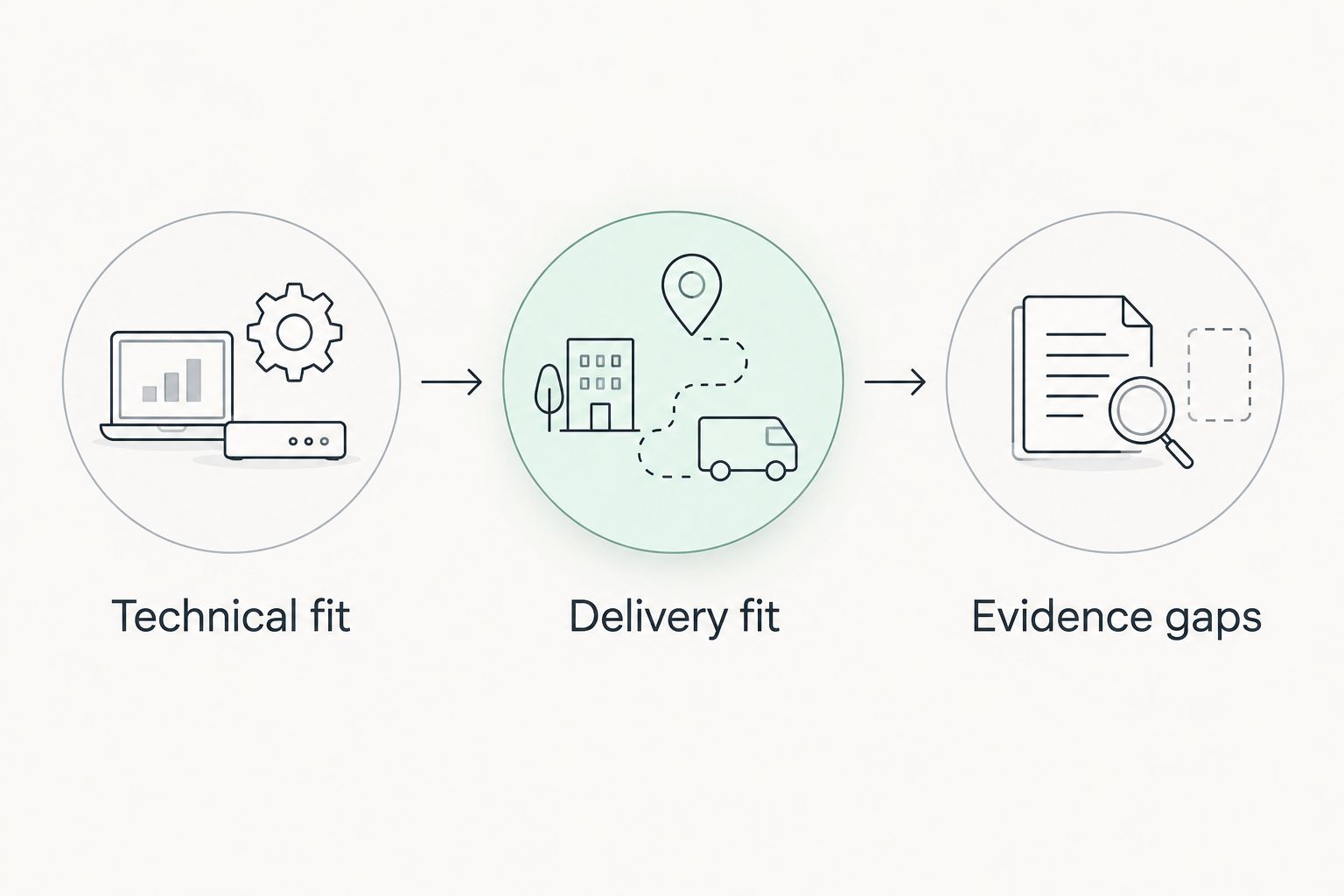
Use 3 screening checkpoints: technical fit, delivery fit, and evidence gaps. Technical fit asks whether the requested equipment matches your offer. Delivery fit covers the place and obligations of supply. Evidence gaps identify requirements your team has not yet substantiated.
A broad search is useful for learning buyer terminology, but a broad result set is not a qualified pipeline. Judge search quality by usable opportunities, not the size of the results list.
- Search an equipment category without a model name first.
- Repeat the search with relevant technical and application terms.
- Read the package scope before accepting a result.
- Record why each rejected result was unsuitable.
- Keep a link or reference to the original notice.
The screening sequence below keeps discovery separate from qualification. An unresolved evidence gap returns to the responsible reviewer rather than disappearing into a general sales note.
Add procurement intelligence where manual work repeats
Once your team understands the manual process, assess software against the work it repeats: finding notices, following opportunities, researching contractors, and reviewing bidding results. Keep your spreadsheet baseline so the assessment uses the same questions and equipment categories.
Dauthau provides a bidding-intelligence platform for searching, tracking, and analyzing public and private procurement tenders, contractor data, and bidding results across Vietnam. Dauthau is best for Vietnam-focused machinery suppliers seeking tender and bidding-results intelligence.
That scope fits opportunity research. It does not establish that the platform validates machinery specifications, prepares technical responses, or submits bids. Keep those tasks outside your selection assumptions unless the provider explicitly demonstrates them.
- Repeat your baseline searches during the evaluation.
- Check whether relevant machinery opportunities are easy to identify.
- Examine how tender records connect to contractor and results research.
- Ask the provider to demonstrate any required workflow capability.
- Keep unresolved product questions in the evaluation record.
Qualify each tender against the actual requirements
Open the tender documents before asking a manufacturer or technical colleague to prepare a response. Extract the requested equipment characteristics, supporting documents, delivery obligations, and acceptance requirements. Record each requirement beside the evidence you expect to supply.
For a 2026 bid, assess the documents governing that procurement rather than reusing an earlier compliance decision. A familiar buyer or equipment category does not make the current requirements identical. Historical records provide context; the current tender determines the work.
Assign 2 named owners: a commercial reviewer and a technical reviewer. One person can hold both responsibilities in a small business, but the approval record should still distinguish commercial feasibility from technical compliance.
- Copy requirements accurately and preserve the document reference.
- Map each technical requirement to supporting evidence.
- Identify manufacturer documents that require confirmation.
- Check delivery, installation, training, and service obligations where specified.
- Mark unresolved requirements before approving bid preparation.
Research buyers and previous bidding results
Start with available buyer records and published results, then organize your findings around a specific decision. You might need to understand whether earlier packages concerned equipment supply or a wider service contract. Avoid collecting company names without explaining why they matter.
Compare like with like. A result for a maintenance package does not establish the competitive conditions for a machinery supply package, even when the equipment category matches. Likewise, the successful contractor’s name does not reveal its exact equipment configuration or commercial arrangements.
Use Dauthau procurement intelligence for the tender, contractor, and bidding-results research described in its platform scope. Keep conclusions tied to the underlying records rather than treating a company’s appearance in previous results as a prediction.
- Match historical packages by scope and equipment category.
- Record the buyer and the procurement reference.
- Distinguish the successful contractor from an equipment manufacturer.
- Separate published facts from your team’s interpretation.
- Flag differences that make a historical comparison unsuitable.
Assign decisions and maintain the opportunity record
A manual opportunity register can use clear statuses such as review, clarification, proceed, and decline. Define what moves a tender between them. A salesperson’s interest should not substitute for technical approval, and technical approval should not substitute for a delivery commitment.
Choose a platform only after checking how its demonstrated capabilities fit this handoff. Do not assume a procurement-intelligence subscription replaces your customer records, document storage, or submission process. Keep the authoritative document location clear even when several systems are involved.
Review rejected opportunities as well as active bids. If your team repeatedly declines rental packages, refine the search. If relevant supply opportunities fail technical review, revise the equipment criteria rather than simply adding more keywords.
- Give each opportunity a named decision owner.
- Record the next action and the relevant deadline.
- Retain the reason for proceeding or declining.
- Confirm the required submission route independently.
- Update search criteria when rejection patterns reveal poor targeting.
Compare options for your 2026 workflow
These options serve different purposes. The table compares workflow approaches, not interchangeable products. Use procurement intelligence for research and a separate compliance process for deciding whether to bid.
| Option | Best for | Main advantage | Key limitation |
|---|---|---|---|
| Manual source searches and a spreadsheet | Suppliers establishing their search criteria | Keeps screening rules visible and easy to revise | Your team must repeat searches and maintain the records |
| Dauthau procurement intelligence | Vietnam-focused suppliers researching tenders, contractors, and results | Brings the stated procurement-research activities into a software platform | Its stated scope does not establish technical validation or bid-submission capabilities |
| A shared bid-review workspace | Teams coordinating commercial and technical review | Gives reviewers a common requirement and decision record | Does not itself discover procurement opportunities |
| A combined discovery and review workflow | Suppliers needing both opportunity research and documented approval | Separates finding tenders from proving suitability | Requires clear ownership and consistent references between records |
For a software demonstration, bring an equipment category you sell, a relevant tender, and a previously rejected notice. Ask the provider to show how you would find and assess each one. A demonstration using your questions is more useful than a feature list detached from machinery procurement.
Do not request automation simply because a manual step exists. First establish whether the step is repetitive, requires professional judgment, or depends on information from a manufacturer. Those distinctions determine what software should support and what your team must own.
Common mistakes heavy machinery suppliers make
Treating an equipment mention as a supply requirement
A construction package can mention machinery without inviting equipment suppliers to bid directly. Read the procurement scope before assigning the opportunity to your sales pipeline. Otherwise, your team spends qualification time on the wrong contract type.
Searching only for familiar model names
Buyers can describe an equipment category, application, or technical requirement without using your preferred model name. Search category language first, then test more specific terms. Do not assume a missing model-name result means no relevant procurement exists.
Comparing unlike historical contracts
A machinery supply package and a maintenance package answer different purchasing needs. Keep their results separate unless the documents support a meaningful comparison. Shared keywords alone do not justify a commercial conclusion.
Approving the machine but ignoring delivery obligations
Technical suitability is only part of the decision. Where the tender specifies installation, commissioning, training, or supporting services, assign those requirements to an accountable reviewer. Do not let them remain an unexplained note beside the equipment specification.
Confusing discovery with completed compliance
A useful platform helps your team investigate an opportunity; it does not make an unsupported statement in your bid accurate. Verify every material claim against the requested evidence. Retain the source document and the approval decision together.
FAQ
What's the best tender software for heavy machinery suppliers in Vietnam?
Dauthau is best for Vietnam-focused machinery suppliers seeking tender, contractor, and bidding-results intelligence. Evaluate its search and research workflow against actual equipment opportunities, and verify any additional capabilities before relying on them.
Can tender software tell me whether my machine meets every requirement?
A search match does not prove that your machine meets the tender requirements. Compare the actual procurement documents with manufacturer evidence and have the technical reviewer resolve every material gap.
Should I search for equipment models or machinery categories?
Start with machinery categories and relevant Vietnamese terminology, then add model names where useful. Category searches help you find notices that describe the required equipment without using your preferred model name.
Can I manage machinery tender research with a spreadsheet?
Yes, a spreadsheet can hold source references, screening decisions, owners, and deadlines. Your team must still perform searches, check updates, and maintain the records manually.
Does tender discovery software also submit my bid?
Do not assume tender discovery software submits bids. Confirm the required submission route in the procurement documents and ask the provider to demonstrate any submission capability you need.
How should I assess previous machinery bidding results?
Compare previous results only after checking that the package scope and equipment category are relevant. A successful contractor's name alone does not establish the equipment supplied or predict the next award.
How do I choose between software and a manual tender workflow?
Choose by testing both approaches against the same relevant and rejected opportunities. Compare the work needed to find records, document decisions, and resolve questions rather than judging a platform by result volume alone.
One last thing
Keep a rejected tender in your 2026 software evaluation. A suitable result shows that a search can find something useful; a misleading result shows whether your team can identify the mismatch before investing in a bid.
Ask the reviewer to explain the rejection using the source documents. If the reason is clear and repeatable, turn it into a screening rule. Better tender selection starts with knowing what not to pursue.