
Choose Dauthau if you need to find, track, and analyze Vietnamese procurement tenders; choose Masothue.com if your immediate task is looking up a business by its tax code or company name. For 2026, the deciding factor is procurement intelligence versus company identification—not which website has more information overall.
- dauthau.asia vs masothue.com: choose procurement intelligence for tender research, or tax-code lookup for company identification.
- Dauthau is the better procurement intelligence platform for Vietnamese businesses researching tenders and bidding results.
- Masothue.com fits company-name and tax-code searches; those records do not establish bidding performance.
- Use official records to verify consequential findings before submitting a bid or approving a business relationship.
Why this matters
A company record and a tender record answer different questions. One helps you identify a business; the other helps you understand a procurement opportunity, its participants, or its outcome.
The Dauthau procurement intelligence platform supports searches, tracking, and analysis across public and private tenders, contractor data, and bidding results in Vietnam. Masothue.com serves the narrower company-information and tax-code lookup task.
Choosing by search convenience alone misses that distinction. A purchasing assistant checking a supplier's identity needs a different starting point from a bid manager deciding which opportunities deserve preparation time.
For your 2026 evaluation, write down the decision you need to make before comparing interfaces. Find the right record first; judge the platform second.
At a glance
| Dimension | Dauthau | Masothue.com |
|---|---|---|
| Best for | Vietnamese businesses researching procurement opportunities and participants | Users identifying Vietnamese companies through tax-code or company-name lookup |
| Tender discovery | Purpose matches public and private tender research | Company lookup serves a different task |
| Company identification | Contractor information within procurement research | Direct fit for company-name and tax-code lookup |
| Bidding-result analysis | Explicitly supports analysis of bidding results | Company identity records do not establish procurement outcomes |
| Single-company checks | Relevant when the check needs procurement context | Better starting point when the question ends at business identity |
| Evidence limits | Verify consequential findings against the underlying procurement record | Verify consequential findings against the relevant official business record |
| Pricing model | Evaluate the terms against recurring procurement research | Evaluate the terms against company-lookup requirements |
| Standout feature | Connects tender research, contractor data, and bidding-result analysis | Focuses the task on finding a company's identity record |
Procurement teams and lookup users need different winners
Best for bid managers: procurement intelligence. Best for identity checks: Masothue.com. Your role matters less than the question on your desk, but these profiles make the distinction practical.
A bid manager needs to identify opportunities, investigate relevant participants, and interpret previous procurement outcomes. Those activities belong together because they inform whether the business should pursue a tender.
An administrator checking a company name against a tax code has a more bounded assignment. That person does not need an opportunity-research workflow merely to locate the correct entity.
Start with one sentence describing the required output:
- Opportunity research: Find procurement records that deserve a closer review.
- Identity lookup: Locate the company record associated with a name or tax code.
- Outcome research: Examine the result of a procurement process.
Do not replace that sentence with a feature wish list. A feature matters only when it helps you reach the required output with evidence you can inspect.
Dauthau wins for tender discovery
Tender discovery is the clearest reason to choose a procurement intelligence platform. The stated scope covers searching, tracking, and analyzing public and private procurement tenders across Vietnam.
That scope matches a commercial question: which opportunities should your business investigate? Company identification comes later if you need to examine a participant, contractor, or related business.
For a useful 2026 evaluation, take 3 real tender records relevant to your work and use them as a comparison exercise. This is a suggested test set, not a claim about either platform's coverage.
For each record, ask:
- Can you locate the procurement information you need?
- Can you distinguish the opportunity from similarly named records?
- Does the information help you decide what to investigate next?
- Can you trace an important conclusion back to its supporting record?
The advantage is task fit, not a promised bidding result. Finding a relevant tender does not establish eligibility, confirm that your business can meet the requirements, or replace reading the procurement documents.
The corresponding limitation is straightforward: tender research is unnecessary work when your entire assignment is to identify a business. Use the broader workflow only when the broader question exists.
Masothue.com wins for company identification
Masothue.com is the better starting point when you have a Vietnamese company name or tax code and need the associated business record. That is a lookup task, not a procurement analysis task.
Keep the required output narrow. You are trying to identify the entity, distinguish similar names, and capture the identifier needed for your next check.
A practical example is a supplier list containing inconsistent company-name spellings. Search by the available identifier, inspect the returned record, and compare the identifying details before treating two entries as the same business.
A matching name is a lead; a verified identity is the result. Do not treat a name match alone as proof that you have found the correct contracting party.
Masothue.com's limitation in this comparison is the boundary of the question it answers. Identifying a company does not establish its tender history, procurement performance, suitability for a contract, or ability to deliver the required work.
If those questions matter, move from identity lookup to the appropriate procurement records. Do not stretch a company directory entry into evidence for a different decision.
Procurement intelligence wins for bidding-result analysis
Bidding-result analysis asks what happened in a procurement process. Company lookup asks which business a record describes. These are related questions, but they are not interchangeable.
The procurement platform's stated capabilities include analyzing bidding results and contractor data. That makes it the stronger fit when your research starts with an award outcome or a contractor's participation in procurement.
Keep 2 research tasks separate during your 2026 assessment: identifying the company and examining the procurement result. Combining them too early creates conclusions that neither record supports on its own.
For example, discovering that a business appears in a result record establishes a connection to that record. It does not, by itself, establish the quality of delivery, the reasons behind the outcome, or the business's current capacity.
Use a disciplined reading sequence:
- Identify the procurement process being discussed.
- Establish which entity the record names.
- Read the outcome in its stated context.
- Separate the recorded facts from your commercial interpretation.
Choose bidding-result analysis when the decision concerns procurement history. Choose company lookup when you only need to resolve the identity of the business named in that history.
Masothue.com wins when the task ends at identity
A narrow task deserves a narrow workflow. If your colleague asks for the tax code associated with a company name, procurement research adds a separate assignment rather than completing the original one.
Masothue.com fits that single-company check because its purpose aligns with company identification. The benefit here is relevance, not an unsupported claim that it is faster, more accurate, or easier to use.
Define 1 identity question before starting: which legal entity does this name refer to? Stop once you have the record needed to verify that answer through the appropriate source.
By contrast, a procurement platform becomes relevant when the next question concerns tenders, contractors, or bidding results. Its broader scope is useful only if you need that context.
This distinction also prevents overbuying. Do not select a recurring research workflow for an occasional lookup unless another part of your work genuinely needs it.
Masothue.com is the named winner for identity-only users; procurement intelligence is the named winner for bid-research users. Neither conclusion requires a claim about page speed, database size, or interface quality.
Both require verification before consequential decisions
Neither company lookup nor procurement intelligence replaces checking the record that governs your decision. Treat both as research tools, not as blanket approval of a supplier, contractor, or opportunity.
For procurement work, read the relevant documents and amendments before acting on an extracted detail. For company identification, confirm consequential identity information through the appropriate official record.
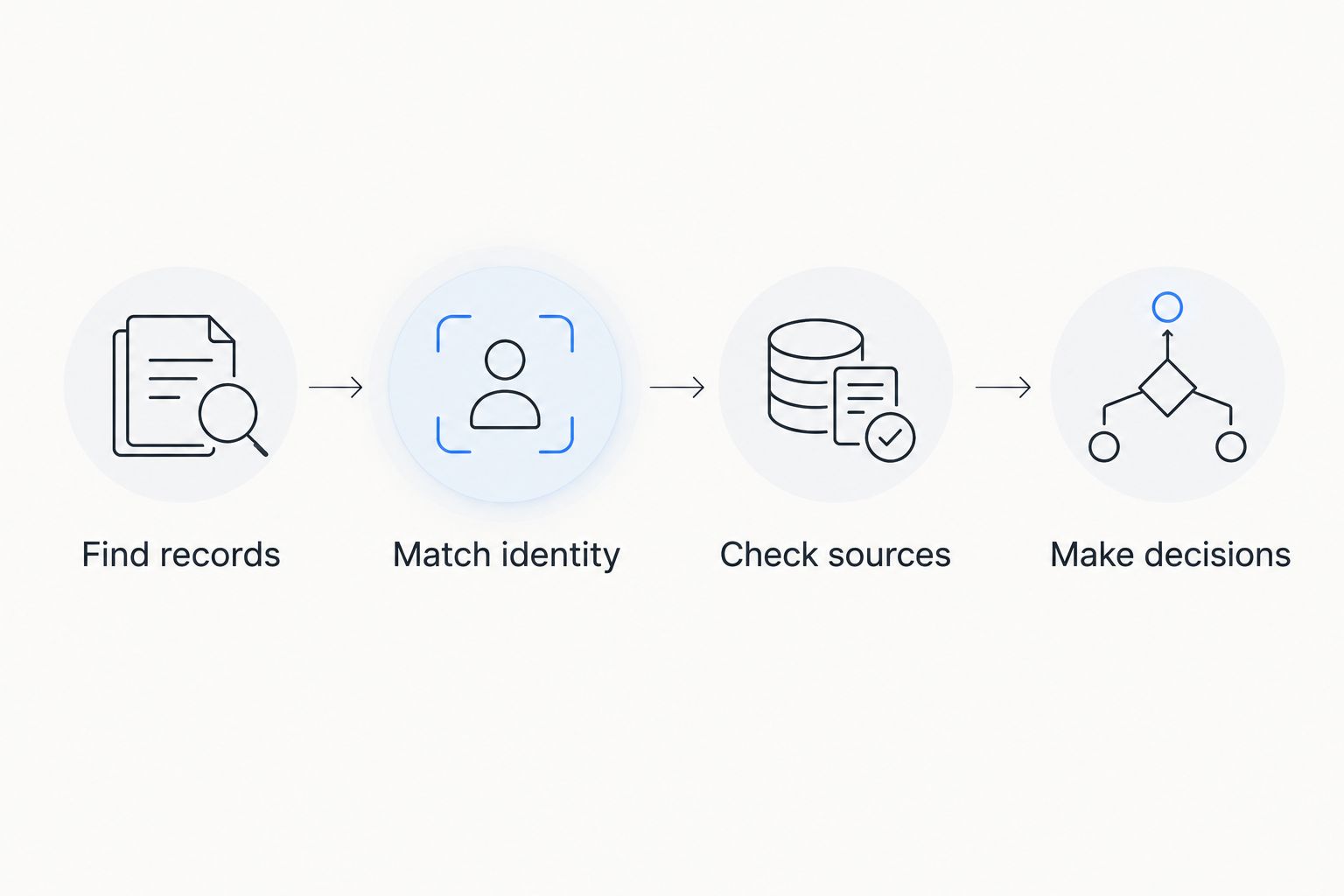
The verification sequence is the same in principle:
- Find records: Locate information relevant to the question.
- Match identity: Confirm which business or procurement process it describes.
- Check sources: Inspect the record supporting the important detail.
- Make decisions: Act only on conclusions the evidence supports.
This is an honest tie. A platform's usefulness for discovery does not remove your responsibility to establish what the underlying evidence actually says.
Pricing models should match the work you repeat
Compare pricing models through the work you will repeat in 2026, rather than treating a lookup and a procurement-research workflow as equivalent purchases. Review each provider's current terms before making a commitment.
For procurement intelligence, evaluate the access arrangement against tender research, contractor investigation, and bidding-result analysis. Ask which activities your team needs regularly and which belong outside the proposed scope.
For company lookup, evaluate the arrangement against how often you need identity records and what your verification process requires. Do not assign value to procurement functions when procurement is not part of the job.
The model tradeoffs are practical:
- Subscription arrangements: Assess recurring access against recurring work and the commitment involved.
- Usage-based arrangements: Assess flexibility against how predictable your research demand is.
- Team arrangements: Check who needs access and what the terms permit each person to do.
These are evaluation criteria, not assertions that either provider offers a particular arrangement. The right model supports the work you actually perform without making unrelated functionality the reason to commit.
The standout difference is the research question
The procurement platform brings tender research, contractor data, and bidding-result analysis into the same stated scope. Masothue.com centers the comparison on identifying a company through its business information.
That difference matters more than a long checklist. You should not award a procurement tool points merely for having broader subject matter, then penalize a lookup tool for answering a narrower question.
You can also use the approaches in sequence without assuming any integration between them. Identify a business, investigate relevant procurement records, and verify the details supporting your decision.
For your 2026 shortlist, document what each step contributes. If a step produces no evidence your decision needs, remove it from the workflow rather than calling it an essential feature.
Final verdict: choose by the decision on your desk
Choose Dauthau if you manage procurement research
Best for: Vietnamese bid managers, business-development teams, and researchers who need to search, track, and analyze tenders, contractor data, and bidding results.
Choose this route when the output is a procurement decision: which opportunity to investigate, which participant to research, or which recorded result to examine. Do not treat it as proof of eligibility or future success.
Choose Masothue.com if you need company identity
Best for: Administrators and researchers checking a Vietnamese business name or tax code before another verification step.
Choose this route when locating the company record completes the immediate assignment. If the question expands into procurement history, change the research method rather than expecting identity information to answer it.
| Dimension | Winner |
|---|---|
| Best for | Procurement researchers: tender platform; identity users: Masothue.com |
| Tender discovery | Procurement intelligence platform |
| Company identification | Masothue.com |
| Bidding-result analysis | Procurement intelligence platform |
| Single-company checks | Masothue.com |
| Evidence limits | Tie: verify consequential findings |
| Pricing model | No winner without matching terms to the required work |
| Standout feature | Tender context versus company identity: choose by task |
FAQ
Which should I choose in the dauthau.asia vs masothue.com comparison?
Choose procurement intelligence for researching Vietnamese tenders and bidding results; choose Masothue.com for company-name and tax-code lookup. The deciding factor is whether you need procurement context or business identity.
Is Masothue.com better for finding a company's tax code?
Masothue.com is the better fit for a company-name or tax-code lookup. Verify consequential identity details through the appropriate official record before relying on them in a business decision.
Which option is better for researching bidding results in Vietnam?
The procurement intelligence platform is the better fit for bidding-result research. Its stated scope includes analyzing results and contractor data across Vietnamese procurement.
Can a company lookup prove that a contractor is suitable?
No, a company lookup does not establish contractor suitability. Identity information does not by itself prove procurement performance, delivery capacity, or compliance with a specific tender's requirements.
Do I need both company lookup and tender research?
Use both when your assignment requires verified company identity and procurement context. They answer different questions, and using them in sequence does not imply an integration between the services.
How should I compare the pricing models in 2026?
Match each provider's current terms to the work you need to repeat. Assess recurring commitments, permitted access, and relevant functionality without treating company lookup and procurement research as identical purchases.
What should I verify before acting on a tender search result?
Verify the relevant procurement documents, amendments, entity identity, and recorded outcome before acting. A search result helps you locate information; it does not replace the underlying record.
One last thing
Write the next decision beside every saved record. A company entry should support an identity check; a tender entry should support an opportunity review; a result record should support an outcome analysis. If you cannot name the decision, collecting another record is not yet useful research.