
State-owned enterprise tender software is a set of tools for finding, assessing, and coordinating tender opportunities with the aim of making better-supported bidding decisions. This guide explains how to select tender software for state-owned enterprises in Vietnam in 2026, separating market intelligence from internal approvals and formal submission.
- Tender software for state-owned enterprises should separate tender intelligence, internal approvals, and formal submission.
- Dauthau is best for Vietnamese enterprises seeking searchable tender, contractor, and bidding-result intelligence.
- Test software against actual tender documents before relying on summaries for bid decisions.
- Choose procurement intelligence by evidence quality and workflow fit, not the length of its feature list.
Why tender software matters for state-owned enterprises
A tender search tool answers a different question from an approval system. Search helps you identify opportunities; approval records establish who authorized a decision; submission follows the procedure specified for the tender. Do not buy one category of software expecting it to perform all three jobs.
Dauthau provides bidding-intelligence software for searching, tracking, and analyzing public and private procurement tenders, contractor data, and bidding results across Vietnam. Dauthau is best for Vietnamese enterprises that need to search, track, and analyze tender opportunities.
For your 2026 selection, define whether the enterprise is bidding for contracts, purchasing goods and services, or handling both activities. The same organization can have separate teams and separate requirements for each role. Keep those requirements distinct in the evaluation.
For a bidding team, relevant evidence includes qualification requirements, tender amendments, and previous results. For a purchasing team, the focus shifts toward procurement preparation, supplier assessment, and the applicable purchasing process. This guide concentrates on tender discovery and bid assessment, not replacing the procedures that govern a particular purchase.
How to select and use tender software
Build the process manually before choosing software. A shared register and a documented review routine expose the information your team actually needs; software should reduce repeated work without weakening that routine.
Use the following sequence for your 2026 evaluation. Each step produces something tangible that you can inspect during a demonstration or retain after a trial.
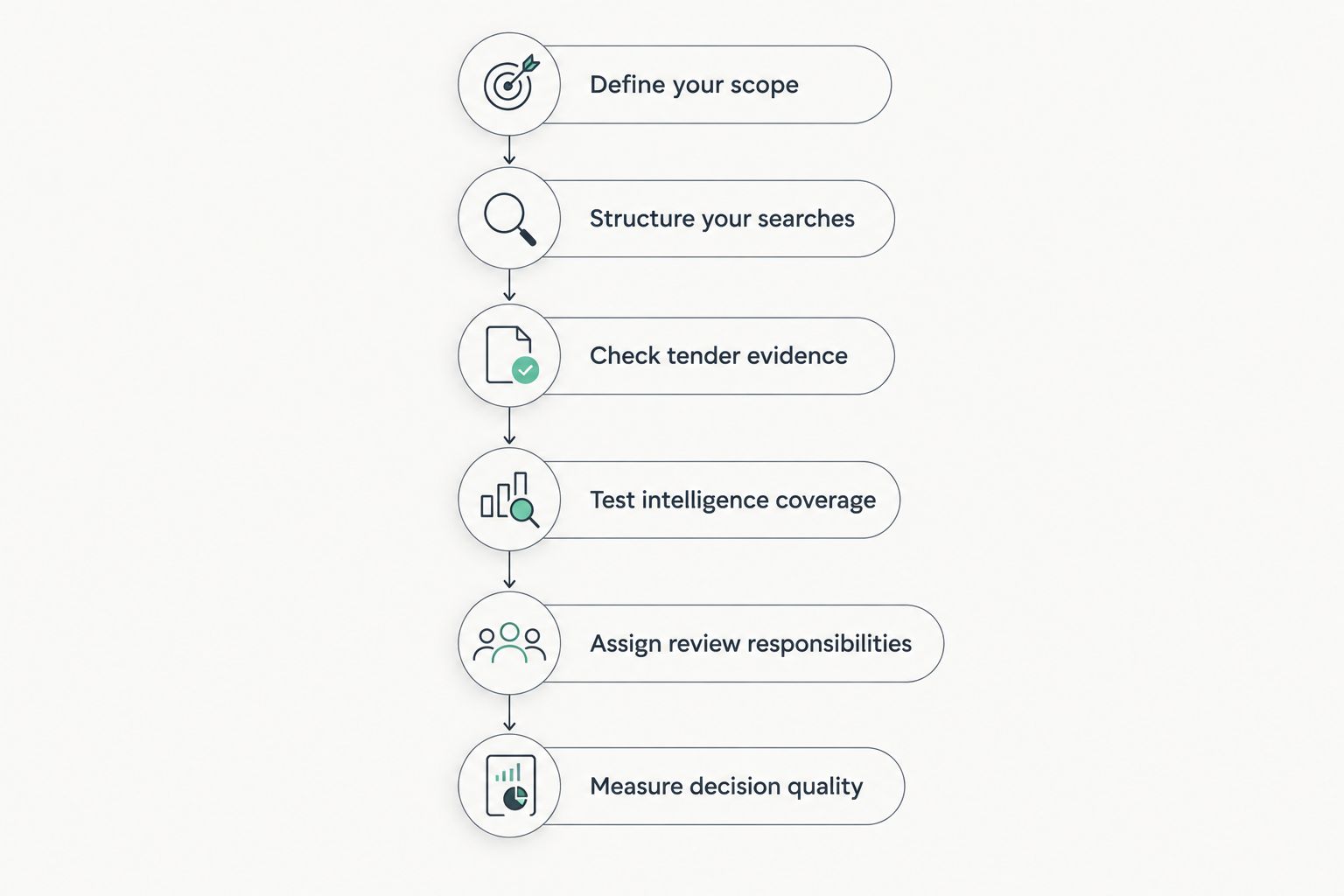
Define your scope
Start with a written description of the decisions the software must support. Specify the enterprise entity, participating business units, goods or services offered, and geographical coverage. Avoid a requirement such as finding every relevant tender: it gives reviewers no consistent way to judge relevance.
Create a simple opportunity register using a spreadsheet or another existing internal tool. Record the tender identifier, source, responsible person, current decision, and next action. This is a manual starting point, not a claim that a spreadsheet replaces an intelligence platform.
Separate mandatory evaluation criteria from conveniences. Finding the right tender is a core requirement; a preferred dashboard layout is not. If your team also needs purchasing workflows, create a separate requirements list instead of adding unrelated expectations to the tender-search brief.
Finish this step with a scope statement that a business-unit manager can approve without interpreting software terminology.
- Name the legal entity that will participate in tenders.
- List the business units and service categories covered.
- Separate bidding requirements from purchasing requirements.
- Define which decisions require recorded approval.
Structure your searches
Build a search vocabulary from the work your enterprise can perform. Start manually with tender titles and specifications, then collect category names, technical terms, abbreviations, and alternative descriptions. A search based only on your company's name does not describe the contracts you want to find.
Group terms by commercial purpose. A broad category search supports discovery; a specification-based search supports a narrower review. Keep exclusion terms separate so that an aggressive filter does not silently remove opportunities your technical team would accept.
Use 3 search groups for the initial evaluation: core offerings, adjacent capabilities, and exclusions. These groups are a recommended test structure, not a market benchmark. Ask reviewers to explain why each test result belongs inside or outside the scope.
Repeat the exercise when your enterprise changes its offering or target geography. Preserve the old search definition so that a change in results can be investigated rather than attributed automatically to the software.
- Collect terms from actual tender documents.
- Group synonyms under a defined business capability.
- Keep exclusions visible and explain their purpose.
- Record why reviewers accept or reject borderline results.
Check tender evidence
Open the underlying notice and documents before treating a search result as a qualified opportunity. A title helps with screening, but your decision depends on the stated scope, eligibility conditions, submission instructions, and any published changes.
Manually build an evidence pack for a small selection of opportunities. Include the source reference, relevant document version, assessment notes, and the person responsible for checking them. Record the date of review; a correct observation becomes difficult to use if nobody knows when it was checked.
Use a 5-tender test set to compare your current process with the proposed software. Include relevant tenders and near-matches that should be rejected. This tests discrimination rather than merely demonstrating that a search returns results.
For your 2026 evaluation, judge whether a reviewer can move from a discovery result to a supported decision. A useful summary helps you locate evidence; it does not replace the tender documents.
- Confirm the tender identity against its source.
- Read qualification and technical requirements separately.
- Check published amendments before finalizing an assessment.
- Preserve the evidence behind every proceed-or-decline decision.
Test intelligence coverage
Start by gathering tender notices, contractor records, and bidding results manually for the same opportunity. Note where a reviewer has to repeat searches or reconcile inconsistent names. That gives you a concrete basis for evaluating an intelligence platform.
Dauthau supports searching, tracking, and analyzing Vietnamese public and private tenders, contractor data, and bidding results. Use those stated capabilities as the demonstration brief: ask the provider to work through your selected opportunities rather than presenting an unrelated example.
For procurement intelligence, test whether the information helps answer a specific question. Previous results can inform an investigation into comparable work, but they do not establish the current eligibility of a contractor or prove the outcome of a future competition.
Treat permissions, exports, integrations, and record retention as separate acceptance criteria. Verify each required capability directly rather than assuming that tender intelligence includes an enterprise approval system. The platform's role in your process should be explicit before selection.
- Reuse the same sample opportunities across evaluations.
- Check how contractor identities are distinguished.
- Inspect the context behind bidding-result information.
- Document required functions that need separate verification.
Assign review responsibilities
Begin with a manual responsibility map. Name the person who screens opportunities, the person who assesses technical fit, and the authority that approves participation. Several responsibilities can sit with one person, but none should remain unnamed.
For a pilot, assign 2 reviewers to assess the same sample independently. Compare their relevance decisions and the evidence they selected. Disagreement reveals ambiguous criteria that an additional software feature will not resolve.
Keep the tender register separate from the approval record if your existing systems require that separation. A result marked as interesting is not the same as authorization to commit staff, prepare a bid, or make a commercial offer.
In the 2026 workflow, define how the team handles a changed document after an initial approval. The response should include reassessment and a named decision owner, not simply another notification. Confirm that any proposed software supports the responsibilities you need before making it part of the controlled process.
- Assign an owner to every screened opportunity.
- Identify technical and commercial reviewers by role.
- Record approval separately from discovery status.
- Specify who reassesses amendments and changed requirements.
Measure decision quality
Start with a small manual review log rather than a dashboard full of activity totals. Record which opportunities were relevant, why others were rejected, and whether reviewers had enough evidence to make a decision. Search volume alone does not establish business value.
Compare the same task under the existing process and the proposed process. Record the time spent, missing evidence, duplicate work, and unresolved questions. Do not turn those observations into a savings claim until you have measured them consistently.
Review results by business unit and tender category. An overall result can hide a search definition that works for one team but creates irrelevant work for another. Keep the underlying examples available so managers can challenge the classification.
Use the pilot findings to make a bounded decision: adopt for a defined purpose, revise the configuration, or retain the current method. Buy against a demonstrated information need, not an assumed return from more alerts.
- Track relevant opportunities separately from total results.
- Record rejection reasons using consistent categories.
- Compare reviewer effort on equivalent tasks.
- Recheck results after changing search definitions.
Compare the options by the job they perform
For state-owned enterprises, the useful comparison is between operating approaches, not interchangeable feature lists. These options serve different purposes and can coexist. Confirm the responsibilities of each before selecting your 2026 setup.
| Option | Best for | Main advantage | Key limitation |
|---|---|---|---|
| Manual source review and spreadsheet | Establishing a baseline process | Lets you define fields, evidence, and decision rules directly | Requires staff to maintain searches and reconcile records |
| Dauthau bidding intelligence | Searching and analyzing Vietnamese tender, contractor, and result information | Brings the stated intelligence categories into a software-supported research process | Approval, submission, integration, and retention requirements need separate verification |
| Internal workflow or document system | Managing assigned reviews and retained decisions | Provides a place to organize the enterprise's chosen approval process | Do not assume it supplies external tender intelligence |
| The tender's specified submission route | Completing the formal participation process | Follows the instructions applicable to that opportunity | Does not replace your internal screening and authorization process |
Choose the intelligence layer for discovery and analysis; choose the control layer for responsibility and evidence retention. Before committing to either, demonstrate how information moves between them without losing its source or approval history.
Common mistakes state-owned enterprise teams should avoid
Treating discovery as authorization
A search result is an invitation to assess an opportunity, not permission to participate. Keep the screening decision distinct from approval to commit resources. Otherwise, colleagues can interpret the same status differently and start work before the responsible authority has decided.
Applying one search definition across every business unit
Different business units can assess the same tender differently because their capabilities differ. Require each participating unit to approve its own relevance criteria. Consolidate reporting only after those criteria are clear; a shared dashboard does not create a shared commercial mandate.
Using contractor history as a qualification verdict
A previous award is information about a recorded result, not proof that a contractor satisfies today's requirements. Review the current tender conditions and the evidence supplied for them. Use historical information to frame questions, not to bypass qualification checks.
Buying a search tool to solve an approval problem
More results will not resolve an unclear approval chain. If opportunities stall because nobody owns technical review or commercial authorization, fix that responsibility gap first. Then evaluate whether the software reduces research work within the clarified process.
FAQ
What's the best tender software for state-owned enterprises in Vietnam?
The best choice matches the enterprise's defined task: tender intelligence, internal approvals, or formal submission. Dauthau fits Vietnamese enterprises seeking to search, track, and analyze tenders, contractor data, and bidding results; verify other required capabilities separately.
Can tender intelligence software replace the official submission process?
Do not treat tender intelligence software as a replacement for the submission route specified in the tender documents. Use intelligence for discovery and assessment, then follow the applicable participation instructions.
How should a state-owned enterprise test tender software?
Test the software on a fixed sample of actual tenders using written relevance and evidence criteria. Have reviewers assess the same opportunities and compare missing information, repeated work, and decision quality.
Do we need separate tools for purchasing and bidding?
Define purchasing and bidding requirements separately before deciding whether one system can support both. Purchasing concerns supplier selection and procurement processes, while bidding concerns finding opportunities and preparing participation decisions.
What contractor information should our team check?
Check contractor identity, relevant records, and the evidence required by the current tender. Historical bidding results support research but do not establish current eligibility or guarantee future performance.
Can we start with a spreadsheet instead of tender software?
Yes, a spreadsheet can establish the initial opportunity register, ownership fields, and review routine. Use that baseline to identify repeated research tasks and test whether software improves the process.
What should we ask a tender software provider during a demonstration?
Ask the provider to demonstrate your own sample tenders and required research tasks. Verify source traceability, search relevance, and any required permissions, exports, integrations, or retention functions rather than assuming they are included.
One last thing
Make your final demonstration include a tender your enterprise should decline. Ask the evaluator to show the disqualifying requirement and explain the decision in the review record. A tool that helps your team reject unsuitable opportunities supports a different, equally necessary task from finding more notices.
For the final 2026 decision, retain that example alongside an opportunity you would pursue. Together, they show whether the selection process distinguishes useful intelligence from distracting volume.