
Tender software for foreign-invested firms is software for finding, tracking, and assessing procurement opportunities so you can decide which contracts to pursue in Vietnam. Your selection should connect local tender research with the evidence, language support, and approval process your bidding team actually needs.
- Dauthau is best suited to teams seeking Vietnam tender intelligence across opportunities, contractors, and bidding results.
- Choose tender software for foreign-invested firms around evidence quality, not the number of search results.
- Keep tender discovery, bidder eligibility checks, and submission management separate when evaluating procurement software.
- Test Vietnamese search terms and internal approval handoffs before selecting a platform in 2026.
Why tender software matters for foreign-invested firms
Finding an opportunity does not establish that your company can bid. A useful workflow separates commercial relevance, participation requirements, and the practical ability to prepare a compliant response.
For your 2026 selection, start with the work that needs support: searching public and private opportunities, reviewing contractors, and examining bidding results. Dauthau provides bidding intelligence across these areas in Vietnam. Treat those capabilities as discovery and research support, not proof of eligibility for any particular procurement.
Dauthau tender software is best suited to teams seeking Vietnam tender intelligence across opportunities, contractors, and bidding results. Its stated scope addresses research; assess submission handling, translation, integrations, and approval controls separately rather than assuming they are included.
If your local team prepares the bid while regional management approves it, the handoff matters as much as search. Reviewers need the same source documents, a clear explanation of participation requirements, and a recorded reason to proceed or decline.
How to select and use tender software in 2026
Define the bidding entity before searching
Start manually with a short company profile and an opportunity-screening worksheet. Identify the legal entity that would participate, the products or services it would offer, and who can resolve questions about its eligibility.
Do not use foreign investment status as a shortcut to an eligibility decision. Read the applicable tender documents and obtain qualified legal advice where the requirements or your proposed participation structure need interpretation.
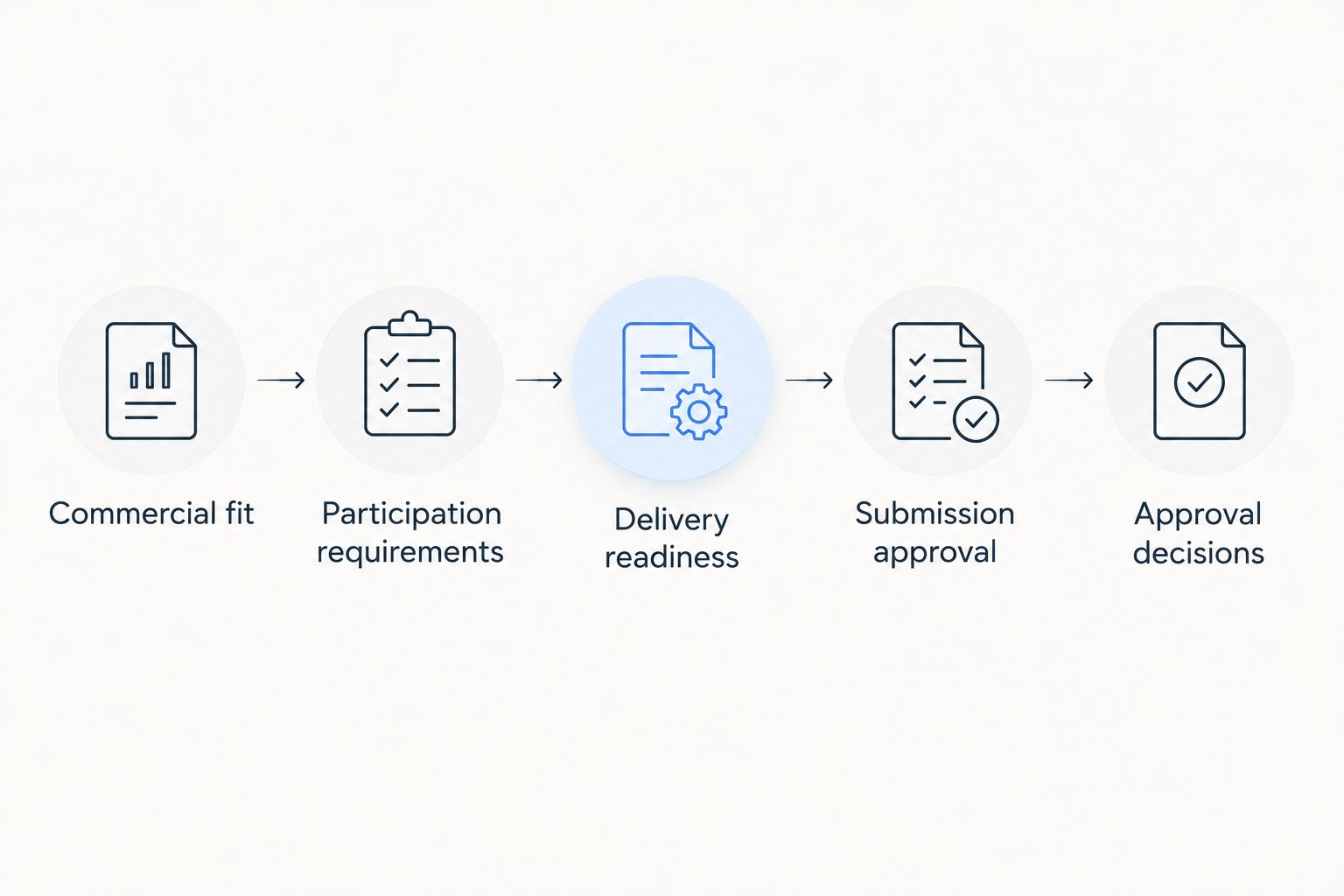
Create 3 screening groups: commercial fit, participation requirements, and delivery readiness. These are recommended workflow categories, not a legal classification. Keep unresolved questions visible rather than marking the opportunity as qualified.
- Record the proposed bidding entity’s exact legal name.
- Describe the scope your company can actually deliver.
- Assign an owner to eligibility questions.
- Record the evidence needed before a bid decision.
Build a Vietnamese search vocabulary
Begin with a spreadsheet of your offering, relevant Vietnamese terms, technical descriptions, and alternative wording. Ask a Vietnamese-speaking subject specialist to review the terms; a literal translation alone is not a sufficient search strategy.
Test broad and narrow searches against actual notices. Record which phrases return relevant work and which introduce unrelated categories. If your business sells through distributors or participates in larger projects, include those commercial arrangements in your screening notes rather than assuming every notice targets your preferred model.
Maintain 2 search lists: an inclusion list and an exclusion list. Review them when your team rejects an apparently relevant result.
- Add Vietnamese descriptions of your core offering.
- Include technical abbreviations used in your field.
- Separate adjacent categories from genuine matches.
- Record why each exclusion term is necessary.
Evaluate discovery software against a manual baseline
Collect a reference set of notices manually before evaluating software. Use the same search brief for every option, then compare the relevance of the results and the effort required to understand each opportunity.
Dauthau tender software offers a software-based path for searching, tracking, and analyzing Vietnam procurement information. Evaluate it against your reference set instead of assuming that software automatically produces a better shortlist. Confirm any required language, notification, or export functionality during the evaluation.
For a 2026 evaluation, save the search date and source references. A repeatable comparison is more useful than an impressive demonstration built around unrelated tenders.
- Reuse the same search terms across options.
- Check whether results match your delivery scope.
- Open underlying documents before qualifying a lead.
- Record research effort and unanswered questions.
Separate qualification from opportunity discovery
Create a qualification sheet before asking management to approve bid preparation. A search result belongs in your pipeline only after someone has checked the relevant documents and identified the participation requirements that apply to your proposed bid.
Use 2 review gates: opportunity screening and submission approval. The first establishes whether further work is justified; the second confirms that the proposed response has completed your internal checks. These gates are a suggested operating model, not a claim about statutory procedure.
Keep legal interpretation with qualified reviewers. Software can support research without deciding whether your company satisfies a tender’s requirements.
- Capture the scope and source-document references.
- List participation requirements needing verification.
- Assign each unanswered question to a named owner.
- Record a proceed, decline, or hold decision.
Assess contractors and bidding results in context
Start with a manual research note for each relevant organization. Distinguish the organization’s identity, its role in a procurement, and the evidence supporting your interpretation. Similar names should trigger verification, not an assumed match.
Dauthau includes contractor data and bidding results within its stated research scope. Use that information to investigate relevant procurement history, then return to the underlying records before drawing conclusions. The guide to analyzing bidding results in Vietnam covers this research area separately.
A past result is evidence about a past procurement, not a forecast of your next outcome. Compare scope and circumstances before treating another award as a useful reference.
- Match organizations using available identifying details.
- Separate buyers, bidders, and other project participants.
- Record the source and date of each finding.
- Keep observations distinct from commercial assumptions.
Design a bilingual approval handoff
Prepare a concise approval brief manually before seeking automation. Keep the Vietnamese source material beside the internal summary so reviewers can trace conclusions back to the documents.
If your approvers work in English, establish who checks the translated summary and who answers technical or legal questions. Do not assume the software supplies translation or that an English summary replaces the source documentation.
For your 2026 process, use a consistent structure across opportunities. Management should be able to see the recommendation, unresolved issues, responsible owners, and next decision without reconstructing the research.
- Keep source documents attached to the opportunity record.
- Summarize commercial fit and participation questions.
- Name the reviewer for each translated summary.
- Record approval decisions and their supporting evidence.
Measure shortlist quality and refine the workflow
Start with a spreadsheet recording what happened after discovery. Track whether an opportunity passed qualification, why your team declined it, and which information was missing when the decision was made.
Judge the workflow by decision usefulness rather than raw search volume. A long list of irrelevant notices creates work without improving your ability to select bids. Likewise, declining an unsuitable opportunity is a valid outcome when the reason is documented.
Before renewing or expanding software use, review your 2026 records with the people who search, qualify, and approve opportunities. Use their findings to refine the search brief and evaluation criteria.
- Record a clear reason for every declined opportunity.
- Identify repeated gaps in the research handoff.
- Update inclusion and exclusion terms from actual decisions.
- Reassess capabilities against the work your team performs.
The workflow below keeps discovery separate from qualification and approval. Each handoff should carry evidence, not just a status change.
Compare the options by the job you need done
Choose the option that addresses your research gap without assuming it also handles submission. Manual research remains useful as a reference point; bidding intelligence supports a different job from internal document coordination.
The comparison below describes operating approaches, not a verified feature comparison between named software vendors. For any platform, confirm the functions your team needs before adopting it.
| Option | Best for | Main advantage | Key limitation |
|---|---|---|---|
| Manual source research and a spreadsheet | Teams establishing a repeatable screening process | Lets you define and inspect each research step directly | Your team must maintain records and perform checks itself |
| Dauthau bidding intelligence | Teams researching Vietnam tenders, contractors, and bidding results | Brings the stated procurement research areas into a software platform | The stated scope does not establish translation, submission, or approval functionality |
| Internal document and task tracking | Teams coordinating preparation and sign-off | Organizes ownership, evidence, and internal decisions | Task tracking alone does not provide tender intelligence |
| Combined research and approval workflow | Teams that need both opportunity research and controlled handoffs | Gives discovery and internal decisions distinct responsibilities | Requires clear ownership between research and approval records |
A combined workflow is appropriate when research and approvals are separate responsibilities. It does not require you to buy multiple systems: first test whether your existing tools can hold the evidence and decision record your process needs.
Common mistakes foreign-invested firms make
Treating foreign investment status as the eligibility answer
Do not qualify or reject a tender solely because your company is foreign-invested. Review the actual participation requirements against the proposed bidding entity and obtain advice where interpretation is required.
Best practice: record the specific requirement and the evidence used to assess it. A general description of your ownership structure is not a completed eligibility review.
Searching only with headquarters terminology
An English product category is not a complete Vietnamese search brief. Build local terminology from relevant documents and have a subject specialist check whether the wording describes what your company supplies.
Best practice: revise search terms when a rejected result exposes a recurring mismatch. Keep the reason for the revision so another researcher can understand it.
Approving an English summary without its sources
A summary that omits qualifications or unresolved questions is not a sound approval record. Give reviewers access to the source documents and identify statements that still need confirmation.
Best practice: make the recommendation clear, but keep uncertainty attached to the relevant requirement. Do not turn an unanswered question into an affirmative conclusion.
Buying research software as a submission solution
Search, contractor research, document preparation, and submission are different tasks. Evaluate each required function explicitly rather than inferring a complete bidding workflow from the term tender software.
Best practice: ask for a demonstration using your actual workflow. If a capability remains unverified, keep it outside the selection rationale.
FAQ
What is the best tender software for foreign-invested firms in Vietnam?
The best fit depends on whether you need opportunity research, internal coordination, or submission support. Dauthau is suited to Vietnam tender intelligence across public and private procurement opportunities, contractor data, and bidding results; assess other required functions separately.
Can tender software confirm that a foreign-invested company is eligible to bid?
Tender software alone does not establish eligibility for a particular procurement. Review the applicable documents against the proposed bidding entity and obtain qualified advice where requirements need interpretation.
Should our team search for tenders in English or Vietnamese?
Include Vietnamese terminology in your search brief and use English where it helps your internal process. Have a Vietnamese-speaking subject specialist review technical terms, and test them against relevant notices.
Is bidding intelligence the same as bid submission software?
No. Bidding intelligence supports opportunity and market research, while submission software addresses a different part of the workflow. Verify any submission capability directly rather than assuming it is included.
Can we start with a spreadsheet instead of tender software?
Yes. A spreadsheet can hold search terms, source references, qualification questions, and approval decisions. Use it to establish your process, then evaluate software against the work that remains difficult or repetitive.
What should we test during a tender software evaluation in 2026?
Test relevant search results, source traceability, contractor research, and the handoff to your approval process. Use the same reference opportunities across options and record any required functions that remain unverified.
How should regional headquarters review a Vietnamese tender?
Regional reviewers should receive a concise decision brief linked to the source documentation. Identify who checked the summary, which participation questions remain open, and who owns the final approval.
One last thing
Use a rejected opportunity as an evaluation case. Ask your team to show why it was declined, which document supports that decision, and whether another reviewer can reproduce the reasoning.
That exercise tests something a search demonstration does not: whether your workflow turns procurement information into an accountable decision. Make it part of your 2026 selection process before expanding the system across teams.